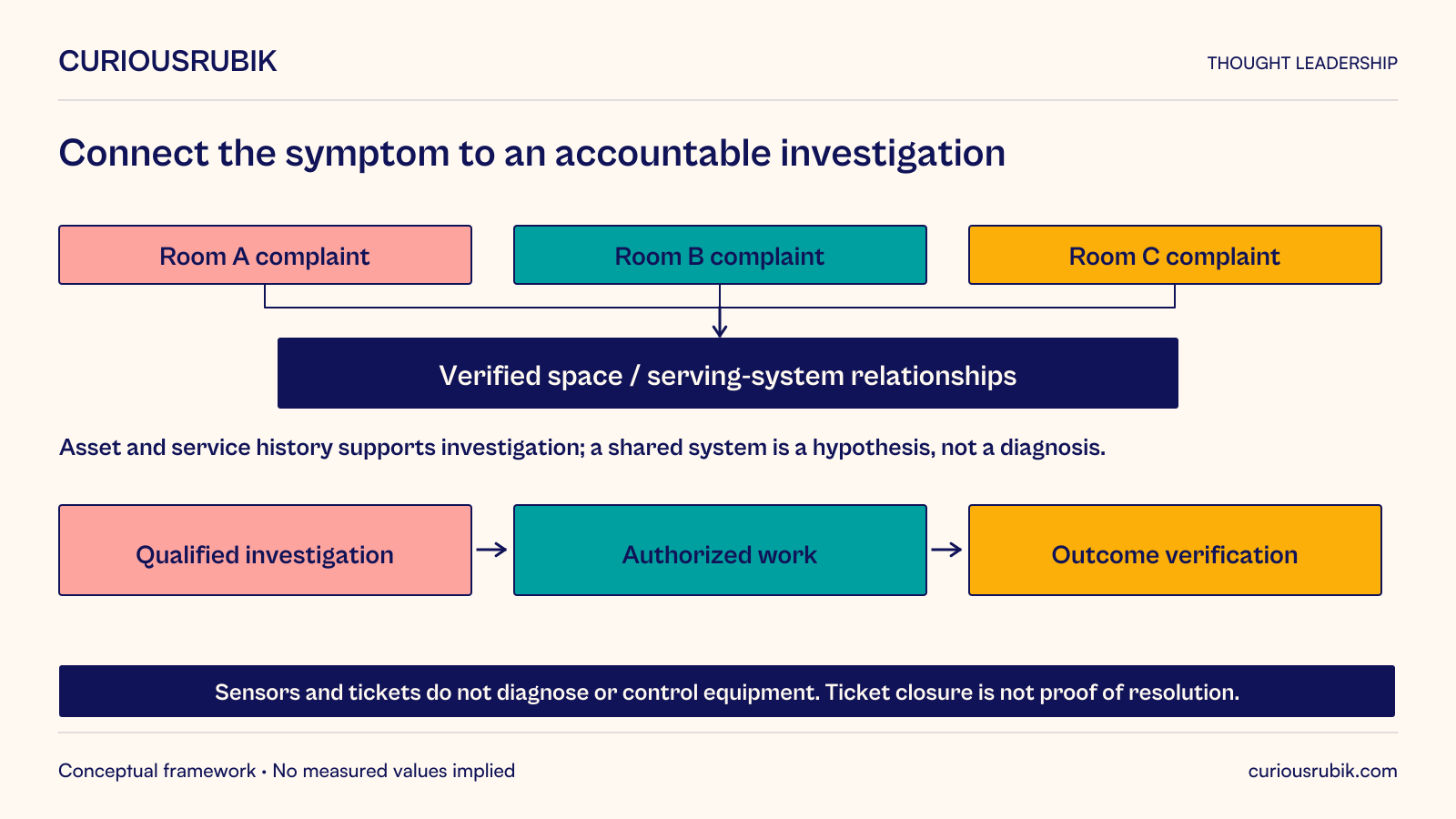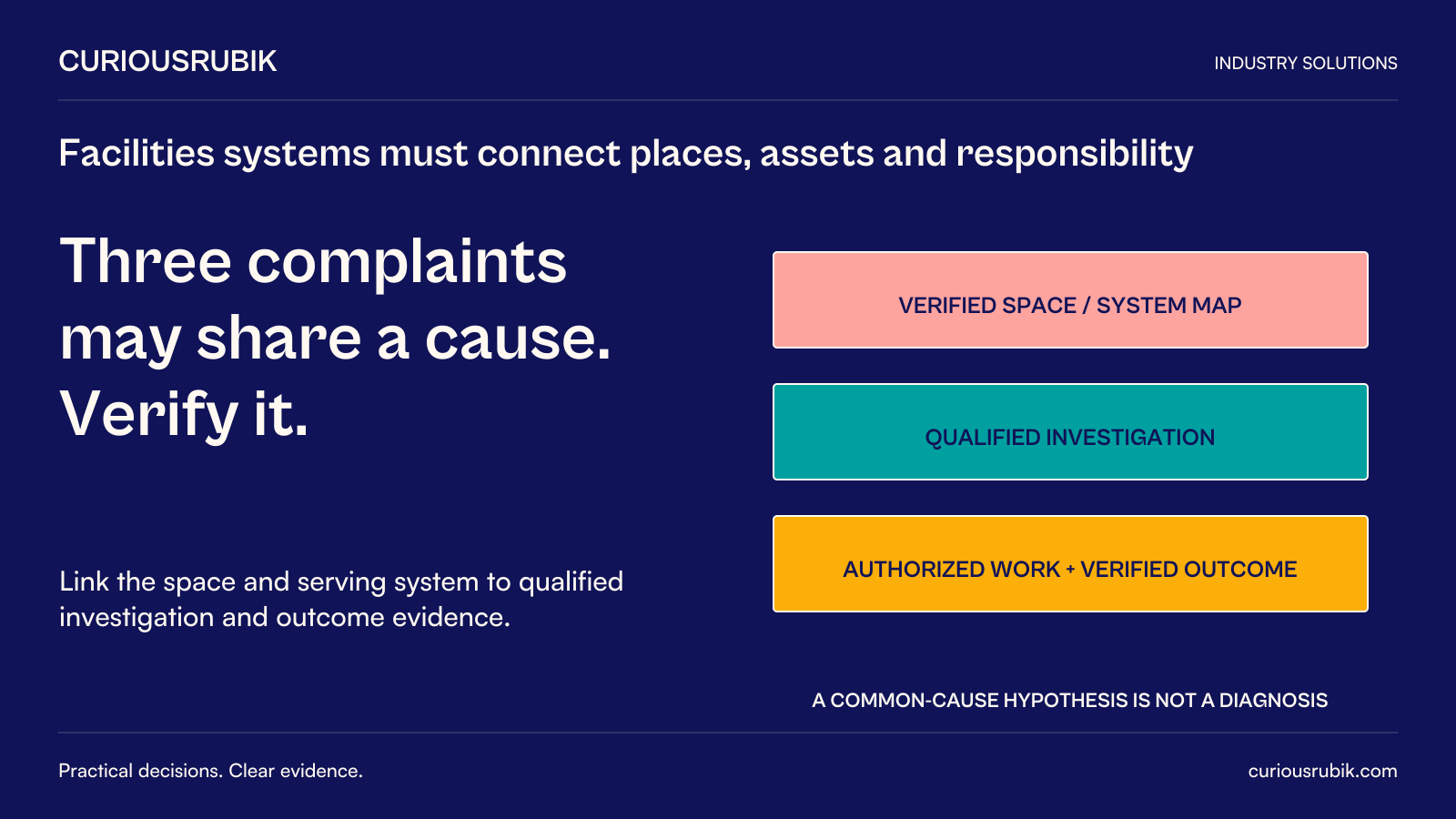
Three rooms generate repeated comfort complaints. The helpdesk creates three tickets, different contractors attend and each ticket is eventually closed. The building manager still does not know whether the complaints share a cause or whether the underlying condition has been resolved.
In this hypothetical example, the missing connection is between spaces, the systems serving them, the evidence gathered during work and the people responsible for the service outcome. Digitizing the ticket form does not create that connection automatically.
Property and facility technology is most useful when it turns scattered records into an operating view that supports decisions: which condition matters, which asset or service may be involved, who is responsible and what evidence is needed before the work can be considered complete.
Connect spaces, assets and service responsibilities
A location hierarchy and an asset register answer related but different questions. A room identifies where an occupant experiences a problem. The equipment serving that room may be located elsewhere and may also serve other spaces.
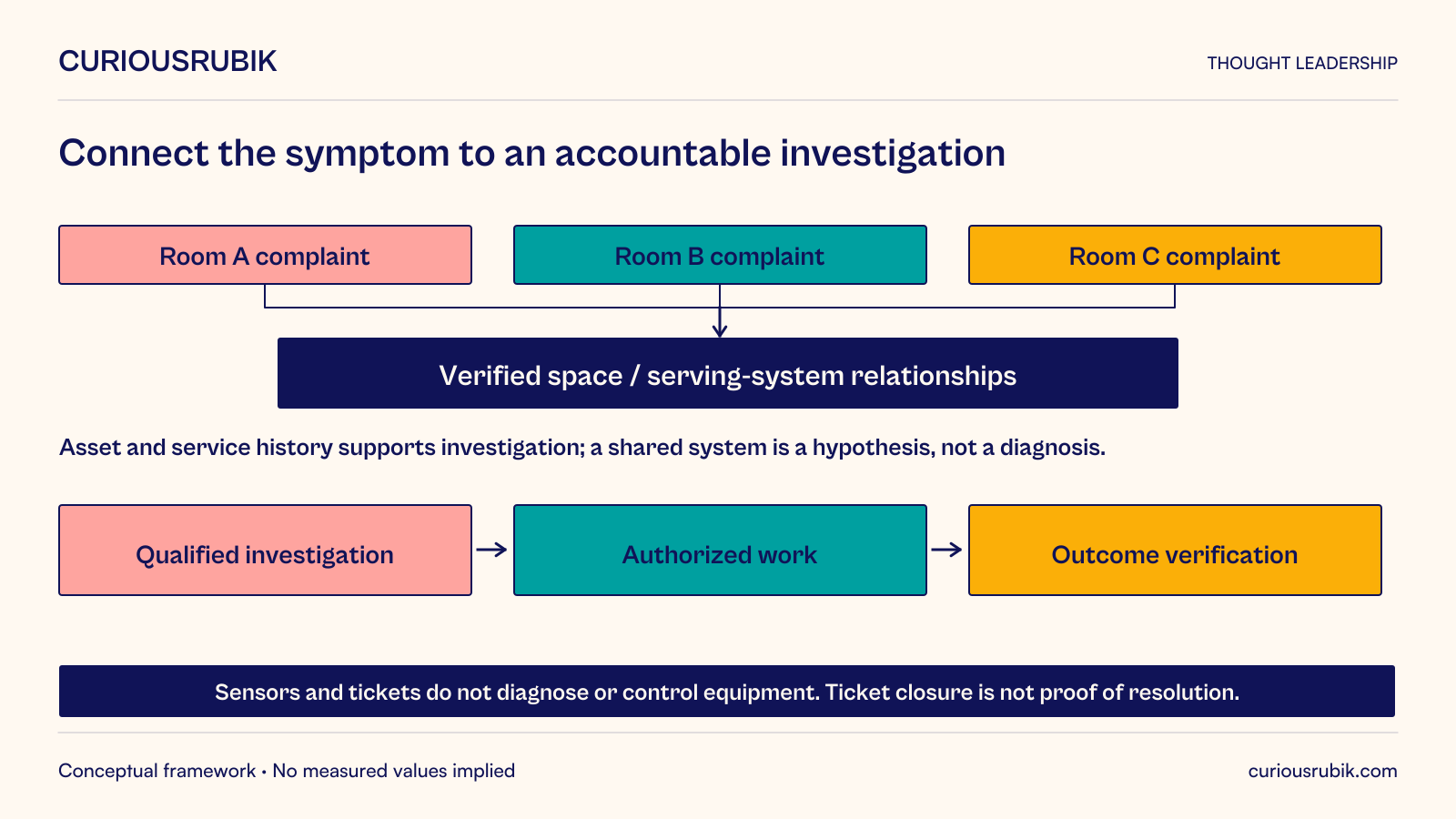
Maintain the relationships needed for the operating decisions. In the complaint example, a verified mapping could show that the rooms share a building-services system. That creates a reason for a qualified investigation; it does not prove that the shared system caused the complaints.
Link relevant history, documents and service arrangements to the asset or system, with access appropriate to the information. Staff should not have to search several folders to establish which equipment is installed or which contractor is responsible for the agreed work.
Responsibility can depend on ownership, occupancy arrangements and service contracts. Record the applicable boundary rather than assuming that the person receiving the complaint has authority to order every repair or allocate every cost.
ISO 41001:2018’s public abstract describes facility management in relation to effective service delivery and the objectives and needs of the organization being served. That supports an outcome-oriented perspective; it does not make a particular software installation compliant or certified. ISO 41001:2018, public abstract.
The useful data model connects the physical environment to those responsibilities and outcomes, not only to a list of equipment identifiers.
Treat the complaint as evidence, not a diagnosis
The occupant’s report can provide valuable information about location, timing and impact. It should not be converted automatically into a technical cause or a prescribed intervention.
Collect enough context for appropriate triage, including whether the issue is recurring and whether related work is already open. Avoid making the reporting process so detailed that occupants cannot use it effectively.
Link potentially related cases while preserving their individual evidence. Several complaints may share a cause, but they may also represent different conditions. Combining them prematurely can hide an unresolved issue for one space.
Qualified personnel should determine the necessary investigation and technical response under the relevant procedures. The digital system can bring together observations, history and responsibilities; it should not substitute an unverified pattern for professional judgment.
This distinction also matters for sensor alerts. An unusual reading can justify review, but its interpretation depends on the sensor, location, operating conditions and data quality. A threshold crossing is not a complete maintenance instruction.
Make work orders carry an inspectable result
A work order should identify the task, scope, authorized responsibility and evidence expected at completion. The appropriate evidence varies with the work and should be defined by the responsible organization and specialists.
Distinguish attendance, work performed and verified resolution. A contractor arriving at the site is not the same as completing the task. A task completed as instructed may still leave the original service condition unresolved.
Record material findings and limitations. If the contractor could not access an area or could not reproduce the reported condition, that matters to the next decision. Closing the record without that context can cause the next team to repeat the same investigation.
Provide a clear route for additional work or changed scope. The person on site should not be expected to make an unapproved commercial or technical commitment merely because the original instruction was incomplete.
Keep follow-up linked to the original issue and asset history. A reopened condition should contribute to understanding recurrence rather than appear as an entirely unrelated new ticket.
The operating owner should be able to explain what is complete, what remains uncertain and who is responsible for the next action.
Use condition information to improve planning
Connected records can help distinguish repeated reactive work from a pattern that deserves a different maintenance or investment decision. The quality of that analysis depends on consistent asset identity, useful findings and a meaningful record of outcomes.
Do not infer failure probability simply from the number of tickets. One asset may receive more reports because it serves more occupants or because its reporting process is easier to use. Compare relevant exposure and operating conditions where the data supports it.
Combine history with the inspection and technical evidence appropriate to the asset. A sensor stream can add context, but missing calibration, incorrect placement or changed usage can affect its meaning. The responsible specialists should establish how the information may be used.
Planning should account for access, occupancy and business interruption as well as labor and parts. The least expensive repair window on a contractor’s schedule may conflict with the property’s operating needs.
For replacement decisions, bring together condition, service consequence, continuing cost and feasible alternatives. Repeated repair expenditure is evidence to examine, not an automatic instruction to replace an asset.
Technology can make this evidence easier to assemble. The investment decision remains a responsibility that needs clear criteria and authority.
Give contractors and internal teams a shared operating picture
External service providers need the current task, relevant location and asset information, access arrangements and a route to report findings. They do not need unrestricted visibility into unrelated property or occupant records.
Define how updates enter the authoritative work record. If a contractor uses a separate application, the integration should preserve the meaning of status, findings and completion evidence rather than merely copy a completed flag.
Handle failed or delayed updates visibly. A work order should not appear untouched to the property team because a mobile upload failed after the contractor left. Equally, a successful upload should not imply that the findings have been reviewed and accepted where review is required.
Coordinate duplicate attendance and related tasks. When several teams work on the same system, the operating plan should identify dependencies and avoid conflicting instructions. The digital platform can expose those relationships but needs an owner to resolve them.
Retain individual accountability. Shared contractor logins or anonymous status changes can make it difficult to determine who reported a finding or authorized a decision. Access and record design should support the organization’s required level of attribution.
Protect the building’s information and control boundaries
Facility systems can hold sensitive information about access, layouts, equipment and occupants. Decide which information each role needs and how it may be shared. Use the minimum appropriate scope rather than treating an internal portal as a reason to expose everything.
Keep monitoring and control authority distinct. Reading an equipment status does not by itself authorize changing a setting or operating a physical system. Any integration that can affect building equipment needs the relevant qualified design, security review and operational authorization.
Plan for unavailable technology. Staff may need a controlled alternative for urgent reporting or access to essential instructions. That alternative should preserve necessary evidence and have a defined handback to the normal record.
Avoid collecting detailed occupant behavior merely because sensors or access systems can provide it. Establish a legitimate purpose, appropriate permissions and responsible handling for the information used in facility decisions.
The security and privacy requirements should follow the actual environment and applicable obligations, with specialist input. This article does not prescribe building-safety procedures, legal responsibilities or a universal retention period.
Measure service quality beyond ticket volume
Useful measures can include recurrence, time to an appropriate response, unresolved conditions, completion evidence and the impact on the spaces or services being supported. Define the start, end and exclusions for each measure.
A shorter average closure time can reflect better resolution, but it can also reflect premature closure or easier tasks entering the mix. Review the evidence behind the change.
Separate planned work from reactive demand and distinguish waiting for access, authorization, parts or specialist assessment. Those causes require different improvements. A single late-work total can conceal the actual constraint.
Use occupant and operating feedback alongside technical records. The service should be assessed against its intended outcome, while recognizing that subjective reports and sensor readings each have limits.
Cost measures also need context. Lower maintenance expenditure may reflect efficiency, deferred work or a temporary change in demand. Connect the number to condition and service evidence before treating it as an improvement.
Begin with one recurring service problem
The repeated-room-complaint scenario provides a practical starting point. Verify the space-to-system relationships, connect existing work history, agree investigation ownership and define what evidence will support resolution.
Test the workflow with the people who report, triage, perform and accept the work. Include an unresolved cause, an access problem and a contractor update failure. Those cases reveal whether the technology supports real operations or only the straightforward demonstration.
Then extend the proven relationships and practices to other services. Avoid attempting to model every asset and process in detail before delivering a useful improvement, but preserve the foundations needed for trustworthy expansion.
Property and facility operations are reshaped when technology helps the organization understand its physical environment and act on that understanding. A connected service record can make responsibility, evidence and unresolved work clearer. The value appears when that clarity produces a better-supported operating decision, not merely a faster way to close a ticket.