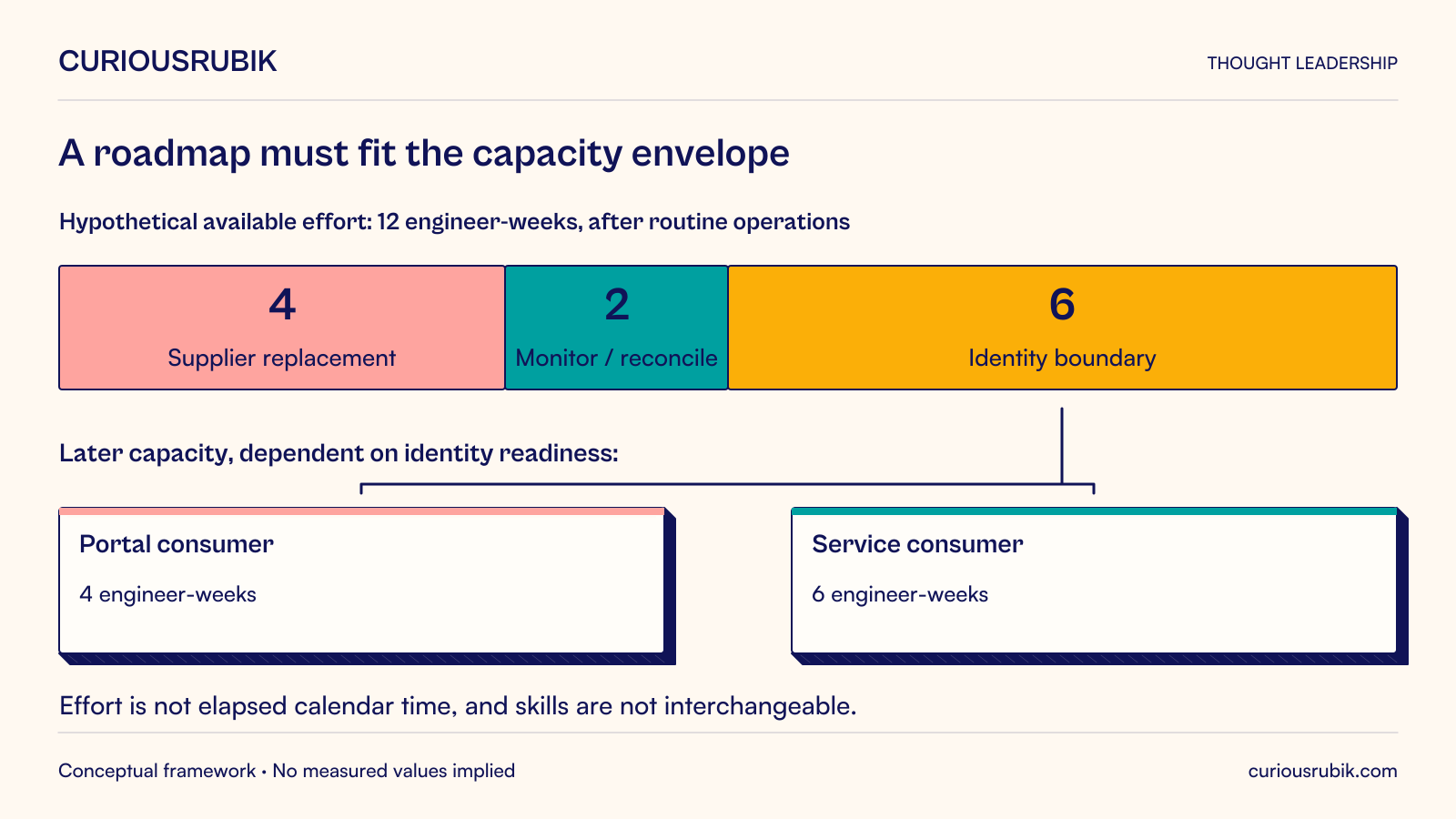
An integration roadmap should sequence improvements to business flows, shared contracts, and operating capabilities under a real capacity constraint. A list of connectors to build is insufficient because it hides prerequisites, transition risk, and the work required to operate the result. The roadmap should explain why each commitment comes next and what evidence permits the following one.
For a CIO balancing urgent service continuity with a new customer portal, the decision is how much capacity to spend on immediate flow repair, reusable identity and contract work, and visible customer features. Foundational work deserves funding when it removes a demonstrated dependency. It should not become an open-ended program that postpones every useful outcome until the enterprise is fully standardized.
Begin with the business flows that matter most over the planning horizon. Record their current problems, upcoming changes, affected owners, and consequences. Then connect those needs to concrete technical work and an achievable sequence.
Inventory flows with their operating obligations
An application inventory tells you which products exist. A flow inventory tells you what the business depends on. For each significant flow, identify the producer, consumers, authoritative data, interaction type, cadence, expected completion state, and business owner.
Add the technical facts needed for change planning: contract and schema versions, authentication principals, rate limits, transformations, retry and duplicate behavior, retention or replay capability, deployment mechanism, and support owner. Record what is unknown. An undocumented dependency is a discovery task, not an excuse to fill the field with an assumption.
Follow the flow beyond its first destination. A customer update may feed service eligibility, a portal, and reporting through several intermediate jobs. A local connector replacement can affect all of them even when only one system appears in the project brief.
Keep the inventory proportionate. Start with critical flows and active change areas rather than requiring every minor export to be documented before any improvement begins. Update the record as work reveals new dependencies, and make ownership part of the operating process so the inventory does not become obsolete immediately.
Separate urgent constraints from reusable opportunities
Some work has a hard external dependency, such as a provider retiring an interface or an application being replaced. Other work addresses current defects, such as incomplete updates or unowned recovery. A third category creates reusable capability, such as a customer-identity contract that several future flows need.
These categories should not be collapsed into one numerical score that hides their different logic. An immovable retirement date can constrain the sequence even when its direct benefit is less visible than a portal feature. A reusable platform component may have little standalone value unless funded consumers actually use it.
For each candidate, state the outcome, dependency removed, effort range, operating cost, and consequence of delay. Identify the evidence behind each estimate. A connector that appears simple can require significant reconciliation and business-rule discovery; a large data volume can still be straightforward when the contract is stable and supported.
Use explicit service objectives to describe reliability work. Google’s SRE guidance distinguishes indicators from target objectives and emphasizes behavior that matters to users. That discipline helps a roadmap specify a result such as usable status freshness or verified completion, rather than the vague promise to “improve integration.” Google SRE, Service Level Objectives
Build the dependency graph before assigning dates
Map which deliverables genuinely require others. A portal may need a stable customer identifier and an eligibility contract before it can show the correct information. It may not require replacement of every customer-data interface in the enterprise.
Distinguish technical prerequisites from organizational ones. Access approval, data ownership, a business definition, or a partner’s test environment can control the sequence just as strongly as software development. Name the owner and expected evidence for each dependency.
Question every “platform first” assumption. Can a narrow vertical slice establish the shared mechanism while delivering one useful flow? Can the first consumer reveal whether a proposed canonical model is too broad? Building reusable capability through a real consumer can reduce speculation, though the team must avoid embedding that consumer’s accidental requirements into the shared contract.
Likewise, question every “quick win.” A temporary bridge may be sensible, but its cost should include support, coexistence, and retirement. A short delivery estimate that omits those obligations can make repeated temporary solutions look cheaper than they are.
A hypothetical capacity choice
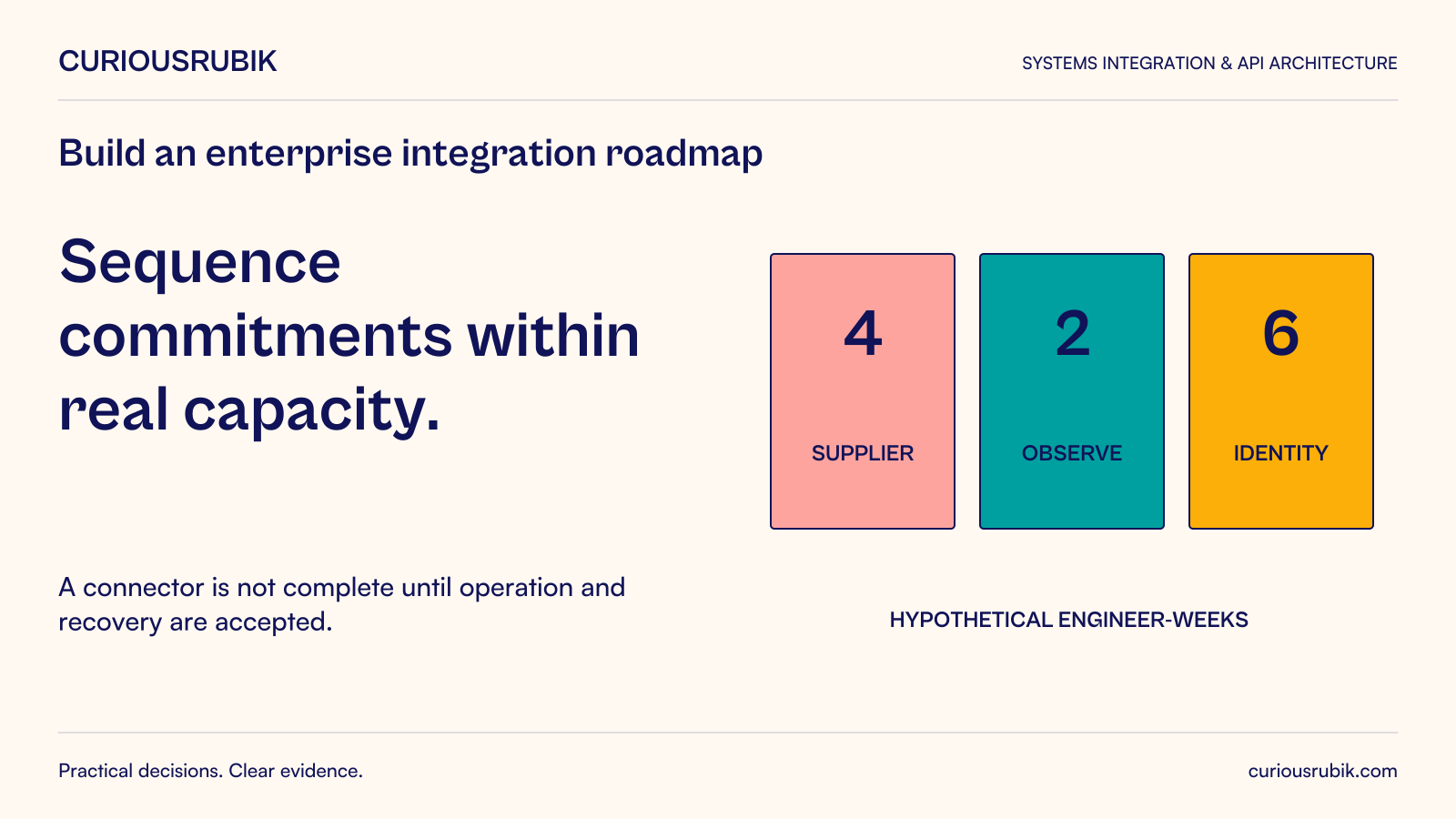
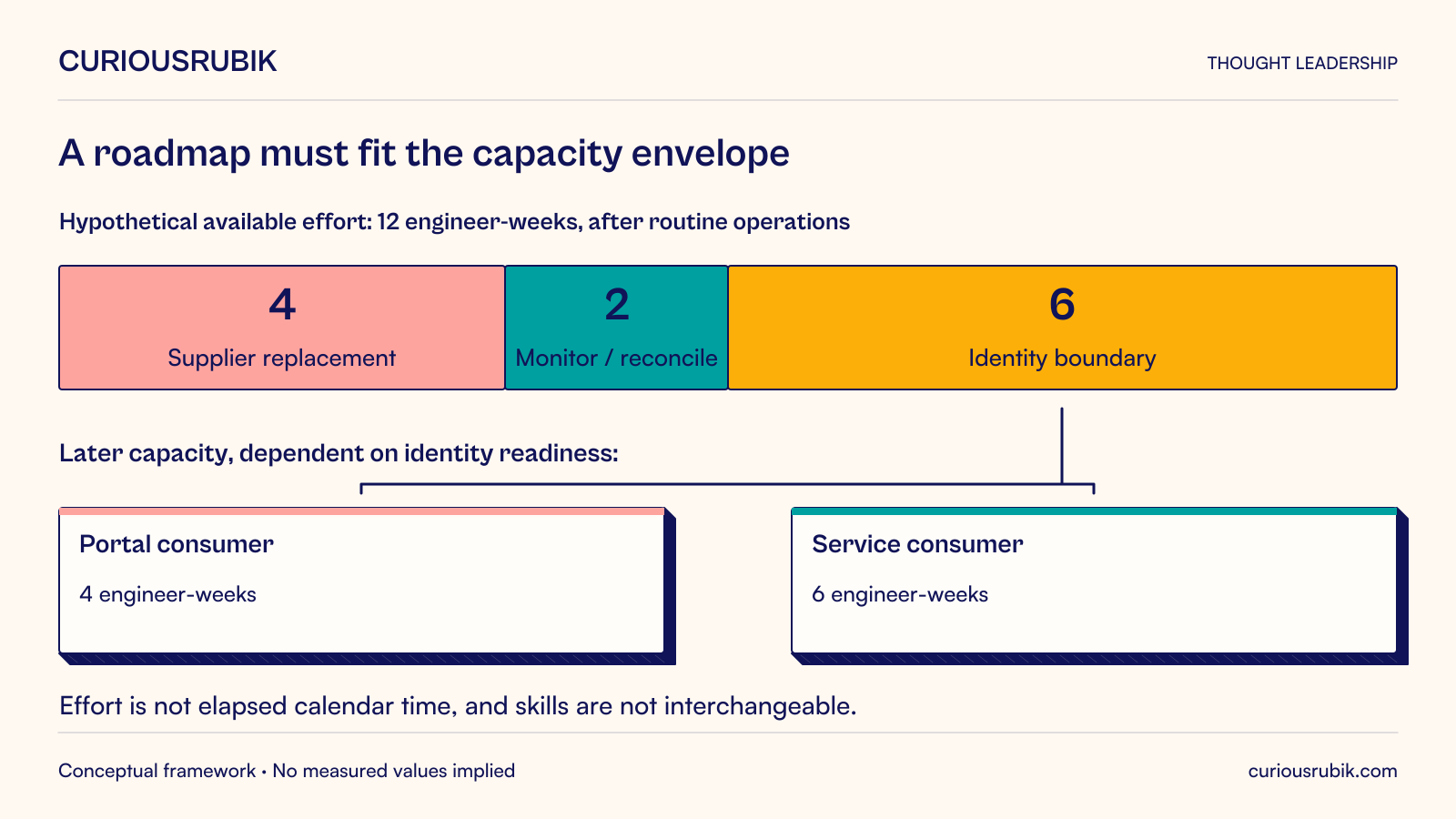
Suppose a hypothetical team has twelve engineer-weeks of delivery capacity for its next planning period after allowing for routine operations. A supplier interface must be replaced before its provider retires the existing endpoint. That replacement is estimated at four engineer-weeks. Basic end-to-end monitoring and reconciliation improvements need two. A reusable customer-identity boundary needs six. A portal consumer would then need another four, while a service-system consumer would need six.
Funding the supplier replacement, monitoring improvements, and identity boundary uses the twelve available engineer-weeks. The portal cannot also be promised in the same capacity envelope. Its four engineer-weeks belong to a later commitment after the identity boundary is usable, assuming the estimates and staffing constraints hold.
Management could choose a temporary portal bridge estimated at three engineer-weeks instead of the six-week identity boundary. Supplier replacement, monitoring, and the bridge would total nine, leaving three engineer-weeks in the envelope. That option may deliver visible functionality sooner, but it also creates a bridge that must be operated and later migrated. The remaining capacity is not proof that the choice is better.
The decision turns on the portal’s urgency, the likelihood of the service-system consumer, the bridge’s risk and retirement cost, and the confidence in the identity design. If the second consumer is speculative, the reusable investment may be premature. If inconsistent identity already causes serious errors across both channels, the foundation may deserve priority.
These figures represent hypothetical effort, not elapsed calendar duration or promised delivery dates. Skills, sequencing, partner availability, and uncertainty can prevent engineer-weeks from being freely interchangeable. The roadmap should expose those constraints before dates are announced.
Deliver in slices with a definition of operational completion
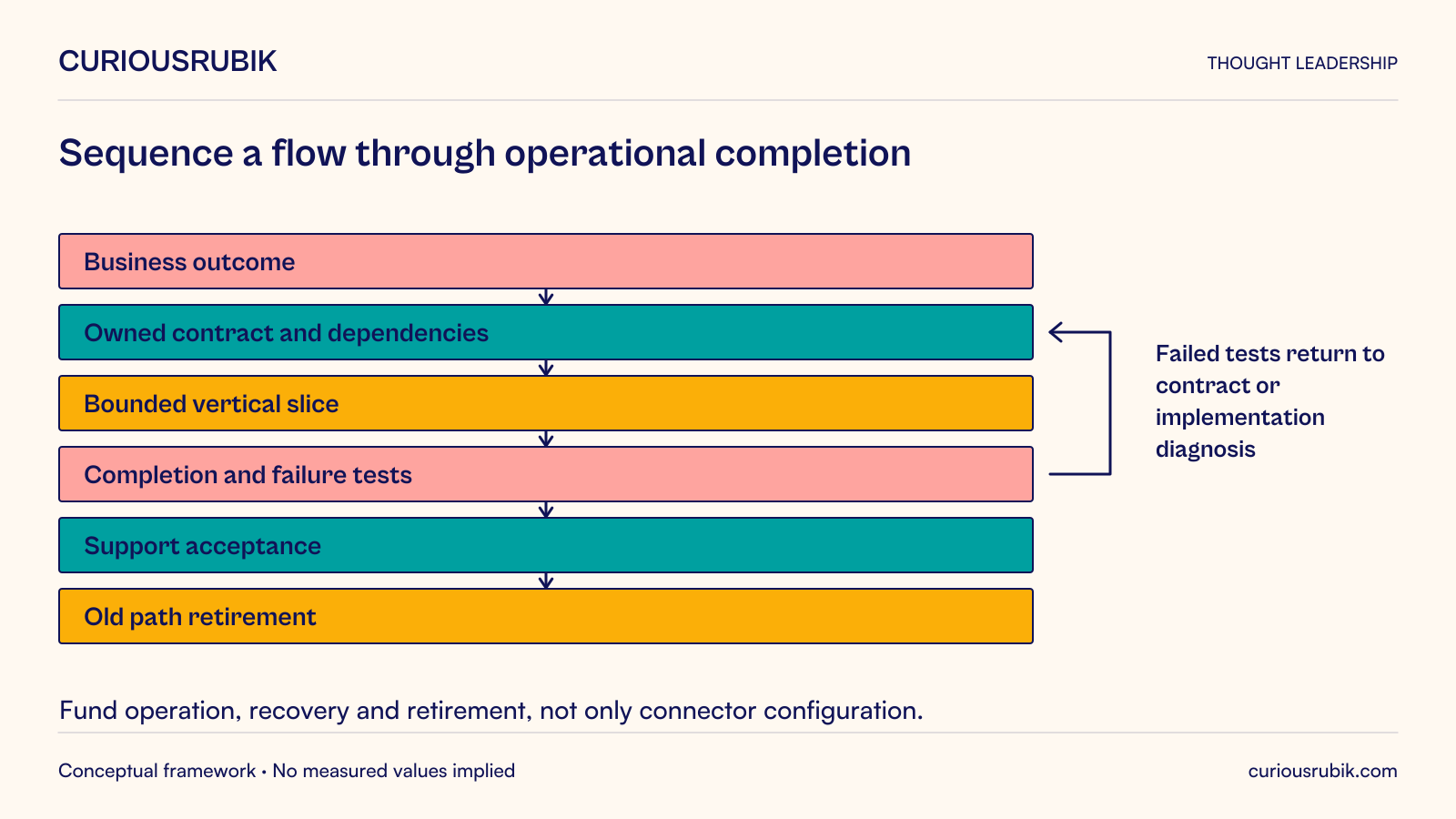
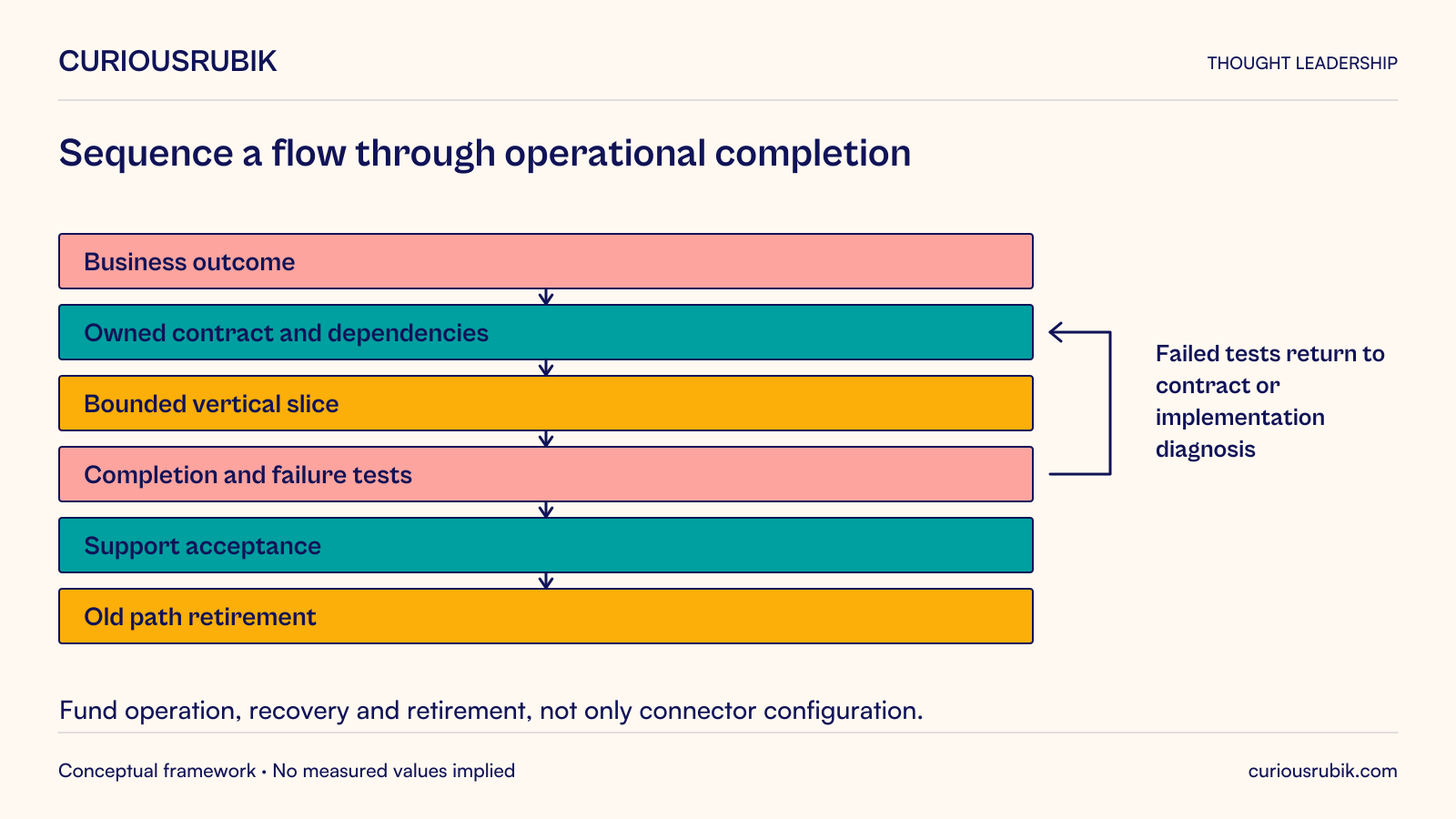
A roadmap item is complete when the intended flow works, is observed, can recover, and has an owner. “Connector configured” is usually an intermediate milestone. Include contract tests, source and destination reconciliation, access review, failure handling, and support handover in the item’s acceptance criteria.
A useful first slice might connect one entity, product group, or channel end to end. Choose a slice that exercises the important semantics and failure modes rather than only the cleanest records. An apparently successful pilot that excludes exceptions can mislead the next funding decision.
Set exit criteria for the slice. The team should demonstrate the expected business state, explain rejected records, recover from a representative interruption, and show that the support owner can operate the flow. These criteria are a working delivery discipline, not a universal certification.
If the slice fails, determine whether the issue is missing data, an incorrect contract, weak implementation, or an unsuitable architecture. Each points to a different next step. Do not automatically expand the pilot or purchase more platform capacity to compensate for an unresolved semantic problem.
Make coexistence and retirement visible work
Most enterprise changes have a period in which old and new paths coexist. Decide which path is authoritative, which can write, and how outputs are compared. A migration should not leave two active writers independently changing the same destination unless conflict behavior is deliberately designed.
Plan the final cutover and the evidence required to retire the old path. Confirm consumer usage, required historical access, unresolved work, schedules, and credentials. Assign retirement to the same roadmap item or an explicitly funded follow-on with an owner and condition.
Include business continuity. A rollback that restores old software may not undo transactions already created through the new path. Define how state will be reconciled and which actions must pause during recovery. This work belongs in the delivery estimate rather than appearing as an emergency request near launch.
Keep temporary exceptions legible. Record the reason, owner, exposure, and review trigger. A bridge created for an urgent deadline can be a responsible choice; an unowned bridge that survives indefinitely becomes a different decision from the one originally approved.
Review the roadmap when assumptions change
Use a small set of evidence to revisit priorities: upcoming interface changes, business deadlines, recurring incidents, measured completion or freshness gaps, and actual capacity. Compare realized effort and operating burden with estimates to improve future planning.
Protect committed work from casual reshuffling, but do not treat the roadmap as a promise immune to new facts. A discovered source limitation, a delayed partner environment, or a changed business launch can alter the sequence. Show what moves, why, and which dependency now controls the decision.
The roadmap should also say what will not be done in the current horizon. A clear deferral with a reason is more useful than a long list of initiatives that all appear to be in progress. Preserve options where uncertainty is high rather than inventing precise dates for distant work.
Start with five important flows and one planning period’s realistic capacity. Document their operating obligations, identify the binding dependencies, and select a sequence that produces a verified business result. An integration roadmap earns credibility when it explains both the next useful delivery and the constraints that keep the organization from promising everything at once.