The easiest process to automate is not necessarily the process that deserves the next investment. A repetitive reporting task may offer a quick demonstration while a less visible reconciliation problem delays customer delivery. A high-volume activity may consume many hours without constraining the business. A low-volume decision may carry consequences that justify careful support.
Automation prioritization should allocate scarce implementation capacity to the opportunities that improve a meaningful outcome under realistic operating conditions. That requires more than ranking tasks by volume and manual effort.
The useful question is: which intervention changes a consequential bottleneck or risk, can be operated responsibly, and remains worthwhile after exceptions and maintenance are included? A disciplined portfolio will contain projects to automate, projects to simplify first, projects to investigate, and projects to leave alone.
Establish the decision the portfolio must serve
Begin with the organization’s actual constraint. Is it struggling to meet demand, control errors, shorten delivery, protect customer commitments, or operate with scarce specialist capacity? Several objectives may matter, but their relative importance must be explicit.
A business facing a service backlog may value released technical capacity differently from one facing a cash constraint. A project with modest time savings may deserve priority if it prevents a material control failure. Those choices belong to leadership and should not be hidden inside unexplained scoring weights.
Define the planning horizon and investment boundary. Include implementation effort, business participation, integration work, continuing support, and the time needed to observe results. A proposal that looks attractive within one department can become uneconomic when its dependencies are included.
GAO’s IT investment guidance examines selection processes, cost-benefit-risk information, and the decisions made using them. The practical lesson for an automation portfolio is to make both the selection method and its underlying evidence inspectable. GAO, Assessing Risks and Returns.
Describe candidates as outcome interventions
“Automate purchase orders” is too broad to evaluate. “Reduce rekeying of approved replenishment requests into purchase orders for a defined supplier group” identifies a tractable intervention.
For each candidate, write the current problem, affected cases, proposed change, expected mechanism of benefit, dependencies, and owner. State what remains outside scope. Distinguish the task being automated from the business result expected to improve.
Collect a baseline through observation or reliable records. Estimate case volume, active handling time, exception frequency, error consequences, and demand variation. Use ranges where evidence is limited and show how the estimate was obtained.
Do not assume that every minute of manual work is avoidable. Some activity is judgment, customer communication, or necessary verification. Some will reappear as exception handling or quality review. A credible candidate brief explains the portion the proposed design can actually remove or improve.
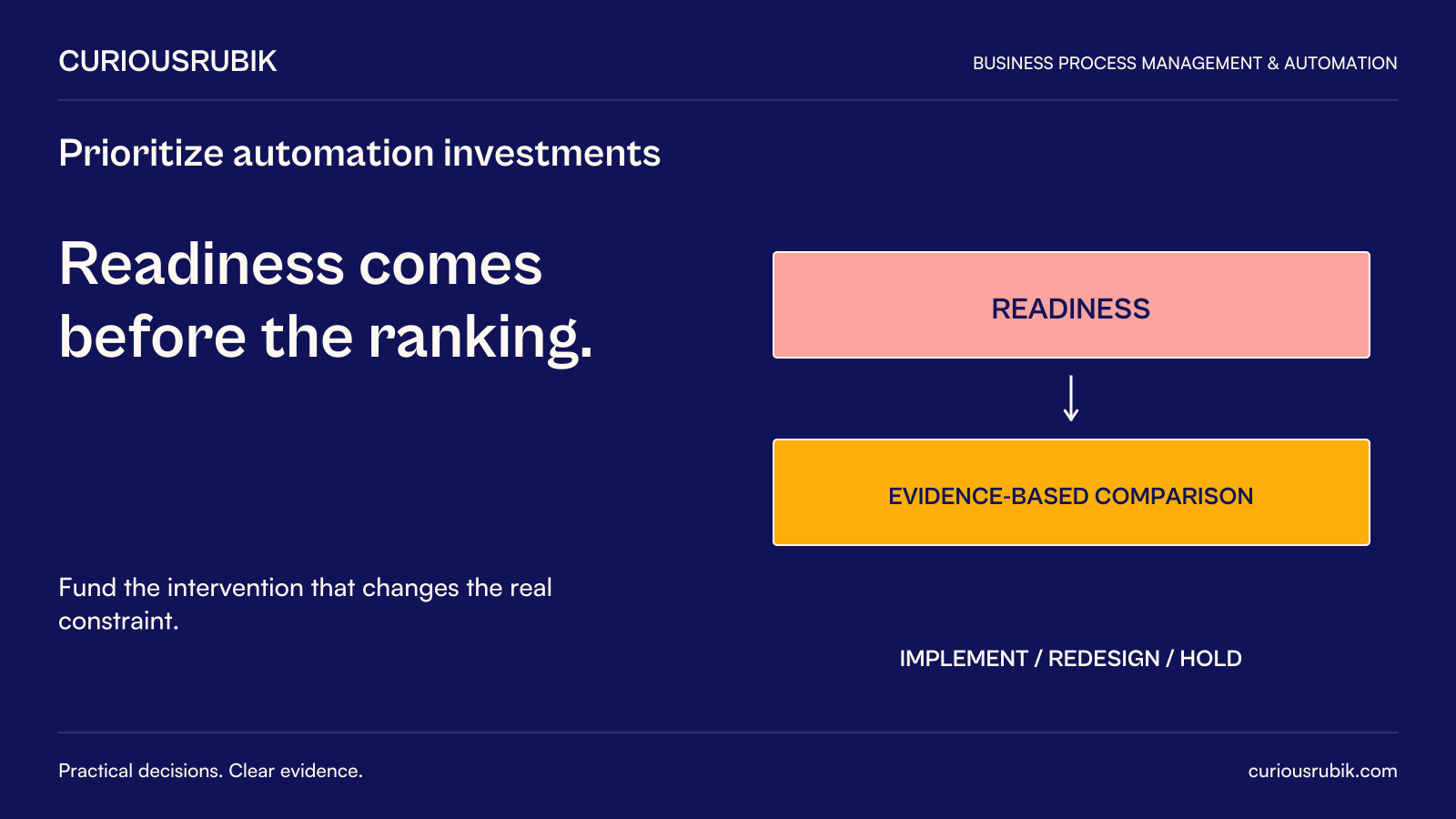
Apply readiness gates before comparative scoring
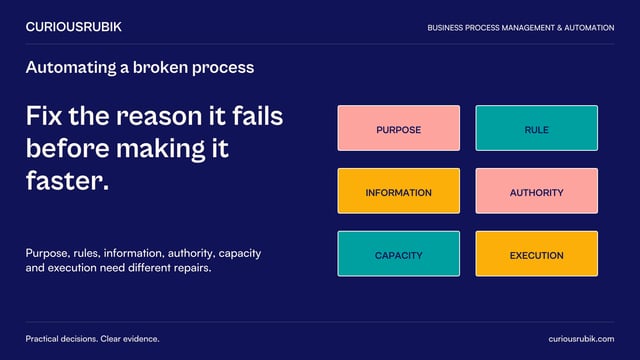
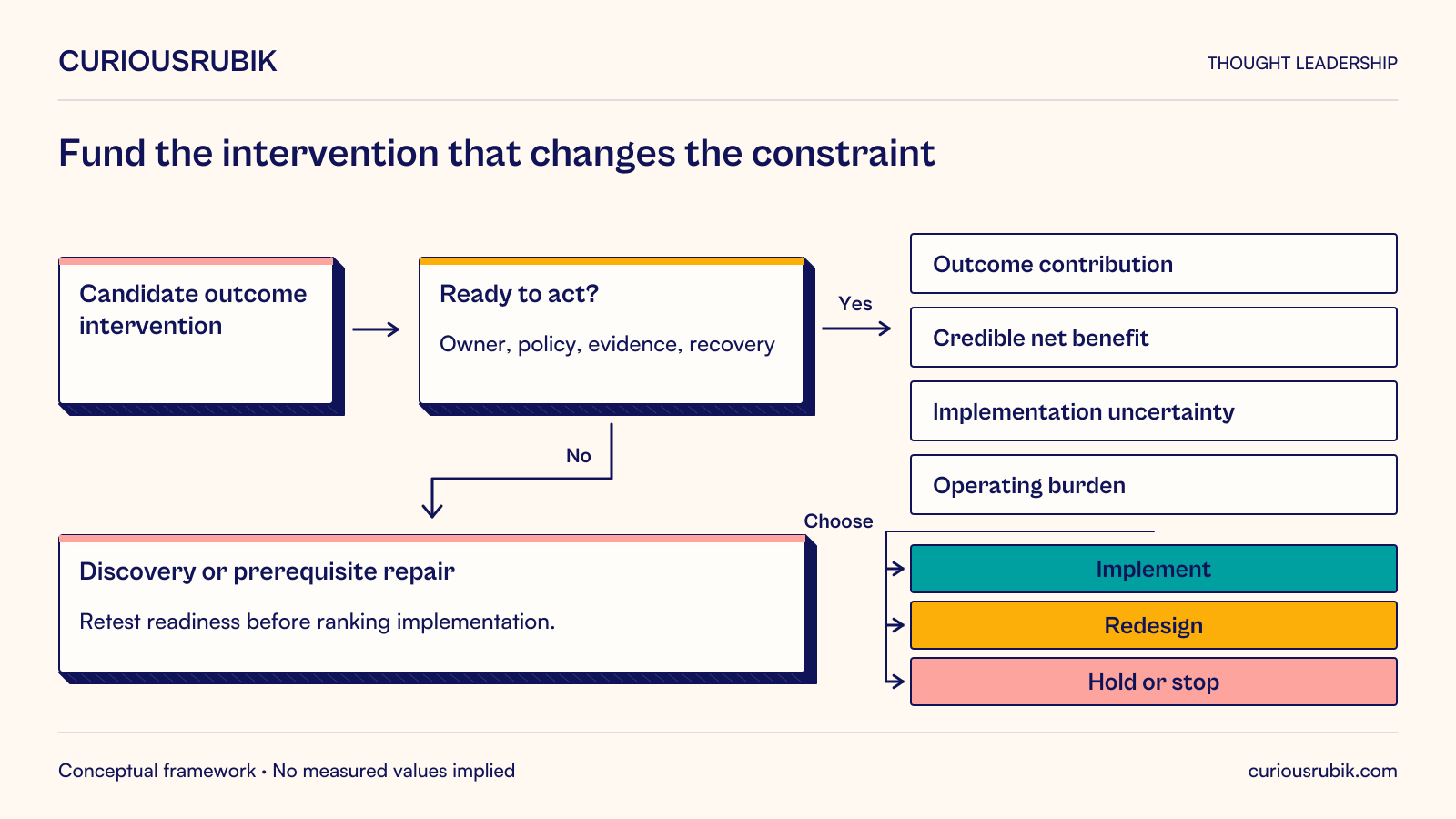
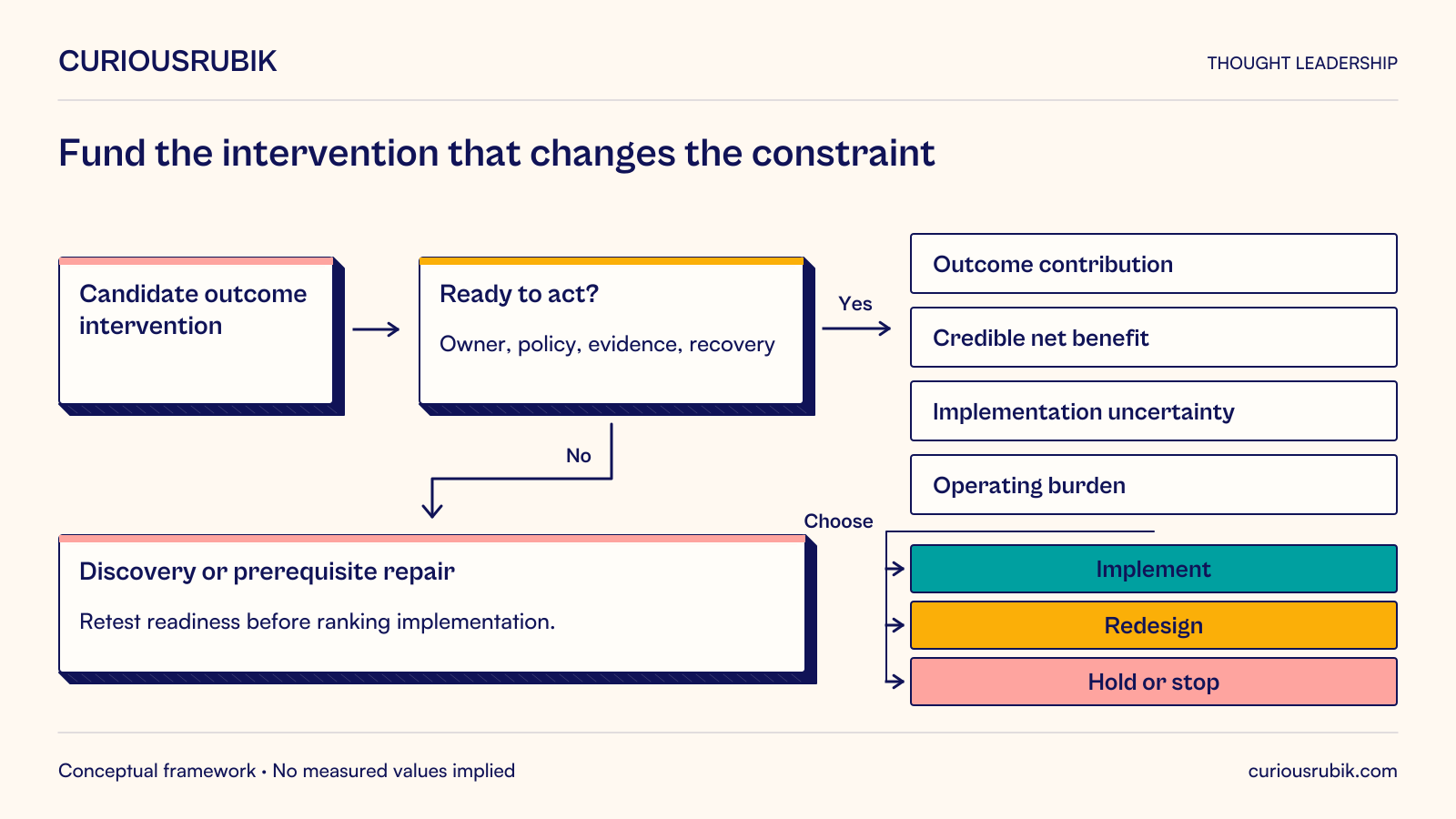
Some candidates should not compete for full implementation funding yet. A process with unresolved policy, no accountable owner, inaccessible evidence, or an unmanageable failure mode needs investigation or repair first.
These are readiness gates rather than reasons to abandon the opportunity. A small discovery effort may resolve the uncertainty cheaply. Keep discovery funding separate from deployment funding so promising but immature ideas are neither rejected prematurely nor presented as implementation-ready.
Check the ability to operate the result. Who will maintain the rules? Can technical support diagnose failures? Will the business handle exceptions during peak demand? Does the proposed solution introduce access or contractual requirements that need approval?
A task can be technically feasible and operationally unsuitable. For example, automatically classifying a request is of limited value if every uncertain case enters an already overloaded specialist queue.
Rank by contribution to the constraint
After readiness screening, compare candidates on four dimensions: outcome contribution, credible net benefit, implementation uncertainty, and operating burden. This is a working heuristic, not a universal scoring standard.
Outcome contribution asks whether the intervention changes the important constraint or protects a material obligation. Credible net benefit distinguishes observed avoidable work from speculative gains. Implementation uncertainty captures the unresolved assumptions most likely to change cost or value. Operating burden considers support, review, exceptions, and dependency management after launch.
Use scores to structure discussion only when their scales have meaningful definitions. A “five” for complexity means little if each sponsor interprets it differently. Preserve the evidence and disagreements beside any summary score.
Do not let a composite number conceal a disqualifying risk. A large estimated benefit should not automatically offset an inability to recover from incorrect external actions. Likewise, a low-cost project may remain a poor choice if it consumes the same scarce business expert needed for a more consequential intervention.
A laboratory services company compares three candidates
Consider a hypothetical commercial materials-testing laboratory. It has limited automation funding and a shortage of experienced technical reviewers. Three proposals compete: automate staff expense entry, create customer status updates, and prepare evidence packs for technical review.
Expense entry is repetitive and relatively straightforward. Status updates consume customer-service time and interrupt analysts. Evidence-pack preparation requires integration with test records but may reduce the time reviewers spend searching for supporting material.
The company first clarifies its constraint: completed tests wait for authorized technical review, delaying final reports. It then measures the work around that queue. Reviewers must still exercise professional judgment; the proposed automation will only assemble traceable evidence and flag missing items.
The status-update proposal is revised after observation shows that many inquiries arise because customers cannot distinguish testing from review. A narrow status view may reduce interruptions, but it cannot promise completion dates the laboratory cannot support.
The evidence-pack proposal receives discovery funding because its value depends on whether records can be reliably linked and whether reviewers trust the assembled material. The pilot includes amended results, retests, and incomplete documentation. It measures preparation time, reviewer search time, missing evidence, and incorrect association of records.
Expense automation may still proceed later or through a separate low-effort route. It is not rejected because expenses are unimportant. It ranks lower within this particular constrained portfolio because the immediate business objective is report throughput and reviewer capacity.
The example makes no claim of realized savings. It demonstrates that priority changes when the decision is anchored to a business constraint rather than the attractiveness of a demonstration.
Separate capacity from cash and additional output
Released employee time can create several kinds of value. It may allow more work, improve response, avoid a future hire, or reduce overtime. These mechanisms should not be treated as interchangeable.
If the organization cannot redeploy the time or reduce a cost, the benefit may remain convenience or resilience rather than cash. That can still matter, but the investment case should state it honestly.
Additional throughput also requires demand and downstream capacity. Preparing more laboratory reports for review is useful only if the reviewer can use the released time and the next stage does not immediately become the limiting factor.
For each candidate, describe how the benefit will be realized and who owns that change. A manager who expects avoided hiring should identify the hiring decision that may change. A sponsor expecting better service should identify the customer outcome and the measure that will reveal it.
Include nonfinancial consequences without disguising them
Some benefits are difficult to monetize credibly: better traceability, reduced reliance on one employee, clearer customer communication, or improved access for staff with different needs. Include them explicitly rather than assigning arbitrary monetary values.
HM Treasury’s 2022 supplementary value-for-money guidance illustrates appraisal that considers non-monetisable factors and explains why the highest benefit-cost ratio need not determine the preferred option. Its public-sector context differs from a commercial automation portfolio, but the principle of making tradeoffs visible is useful. HM Treasury, Value for Money guidance.
State which consequences are mandatory constraints, which are strategic preferences, and which are uncertain benefits. This prevents a sponsor from describing every desirable feature as an essential requirement.
Where risk reduction is material, explain the event, exposure, proposed control, and evidence supporting the reduction. Avoid inventing a probability simply to produce a precise expected-value calculation.
Use pilots to resolve investment uncertainty
A pilot should target the assumption most likely to change the decision. If identity matching is uncertain, test difficult matches. If user verification effort may eliminate the saving, measure that effort. If the benefit depends on customer behavior, test the response rather than only the software function.
Define a decision rule before the pilot. The result may justify expansion, a different design, more evidence, or stopping. A pilot that can only produce a success narrative is a demonstration, not an investment test.
Keep the test representative. Exceptional vendor support, hand-cleaned data, or unusually experienced users can make a pilot look easier than normal operations. Record those differences and estimate what maintaining the same conditions would cost.
Do not demand statistical precision from a tiny pilot. It can identify a fatal design assumption or establish operational feasibility without proving an enterprise-wide benefit. Match the conclusion to the evidence.
Manage the portfolio after selection
Priorities should change when assumptions change. A planned acquisition, new service obligation, altered demand pattern, or failed pilot can make yesterday’s ranking inappropriate.
Maintain a short decision record for each funded initiative: reason for selection, key assumptions, benefit owner, dependencies, review trigger, and conditions for stopping. Review the portfolio’s shared constraints, including business experts and support capacity.
Watch for local accumulation. Ten small automations can create a large maintenance burden, particularly when they use different tools and duplicate rules. Assess the combined operating cost rather than approving each project as if it were the only one.
Retire automations whose purpose has disappeared or whose benefit is no longer credible. Maintaining an obsolete workflow because its build cost has already been incurred compounds the original commitment.
What a buyer should request
Ask prospective suppliers for evidence-based candidate discovery, not a list of tasks their tool can automate. Require them to distinguish business outcomes from activity savings and to explain how exceptions affect the case.
Compare options that include process simplification and ordinary application configuration. A specialized automation product should earn its place against simpler ways to achieve the outcome.
The best portfolio does not maximize the number of automated processes. It directs scarce change capacity toward interventions that matter, proves uncertain assumptions at an appropriate scale, and funds the operating responsibilities that make the benefit durable.