A transformation can reach the end of several successful supplier work packages without producing a usable service. One vendor has configured the application, another has built the interfaces and a third has prepared the infrastructure. Each can demonstrate completion within its own boundary, while the business still lacks evidence that the boundaries work together.
The client’s central responsibility is to govern the whole outcome and the work between suppliers. That includes shared definitions, versions, test conditions, decision rights and recovery ownership. A lead integrator can perform important coordination work, but the organization must still know which business decisions and risks it retains.
For a program director, the practical objective is to make cross-vendor obligations visible before a failure turns them into a commercial dispute. The method is a shared delivery model with explicit evidence at the points where one party’s output becomes another party’s dependency.
Define the outcome above the work packages
Describe the end-to-end business scenarios the program must support and the evidence needed for acceptance. Then map each supplier’s contribution and the client’s own responsibilities to those scenarios.
Do not assume that a responsibility omitted from a statement of work belongs to somebody else. Data decisions, test participation, identity administration, operational training and cutover coordination can fall between commercial boundaries. Assign an owner and confirm the arrangement through the appropriate contractual and governance process.
Keep business acceptance separate from supplier deliverable acceptance. A component may satisfy its agreed specification while the overall process still requires additional work. Conversely, a business defect should not automatically be attributed to a supplier without examining the agreement and evidence.
The program needs a route for resolving those distinctions promptly. Delivery teams should understand who can authorize a technical correction, who can change a shared requirement and who can make a commercial decision.
Give every important boundary an owner
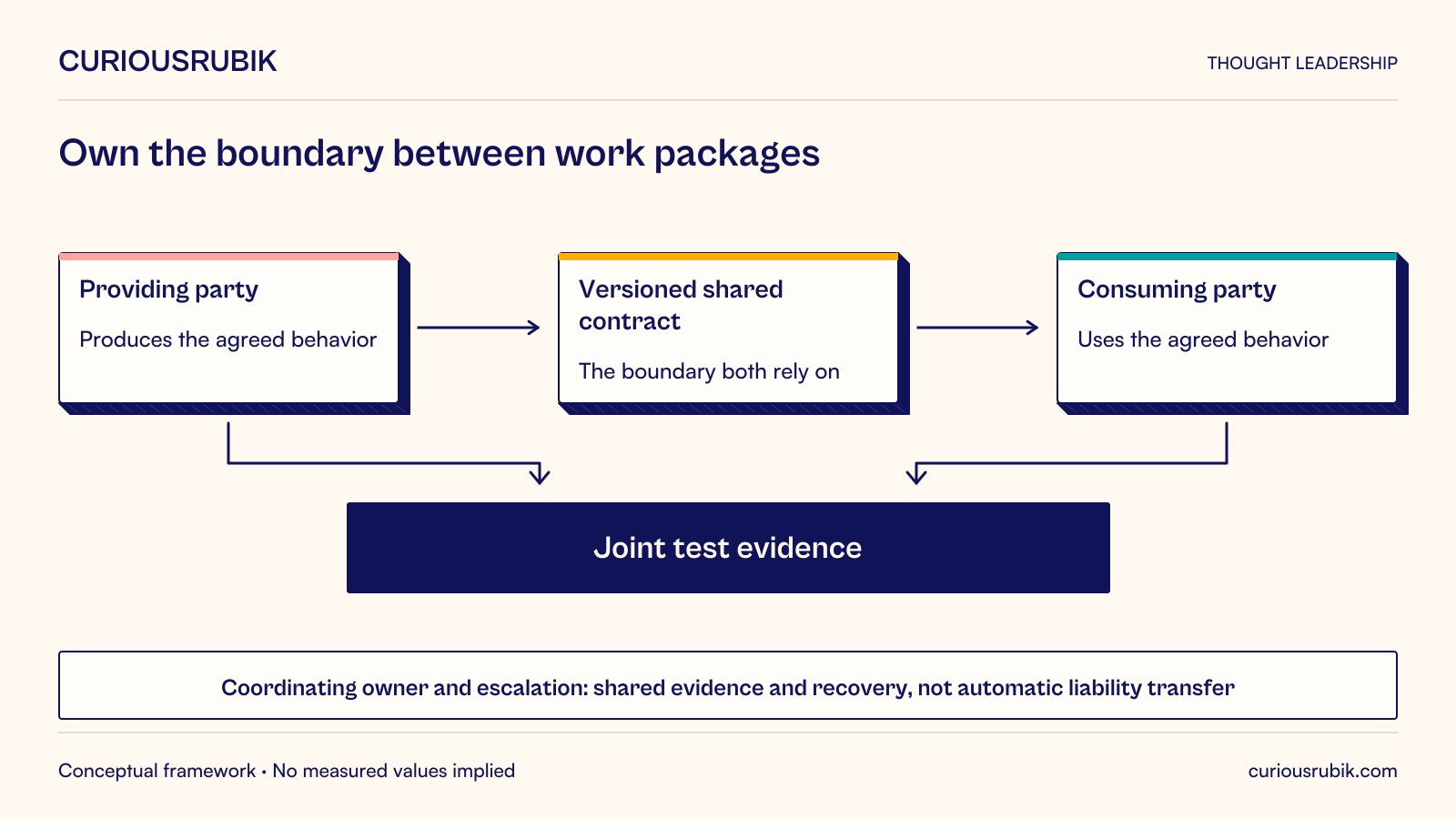
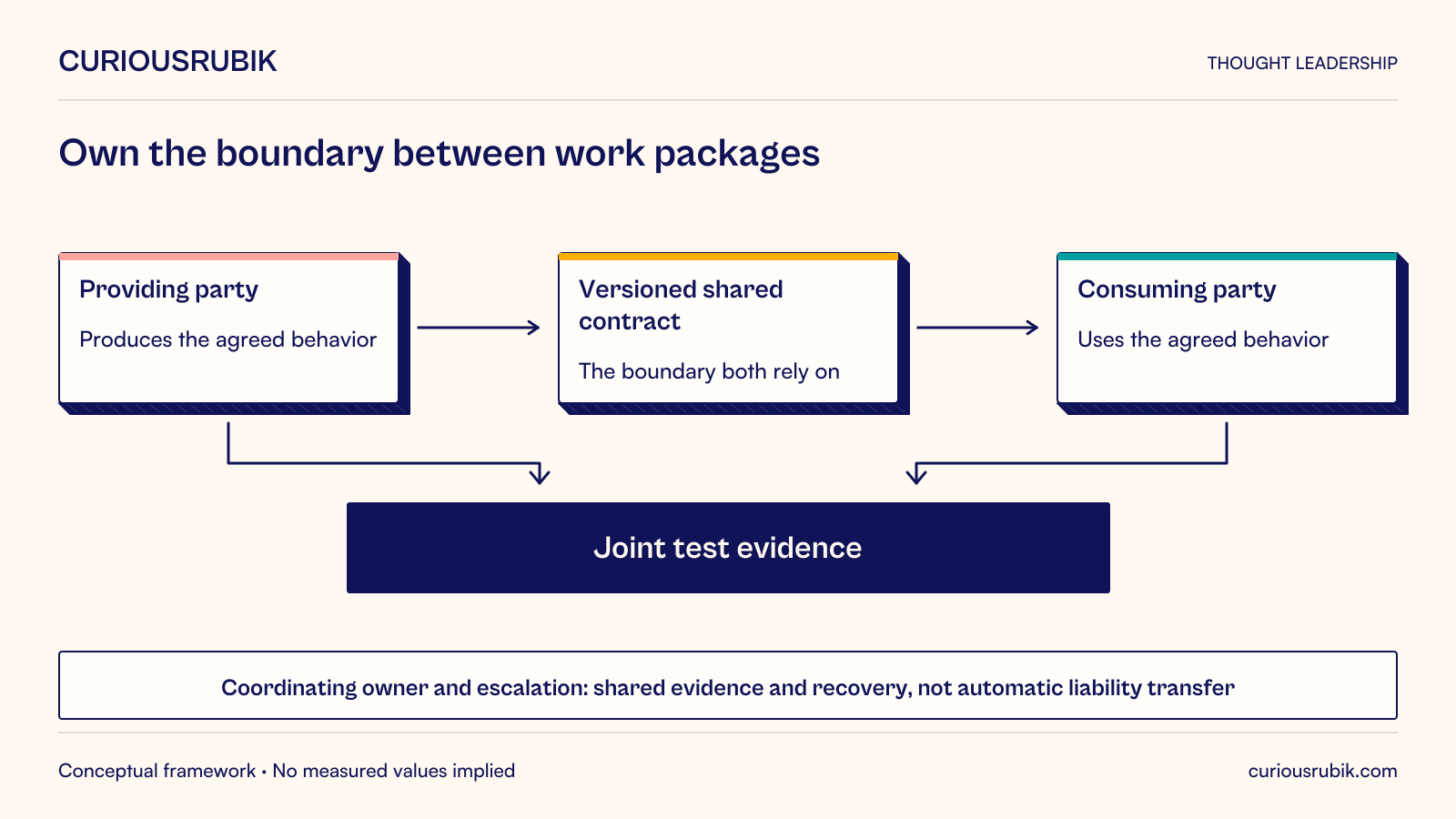
For each critical interface or handoff, record the providing party, consuming party, shared contract, relevant versions, test evidence and operating owner. Include client teams where they own part of the boundary.
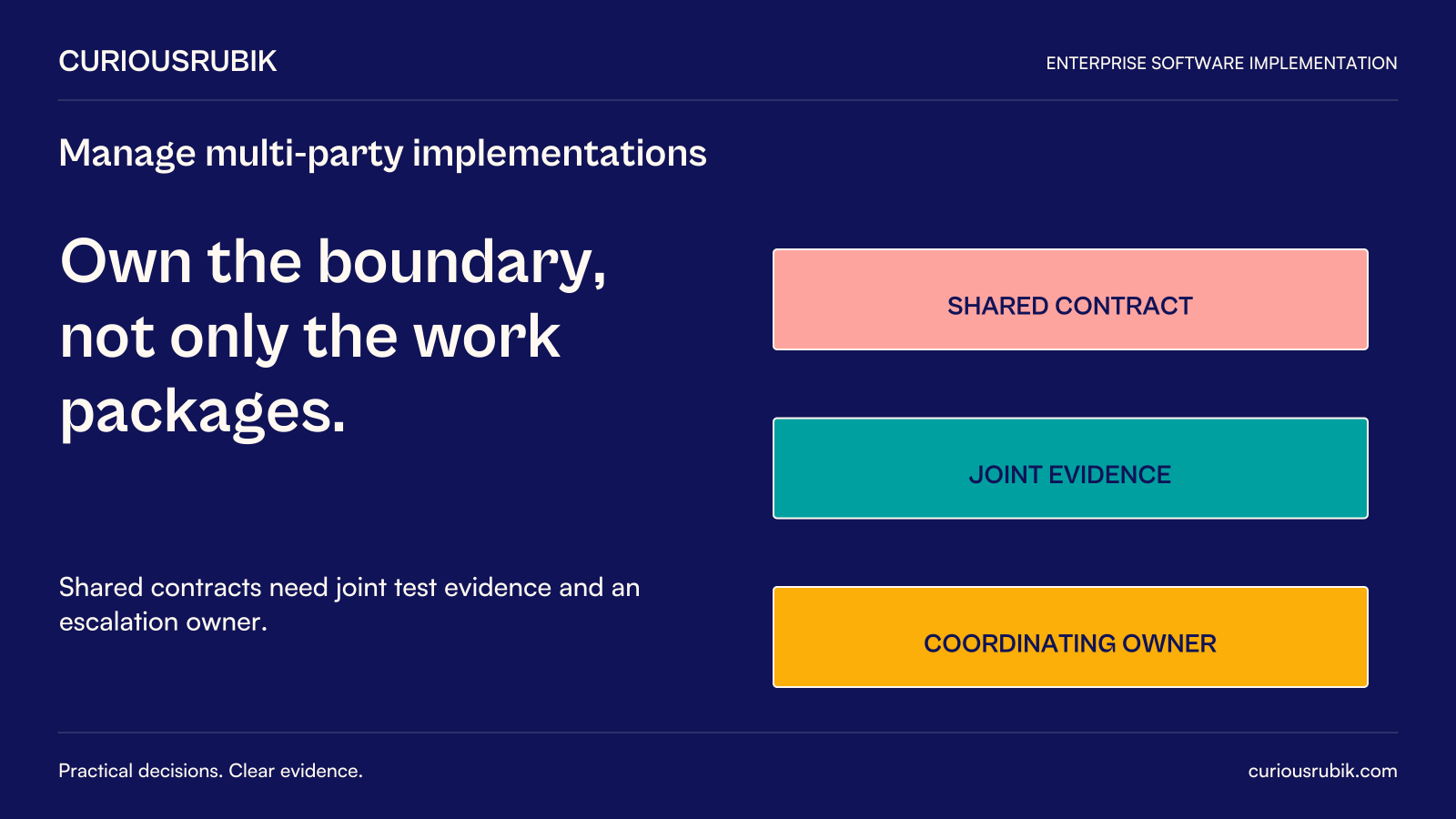
The owner should coordinate the result across both sides, not merely forward messages. They need enough authority to obtain evidence, convene the relevant specialists and escalate a decision that exceeds their mandate.
NASA’s 2016 Systems Engineering Handbook describes interface management as a way to control development divided among parties and maintain compatibility between products that must interoperate. Its guidance includes interface responsibilities, change control and verification. An enterprise program can apply that discipline proportionately without importing an aerospace governance structure. NASA Systems Engineering Handbook, section 6.3.
Avoid making the boundary register an inventory that nobody uses. Link it to the integrated plan, release decisions and support process. When a dependency changes, the affected owner should know which parties and evidence must be revisited.
Use one integrated view of the critical work
Suppliers may use different internal planning methods. The client still needs a common view of the dependencies that determine the business milestone.
Show the inputs each party needs, when they are available, the work they enable and the evidence that completes the handoff. A supplier’s planned finish is not a confirmed input until the receiving party can use the result under the agreed conditions.
Include shared environments, representative data, security access, external service windows and business reviewers. These resources often constrain integration even when each supplier has enough development capacity.
Preserve local planning autonomy where it does not affect the shared outcome. The purpose of the integrated view is to coordinate consequential dependencies, not require every vendor to maintain identical task boards or duplicate all internal reporting.
A version mismatch exposes the missing joint obligation
Consider a hypothetical wholesale business implementing an order platform with three delivery partners. Partner A configures the order application, Partner B builds the integration layer and Partner C manages the warehouse system connection. The scenario is illustrative, not a client account.
Partner A demonstrates an accepted-order event using the latest agreed application configuration. Partner B passes its tests against a stored sample from an earlier interface version. Partner C confirms its adapter using a simulator that always supplies a complete warehouse response. Each demonstration is locally successful.
During the first joint scenario, the integration interprets a newly introduced status incorrectly, and the customer-facing order view never receives the expected warehouse state. The initial discussion centers on which supplier caused the failure. The more useful finding is that the program never established a controlled shared test contract and a joint version baseline.
The recovery has several parts. The client-appointed boundary owner confirms the intended business state with the appropriate process owner. The parties agree the supported contract version and representative fixtures. Each supplier updates the affected work, and the joint test includes delayed and incomplete responses instead of relying only on the successful simulator path.
Commercial responsibility for the changes is assessed through the actual agreements; the technical diagnosis does not decide it automatically. Meanwhile, the program records the operating consequence and a coordinated recovery plan so the business is not left waiting for a blame decision before useful investigation begins.
The next acceptance review requires one traceable transaction through the complete path, with the configuration and interface versions recorded. The program has added a joint obligation that separate component demonstrations could not provide.
Make joint testing a planned deliverable
Reserve time and people for integration and business-scenario testing before supplier teams disperse. Agree the environment, data, versions, expected behavior and failure cases in advance.
Define who prepares each part and who accepts the combined evidence. A test cannot establish much if every dependency is simulated independently using different assumptions. Simulators are useful, but their limitations must be explicit and the necessary real-service tests must still occur.
Include investigation and retest capacity in the plan. A joint test window that ends immediately after discovering defects creates pressure to accept unresolved behavior or wait for the next distant availability slot.
Preserve the test record so future changes can be assessed. If a vendor updates a component, the boundary owner should know which evidence remains valid and which scenarios need to run again. This is particularly important when release cadences differ.
Establish a shared incident and defect route
During testing and early operation, the business should have a clear way to report a cross-system problem without first proving which supplier owns it. Assign an initial coordinating owner who maintains the case until responsibility and next action are established.
Collect a common evidence set: business identifiers, relevant times, versions, observed state and known actions. Share only the information each party is authorized to receive, with appropriate handling of sensitive records and credentials. More unrestricted logs are not automatically better evidence.
Separate the business impact clock from individual supplier ticket statuses. A case marked “waiting for another party” may accurately describe one team’s position while the overall service remains blocked. The coordinating owner should keep the end-to-end consequence visible.
Use joint investigation to narrow the problem, then assign corrective work through the agreed process. The goal is timely resolution with defensible accountability, not a permanent meeting in which every supplier repeats its status.
Align incentives and escalation with the whole result
Commercial arrangements should support the participation required for the delivery model. Ask the appropriate procurement and legal teams to review obligations for shared testing, evidence, change handling, support and exit. Do not assume a technical plan can create contractual duties by itself.
Avoid incentives that reward narrow completion while leaving integration and operating consequences unowned. The solution may involve clearer acceptance conditions or retained participation at key transitions, but the appropriate mechanism depends on the agreement and context.
Provide escalation levels with real decision authority. Technical leads resolve technical questions within their remit. Program leadership resolves scope and sequencing conflicts. Authorized commercial owners address contractual matters. Executives decide material business tradeoffs. Sending every issue immediately to senior management can slow the program and weaken local accountability.
Keep decisions visible across parties. A scope change agreed with one vendor can create work for another. The integrated change review must identify those effects before the program treats the first agreement as complete.
Design the handover before supplier teams leave
Operational support needs the combined solution, not only separate vendor manuals. Document authoritative sources, interface versions, monitoring, recovery, escalation and the ownership of recurring tasks.
Confirm that the organization can access the artifacts it needs under its agreements and that knowledge transfer includes representative incidents. A recorded presentation is less useful than demonstrating how the support team diagnoses and routes a real class of failure.
Plan for a supplier change. The business should know which dependencies, documents, configurations and permissions are needed to transition a responsibility. This is an operating-continuity question as well as a commercial one.
Multi-vendor delivery works when boundaries are managed as carefully as individual components. Start with the critical business scenario, map the suppliers and client teams it crosses, and identify every place where successful local work could still produce an incomplete outcome. Giving those boundaries owners, evidence and an escalation route turns a collection of contracts into a coordinated transformation program.