A production order says 100 units are complete. The warehouse can find only 80 units that are cleared for shipment. Finance receives a total labor charge but cannot tell which work remains unfinished. Each team may have recorded something accurately; the problem is that “complete” means something different in each record.
Connecting manufacturing systems starts with these distinctions. A machine cycle, an operation confirmation, a finished unit, a quality release and a financial posting are different events. Treating one as a substitute for all the others can make a connected system spread a misunderstanding faster.
The practical objective is a traceable account of what material entered production, what happened to it, which output is usable, which work remains and how the relevant costs are supported. That account should help people act during the shift as well as explain the position at the reporting boundary.
Start with the physical transformation
Consider a hypothetical workshop that machines one blank into one component. For this example only, each blank produces at most one finished component, all quantities use the same unit and the population is one identified production order. Real processes may have multiple outputs, weight-based yields, recoverable material or other relationships that require a different model.
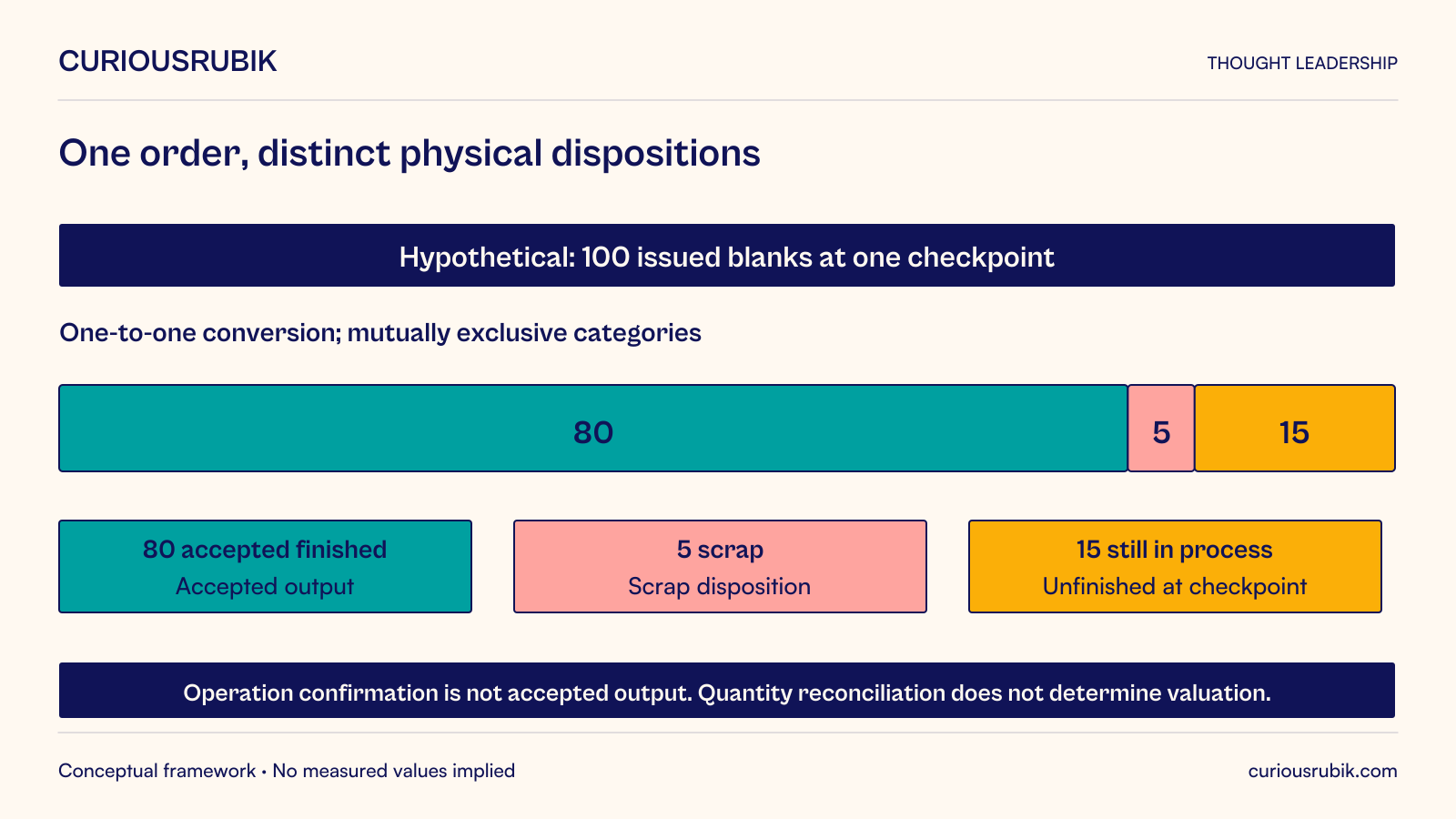
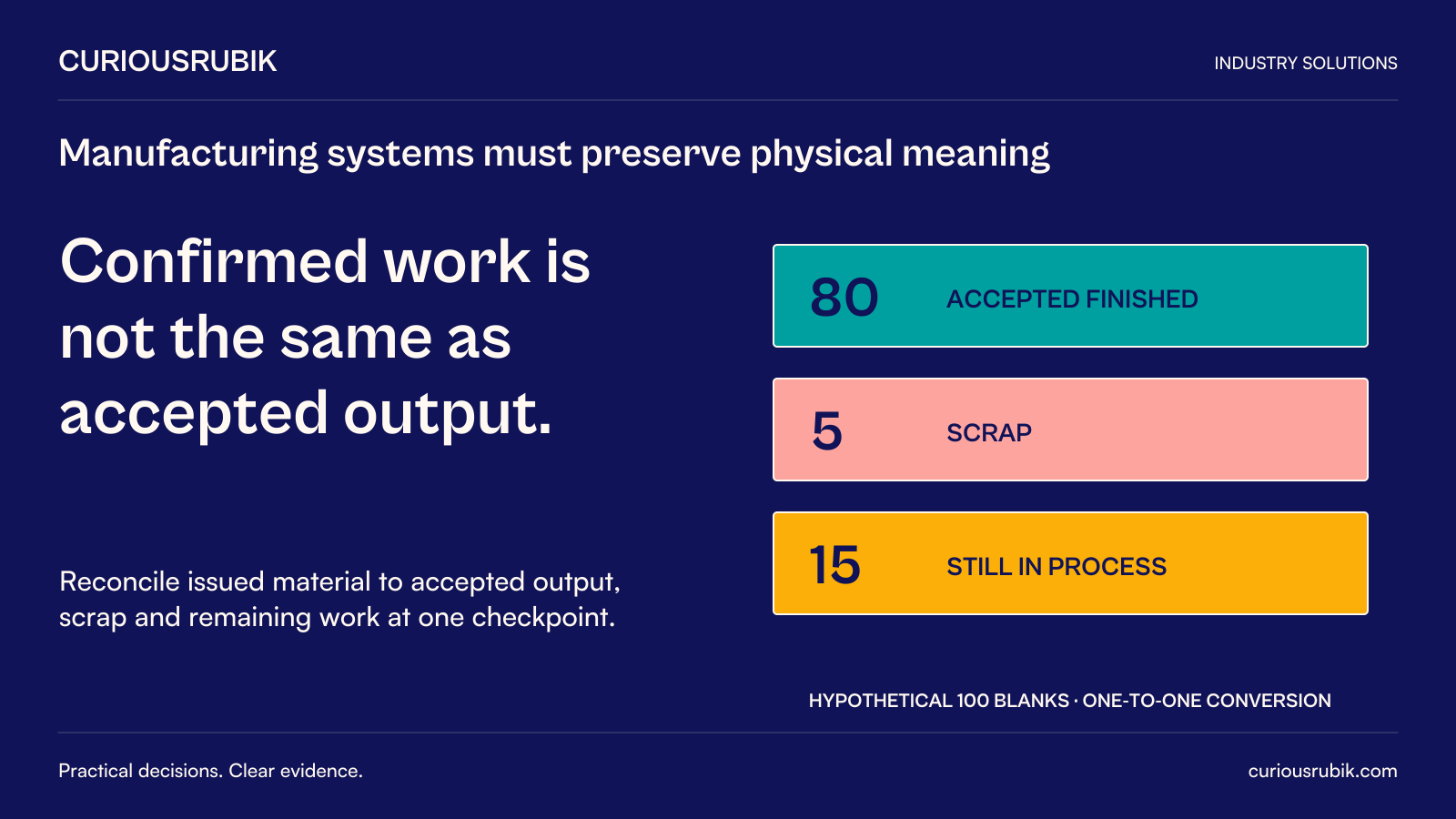
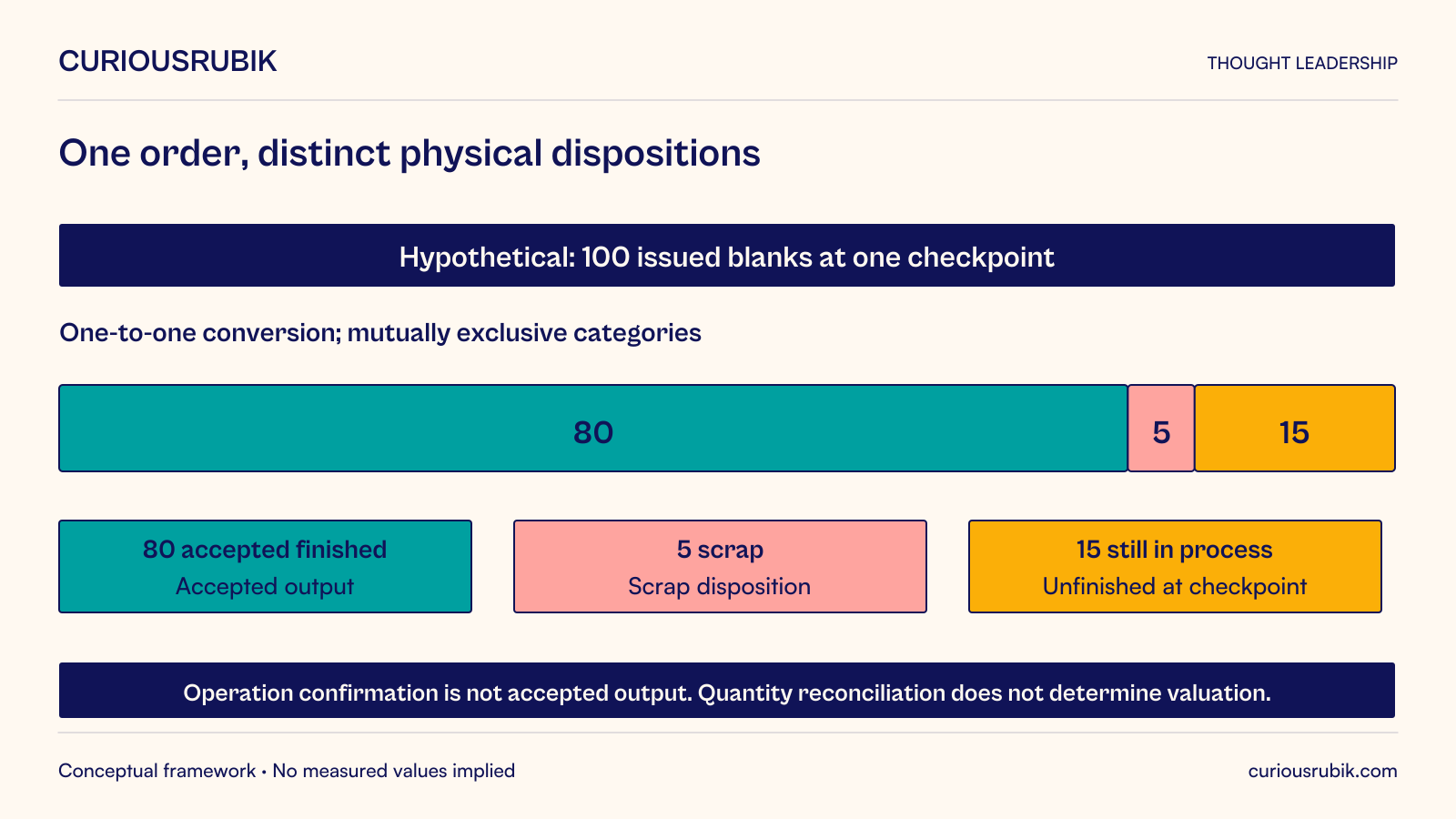
The workshop issues 100 blanks. At a defined checkpoint, 80 have become accepted finished components, five have been identified as scrap and 15 remain in process. The quantity account is 100 = 80 + 5 + 15. It is an account of these physical dispositions, not a valuation formula.
If an operator confirms that the first machining operation has processed all 100 blanks, that confirmation does not establish that all 100 are accepted finished goods. The 15 unfinished components may still require another operation. The five scrapped blanks are not available for sale. Recording 100 as finished output would obscure both facts.
The example also assumes the dispositions do not overlap. A component waiting for inspection cannot simultaneously appear in accepted stock and in work in process. If inspection is a separate state, include it explicitly and adjust the reconciliation accordingly. A convincing total does not rescue poorly defined categories.
A useful design session follows one actual production route with production, warehouse, quality and finance participants. Ask what changes physically at each point, which record proves that change and which next action it permits. The resulting model should use the plant’s real material and routing relationships rather than forcing every product through the same simplified diagram.
Make each event carry enough context
An event needs more than a quantity and a timestamp. Depending on the process, it may need the production order, item and revision, input lot, operation, output identity, unit of measure, location, disposition and responsible source. Capture the information that supports the decisions and traceability requirements rather than collecting fields without a purpose.
A routing revision matters because the same operation name can refer to different work after a process change. A unit of measure matters because a count of cases cannot be reconciled directly with a count of individual components. A location matters because output reported at a machine may not yet have arrived in a warehouse bin.
Separate the time an event occurred from the time it was entered or received. A late shift confirmation should not make material appear to have been processed later than it actually was. Preserve the relevant history while controlling who can correct an entry and how its downstream effects are reviewed.
The source of a measurement also matters. An automated counter may provide reliable cycle evidence but lack the context to determine accepted output. A manual declaration may capture a necessary judgment but require supporting evidence. Select the source for each fact, and define how conflicting evidence is investigated.
Do not require duplicate entry just to make every system appear authoritative. Production may own operation completion, quality may own a release decision and the warehouse may own a physical receipt. The integrated account should retain those responsibilities while making their relationships visible.
Connect the quantity account to cost evidence
Finance needs operational evidence, but operational quantities do not by themselves determine the accounting treatment. The IFRS Foundation’s overview of IAS 2 describes inventory cost as including purchase costs, conversion costs such as direct labor and production overhead, and other costs of bringing inventory to its present location and condition. That narrow principle explains why manufacturing information and cost records need a reliable connection. It does not prescribe the correct treatment for a particular factory or transaction. IAS 2 overview.
In the workshop example, allocating every recorded cost to the 80 finished components without examining the 15 unfinished units could misrepresent the work remaining. Conversely, treating every issued blank as finished stock would ignore the actual process state. The appropriate valuation requires the organization’s applicable accounting policies and qualified finance judgment, including the treatment of scrap and other losses.
Build a bridge between the records that finance must evaluate: material issues and returns, operation evidence, labor or machine usage where relevant, output quantities, unfinished work and approved adjustments. Identify the production order and period each record belongs to, with a controlled way to explain late or corrected information.
A standard cost can provide a planning or valuation basis under the chosen design, but it should not erase the distinction between planned consumption and actual reported activity. Similarly, a variance is a signal for interpretation, not automatic proof that an operator performed badly. Product mix, incomplete confirmations, routing changes and measurement errors may affect what the comparison means.
Before automating a posting, ask finance to specify the triggering evidence, accounting rule, exception treatment and reversal or correction process. Connecting the systems should make the basis of the entry easier to explain. It should not hide policy decisions inside an interface mapping that nobody owns.
Design for unfinished work and corrections
The difficult integration tests often occur between the tidy endpoints. A job may span shifts, move to an outside processor, wait for an inspection, require rework or stop after only part of the planned quantity is completed. These situations should have legitimate states rather than being forced into “open” or “done.”
For the 15 components still in process, identify their actual operation and location. That information can support the next shift’s plan and explain why the order is not ready to close. A single aggregate work-in-process balance may be sufficient for some financial purposes while still being inadequate for operational dispatching.
Rework needs particular care. Reprocessing a component does not necessarily create a second component. Preserve its identity or an appropriate linked history so an additional operation confirmation does not inflate finished output. If a previously accepted unit is placed on hold, define how the status change affects availability and any commitments already made against it.
Corrections should repair the affected account rather than silently replacing history. If an operator entered eight scrapped units instead of five, the authorized correction needs to update the relevant quantity position and trigger review of any dependent decisions. Whether a financial adjustment is needed depends on what has already been posted and the applicable process.
Connection failures require similar discipline. A warehouse receipt may exist even if its acknowledgment did not reach production. Retrying should not create a second receipt. Use an identifiable business event and a reconciliation process that can distinguish missing evidence from a missing physical action. The team responsible for the exception needs both the technical delivery status and the operating context.
Test one connected order before scaling the template
Choose a pilot order that exercises meaningful complexity without making the first test unmanageable. A perfectly straightforward route can demonstrate data movement while missing the conditions that create most disagreement. Include a partial completion, a quality hold or a correction where those situations are relevant to the plant.
At each checkpoint, have the participants answer the same questions independently: what has been consumed, what is accepted and available, what remains unfinished, what is held or lost, and which costs have supporting evidence? Compare their answers with the physical and documentary evidence. Agreement between screens is insufficient if all screens inherited the same wrong event.
Test timing as well as totals. A correct end-of-day reconciliation does not prove that an earlier availability promise was safe. Likewise, an operational exception resolved before the reporting boundary may still have caused an avoidable scheduling interruption. Select evaluation windows that match the decisions being supported.
Include the negative paths. Reject an unknown unit conversion rather than guessing it. Prevent an unauthorized quality release. Demonstrate the handling of a duplicated confirmation and a late correction after an order has been closed. Establish who may reopen or adjust the relevant records under the organization’s controls.
Document the limits of the pilot. A one-to-one machining route does not prove that the same template works for blending, disassembly or multiple-output production. Reuse the common event and control principles, then validate each materially different transformation model before wider rollout.
Judge improvement by decisions people can now make
A connected manufacturing environment should let production identify the next executable work, let the warehouse distinguish usable stock from reported activity and let finance trace cost conclusions to relevant evidence. These are specific capabilities to demonstrate, not benefits to assume because three systems exchange messages.
Useful operating checks include unresolved quantity differences, age of unconfirmed work, late corrections, availability reversals and the effort required to explain a production order’s position. Define each measure carefully and retain the relevant product and process context. A lower exception count may reflect better operations, but it may also reflect weaker detection or premature order closure.
Assign ownership for the shared definitions and for changes to them. New products, routings, subcontracting arrangements or quality requirements can alter the meaning of an event. Reviewing those changes together is part of operating the connection, not a one-time implementation exercise.
The strongest transformation is one in which the same production order can be followed from material input to accepted output, unfinished work and justified financial treatment. People still make the judgments appropriate to their roles, but they no longer have to reconstruct the basic story from incompatible versions of “complete.”