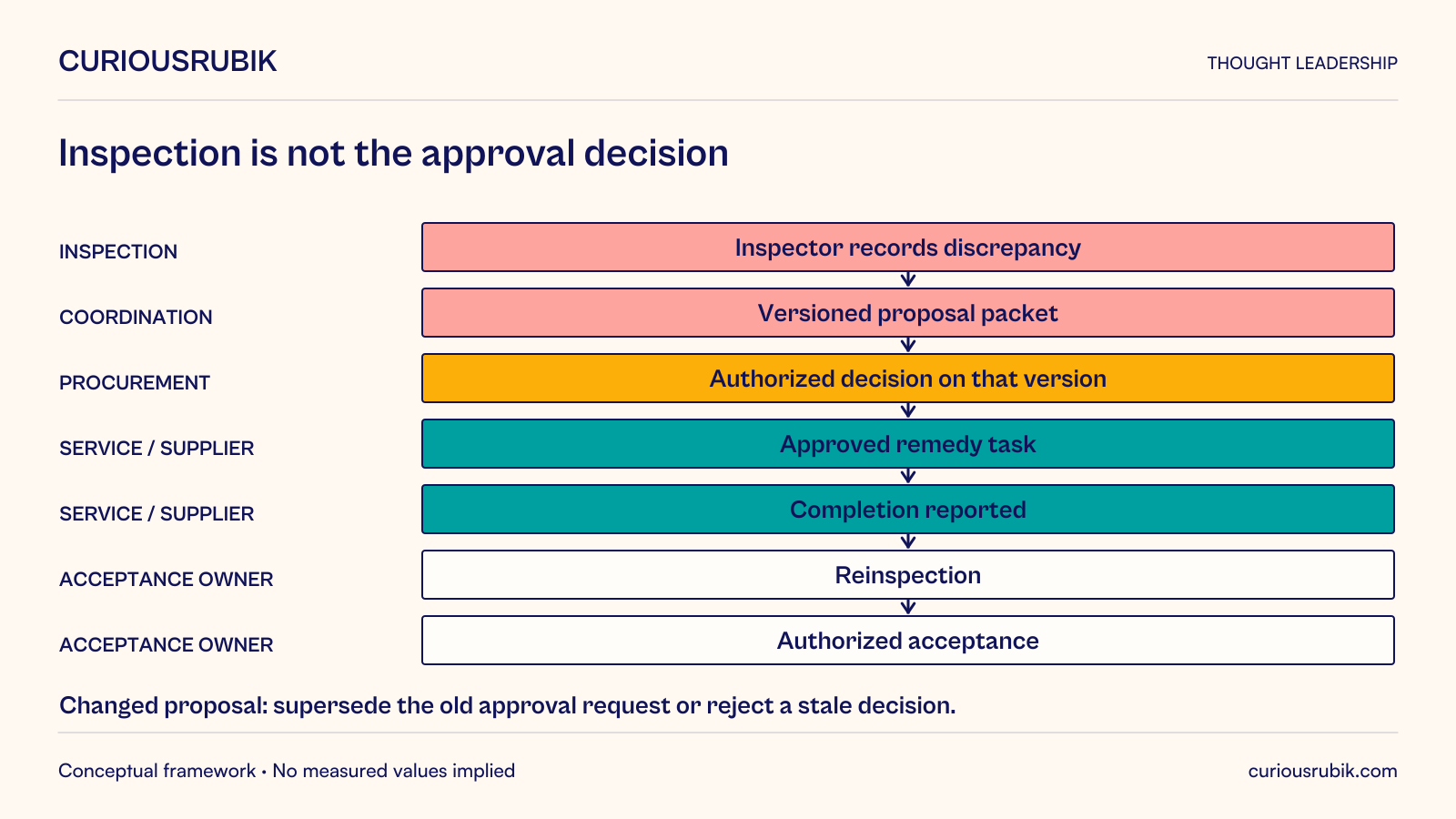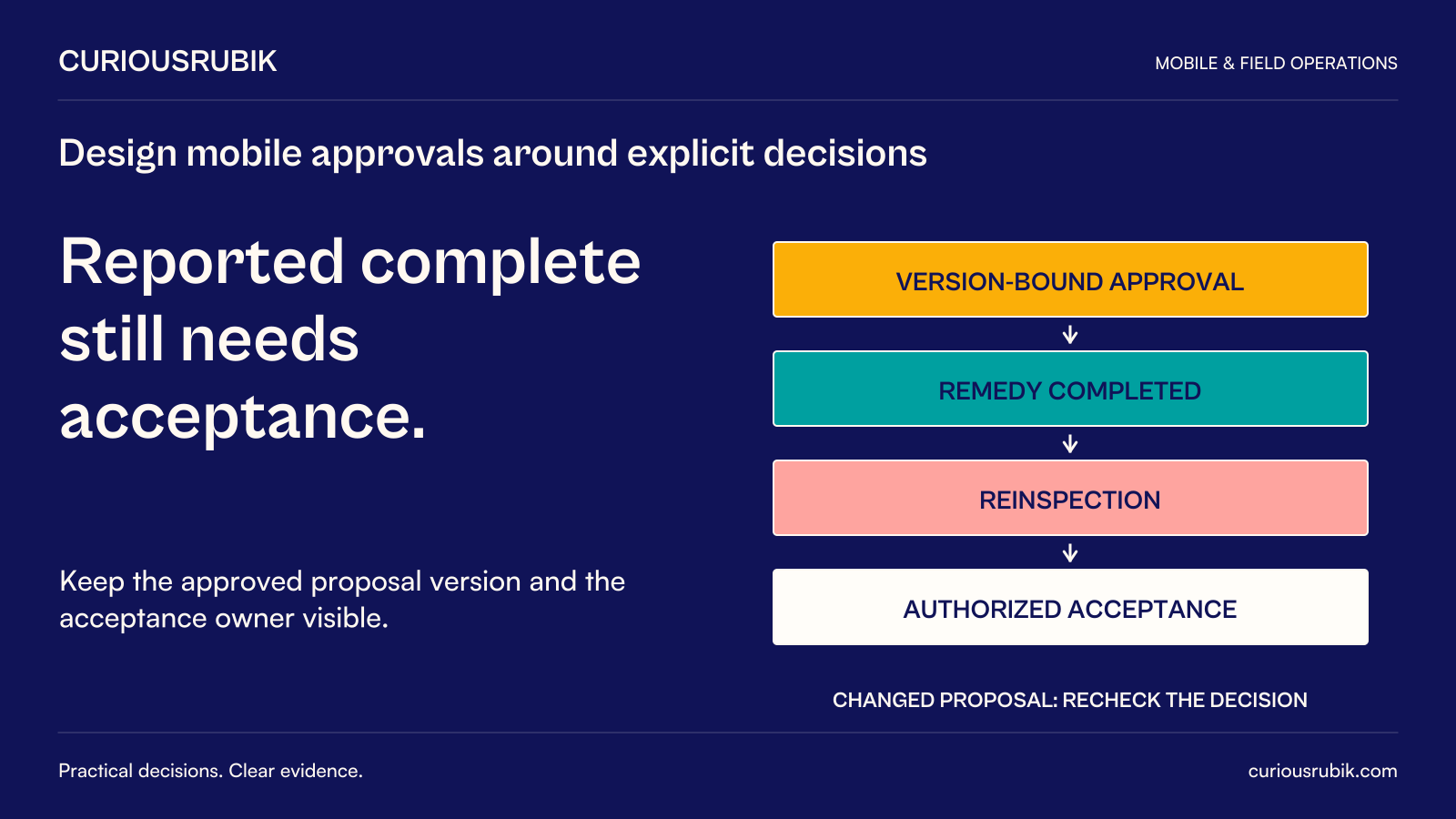
Approvals, inspections, and service tasks can share a mobile experience, but they represent different kinds of work. An inspection records evidence. An approval grants authority for a defined decision. A service workflow coordinates actions until an agreed outcome is accepted. Combining them into one Complete button makes the process easier to tap and harder to control.
For an operations or procurement leader digitizing on-site acceptance, the key decision is which event changes the business state and what evidence and authority that event requires. A mobile-first workflow should make routine actions concise while preserving the context needed for consequential decisions.
This article uses a hypothetical office-furniture installation to connect inspection, exception approval, and remedial service. The example concerns commercial acceptance of supplied items. It does not substitute for building, fire, electrical, or other safety inspections that require their own qualified procedures and authority.
Distinguish evidence from authorization
An inspector may record that a desk arrived with a different finish from the order. That observation does not authorize the supplier to substitute it, establish a price adjustment, or accept the completed installation. Each of those outcomes requires a separately defined decision.
Model the workflow with explicit states. An item might be delivered, inspected with a discrepancy, awaiting a commercial decision, awaiting remedy, ready for reinspection, and accepted. Use only states that change responsibilities or permitted actions. The goal is a useful operating model, not the largest possible state diagram.
For every transition, identify the actor, required evidence, applicable authority, and next owner. A technician can report a repair complete while an authorized recipient decides whether the result satisfies the acceptance conditions. If the same person can perform both roles under approved policy, record that deliberately rather than allowing it accidentally.
Define the relationship between item-level and overall completion. Accepting nine desks out of ten does not necessarily complete an installation order. The business may permit partial acceptance, require all critical items, or use another rule. The application should show that rule and the remaining exceptions.
A hypothetical office installation
Imagine a hypothetical company receiving furniture for a new office area. The installation coordinator uses a mobile checklist linked to the approved order and room plan. For each item, the coordinator confirms identity, location, visible condition, and the relevant acceptance criteria.
One desk has the wrong finish. The coordinator records the discrepancy, links a photograph, and identifies the affected order line. The app creates an exception rather than requiring the coordinator to choose between accepting everything and rejecting the whole delivery.
The supplier proposes keeping the desk with a commercial adjustment. The procurement manager receives an approval task showing the ordered finish, observed finish, proposed adjustment, affected quantity, and the consequences of accepting the substitution. The hypothetical workflow requires that manager’s authority for this decision; the inspector’s observation alone is insufficient.
Before the manager acts, the supplier changes the proposal to a replacement at a later date. The original approval task must not retain a live Approve button that silently applies to the new terms. It should either remain bound to the original version and reject a stale decision, or be superseded with a clearly identified new request.
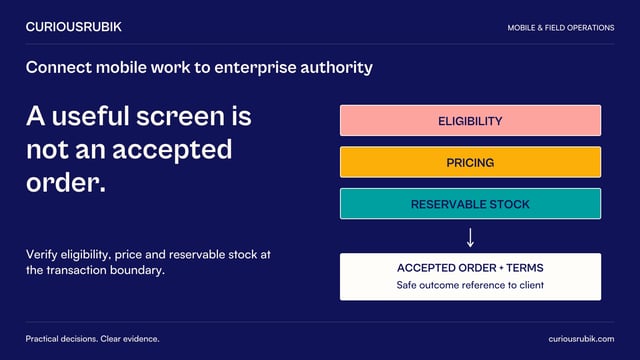
Suppose the manager chooses replacement under the approved process. A service task then coordinates the removal and installation. The supplier’s completion report moves the item to ready for reinspection, not directly to accepted. The coordinator checks the replacement and records the final acceptance decision with the required authority.
At the end, the order view shows which items were accepted, which remained open, and which version of each exception decision governed the remedy. That history supports operational understanding without implying that a mobile photograph or drawn signature alone establishes every legal or contractual requirement.
Design an approval as a reviewable decision packet
An approval screen should show the object, proposed action, material terms, supporting evidence, and relevant exceptions. For a substitution, that includes what was ordered, what is proposed instead, and what changes in quantity, timing, or cost. Avoid hiding consequential information behind a vague summary.
Bind the decision to a specific version of that packet. Record the request identity, version, approver identity, authority evaluated, decision, and time. Preserve the evidence needed to explain what was approved. The exact retention period and formal record requirements depend on the organization’s obligations.
Revalidate at commitment. A manager may open a task, put the phone away, and return after the proposal or their authority has changed. The server should evaluate whether the submitted decision still applies. A previously displayed button should not serve as the final permission check.
HTTP conditional requests such as If-Match support checking a representation version before applying a method. They can help reject stale updates, but the application still needs business rules for approval authority and material changes. RFC 9110, Section 13.1.1
Make rejection and request-for-information meaningful. A rejection ends or redirects a proposal under a defined rule. A request for information may keep it pending with a named owner. Treating both as a generic return can obscure whether the requester should revise terms, provide evidence, or stop work.
Make inspection criteria observable
An inspection question should describe something the assigned person can actually establish. “Item acceptable” can conceal several judgments. Separate identity, quantity, visible condition, and other approved criteria when they lead to different exceptions or evidence requirements.
Provide options for not inspected and unable to assess where appropriate. If the item is inaccessible or a required reference is missing, forcing a pass or fail answer produces unreliable data. The workflow should route an incomplete assessment without disguising it as a completed inspection.
Use evidence requirements selectively. A discrepancy may justify a photograph and explanation. Requiring the same photograph for every ordinary pass can increase effort without improving the receiving decision. The process owner should decide which evidence serves a real control or operational need.
Keep the inspected object and reference version visible. An employee moving through several rooms can otherwise attach evidence to the previous item. Where a plan or specification changes, preserve which version informed the observation rather than rewriting history to match the newest document.
Treat remedial service as an owned commitment
An exception should become a service task only when its scope, responsible party, and required outcome are defined. “Fix issue” is insufficient. The task should identify the affected item, approved remedy, dependencies, and evidence needed for the receiving party to evaluate completion.
Separate scheduling, work performed, and accepted resolution. A scheduled visit is a plan. A completion report is a statement about work. Acceptance confirms the defined outcome under the applicable process. These distinctions help avoid closing a customer’s problem merely because a technician has ended a visit.
Escalation should preserve responsibility. If the assigned person is unavailable, transfer the task to an authorized owner or team queue and record the change. Sending more notifications to an absent individual is not a recovery mechanism.
Define reopening behavior. If a remedy fails or an accepted item later develops another problem, determine whether the process reopens the original case or creates a linked new one. Either can be appropriate, but the relationship should remain clear so reporting does not count repeated work as unrelated success.
Keep mobile interaction concise without concealing risk
Show the most important decision context first, with a clear route to the supporting detail. A small screen can support review, but it may be unsuitable for comparing extensive contractual documents or complex drawings. Provide a larger-screen route when the decision cannot be responsibly made within the mobile interaction.
Use confirmation steps proportionately. A routine acknowledgment may require little friction. A commercial acceptance or release of a controlled item may require a deliberate review of the specific consequence. Repeating the same generic confirmation on every tap can make the important one less meaningful.
Preserve draft work across interruptions, but distinguish a draft from a committed decision. A locally recorded inspection may remain pending until transmitted. A consequential approval may require current server validation. The offline policy should specify which actions are permitted rather than assuming every workflow can complete without connectivity.
Provide an outcome receipt the user can understand. It should identify the accepted decision or explain why it was not applied, including stale version, changed authority, or missing evidence where appropriate. Do not leave the user to infer success from a disappearing task.
Test the exceptions that can change the decision
Before rollout, rehearse a changed proposal, unavailable approver, reassigned inspector, missing evidence, partial acceptance, failed remedy, and a submission whose response is lost. Ask whether the final record explains what happened and whether the next owner knows what to do.
Review both process correctness and user effort. A workflow can preserve every control while demanding unnecessary entry at each stage. Remove duplicated context that the system can carry safely, while keeping users aware of the object and terms they are confirming.
Measure accepted resolution time, clarification burden, stale-decision rejection, and aging open exceptions with clear definitions. A high approval speed is not necessarily a success if reviewers lack the information needed to make sound decisions. Likewise, a large number of completed service tasks can coexist with unresolved issues.
The next step is to map one real exception from observation through final acceptance. Write down which actor supplies evidence, which actor grants authority, and which event closes the operational loop. Build the mobile workflow around those distinctions, then test a material change while an approval is open. A process that handles that moment correctly is much closer to being dependable than one that merely makes approval faster.