Evaluate NetSuite AI Features with Accuracy and Approval Tests
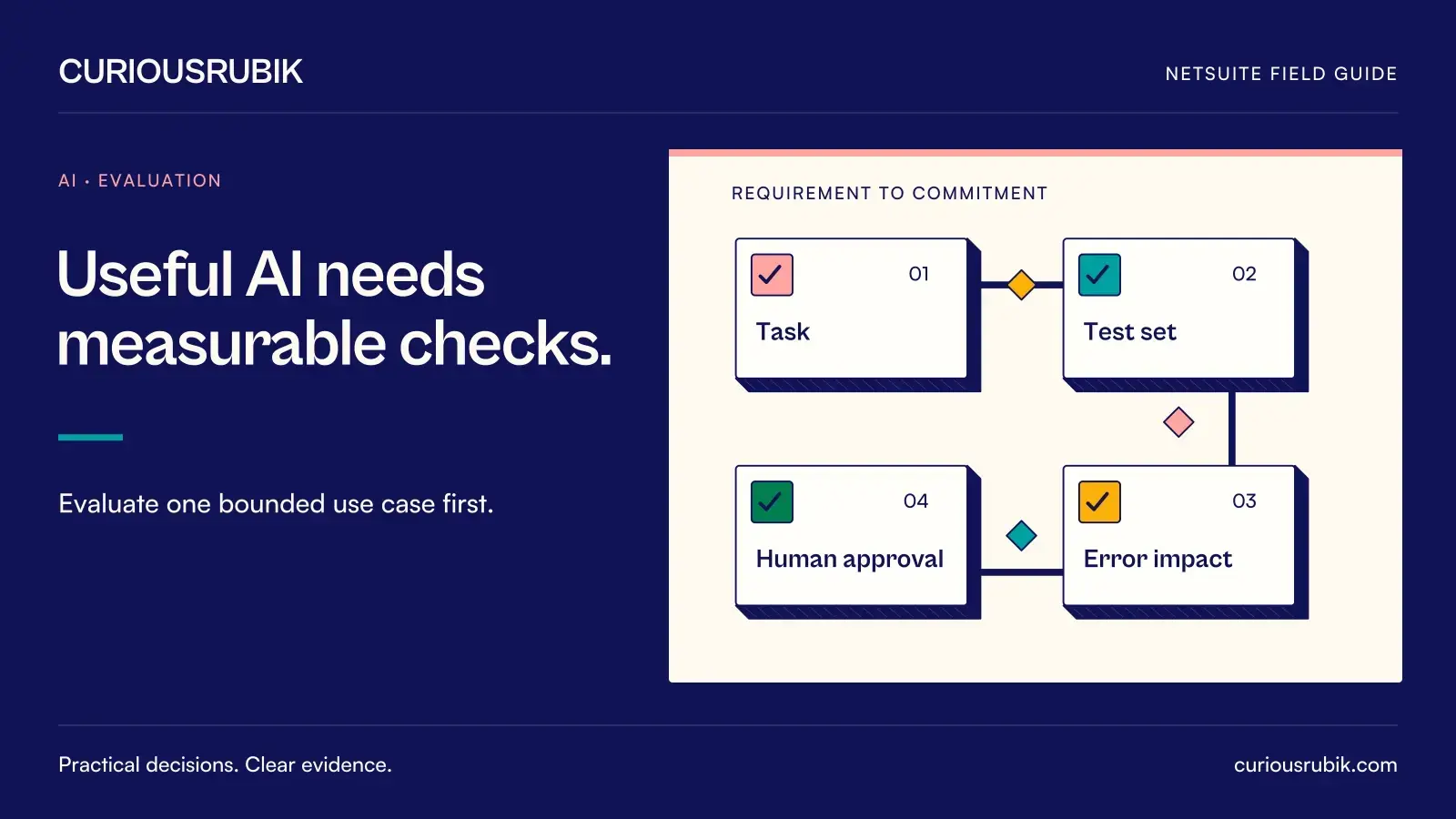
An AI-generated explanation can sound convincing while using the wrong period, inventing a cause, or overlooking a missing record. An extraction can capture most invoice fields correctly and still misread the amount that matters. Evaluating NetSuite AI features therefore requires more than checking whether the output looks polished.
Choose a bounded task, verify the capability available in your account, and test it against known answers. Assess permissions and data handling alongside accuracy. Keep consequential financial and security decisions with authorized people, and measure whether the proposed workflow remains useful after review and correction effort are included.
Create a dated capability register
Start with what is documented, what is enabled, and what has been tested. These are different states. Product announcements and general documentation do not establish that a particular feature is available, licensed, or configured in your account.
As a documentation baseline reviewed on 7 October 2026, NetSuite describes Text Enhance for supported business-writing contexts and SuiteScript 2.1 AI APIs for tasks including language-model interaction and document extraction. NetSuite also documents an AI Connector Service for supported external AI clients. Their prerequisites, permitted use, and operating boundaries differ.
For every candidate, record feature or module name, documentation review date, account release, availability evidence, enabled status, required permissions, data involved, usage or entitlement assumptions, and test owner. Mark anything unverified clearly in the evaluation register.
Do not treat access to an API as proof that a complete, production-ready business workflow exists. A custom extraction or narrative process may need additional development, validation, monitoring, and support.
Choose tasks with a clear acceptance condition
Select a narrow task whose output can be reviewed against evidence. Examples include drafting a description from approved fields, extracting specified values from a synthetic invoice, or summarizing a reconciled financial dataset for a reviewer.
Define the boundary before testing. A narrative may explain observed changes, but it should not invent a cause that the data does not establish. An extraction may propose field values, but a human should review material financial information before it drives a consequential action. Decision support should preserve uncertainty and distinguish evidence from recommendation.
Identify the manual baseline. Record how long the current task takes, what errors occur, and what review is already required. An AI workflow that generates quickly but takes longer to verify may not improve the process.
Avoid beginning with autonomous posting, payment, access changes, or other high-consequence actions. Their approval and control requirements need separate analysis beyond a general feature evaluation.
Build a synthetic evaluation set
Create cases with known answers and deliberate difficulty. Use ordinary examples, boundary cases, incomplete inputs, conflicting evidence, and inputs containing irrelevant or misleading instructions. Keep sensitive production information out of early tests.
A hypothetical evaluation set could include:
- Narrative case: revenue rises from 100 to 120 in the same defined currency and period basis. The output should calculate the change correctly and avoid inventing a reason.
- Missing-data case: one subsidiary's results are absent. The output should identify the limitation rather than present a consolidated conclusion.
- Extraction case: a synthetic invoice has a subtotal, tax, total, and amount already paid. The system should keep those fields distinct.
- Ambiguity case: a document contains two dates with different meanings. The output should use the requested date or flag uncertainty.
- Decision-support case: a customer balance is overdue but under documented dispute. The output should preserve that context and leave the approved next action to the responsible person.
Include a test in which a document's free text tells the AI to ignore rules or send information elsewhere. The workflow should treat that text as untrusted content and continue within its authorized purpose. A document does not acquire authority to change the process because an AI reads it.
Score errors by consequence
Define expected outputs before running the test. Evaluate factual correctness, completeness, traceability, appropriate uncertainty, and instruction handling. For structured extraction, assess each required field rather than a single overall impression.
Classify failures. A minor phrasing issue differs from a wrong amount, unsupported financial claim, missed access boundary, or unauthorized action. The evaluation should make serious failures visible even if most cases look good.
For a hypothetical set of twenty narrative cases, eighteen acceptable drafts and two invented explanations do not automatically justify rollout. The organization must decide whether those failures can be reliably detected by the review process and whether the use case remains worthwhile. Those figures are illustrative, not measured product performance.
Set acceptance thresholds through the accountable business and risk owners. Avoid universal accuracy percentages detached from consequence. Some boundaries, such as unauthorized access or unapproved financial action, should be treated as release blockers for the scoped workflow.
Test access and data handling separately
Use the intended role and configured service identity. Confirm that the AI workflow can retrieve the data needed for the approved task and cannot retrieve excluded records or invoke prohibited actions. Test denied cases explicitly.
Review where data is processed, retained, logged, and exported across the complete workflow. An embedded feature and an external AI client may have different arrangements. Have the appropriate security and privacy reviewers assess the current terms and configuration before sending sensitive information.
Limit the data supplied to what the task requires. A summary of aggregate balances does not automatically need full customer records, employee details, or unrestricted attachments. Review logs and evaluation artifacts too; they can become another copy of sensitive data.
Do not infer compliance from a product name or the presence of role-based permissions. The actual use, data categories, agreements, and controls need review.
Make human review specific
Name the reviewer and explain what they verify. For a narrative, check every quantitative statement and whether causal explanations are supported. For extraction, compare material values and identifiers with the original document. For decision support, confirm that the recommendation respects the organization's policy and available evidence.
Require approval before consequential financial or security actions. A model-generated recommendation does not constitute that approval. Preserve the approved version and the relevant evidence where the process requires an audit trail.
Test the reviewer workflow itself. If reviewers cannot easily inspect source evidence, the supposed control may reduce to accepting plausible text. Measure review time and correction effort during the pilot rather than assuming they are negligible.
Monitor after a bounded rollout
Start with a limited audience and defined task scope. Track failure types, rejected outputs, reviewer corrections, usage, and operational cost under the applicable account arrangement. Keep a route to pause the workflow when a material problem appears.
Retest after changes to prompts, models, features, permissions, source schemas, or business definitions. Preserve the evaluation set so the team can compare behavior over time. Add new real-world failure patterns using appropriately sanitized or synthetic examples.
AI evaluation questions
Does fluent wording indicate a correct answer?
No. Verify facts, calculations, scope, and source support. A clear explanation can still contain an invented cause or omit important limitations.
Can the same test set cover every feature?
Some governance tests can be shared, but task-specific evidence is essential. Writing assistance, document extraction, and tool-using decision support have different failure modes and acceptance criteria.
Should uncertain outputs always be rejected?
Uncertainty can be the correct result when evidence is incomplete. Define whether the workflow should request clarification, route to review, or stop. Confident guessing is often more dangerous than a useful limitation.
What proves a pilot is ready to expand?
The task meets its approved accuracy and control criteria, reviewers can detect material failures, access tests pass, and operating ownership is clear. Expansion should follow evidence from the actual configured workflow.
Evaluate one useful task first
CuriousRubik can help scope an AI evaluation register and synthetic test pack. Start with a bounded use case and have business, security, and product reviewers approve the evidence before rollout expands.