NetSuite ERP Evaluation in Australia Through Local Workflows and Cost
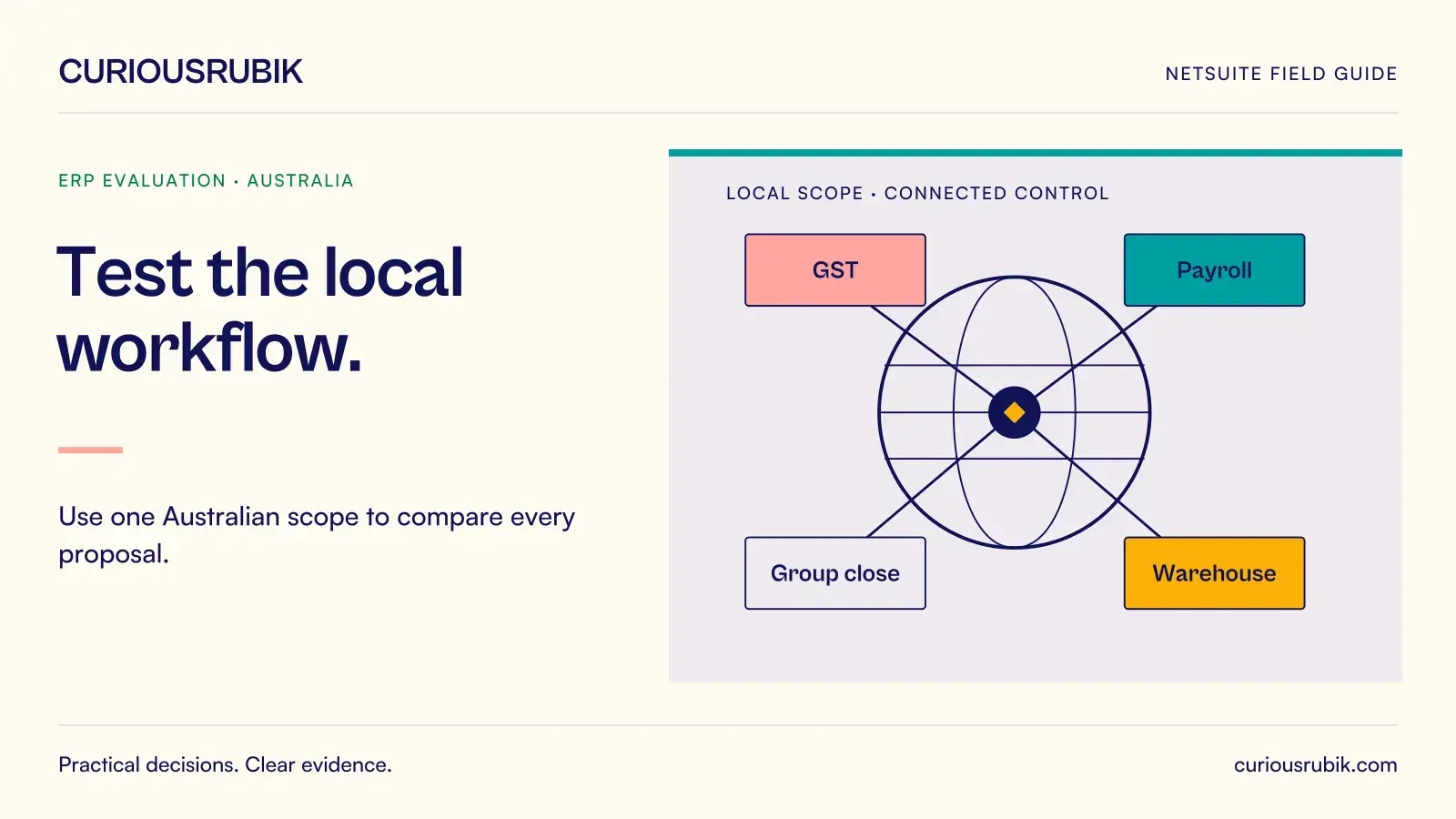
An Australian ERP shortlist needs more than a general product comparison. Finance must understand the local reporting and document scope. Operations must see the warehouse process work. IT must know where payroll, banking and other connected systems begin and end.
Compare NetSuite with alternative ERP approaches through a common Australian operating scenario. The purpose is to expose scope, responsibilities and commercial assumptions before selecting a solution. Local requirements should be reviewed by the appropriate Australian finance or tax adviser; a demonstration does not establish regulatory compliance.
This guide provides a practical evaluation pack for an Australian CFO and IT lead. It makes no assumptions about current tax rates, filing obligations or universal availability of regional features.
Define the Australian scope in business terms
Start with the entities, registrations, currencies, locations and transaction types the proposed implementation must support. Identify whether the business operates only in Australia or also trades through overseas subsidiaries.
List the documents and outputs finance actually uses: sales invoices, credit notes, supplier bills, payment records and relevant tax reports. Include the fields, approval evidence and reconciliation expected for each. Have the responsible adviser confirm which requirements apply to the business.
Separate local obligations from internal preferences. A management report by warehouse is important, but it has a different approval owner from a tax reporting requirement. Keeping those categories clear helps the delivery team estimate configuration, localization and reporting work accurately.
For each proposed capability, ask whether it is included in the quoted account, separately licensed, delivered through a SuiteApp or extension, or handled outside the ERP.
Put payroll outside the assumption zone
Payroll is a common source of ambiguous scope. Ask whether the proposal includes payroll processing, a payroll integration, a journal import or only an accounting destination for summarized results.
Define the required inputs to finance: posting dates, expense dimensions, liabilities, payment totals and any approved allocation detail. Identify who owns corrections and how a rerun avoids duplicate postings.
A hypothetical payroll adjustment after the original journal has posted is a useful demonstration. The team should explain whether the correction arrives as a replacement, reversal or incremental entry under the approved design, and how finance reconciles the result.
Do not infer local payroll coverage from a broad ERP feature list. Confirm the exact service, region, edition, integration and provider responsibilities in writing before treating the requirement as satisfied.
Run a domestic transaction and its correction
Prepare a hypothetical domestic sale with several lines, an agreed tax treatment and a subsequent partial credit. Ask the delivery team to show the original document, accounting impact, credit document and relevant reporting output.
The finance reviewer should inspect the fields and treatment against the business's approved requirements. The evaluator should record the configured tax setup and any regional components used. Avoid assuming that one successful invoice proves every transaction type works.
Add a purchase with a different treatment or an exception that matters to your business. Then correct a classification and inspect the consequences. The useful evidence is a traceable chain from transaction to output, including the correction, rather than a screenshot of a completed report.
Any legal or tax uncertainty should remain an open review item until the appropriate adviser resolves it.
Test a warehouse process at Australian operating scale
Use an order that requires stock from two locations and a partial delivery. Include units of measure, backorders, returns and inventory detail appropriate to the business. Ask operations to verify what staff will see and do at each handoff.
A hypothetical importer receives eighty cartons at a distribution centre, transfers thirty to another warehouse and fulfills a customer order partly from each location. The demonstration should make ownership, available quantity and transaction references clear throughout the sequence.
Where freight, landed costs, scanning or shipping applications are in scope, show the complete proposed workflow. Confirm which amounts and operational events are entered in each system and how they reach finance.
Record volume assumptions. A process that is practical for ten daily orders may require different automation when order volumes are materially higher.
Include the regional group close
For a business with overseas entities, test local results and group reporting separately. Use different base currencies where relevant and include an intercompany timing difference.
Ask how the proposed design handles entity access, shared master data, rate review, eliminations and consolidated reporting. For NetSuite, verify the OneWorld and other features included in the actual scope. Avoid assuming that a multi-entity demonstration also proves every country-specific reporting requirement.
The Australian controller should be able to explain a group balance from the underlying entity evidence. If a separate consolidation application is proposed, include its interfaces, ownership and reconciliation in the evaluation.
Compare quotes with a common assumption sheet
Give each delivery team the same assumptions for users, entities, locations, transaction volumes, integrations and migration history. Request explicit exclusions and identify any limits that could affect the planned operation.
Build a cost model with separate lines for software, regional components, implementation, data migration, integration, training, support and internal effort. State currency and whether quoted amounts include or exclude applicable taxes. Confirm these details from the proposal rather than assuming them.
Use a three-year view with a realistic growth case, such as a new warehouse or overseas entity. Ask how that change affects licenses, configuration, integration and support. Keep indicative estimates visibly separate from binding commercial terms.
The cheapest initial quote may omit responsibilities that another proposal includes. Reconcile those differences before comparing totals.
Finish with an acceptance and ownership sheet
For every important workflow, record the required outcome, demonstration result, dependencies, unresolved question and owner. Add the person authorized to accept the delivered result during implementation.
A hypothetical business might accept an external payroll integration while requiring inventory and finance to share a controlled item model. Another might retain a specialist warehouse platform and place stronger emphasis on interface reconciliation. Both choices need evidence and clear ownership.
The final selection document should explain these trade-offs in ordinary language so finance, operations and IT agree on what is being purchased.
Australian ERP evaluation questions
Does Australian localization mean every requirement is covered?
No. Confirm the applicable transaction types, documents, outputs and integrations for your business. Availability and configuration can vary, and professional review remains necessary.
Should payroll be evaluated in the same demonstration?
Include the finance boundary at minimum. If payroll processing itself is in scope, require a separate, appropriately reviewed demonstration of the proposed local service.
How should quotes in different currencies be compared?
Keep original commercial currencies visible and use a documented comparison assumption. Model exchange-rate exposure separately rather than hiding it inside a single converted total.
Who should sign off the local workflows?
Assign the Australian finance owner, relevant operational owner and appropriate professional adviser according to the requirement. Technical acceptance alone is insufficient for accounting or tax treatment.
Build a locally relevant test pack
CuriousRubik can help scope a NetSuite evaluation around Australian documents, warehouse workflows, payroll boundaries and group reporting. Bring your actual requirement list and quote assumptions so the comparison addresses your operating model.
Related reading