NetSuite ERP Selection for a Thai Regional Business
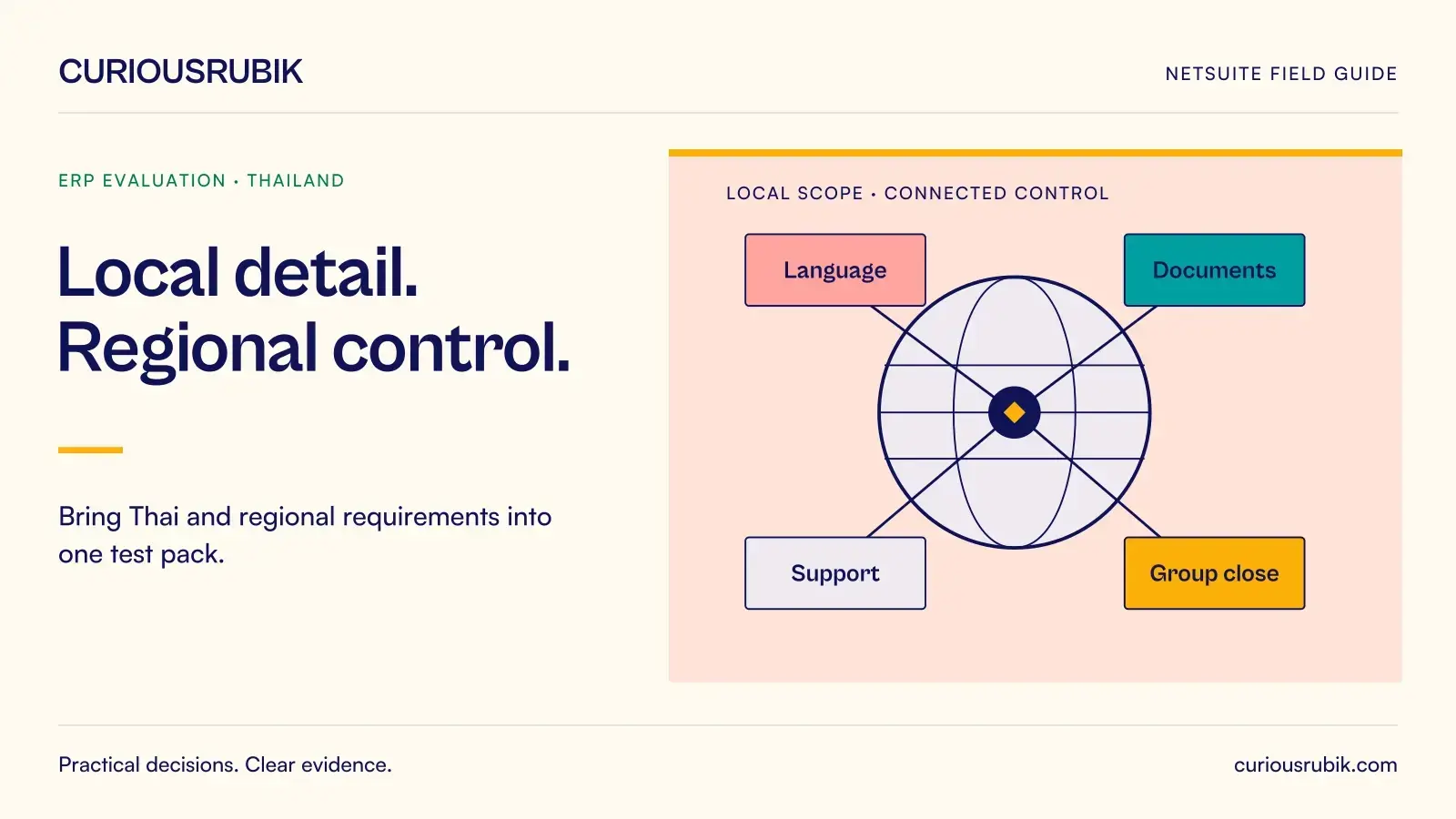
A regional ERP can produce an attractive group dashboard while leaving a Thai finance team with difficult document corrections and manual local work. A locally comfortable application can create the opposite problem if regional consolidation depends on repeated spreadsheet reconstruction.
For a Thai business evaluating NetSuite and alternative ERP approaches, selection should test both levels together. Use Thai and English business documents, realistic local transactions and a regional close scenario. Then identify who owns localization, extensions, support and changes after go-live.
This guide offers a practical evaluation structure for a Thai CFO and regional IT lead. Local accounting and tax requirements must be confirmed by an appropriately qualified Thai reviewer. The examples are hypothetical and do not prescribe a legal treatment, tax rate or filing format.
Separate language from localization
A translated interface does not establish that the business can create the required documents or produce the appropriate local outputs. Localization includes transaction treatment, document fields, numbering, reporting and correction processes where applicable to the organization.
List the Thai-language and English-language documents that staff, customers, suppliers and group finance actually need. Specify whether each document requires bilingual content, separate versions or only an internal translation for review.
Use samples approved by the local finance team. Ask the evaluator to show names, addresses, descriptions, date presentation and document references without truncation or ambiguous transliteration. Confirm search behavior too: staff may need to locate a party using either a Thai name or an English reference.
For NetSuite, establish which features, templates, regional components or extensions are included in the proposed account. Treat each local requirement as something to demonstrate, not something implied by the product name.
Build a local document test pack
Start with a hypothetical domestic sale, a supplier bill and a correction. Add any other transaction type that materially affects the business. The local reviewer should define the expected treatment and outputs before the demonstration.
A hypothetical bilingual test record could use the title ใบแจ้งหนี้ / Invoice, ลูกค้า / Customer, เลขที่เอกสาร / Document number and วันที่ / Date. Enter fictional Thai and English customer names, a sample document reference and an agreed test date. These labels are language test inputs, not an approved statutory form. The Thai-speaking reviewer should validate terminology, display and suitability before the template is accepted.
For each sample, retain the original business facts, approved expected result and actual output. Inspect the document and its accounting impact together. A correctly formatted invoice can still carry an incorrect classification or incomplete reference.
Include a correction after the initial document has been issued. Ask how the system preserves the original record, creates the appropriate corrective document and updates reporting under the approved process. Confirm who may perform the correction and what evidence remains.
Do not make a selection based on a static sample PDF supplied in advance. Ask the presenter to generate the output from a transaction entered during the session, with the relevant configuration visible.
Test the regional close from the Thai entity upward
Use a hypothetical Thai operating entity and a regional parent with a different base currency. Add an intercompany charge recorded in different periods by the two entities.
The demonstration should show the Thai entity's ledger, the counterpart balance, the identified difference and the approved resolution. Then inspect the consolidated result and its supporting rate and elimination context.
Ask group finance to drill from the regional report to the originating transaction. Ask local finance to demonstrate the same transaction under its normal access. Both teams need usable evidence, although their views and responsibilities may differ.
If consolidation occurs outside the operational ERP, document the extraction, mapping, adjustment and reconciliation process. A separate tool can be workable, but its ownership and recurring effort belong in the selection score.
Give extensions a named owner
A proposed solution may use local templates, tax-related components, banking integrations or other extensions. Require a register identifying what each component does, who supplies it and who maintains it.
Ask how an extension behaves when the core platform changes. Who tests the Thai documents? Who verifies that an amended report remains correct? Who coordinates a defect that involves both the extension and the ERP configuration?
The contract and implementation scope should reflect the answers. Avoid relying on the informal knowledge of one consultant whose future availability is uncertain.
Keep the scope specific. A statement that a partner “handles Thailand” does not identify which requirements are covered, what is excluded or who approves the accounting treatment.
Evaluate support through a realistic incident
Use a hypothetical month-end incident: a Thai user cannot produce a corrected customer document, while regional finance needs the ledger finalized. Ask the delivery team to walk through the support process.
Identify the support language, working hours, escalation route and responsibility for the business workaround. Confirm the response expectations actually offered in the proposal. Do not assume that regional coverage guarantees Thai-speaking support at the time the local team needs it.
Include the internal side of support. Name a local process owner who can explain the transaction and a regional application owner who can coordinate technical investigation. A support ticket with only a screenshot and no business context often slows resolution.
Have a Thai-speaking reviewer assess the usability of the support and training materials intended for local users.
Score fit and commercial uncertainty separately
Build a scorecard covering local documents, transaction controls, regional reporting, operational workflows, integration recovery and support ownership. Apply weights that reflect the business's actual risks, while treating essential requirements as mandatory gates.
A hypothetical manufacturer may place substantial weight on inventory and production dependencies. A regional services group may emphasize contract billing and entity reporting. Neither should borrow the other's priorities unchanged.
Request a commercial scope identifying user categories, entities, modules, regional components, implementation, training, migration and support. Record quote currency and local obligations that require separate professional advice. Model a credible expansion scenario, such as another regional entity, with its own assumptions.
Keep unknowns visible until demonstrated or resolved in writing. An attractive price cannot be evaluated properly when the necessary localization work is still undefined.
Questions Thai regional buyers should ask
Is an English demonstration sufficient?
It may help regional stakeholders, but Thai users and reviewers should test the documents, searches and workflows they will use. Language quality and local process fit need direct evidence.
Who should approve local accounting treatment?
The accountable Thai finance owner and appropriately qualified adviser should approve it. The implementation team configures the agreed design and demonstrates the resulting behavior.
Can localization be delivered through an extension?
It can be considered where the complete workflow is proven and maintenance responsibility is clear. Include the extension's commercial and upgrade dependencies in the decision.
What is the most useful final selection record?
Keep the scored test pack, sample outputs, architecture, responsibility register and unresolved items together. The recommendation should explain how local operations and regional reporting will both work.
Bring local and group requirements into one workshop
CuriousRubik can help scope a NetSuite evaluation around Thai document workflows and regional finance requirements. Include a Thai-speaking business reviewer and the group reporting owner so the test pack reflects both perspectives.
Related reading