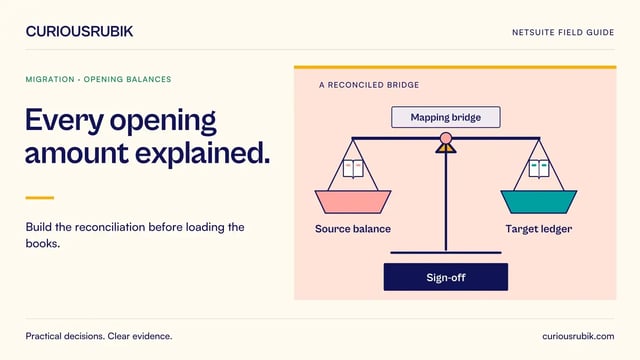
Migrating Open AR and AP to NetSuite Without Duplicating the Ledger
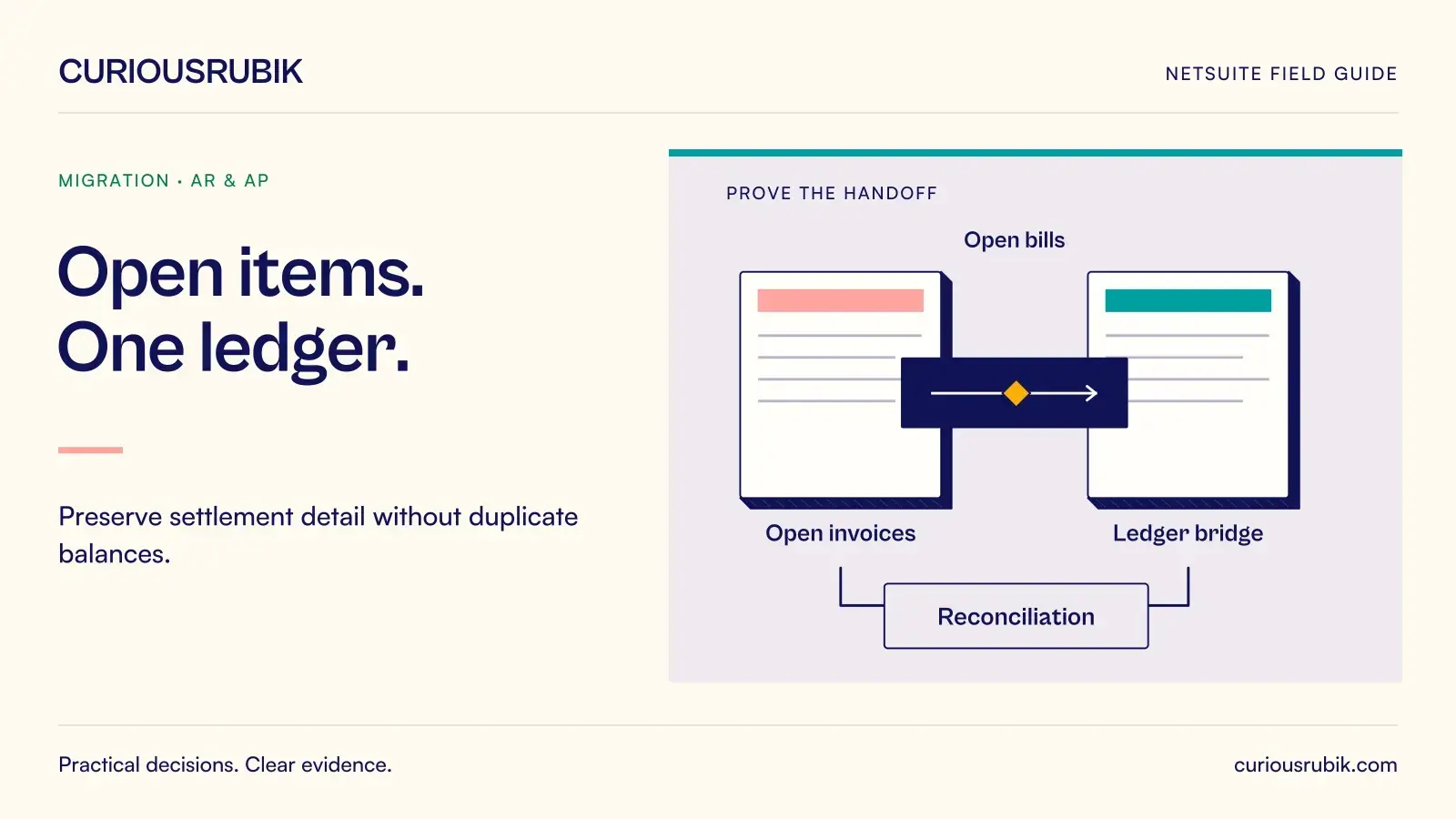
Open invoices and bills have two jobs during a finance migration. They must preserve the amounts customers owe and suppliers are owed, and they must agree with the opening general ledger. Loading both datasets independently can count the same receivable or payable twice.
The safest starting point for a NetSuite open AR and AP migration is a written reconciliation design. Decide which records create the opening balances, which records provide operational detail and how any migration clearing accounts are expected to resolve. The finance lead should approve that design before the first rehearsal.
The illustrations below are hypothetical and intentionally simplified. They describe control objectives rather than universal journal instructions. Your accounting team must approve posting dates, tax treatment, exchange rates and transaction methods for the actual migration.
Freeze an open-item population
Choose a precise cutover date and extraction time. An invoice paid after the extraction but before go-live creates a different opening position unless the settlement is included in a controlled delta process.
For each receivable or payable, retain the legacy document identifier, counterparty, subsidiary, document currency, original date, due date, original amount and remaining amount. Capture credit notes, unapplied cash, deposits and disputed items as distinct categories. They may require different record types and application logic.
Do not silently net unrelated invoices and credits into a single customer balance. Collection teams need document-level evidence, and payment teams need the references that suppliers recognize. Preserve the distinction between an overdue invoice and an unapplied receipt even where the net customer balance is small.
A signed extraction report should identify excluded records and explain why they are outside the opening population.
Choose one coherent opening-ledger design
Two common design patterns are worth discussing with the controller.
In one pattern, operational open-item transactions establish the receivable and payable control-account balances. The complementary opening ledger load is designed so those balances are not introduced a second time.
In another pattern, the opening ledger and operational documents are bridged through designated migration clearing accounts and approved offset entries. Every clearing movement has an expected counterpart and a reconciliation owner.
Neither description is a ready-to-post instruction. The exact transaction forms, accounts and timing depend on the target configuration and accounting requirements. Draw the expected debit and credit effects before importing, then test them in the rehearsal account.
Avoid using ordinary current-period revenue or expense accounts merely because they are convenient defaults. Historical open balances should not create unintended new operating activity.
Work through a partial-settlement example
Consider a hypothetical cutover with these remaining balances, expressed in the subsidiary's base currency:
- Customer invoice A originally totaled 12,000. A pre-cutover receipt of 5,000 leaves 7,000 open.
- Customer invoice B remains fully open at 3,000.
- Supplier bill C originally totaled 8,000. A pre-cutover payment of 2,000 leaves 6,000 open.
- Supplier bill D remains open at 1,500.
The operational opening population must reconcile to receivables of 10,000 and payables of 7,500. Loading the original gross values without the historical applications would overstate receivables by 5,000 and payables by 2,000.
The migration design might load residual balances while preserving original-document details in appropriate reference fields or accessible history. Alternatively, it might recreate gross documents and their applications where a tested scope justifies that complexity. Choose deliberately. Do not combine residual invoices with the same historical receipts, because that would apply the settlement twice.
After import, test the first post-cutover receipt against invoice A. A receipt of 7,000 should clear the agreed opening balance, with no unexplained remainder caused by the migration approach.
Keep document currency and base value visible
Foreign-currency open items require a second reconciliation axis. A document can have the correct outstanding foreign amount but the wrong base-currency carrying value.
Suppose a hypothetical euro invoice has EUR 4,000 outstanding and an approved opening carrying value of USD 4,360. The migration pack should preserve both values and the basis for the carrying amount. Multiplying EUR 4,000 by an arbitrary current rate because it is readily available may not reproduce the approved opening ledger.
Record the transaction exchange-rate treatment, any required pre-cutover revaluation and the intended handling of subsequent settlement differences. These decisions require accounting review. Test the first foreign-currency settlement and the first relevant period-end process, rather than stopping after an aging report agrees in euros.
Keep foreign amounts separated by currency. A grand total that adds euros and dollars together provides no useful control.
Sequence the load around dependencies
Counterparties, subsidiaries, currencies, terms and account mappings must exist before dependent transactions can load reliably. Validate that the customer or vendor is available for the relevant subsidiary and currency under the configured account.
Then load a small approved sample, inspect its accounting impact and reconcile it before expanding. Apply credits and receipts only through the selected design. Use stable external identifiers and a documented retry method so a failed batch does not become a duplicate batch.
At cutover, track four populations: extracted, approved for load, accepted by the target and rejected or held. Rejected rows remain part of the reconciliation until resolved or explicitly excluded. They should never disappear from the control total simply because the import log labels them unsuccessful.
Sign off a three-part reconciliation
The finance lead should receive three connected proofs.
First, the source open-item report must agree to the approved migration file after documented exclusions and adjustments. Second, the target aging and transaction detail must agree to that file by subsidiary, account and currency. Third, the target subledger must agree to the opening general ledger under the chosen design.
Add a separate clearing-account schedule where clearing accounts are used. Explain each residual by document and cause. An unexplained zero achieved through an unsupported plug is weaker evidence than a visible difference with an approved correction plan.
Retain due-date aging as well as totals. A migration can preserve 10,000 of receivables while moving every due date into the future, materially distorting collection priorities.
Common migration questions
Do we need every historical payment in NetSuite?
Not necessarily. The scope depends on audit, service and reporting needs. Residual-balance migration may be suitable when historical detail remains accessible, but its implications must be approved and tested.
Can an opening journal replace customer invoices?
A journal may support a ledger design, but it does not automatically provide the operational document detail required for collections and applications. Test both accounting and user workflows.
What happens to unapplied cash?
Keep it visible as its own population and use the approved target treatment. Do not force it against an unrelated invoice simply to reduce the number of migration records.
When should finance sign off?
After open items, ledger balances, clearing accounts and representative settlements reconcile. An import completion notification alone is too early.
Review the bridge before the full load
CuriousRubik can help scope a review of your open-item files, opening-ledger design and rehearsal evidence. Start with partial settlements and foreign-currency exceptions, where duplicate accounting is easiest to miss.
Related reading