NetSuite Opening Balance Reconciliation from Source Books to Sign Off
A migrated trial balance can balance and still be wrong. Open invoices may have been counted twice, supplier credits may be missing, or inventory detail may disagree with the control account. NetSuite opening balance reconciliation needs to explain how each source balance becomes the intended target balance and how the supporting records remain usable.
Build that explanation before the final load. Define the population, approve the mappings and create a ledger bridge showing every planned contribution. Then test the actual migration behavior and reconcile the result at both total and detail level.
Freeze a defined source population
Agree the cutoff date and time, entities, currencies, accounting periods and source reports. Record the extraction version and the people authorized to approve changes. Different reports run at different times can create apparent discrepancies that are actually population differences.
Obtain the trial balance and the supporting schedules for material balances. For receivables and payables, include invoices, bills, credits, partial applications and other relevant open items. For inventory, retain the quantity and valuation detail required by the approved design.
Reconcile the source before treating it as the migration target. If a supporting schedule differs from the ledger, document the cause and approved treatment. An unexplained source discrepancy should not become an unexplained opening discrepancy.
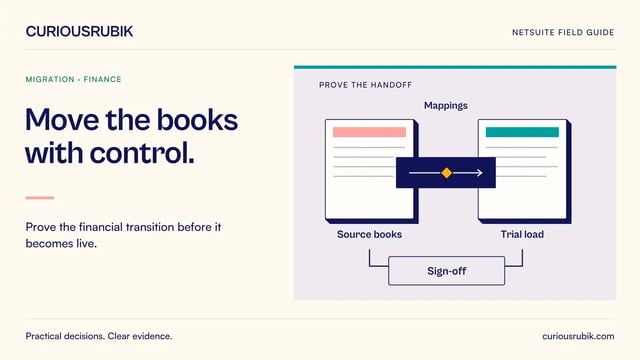
Approve mappings and financial entry routes
Map each source account and relevant dimension to the target structure. Record splits, consolidations and classification decisions. Finance should approve the accounting meaning, while the implementation team confirms how the design can be loaded and tested.
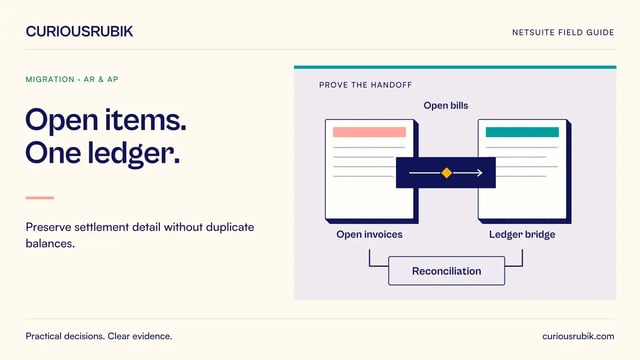
Next, identify the route by which each balance enters the target ledger. Open invoices, bills and inventory-related records may create accounting effects depending on the configured method. The opening-balance process must incorporate those effects rather than duplicate them.
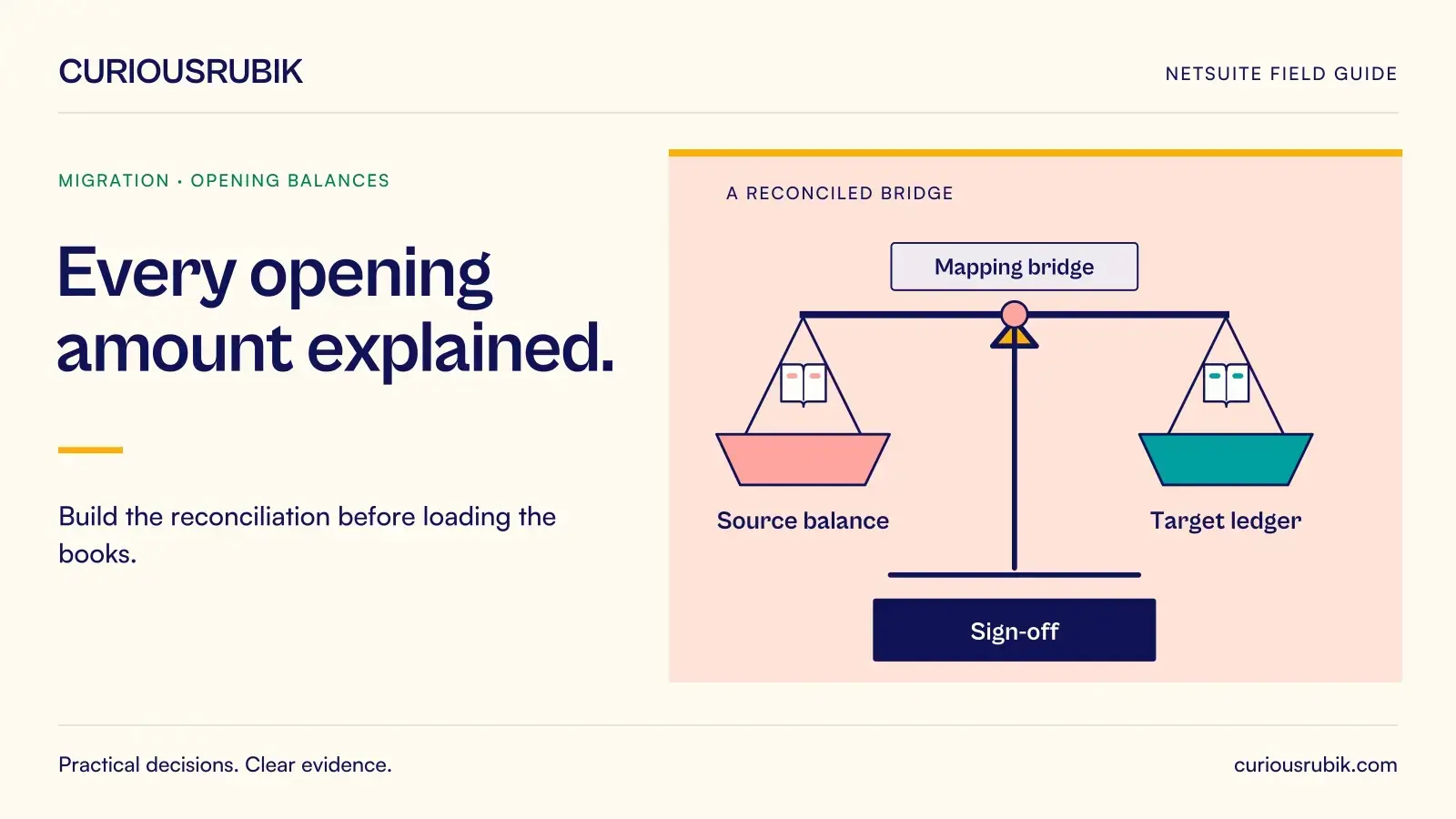
NetSuite provides opening-balance functionality, but the correct sequence for a particular migration depends on scope and design. Have a qualified implementation specialist and controller validate the proposed method in an appropriate non-production environment. The bridge below illustrates control logic, not a universal import or posting procedure.
A synthetic source trial balance
Assume a hypothetical business has the following approved balances, all in one illustrative reporting currency:
- Cash: debit 50,000.
- Accounts receivable: debit 120,000.
- Inventory: debit 80,000.
- Equipment: debit 150,000.
- Accounts payable: credit 70,000.
- Loan: credit 100,000.
- Equity: credit 230,000.
Total debits are 400,000 and total credits are 400,000. The open-receivables schedule supports 120,000, the open-payables schedule supports 70,000 and the inventory valuation supports 80,000.
These invented figures illustrate reconciliation, not company-specific accounting advice. Actual classifications and migration transactions require professional review.
Build the ledger bridge before loading
Suppose the approved migration design uses separate posting populations for receivables, payables and inventory, with an agreed technical clearing account to connect them to the remaining opening position. The expected contributions in this simplified example are as follows.
The residual opening contribution contains cash debit 50,000, equipment debit 150,000, loan credit 100,000 and equity credit 230,000. A clearing debit of 130,000 makes that contribution balance at 330,000 on each side.
The receivables population contributes a debit of 120,000 to receivables and a credit of 120,000 to clearing. The payables population contributes a credit of 70,000 to payables and a debit of 70,000 to clearing. The inventory population contributes a debit of 80,000 to inventory and a credit of 80,000 to clearing.
The clearing calculation is therefore a 130,000 debit, less 120,000, plus 70,000, less 80,000, leaving zero. The final expected trial balance reproduces the source balances: debits of 400,000 and credits of 400,000.
This is a synthetic ledger bridge of intended effects. It does not prescribe which NetSuite transaction types to use. Actual import behavior, account restrictions, valuation and accounting policy must be verified before executing any production migration.
Show how double counting would appear
If the team instead loaded the full source receivables debit of 120,000 and then added a posting open-invoice population contributing another 120,000, receivables could reach 240,000. Other entries might keep the trial balance balanced, so the fact that debits equal credits would not identify the mistake by itself.
For payables and other detailed populations too, show every affected account’s expected final balance rather than checking individual loads alone.
Reconcile the actual posted contributions after every major step. If the clearing balance differs from the planned amount, stop and investigate the population, mapping and posting behavior. Do not clear an unexplained difference simply to make the account reach zero.
Prove the supporting detail
For receivables, compare totals by entity, customer, currency and relevant aging category. Inspect credits and partially paid invoices. Confirm that document references and remaining amounts support the intended collection and application process.
For payables, perform equivalent checks by supplier and currency. Verify that credits, disputed items and payment-related information have the agreed treatment. A correct liability total is insufficient if users cannot identify which obligations remain open.
For inventory, reconcile quantities and values at the level required by the operating design. Investigate negative quantities, missing locations or unexplained valuation differences. Test the resulting behavior under the configured valuation method rather than assuming a source value will automatically be reproduced.
Use record counts and exception reports too: offsetting monetary errors can hide incorrect detail.
Control late changes and reruns
Define what happens when a source transaction changes after extraction. The team needs an approved delta or replacement process and a way to prevent duplicate loading. Record which populations were replaced, corrected or supplemented.
Make reruns reproducible. Keep the source version, transformation rules, mapping version, load result and reconciliation together. A successful rehearsal should establish how the team identifies already processed records and handles rejected or partially loaded populations.
After a material correction, repeat the affected reconciliations and representative operational tests. Previous evidence may no longer apply to the revised data or configuration.
Assemble the sign-off evidence
The final pack should include the approved source trial balance, supporting schedules, mapping approvals, ledger bridge, load results, target reports, detailed reconciliations and exception register. State the cutoff, entities and currencies on the relevant evidence.
For each difference, record the cause, treatment, owner and approval. Distinguish an explained timing or presentation difference from an unresolved error. Any tolerance should be defined by the appropriate finance authority and suited to the population being reviewed.
Record reviewers, accepted evidence and first-day and first-close checks for consistency as new activity begins.
Questions migration leads ask
Is a zero clearing balance proof of success?
No. It is one control. Incorrect assignments or offsetting errors can still produce zero. Reconcile each target balance and the supporting detail to the approved source population.
Can we use the same method for every migration?
No. The appropriate approach depends on the data, configured transaction behavior, accounting policies and scope. Test the actual design and obtain the required finance approval.
What if the source books do not reconcile?
Investigate and agree the treatment before final migration acceptance. Preserve the explanation and approval rather than hiding the difference in an unexplained opening adjustment.
Who should sign off opening balances?
The designated finance authority should approve the financial evidence, supported by migration specialists and operational owners. The project sponsor uses that conclusion as part of the broader launch decision.
Make every opening amount explainable
Bring your source schedules, proposed load sequence and reconciliation gaps to CuriousRubik. A controlled NetSuite opening balance starts with a bridge the business can inspect, test and approve.
Related reading