Last reviewed: 10 October 2026. Product details reflect this review date. Availability and behavior can vary by account, role and release.
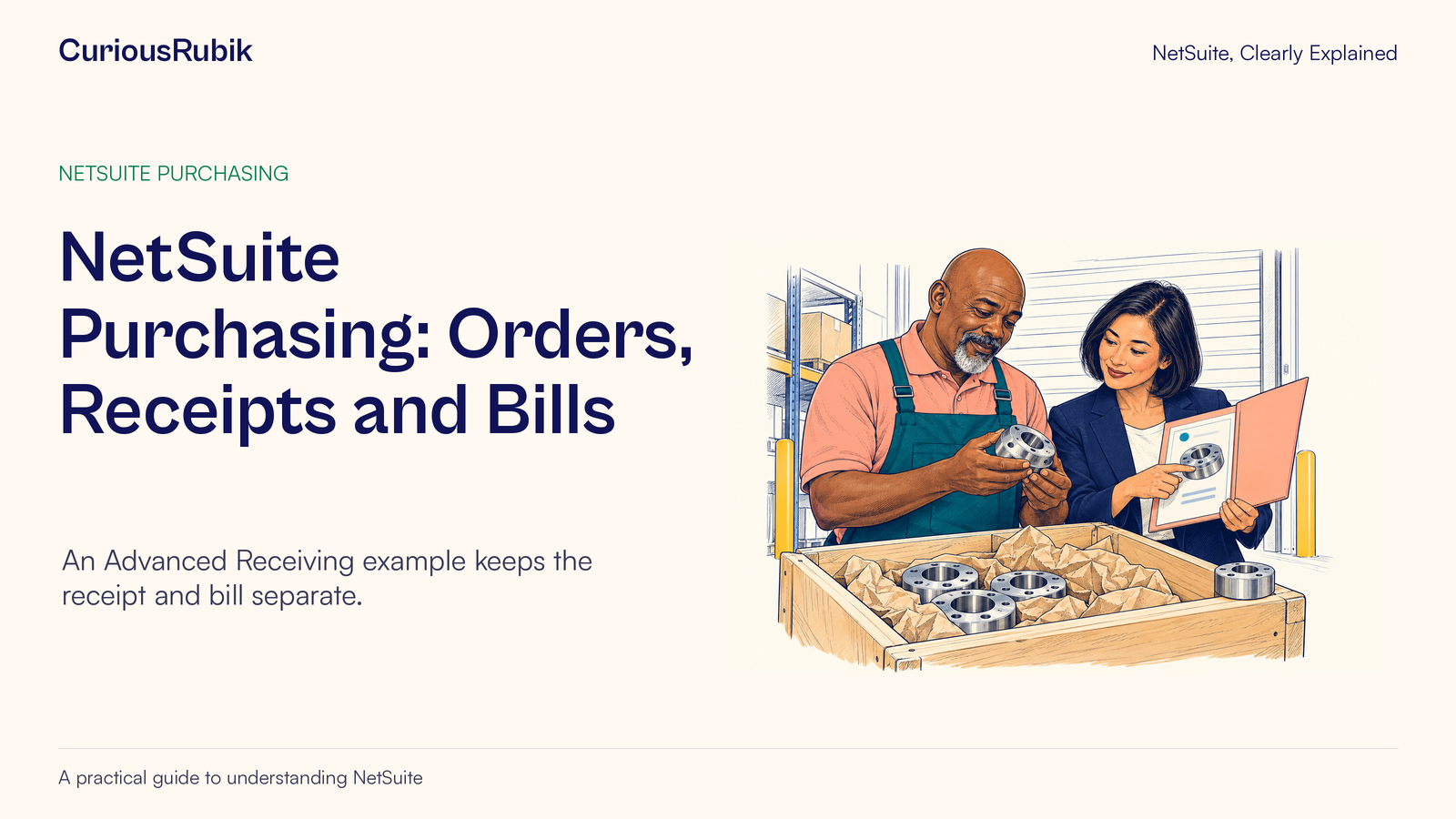
Editorial ink illustration: Two colleagues compare received components with a purchase record.
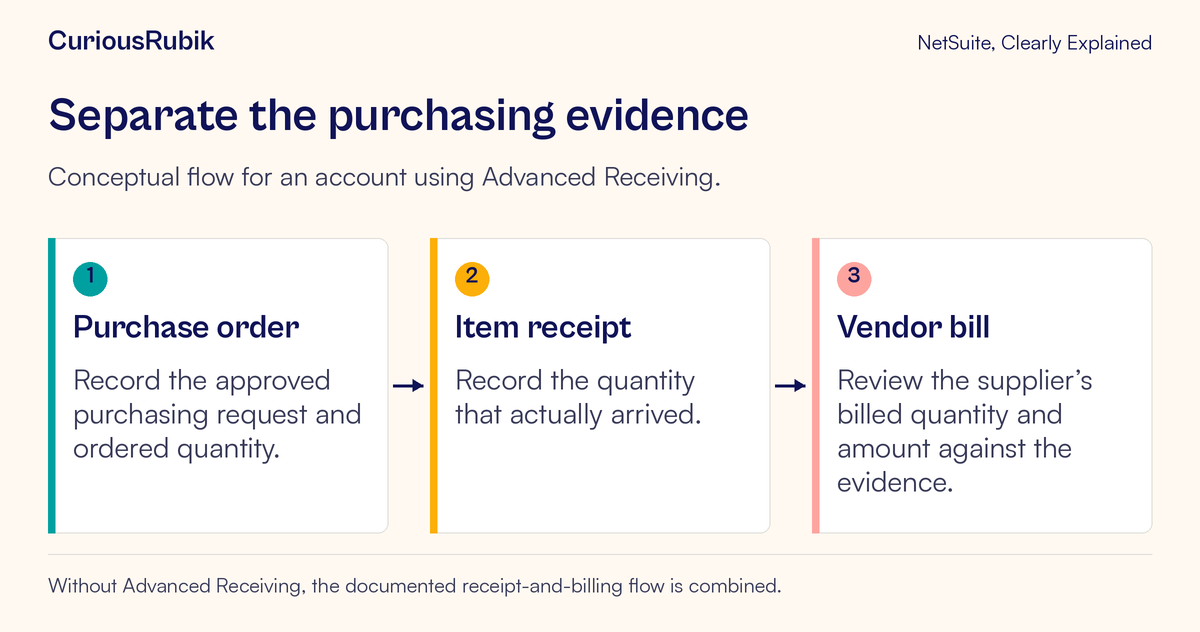
A purchase order says what the business ordered. A receipt says what arrived. A vendor bill records the supplier's charge through the payable process. When those facts differ, the difference needs investigation rather than a transaction entered merely to make the records agree.
NetSuite can separate receiving and billing with Advanced Receiving. Without that feature, the documented purchase flow combines those steps. Confirm the account's setup before expecting three separate records or following a training example.
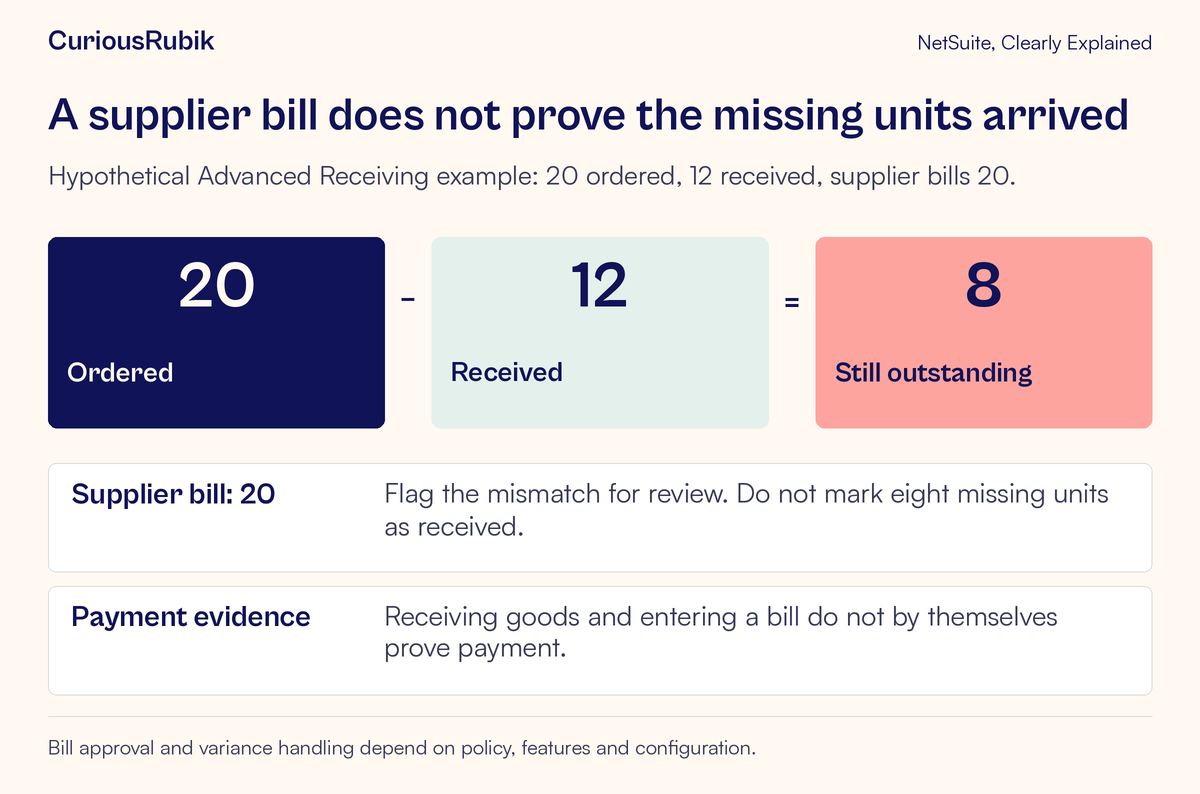
This lesson uses an Advanced Receiving example: twenty units ordered, twelve received, and a supplier invoice charging for twenty. It helps purchasing, receiving, and accounts payable understand the records and decide which question belongs to which owner.
Read the purchase order as a commitment
A purchase order authorizes the supplier to provide the specified goods or services. It records the intended items, quantities, supplier, expected timing, and other agreed purchasing details.
The order does not prove delivery. An expected receipt date is a plan, and an ordered quantity is an expectation. The warehouse still needs to record the actual arrival.
A purchase order is also different from a payment. It expresses a purchasing commitment without itself establishing that money was sent. Do not use an order's total as evidence of cash paid or a completed payable.
For an investigation, identify the exact order and line. A supplier may send several shipments or invoices against the same order. A top-level reference can be correct while the particular quantity or item being discussed belongs to another line.
Receiving establishes the physical event
The receiving team matches the shipment with the purchase order and records the quantity that actually arrived. For inventory items, receipt affects stock and related accounting information through the configured process.
With Advanced Receiving, the item receipt can be recorded separately from the vendor bill. A partial receipt records the arrived quantity while leaving the outstanding quantity to be handled later.
The evidence should be specific: item, quantity, unit, location, receipt date, and any required inventory details. The ordered quantity is not a substitute for counting the shipment. A packing slip can help identify the delivery, but it should not override the actual receiving observation.
Receiving can have financial consequences even before the bill exists. Therefore, do not describe an item receipt as merely a warehouse note. Finance needs the correct receipt timing and values for the applicable accounting process.
The lesson on on-hand, committed, and available inventory explains why ordered supply and received stock must remain distinct.
Billing records another part of the purchase
A vendor bill represents the supplier's charge in NetSuite's payable process. Its quantities, rates, taxes, currency, and other amounts need to be checked against the appropriate evidence and policy.
Recording a bill, approving it, and paying it are separate questions. The bill's actual status and posting treatment matter. Do not infer approval or payment simply because a bill record exists.
The receiving team is best placed to confirm what physically arrived. Purchasing can clarify the order and commercial agreement. Accounts payable can review the supplier invoice and the required financial controls. A good handoff gives each team the references and facts it needs without asking one team to invent another's evidence.
In an account without Advanced Receiving, receipt and billing are combined in the supported flow. The business meanings still differ, but the record sequence is different. Check that setup before diagnosing a “missing receipt” or assuming a separate receipt must exist.
Follow a fictional partial delivery
Suppose Brookfield Components places purchase order TEST-PO-81 for twenty units of an inventory item. The company uses Advanced Receiving, and the order line is measured in each. The supplier sends a shipment containing twelve units.
The warehouse verifies the item and records twelve received against the correct order line and location. Eight remain outstanding. These numbers describe the physical purchasing position: twenty ordered less twelve received equals eight still to resolve.
The supplier then sends an invoice charging for twenty units. Accounts payable compares the supplier invoice with the purchase order and the recorded receipt. The order supports a request for twenty, while the current receipt evidence supports arrival of twelve.
That difference does not establish the cause. The remaining eight might be in a second shipment, received elsewhere, not yet entered, or incorrectly billed. The commercial agreement might also contain relevant terms. The team needs evidence before deciding.
Keep the receipt honest
The warehouse should not record another eight units merely to make the supplier invoice match. That would increase recorded stock without evidence of arrival and could create later shortages, count differences, or misleading availability.
Instead, the receiving owner checks for another delivery and confirms whether any receipt was missed or entered against the wrong order or location. If a genuine receipt was omitted, it is recorded through the approved process with its actual details.
If the goods have not arrived, the physical balance remains twelve received and eight outstanding. The purchasing owner follows up on the remaining quantity and the supplier's delivery information.
Review the supplier charge separately
Accounts payable follows the organization's process for recording, holding, approving, or resolving the supplier invoice. This lesson does not prescribe a universal rule to reject the invoice or pay only a calculated fraction.
The reviewer checks whether the quantity difference is explained and whether other differences exist, such as a rate change, shipping charge, tax treatment, or currency effect. A matching grand total can still conceal an incorrect quantity and rate combination.
The resulting finding should name the facts: “Twenty units were ordered. Twelve are recorded as received at this location. The supplier invoice charges for twenty. The remaining eight and the billing basis require review.” That is a useful exception report without an unsupported allegation against the supplier.
Compare the same item, unit, and transaction scope
Before escalating a mismatch, confirm that the records describe the same thing. A purchase order in cases and a receipt in individual units can look different while representing the same quantity. Use the configured unit conversion rather than guessing.
Check the supplier, subsidiary where applicable, location, item, and order line. A receipt at a second location or against a related order may explain a missing quantity, but it must be traced rather than assumed.
Then align timing. A supplier invoice reviewed before the second shipment arrives can differ from the final completed order. Preserve the review date so that a later receipt does not make the earlier exception appear careless.
Check partial transactions together. One purchase order can have several receipts and bills. Compare the relevant totals and line relationships while guarding against counting the same receipt or bill twice.
Understand what variance processing does and does not prove
With the relevant Advanced Receiving setup, vendor-bill variance processing can address differences involving quantities, rates, and exchange rates. Item settings, variance accounts, matching choices, and transaction state affect the supported process.
This is an accounting mechanism, not a substitute for investigating a physical shortage. Posting a variance does not establish that the missing eight units arrived or that the supplier's charge was approved under company policy.
Finance should review the appropriate treatment and its consequences. Variance postings can also constrain later changes to associated records, so do not use them experimentally on live transactions.
Similarly, the phrase three-way match describes a comparison of order, receipt, and bill evidence. It does not guarantee that every NetSuite account automatically blocks every mismatch or has the same approval workflow. Verify the controls actually configured and tested in your account.
Trace payment as its own event
After a bill is reviewed and approved under the applicable process, payment has its own records and controls. A receipt does not prove payment, and a bill marked for attention does not establish that funds moved.
If the supplier asks whether payment was made, inspect the relevant payable and payment evidence. If the question concerns bank settlement or statement reconciliation, follow that separate process rather than relying on the purchase-order status.
The lesson on bank matching and statement reconciliation explains why matching one bank line and completing a statement review are also different steps.
Keeping payment separate protects the clarity of the partial-delivery investigation. The team can explain what arrived, what was billed, what was approved, and what was paid without combining four different measures.
Troubleshoot the record that carries the disputed fact
If the order remains partially received, inspect its outstanding lines and related receipts. Do not close a line merely to remove it from a queue; confirm whether the business still expects the goods.
If the bill quantity is unexpected, compare the supplier invoice, the order line, and the intended receipt linkage. Have accounts payable investigate the entry or supplier charge rather than asking the warehouse to change physical evidence.
If stock is wrong despite a correct receipt, inspect the item, location, units, and subsequent inventory movements. A later fulfillment or transfer can explain the current balance.
If a separate receipt step is unavailable, verify Advanced Receiving and the relevant item and role settings. A tutorial based on a different feature configuration can be the source of confusion.
Your purchase-to-bill checklist
- Identify the purchase order and exact line
- Confirm Advanced Receiving and the intended record sequence
- Record only the quantity physically received
- Align item, unit, location, subsidiary, and timing
- Trace all relevant partial receipts and bills without duplication
- Compare quantities and rates separately from the total
- Assign physical questions to receiving and commercial questions to purchasing
- Have accounts payable review the supplier charge and approval state
- Use variance processing only with approved accounting treatment
- Verify payment separately when the question concerns money sent
The records are most useful when they preserve different facts clearly. Let the order describe the commitment, the receipt describe arrival, and the bill describe the financial charge. Investigate the gaps instead of hiding them.
For help training teams across purchasing, receiving, and finance, explore CuriousRubik's NetSuite training services.