NetSuite Saved Search Governance for Safe Maintenance and Retirement
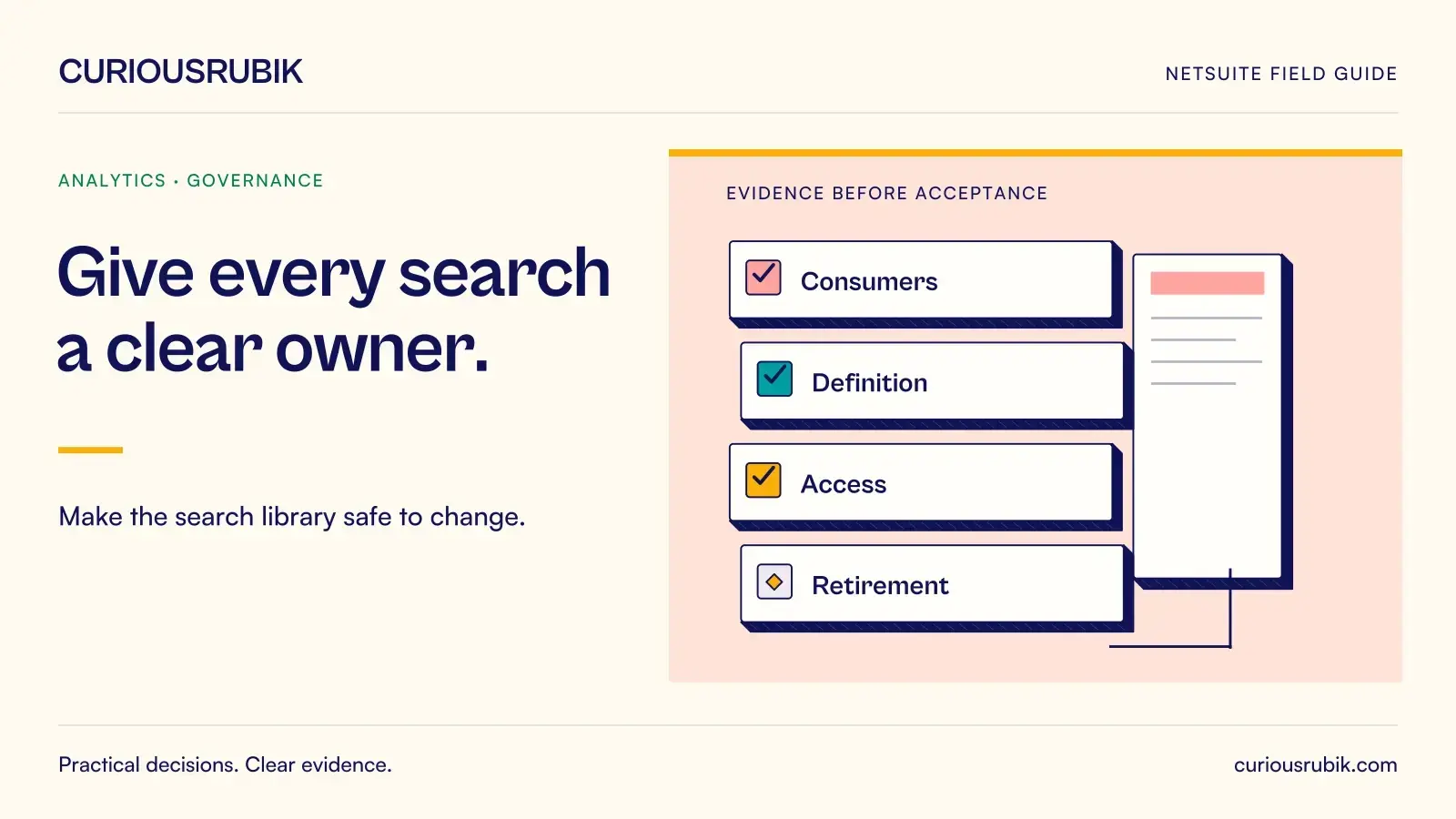
A saved search can begin as one person's helpful report and become a dependency for a dashboard, scheduled email, integration, or month-end control. Years later, its title may still say “test,” its owner may have left, and nobody may know what would break if it changed.
NetSuite saved search governance makes those dependencies visible. Build an inventory, assign accountable owners, test access and performance, and retire searches with evidence. The objective is a usable reporting library whose important definitions and consumers are understood, rather than a smaller search count achieved through risky deletion.
Inventory the search and its consumers
Start with the searches that affect financial reporting, operational decisions, integrations, or recurring distribution. Expand the inventory as dependencies emerge. A full list of titles is useful, but it does not reveal consequence.
For each search, record:
- Internal identifier and descriptive title
- Business purpose and accountable owner
- Technical maintainer and backup
- Record type, criteria, important formulas, and row grain
- Intended audience and access settings
- Dashboard, script, integration, or other consumers
- Email recipients and schedule where applicable
- Typical execution conditions and performance observations
- Last reviewed date and next review trigger
- Proposed status and retirement evidence
Distinguish a confirmed dependency from an assumption. Ask process owners to identify uses, then inspect authorized configurations where possible. A search with no obvious interactive users may still feed a scheduled process.
Do not infer that an old creation date means a search is obsolete. A stable annual control may be old precisely because its definition has not needed to change.
Assign ownership to the business definition
The owner approves what the search means and who needs it. The maintainer implements changes and investigates technical behavior. One person may hold both responsibilities, but the distinction should remain clear.
For a hypothetical receivables review search, the controller owns the definition of overdue and the permitted exclusions. The administrator maintains criteria, columns, and scheduling. The collections team consumes the result. A request to exclude disputed invoices therefore requires a business decision before a criteria change.
Use titles and descriptions that explain purpose without exposing sensitive information. A naming convention can help users distinguish an operational queue from a financial control, but it should support the inventory rather than replace it.
When an owner leaves, transfer accountability explicitly. A technical ownership change alone does not establish that anyone has accepted responsibility for the report's meaning.
Review access and distribution together
Inspect who can discover, run, edit, and receive results. Consider scheduled emails, exported files, dashboards, and downstream integrations in addition to interactive access. A search that is appropriately restricted in one context can still distribute sensitive output too broadly through another configured path.
Test with representative users. Include one user who should see the full intended scope, one with a narrower scope, and one who should be denied. Verify actual results and relevant exports rather than relying entirely on settings.
Personal filters and familiar navigation are not security controls. Review the role, search configuration, and distribution mechanism together. Any proposed expansion of access needs approval from the responsible data owner.
Keep the review evidence minimal and appropriate. Record the tested scope and result without copying unnecessary payroll, customer, or financial detail into a broadly shared governance spreadsheet.
Treat criteria and formulas as controlled logic
A small filter change can alter a material total. Capture the current definition before editing, including date basis, statuses, line criteria, joins, and important formulas. Identify who must approve the change and which consumers need notice.
Test a representative set containing ordinary, boundary, and exception records. For a date-based search, include a record exactly on each boundary and a relevant time-zone case. For a line-level search, test header and joined-record duplication. For a formula, verify nulls, sign conventions, and units where they affect interpretation.
Use specialist formula and join guidance when the expression itself requires deeper analysis, but keep the accepted business definition with this search's record. A clever formula without a named owner becomes difficult to maintain safely.
Preserve the stable identifiers and expected output contract when consumers depend on them. Changing a column label may be harmless for a person and disruptive for an extract that expects a particular structure.
Measure performance in the context of use
Collect a reproducible baseline: role, criteria, data period, record volume, execution time, and concurrent conditions where known. A search that performs adequately for a narrow interactive view may behave differently when scheduled over several years of data.
Investigate expensive criteria, unnecessary columns, complex formulas, and joins that expand the population. Make one controlled change at a time and compare both execution behavior and result correctness. A faster search that omits required records has failed the test.
Review schedule overlap and repeated consumers. Several searches executing similar broad queries at the same time may create avoidable work. Consolidation can help when definitions truly match, but do not merge reports whose audiences or accounting meanings differ simply because their titles look similar.
Set performance expectations from the business process. A dispatch queue and a historical audit extract may have different acceptable completion windows.
Retire with a reversible transition
Use a staged retirement decision. First establish the owner and consumers. Then identify a replacement or confirm that the purpose has ended. Preserve the definition and dependency evidence according to the organization's retention policy.
Consider a hypothetical search named “Open Orders Old.” It appears redundant with a newer queue, but investigation finds that a warehouse script still reads its identifier. The retirement action becomes a controlled migration of that dependency, followed by a comparison period and owner approval. Deleting the search first would have converted cleanup into an incident.
Where the platform and organization permit a reversible deactivation or distribution pause, use it within an approved change plan and monitor the affected process. Do not assume every consumer failure will generate an obvious complaint. Check the specific dashboard, schedule, or integration that depended on the search.
Delete only after the authorized retirement criteria are met and recovery implications are understood. Keep a record of what was retired, why, who approved it, and how the replacement was verified.
Questions about a governed search library
Should searches without recent use be deleted?
Not automatically. Usage evidence may miss annual processes or indirect consumers. Confirm purpose and dependencies with the owner before deciding. Lack of visible activity is a lead for investigation, not proof of redundancy.
Who approves a formula correction?
The business owner approves the intended meaning, and the technical maintainer validates implementation. Material finance logic needs appropriate accounting review. Record both the reason for the correction and the test evidence.
Can duplicate searches be consolidated?
Yes, when their definitions, audiences, and delivery needs genuinely match. Compare them with representative records and identify all consumers before moving to a shared version. Preserve separate versions when their purposes differ.
How often should governance reviews happen?
Use risk and change triggers. Critical controls deserve regular review, while ownership changes, new integrations, permission changes, and release-related behavior changes can justify an immediate check. Avoid an arbitrary cadence that ignores consequence.
Make the library understandable
CuriousRubik can help scope a saved-search review around critical consumers, ownership gaps, and retirement candidates. Begin with the searches that drive business action, then use verified dependencies to prioritize the rest.