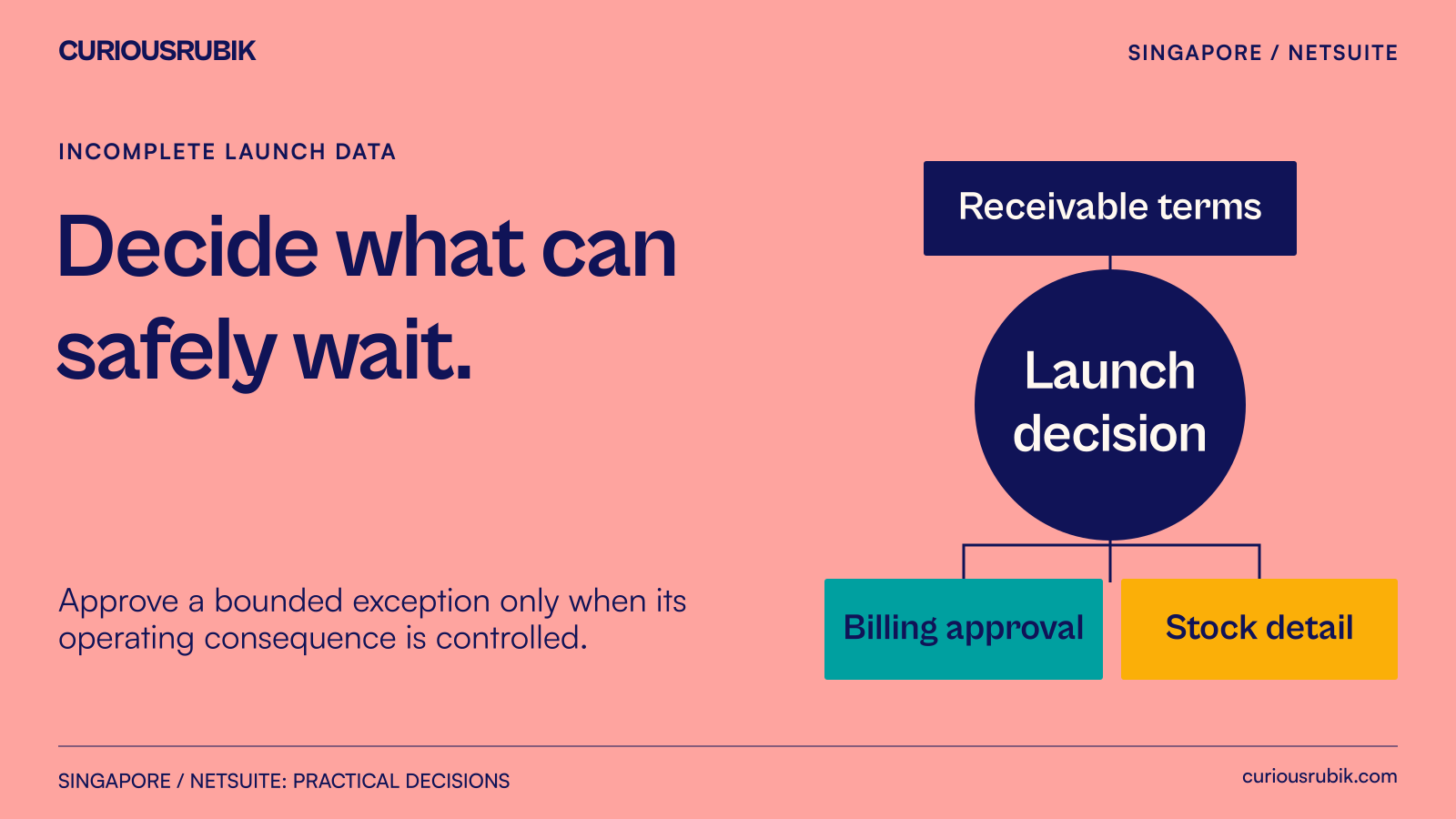
Accept a bounded exception only when its business consequences can be controlled.
A new Singapore entity can sometimes begin operating with a bounded data exception, but only when the affected task, financial representation and temporary controls are explicitly approved. Missing information that prevents a safe customer invoice, collection decision or stock release cannot be converted into a harmless gap by filling in a default value.
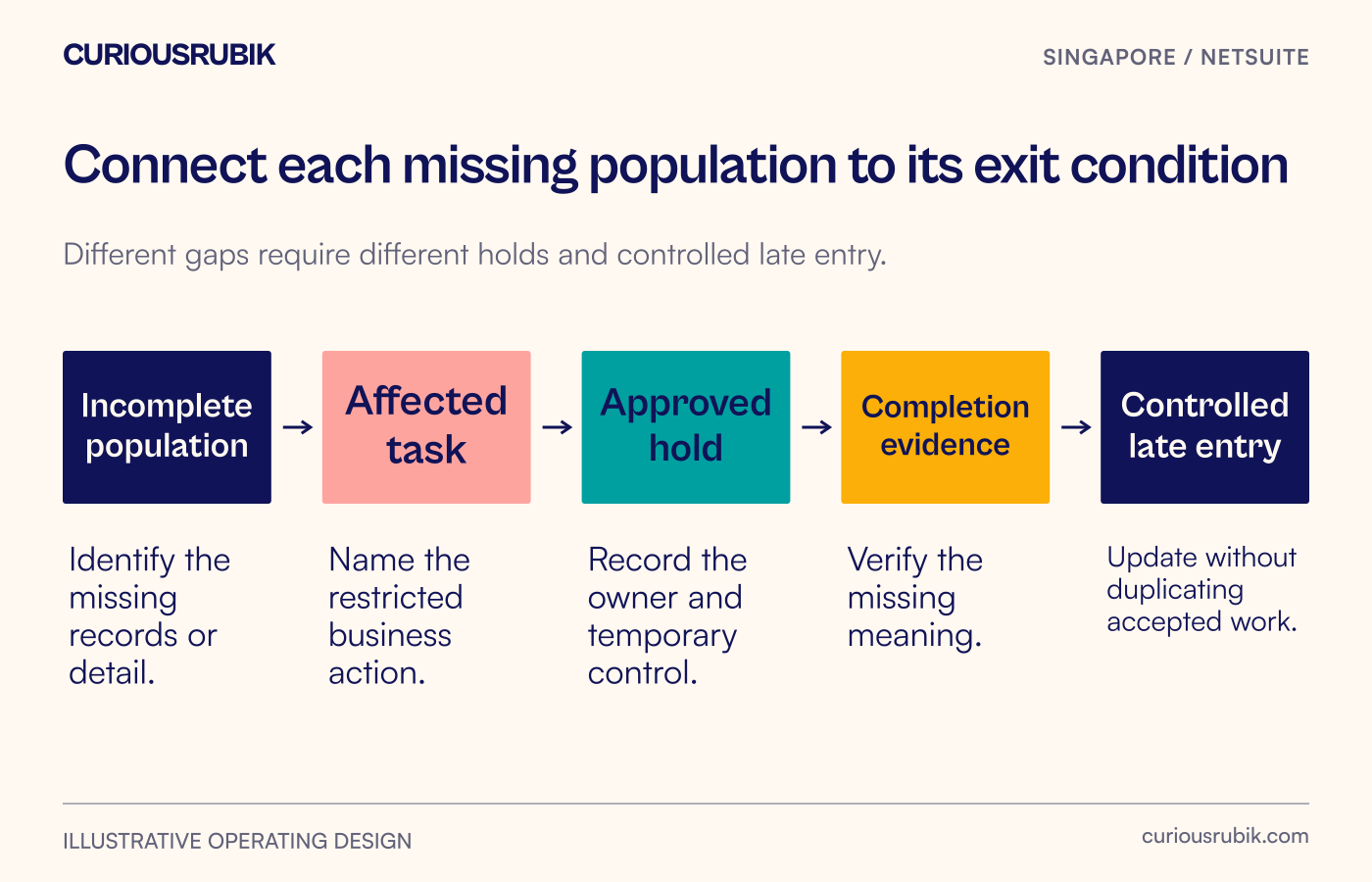
The launch decision should therefore be made by business task and record population. Identify what must work on day one, what can be held without creating another obligation, and how completed records will enter later without duplicating the opening position. This is especially important when the entity joins a regional NetSuite account that is already live for other countries.
Three incomplete populations before launch
Consider this illustrative regional group adding two fictional Singapore entities. A trading entity must collect receivables and fulfil orders. A service entity must invoice approved work. Their migration files are mostly prepared, but three populations remain incomplete.
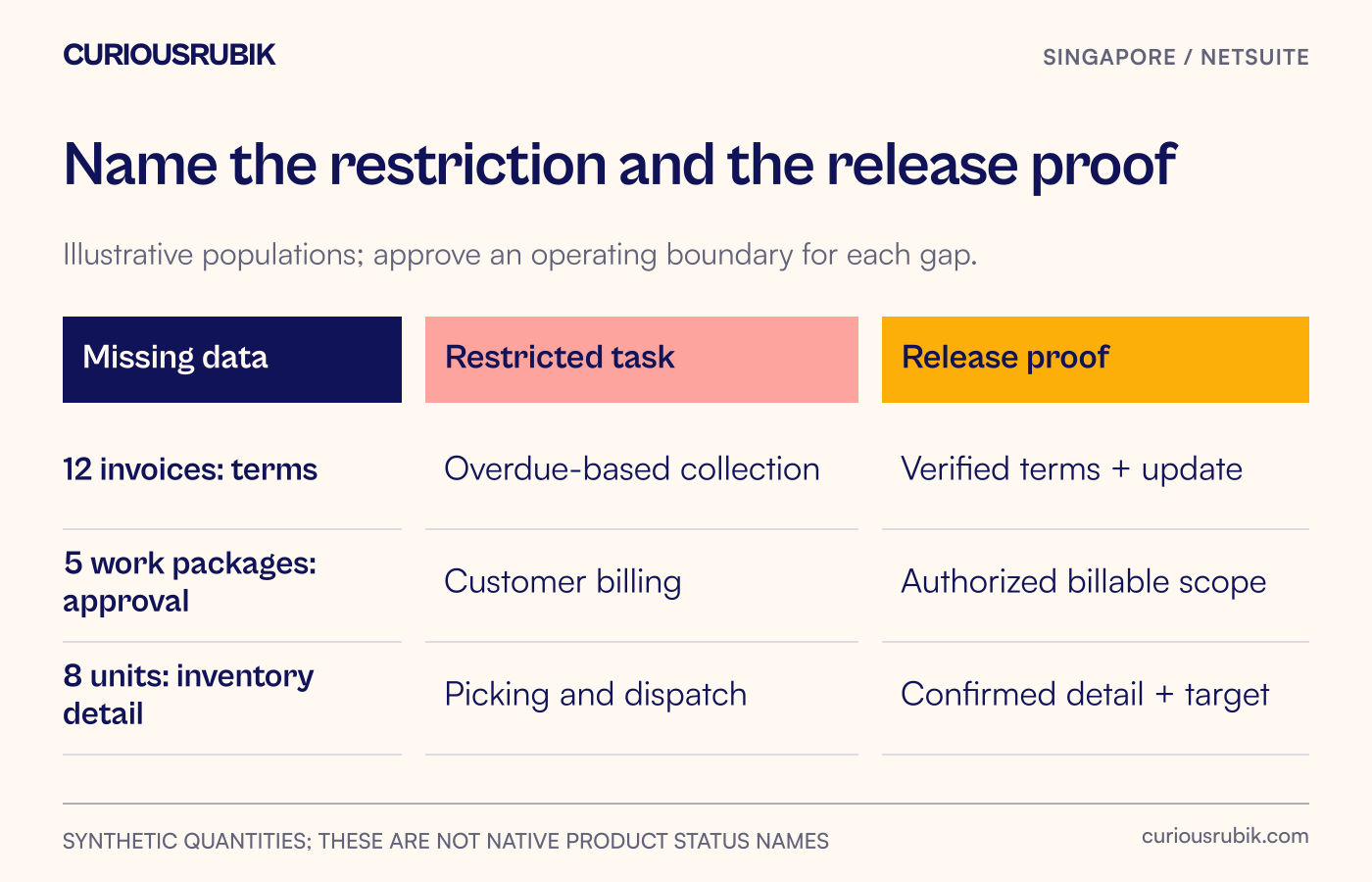
The trading entity has 12 open invoices with supported outstanding amounts but unresolved due terms. The service entity has five work packages whose completion is documented but whose billing approval is missing. The trading entity also has eight stock units without the serial detail required by the approved target inventory design. All quantities are invented to demonstrate the decisions, not migration benchmarks.
The project manager asks whether these exceptions justify delaying both entities. The loader proposes using a common due date, marking the work approved and loading the stock as an aggregate quantity so the imports can finish.
Those proposals would replace missing business decisions with invented facts. A better decision separates each population from the tasks it could affect. The entities may have different launch outcomes, and a blocked task may not require every unrelated process to stop. Equally, a small record count can still block launch if those records support an essential commitment.
Invoices with unresolved due terms
Finance first confirms what is known: the customer identity, outstanding amount, currency and supporting invoice evidence. It then identifies what the unresolved terms affect. Collections may be unable to determine whether an invoice is overdue or what reminder is appropriate. Ageing and credit decisions may also depend on the missing information.
The launch decision has two parts. Finance must approve how the opening receivable is represented, while the collections owner must decide which actions remain on hold. A supported temporary representation may be possible, but the implementation team must prove it without manufacturing a due date or causing unintended accounting effects. If the target requires data that cannot yet be supplied, another approved treatment or a delay may be necessary.
In the illustrative decision record, the 12 invoices are withheld from automated collection actions and overdue-based decisions until their terms are resolved. Finance accepts only a tested opening treatment that keeps their value visible and does not imply the invoices are absent. If that separation cannot be demonstrated, the affected collection launch remains blocked.
Name the person who obtains the missing terms and the person who approves them. “Finance to resolve later” is insufficient when users will rely on the balances immediately.
Unbilled work without approval
The five service work packages raise a different issue. The available evidence may establish that work occurred, but the person authorized to approve billing has not accepted the billable scope. The migration team cannot supply that commercial decision.
The service entity may still perform other approved day-one tasks if their required data is complete. Billing for these five packages remains blocked. The accountable finance owner separately determines whether their value requires an opening accounting representation; withholding an invoice does not decide the accounting treatment.
Record the contract reference, work evidence, missing approval and proposed billing route. If an approved temporary schedule is used to track the work, make its status visible to the billing team and define who maintains it. Do not let a parallel spreadsheet become an unmonitored second source of invoices.
The exit condition is specific: the authorized approver confirms the billable population and the target billing design has been validated. Project, billing or other relevant capabilities may require enabled features, configuration or additional entitlement. Their availability must be checked in the actual regional account before promising that the late work can be processed in a particular way.
Stock without required detail
For the eight units, operations needs to establish the physical identity and the inventory detail required by the agreed design. A correct aggregate count does not make those units ready for picking or traceable dispatch.
The sample decision is to keep the units unavailable for release until the required detail is confirmed. The warehouse owner identifies how that restriction will work physically and in the connected systems. Finance approves how the stock value is included in the opening position; it must not disappear merely because the operational representation is incomplete.
Do not weaken a shared item or inventory setup solely to clear this Singapore population. Existing country transactions may depend on that configuration. The regional application owner should assess any proposed change and its affected users before it becomes part of the exception plan.
If the eight units are needed for an essential day-one customer commitment and no approved alternative exists, the fulfilment task is blocked. If they are not needed immediately and the restriction is dependable, management may approve a bounded hold while other operations begin. That judgment belongs to the business owners with the relevant evidence.
Use a task-level launch decision card
The filled card has three rows:
- Receivable terms: collection decisions are restricted; finance must preserve an approved opening position; release requires verified terms and a tested update route. Owners are finance and collections.
- Billing approval: the five packages cannot be invoiced; any accounting treatment is separately approved; release requires the authorized scope and billing approval. Owners are the service approver and finance.
- Stock detail: the eight units cannot be released; physical and system restrictions must agree; release requires confirmed inventory detail and a validated target representation. Owners are warehouse operations and finance.
Add the consequence of waiting, the required resolution point and the evidence that permits the next action. If a temporary control cannot be maintained by the receiving team, treat that as a launch constraint rather than a documentation task for later.
Bring completed records in once
Create a late-entry ledger before the initial load. For each held source identity, record its population version, target reference if one exists, approved opening treatment, restriction and completion evidence. The ledger must reveal whether an amount or quantity is already represented elsewhere in the target position.
When missing information arrives, the migration lead proposes the exact next action. It may be an approved update to an existing representation or a newly supported record with an accompanying reconciliation. Finance must approve any change affecting the opening position. Do not simply append the completed record to the next import file and assume its value has never been counted.
Preserve the original source identity and the completion version. If a late load stops with an uncertain result, investigate the target before repeating it. Oracle documents that CSV import availability depends on record support, permissions and enabled features; the chosen late-entry procedure needs account-specific testing.
After acceptance, reconcile the late-entry population, lift only its approved restrictions and retire its temporary tracking route. Leave unresolved populations visibly open. A single exception's completion does not authorize releasing the rest.
Sign off what the entities can actually do
The launch pack should state which collection, billing and stock tasks are ready, which remain restricted and which commitments would be affected by waiting. NetSuite OneWorld supports multiple subsidiaries in an account, but that capability does not resolve missing source evidence or authorize changes to existing regional processes.
Keep broader history decisions separate; CuriousRubik's transaction-history migration guide addresses live data, comparatives and retained access. The immediate Singapore launch question is narrower: can each essential task operate with truthful data, an approved opening position and a controlled route for what arrives late? Use that answer to set the migration boundary.