Test NetSuite Wholesale Distribution from Customer Price to Margin
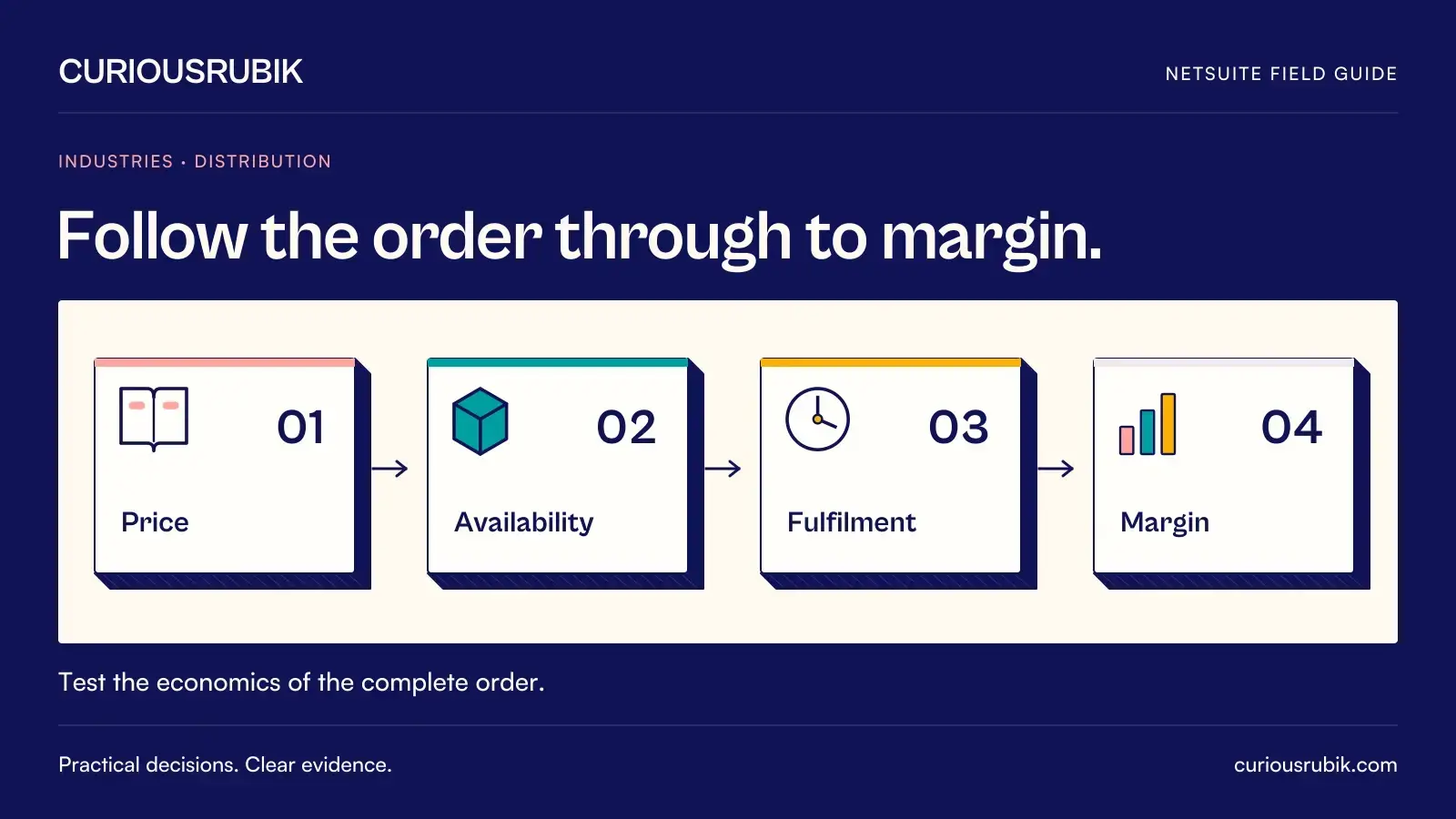
Wholesale distribution brings commercial promises and warehouse constraints into the same order. A customer-specific price may be correct while the available quantity is overstated. A shipment may leave on time while its margin omits freight. Evaluating each feature separately can miss those connected failures.
A NetSuite wholesale distribution implementation should be tested through an end-to-end order that includes negotiated pricing, partial availability, a backorder, and reviewed cost. For a distribution CFO and operations director, that shared test establishes whether the process supports both service and margin decisions.
Choose an order that represents the business
Use a representative customer, item, selling unit, warehouse, and delivery promise. Include relevant price agreements, minimum quantities, credit rules, and fulfilment preferences. Select an order with a realistic exception rather than an unusually simple transaction.
Confirm the account features and configuration supporting pricing, inventory availability, fulfilment, landed cost, and reporting. Additional warehouse, planning, or integration capabilities may have separate prerequisites. The test should identify which steps are supported directly and which rely on configured workflows or operating procedures.
Write the expected outcome before the demonstration. Otherwise, a plausible system response can be accepted even when it differs from the business's intended rule.
Prove the customer price and its authority
In a hypothetical order, a customer buys 100 units of an item. The list price is 50 currency units, but an approved customer agreement sets the price at 46. The order's net merchandise value is therefore 4,600 before tax, shipping, or other charges.
Test the applicable unit, currency, effective dates, and quantity conditions. If the agreement is expressed per case while the order is entered in individual units, verify the conversion and resulting price.
Check the hierarchy when several rules could apply. A promotion, quantity break, and customer price may compete. Document which source owns the final selling price and who can override it. Record a deliberate unauthorised override attempt to confirm the actual control.
Define availability before making a promise
Suppose the warehouse holds 70 units, of which ten are on a quality hold. For this test, no other commitments exist and the held units cannot be used. Usable stock is therefore 60.
The customer allows partial delivery, so the intended first shipment is 60 units with 40 remaining on backorder. The system's availability, allocation, and warehouse work should reflect that decision.
Physical on-hand stock alone is insufficient. Review holds, reservations, other orders, in-transit stock, and expected supply. A purchase order due next week should not be treated as stock available for today's dispatch unless the promise process explicitly supports that timing and its uncertainty.
Follow the partial fulfilment through billing
Pick, pack, and dispatch the first 60 units using the intended warehouse process. Confirm that the remaining order quantity is 40 and that the shipment does not inadvertently close the entire order.
Under the hypothetical billing rule, only shipped units are invoiced. The first invoice is 60 times 46, or 2,760, excluding tax and shipping. The unfulfilled merchandise value remains 1,840.
Inspect the handoff between fulfilment and billing. Check which event allows an invoice, how a mistaken fulfilment is corrected, and whether a duplicate integration message could create another shipment or invoice. Do not assume an order-level status gives enough detail for partial deliveries.
Include landed cost in the margin test
Assume the applicable unit acquisition cost for the example is 32 plus three of approved landed charges, producing a total carrying cost of 35 per unit. The first 60 units therefore carry an illustrative cost of 2,100.
Against revenue of 2,760, gross contribution is 660. Dividing 660 by 2,760 gives approximately 23.91%. This excludes other operating costs and assumes the stated cost basis and revenue treatment are appropriate for the test.
If the report used only the purchase cost of 32, it would show cost of 1,920 and contribution of 840. The apparent margin would be approximately 30.43%. The difference demonstrates why the cost definition matters before anyone interprets a margin percentage.
Validate the actual costing method, late charges, and posting timing in the account. A management estimate and a posted gross margin should be labelled according to their evidence.
Release the backorder with a new availability check
Suppose a later receipt adds 50 usable units. Fulfilling the remaining 40 leaves ten units available, assuming no other demand or movement. The second invoice is 1,840 and illustrative cost is 1,400, giving contribution of 440.
Across both shipments, revenue is 4,600, cost is 3,500, and contribution is 1,100. The combined margin remains approximately 23.91%. The quantity bridge is equally clear: 100 ordered, 60 first shipped, 40 later shipped, and zero remaining.
Before releasing that second shipment, retest customer hold status, delivery instructions, and order changes. A backorder can remain open long enough for the commercial circumstances to change.
Test the exceptions that cross departmental boundaries
Add a customer cancellation of the remaining quantity before the second shipment in a separate scenario. Check whether warehouse work, supply commitments, and the sales order remain aligned.
Test a return requiring inspection. The commercial credit decision and the inventory disposition may occur at different times. Do not assume issuing a credit automatically makes returned goods suitable for resale.
Include a late freight adjustment that changes margin after the sale. Finance should be able to identify the affected cost population and explain the change. Sales should not interpret the revised margin as an unexplained price override.
Use a joint acceptance checklist
The distribution team should be able to demonstrate that:
- The correct customer price is applied in the correct unit and currency.
- Held and committed stock are treated appropriately in availability.
- Partial shipment permission drives the intended warehouse decision.
- Shipped, invoiced, and remaining quantities reconcile.
- Backorders retain an owner and a reviewed promise date.
- Landed costs and later adjustments are reflected or clearly identified.
- Returns, cancellations, and duplicate messages have controlled outcomes.
- Reported margin uses a stated cost and revenue basis.
Have commercial, warehouse, and finance owners sign off the same test. Separate departmental demonstrations can each pass while the handoffs remain unreliable.
Turn the test into operating measures
After rollout, monitor late backorders, unauthorised price overrides, short picks, invoice exceptions, and cost adjustments affecting margin. Define the population and cutoff for each metric.
Review individual failures with their transaction chain. A high fulfilment rate can conceal a small number of important customers with persistent shortages. A healthy average margin can conceal items whose acquisition costs remain incomplete.
Use those findings to improve pricing governance, stock policy, and receiving discipline. The end-to-end test becomes a reusable control rather than a one-time implementation demonstration.
Frequently asked questions
Is available stock the same as on-hand stock?
Not necessarily. Holds, commitments, locations, and the selected availability logic can change what is usable for an order. Confirm the definition used in the promise process.
Should partial shipments always be allowed?
That depends on customer agreements, service policy, shipping economics, and operational constraints. Test both allowed and prohibited partial-delivery scenarios.
Why can margin change after dispatch?
Later cost information, credits, returns, or accounting corrections may affect the result. Preserve the original and revised basis so the change can be explained.
What is the most useful distribution demonstration?
One realistic order followed through pricing, availability, warehouse execution, billing, and cost review, including a material exception. The connected evidence is more informative than isolated feature screens.
Evaluate the complete order economics
CuriousRubik can discuss a scoped wholesale distribution workshop built around customer pricing, backorders, fulfilment, and margin reconciliation. Bring a representative order and a recurring exception to focus the evaluation.