What Must Change Before You Restart an ERP Project? Verify that the problems behind the first attempt have been addressed.
A new plan, a different team, or a revised launch date can make an ERP restart look materially different while leaving the conditions behind the earlier failure intact. Decision authority may still be unclear. Business specialists may still be unavailable. Data ownership may still depend on informal cooperation.
Before authorizing the restart, require evidence that those conditions have changed. The question is narrower than whether to recover, reduce scope, or replace the previous approach. Assume a direction has been chosen. Now establish whether the organization can responsibly commit to the next stage.
A restart assurance dossier connects each prior failure condition to a corrective action, a verification result, and the remaining risk. It allows sponsors to release scope and resources in stages while keeping the conditions for further commitment explicit.
Describe the conditions that undermined the first attempt
Begin with an agreed account of the relevant failure conditions, supported by records and clearly labeled uncertainties. Avoid reducing the explanation to a list of individual mistakes or an assertion that the organization chose the wrong technology.
Useful condition statements are specific enough to test. “Governance was weak” is broad. “Cross-functional process disputes had no decision-maker with authority to resolve them before configuration began” identifies an observable operating condition.
Other examples might concern unavailable business capacity, unresolved data ownership, unclear acceptance requirements, uncontrolled scope, unrealistic dependencies, or essential scenarios that were never demonstrated. Include genuine solution limitations where the prior diagnosis supports them.
For each condition, record its evidence, consequence, affected work, and confidence in the diagnosis. Keep disputed explanations visible rather than manufacturing agreement. If the cause remains uncertain, the restart plan may need an exploratory stage that resolves the uncertainty before larger commitments are made.
Separate an action completed from a condition changed
A corrective action is something the organization did. A changed condition is an observable result that matters to the new attempt. The dossier should contain both.
Appointing a process owner is an action. Demonstrating that the owner can resolve a cross-functional decision within their authority is evidence of a changed condition. Scheduling more training is an action. Showing that the assigned role can perform a consequential task is evidence of readiness.
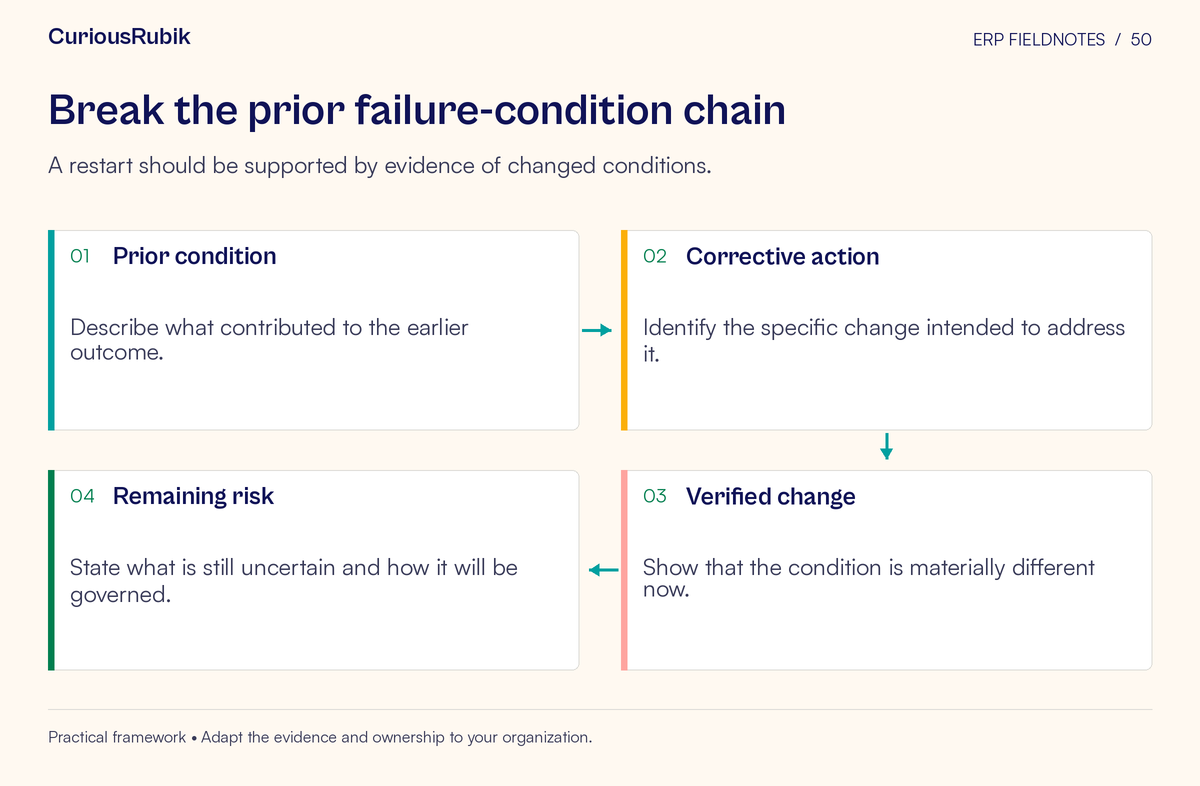
Use a four-part record:
- Prior condition: What was missing or unreliable, and how it affected the earlier attempt
- Corrective action: What changed in the design, authority, capacity, or operating arrangement
- Verified change: What evidence demonstrates that the relevant condition now holds
- Remaining risk: What is still uncertain, who accepts it, and what would invalidate acceptance
Choose the proof before declaring the action complete. Otherwise, teams may select convenient evidence after the fact. The verifier should understand the business consequence and be able to challenge the person delivering the correction.
Test authority through real decisions
An updated governance chart does not prove that decisions will be made differently. Select representative decisions that previously stalled or caused rework. Establish who can decide, what evidence they need, who must be consulted, and where unresolved disagreement goes.
Exercise that route before the affected work resumes. Where possible, use a real open decision rather than an artificial example. Observe whether the named owner is available, has the required authority, and can make a decision that other teams will implement.
Record the decision and its implications for scope, cost, timing, and controls. If the owner must refer everything back to a sponsor who cannot respond, the authority problem remains. If teams can ignore the decision without consequence, the governance record is incomplete.
Test escalation under an uncomfortable condition. A restart must have a credible route for surfacing evidence that threatens the preferred schedule. The sponsor should explain how concerns will be heard, how decisions will be documented, and who can suspend an unsafe or unsupported next step.
Verify capacity in the calendar and the work
Named resources are not the same as available capacity. Review the actual obligations of critical business specialists, technical staff, process owners, and approvers. Include normal operations, other initiatives, planned absences, and support work left from the earlier attempt.
Confirm how protected project time will be created. If a manager has committed a specialist, identify which ordinary responsibilities are reduced, reassigned, or covered. A capacity plan that assumes people will absorb both workloads repeats a condition rather than correcting it.
Use early work to test the arrangement. Can the assigned team attend the necessary decision sessions, prepare reliable inputs, and complete reviews without persistent cancellation or hidden overtime? Record the observation period and its limitations. A quiet week does not prove capacity through a demanding operating cycle.
Plan backups for roles whose absence would block decisions or evidence review. Where specialist support is external, verify availability and the approved scope of support. Do not treat a hopeful recruitment plan or an unsigned resource request as present capacity.
Make data and process readiness demonstrable
For data, identify accountable owners, definitions, quality rules, and correction routes for the populations needed in the next stage. Demonstrate that owners can resolve representative issues and preserve a traceable result. A cleanup campaign may improve records temporarily while leaving ownership unchanged.
For process readiness, verify the decisions required before configuration or testing resumes. Include exceptions, cross-team handoffs, and accepted deviations from the prior operating model. A signed process diagram is useful only if the relevant roles agree on how they will operate it.
Use representative scenarios to test the combined arrangement. Data, access, process rules, and review authority should work together under the conditions expected in the next stage. Record what was demonstrated and what remains untested.
Treat proof as perishable. A change in scope, staffing, configuration, transaction mix, or external dependency can invalidate earlier evidence. Add revalidation triggers to the dossier so a previous acceptance does not silently cover materially different conditions.
Rebuild the value case using current assumptions
The restart decision needs a current account of why the remaining work is worthwhile. Revisit intended outcomes, scope, future costs, sustaining effort, dependencies, and the consequences of delay. Preserve the history of changed assumptions instead of quietly replacing the original business case.
Separate recoverable value from expenditure already incurred. Historical spending can explain the situation, but future commitment should be assessed against the current alternatives and obligations. Finance and the accountable sponsor should review the estimates and decision method.
Show uncertainty explicitly. Where effort depends on an unproven scenario, identify the evidence needed to narrow the estimate. Avoid presenting a single detailed schedule or cost figure as reliable when the underlying conditions remain unresolved.
The value case should also reflect business capacity. A technically feasible restart can still be impractical if the organization cannot supply the people required to obtain its benefits without unacceptable operational disruption.
Assemble a dossier that supports staged authority
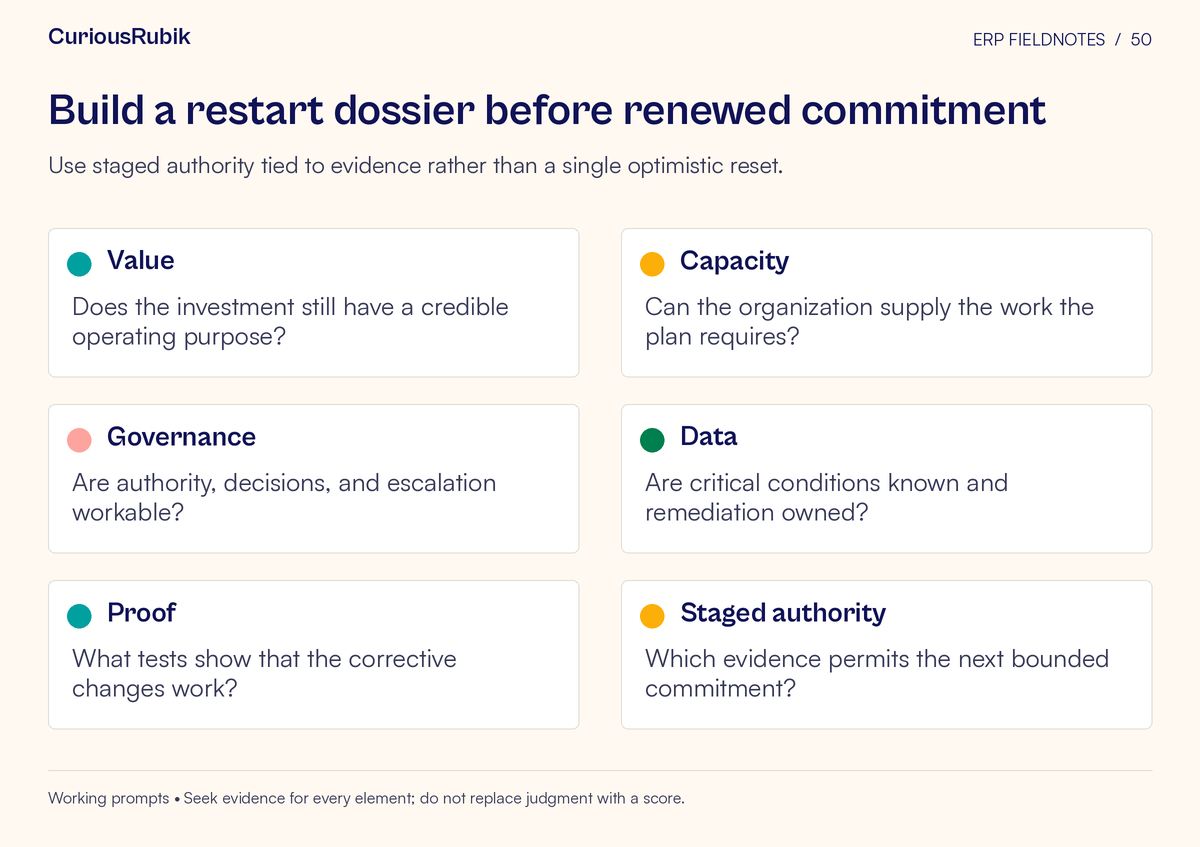
Keep the dossier organized around six questions:
- Value: Is the remaining investment justified by current outcomes, assumptions, costs, and alternatives?
- Capacity: Are the required people available, supported, and able to perform the work?
- Governance: Can consequential decisions and escalations reach an empowered owner?
- Data and process: Are the necessary definitions, records, rules, and handoffs ready for the next stage?
- Proof: What demonstrates that prior failure conditions have changed, and what are the limits?
- Staged authority: Which scope, resources, and commitments are approved now, and what evidence is needed next?
Link the supporting records rather than creating a large narrative that hides unresolved items. The decision-maker should be able to trace each consequential claim to evidence, an owner, and a limitation.
A hypothetical restart gate
Imagine a hypothetical organization whose first attempt stalled because process decisions remained open and finance specialists were repeatedly pulled back into daily operations. The restart proposal names new leads and introduces a revised schedule.
The sponsor asks for evidence of changed conditions. A representative dispute follows the new decision route and reaches a clear, accepted resolution. That supports the authority change. The capacity review, however, shows that the same finance specialists still carry their full operational workload, with no approved cover.
The sponsor authorizes a limited preparation stage that does not depend on unavailable finance reviews. Broader build activity remains conditional on an approved coverage arrangement and evidence that the specialists can perform the required work. The decision records the scope boundary and the next review event.
This is a substantive restart decision even though it does not release the full program. It permits useful work while refusing to treat new names and dates as proof that the earlier capacity constraint has disappeared.
Keep the restart conditional on continuing evidence
At each stage, review whether the verified conditions still hold. Use independent challenge proportionate to the commitment and make material disagreements visible. Do not let completed expenditure or public confidence in the restart substitute for current evidence.
Define who can stop progression, what triggers reconsideration, and how the business will maintain continuity during a pause. Teams should know that raising a supported concern is part of the operating model, with a clear response route.
Before approving the next restart milestone, choose the prior failure condition with the greatest consequence and ask for its verified-change record. If the evidence shows only an action completed, the condition still needs testing. That distinction is the foundation for making the next attempt genuinely different.