Role-based access control is useful when it turns recurring job responsibilities into understandable permission sets. It becomes unreliable when a role name conceals broad privileges, data scope is lost, or old assignments accumulate as people move through the organization. The practical objective is an access model that business owners can explain and the system can enforce consistently.
For an enterprise application owner, the immediate decision is how to separate functional roles from the entities, regions, or records on which those roles may act. A buyer role may describe what someone can do; it does not necessarily establish which company’s purchases they may create.
RBAC is therefore a foundation rather than a complete answer. Some decisions also depend on resource attributes, transaction state, conflicts of duty, or temporary authority. The model should combine those conditions deliberately instead of granting a broad role and relying on users to stay within their responsibilities.
Build roles from tasks and protected operations
Start with the actual work: view an order, create a purchase request, approve a defined transaction, maintain reference data, or administer configuration. Identify the permissions each task needs and the consequences of granting more.
Separate ordinary work from privileged administration. A person who supports users may need diagnostic access without permission to change every business record. A manager’s seniority does not automatically justify inheriting all operational and technical privileges beneath them.
Give each role a purpose, permission definition, owner, eligible population, and review trigger. Avoid descriptions such as “standard access” that require tribal knowledge to interpret. The approving owner should be able to explain why each material capability belongs in the role.
Review existing assignments as evidence, not as the target design. A role mined from current usage can reproduce years of accidental privilege accumulation. Rarely used permissions may be unnecessary, but usage alone cannot determine need: an emergency capability may be legitimate while requiring stronger controls than a routine grant.
Preserve the relationship between role and scope
A grant should retain the association among the principal, function, resource scope, and relevant conditions. Flattening functions and scopes into unrelated lists can create permissions no one intended.
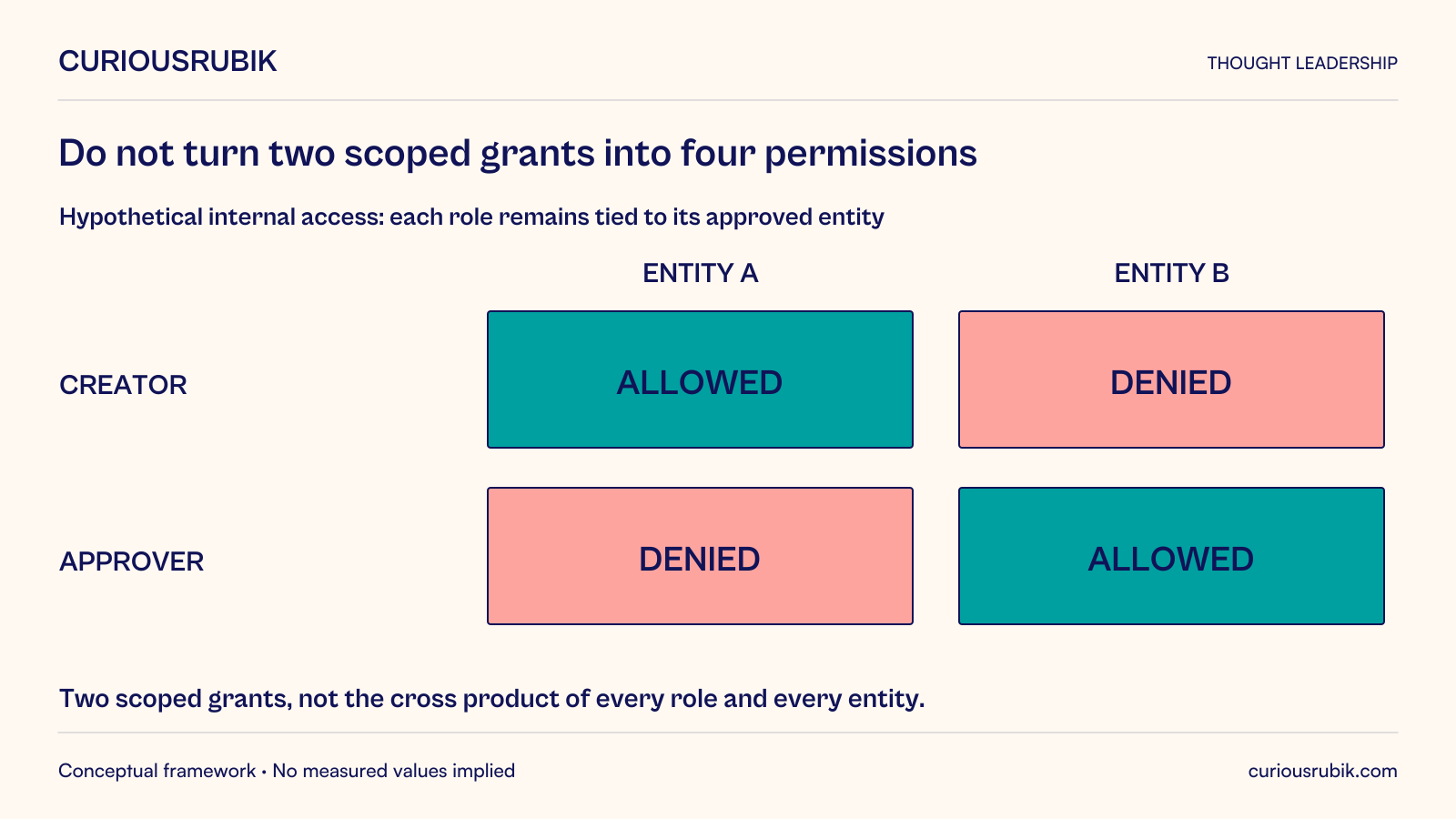
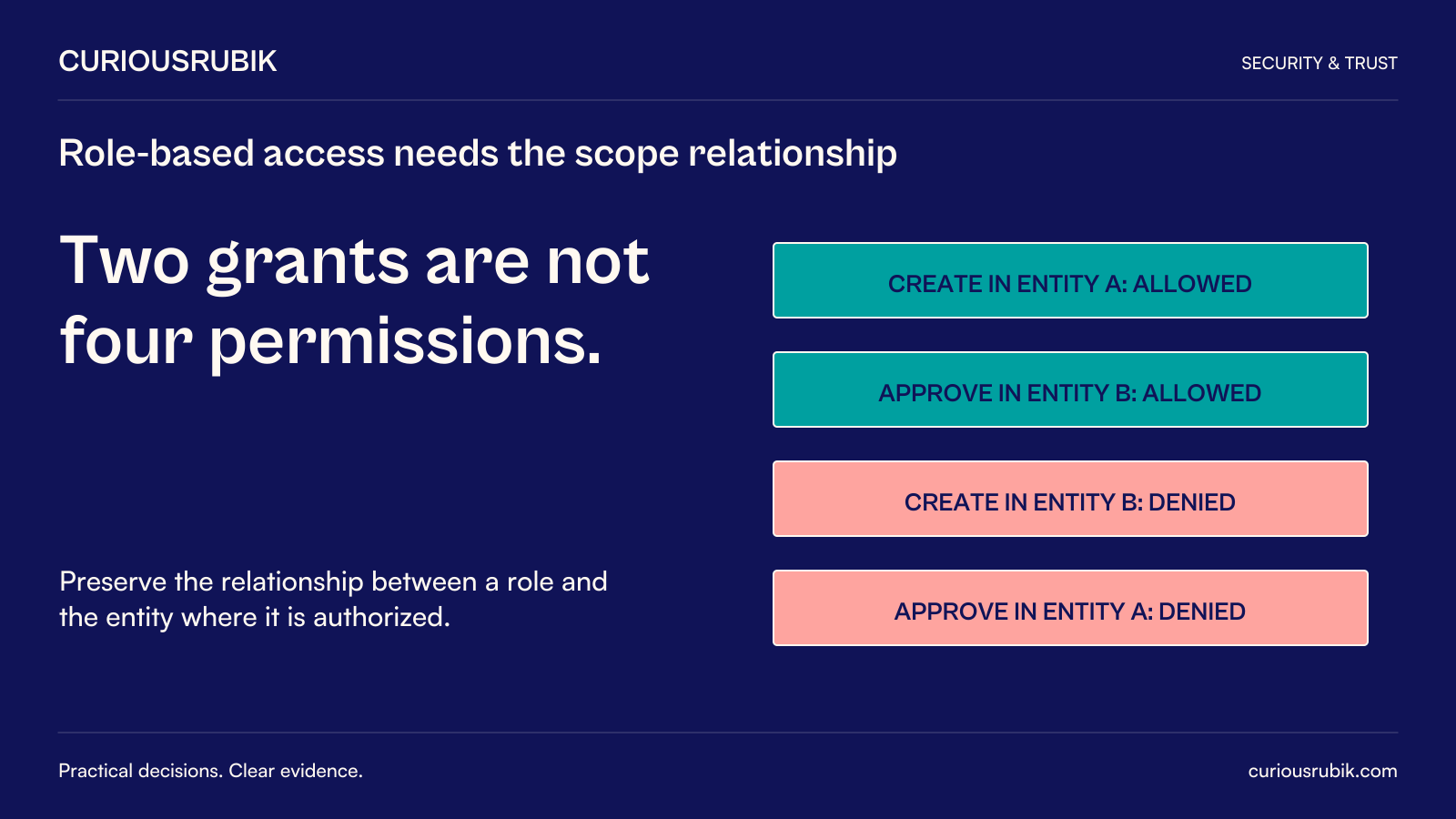
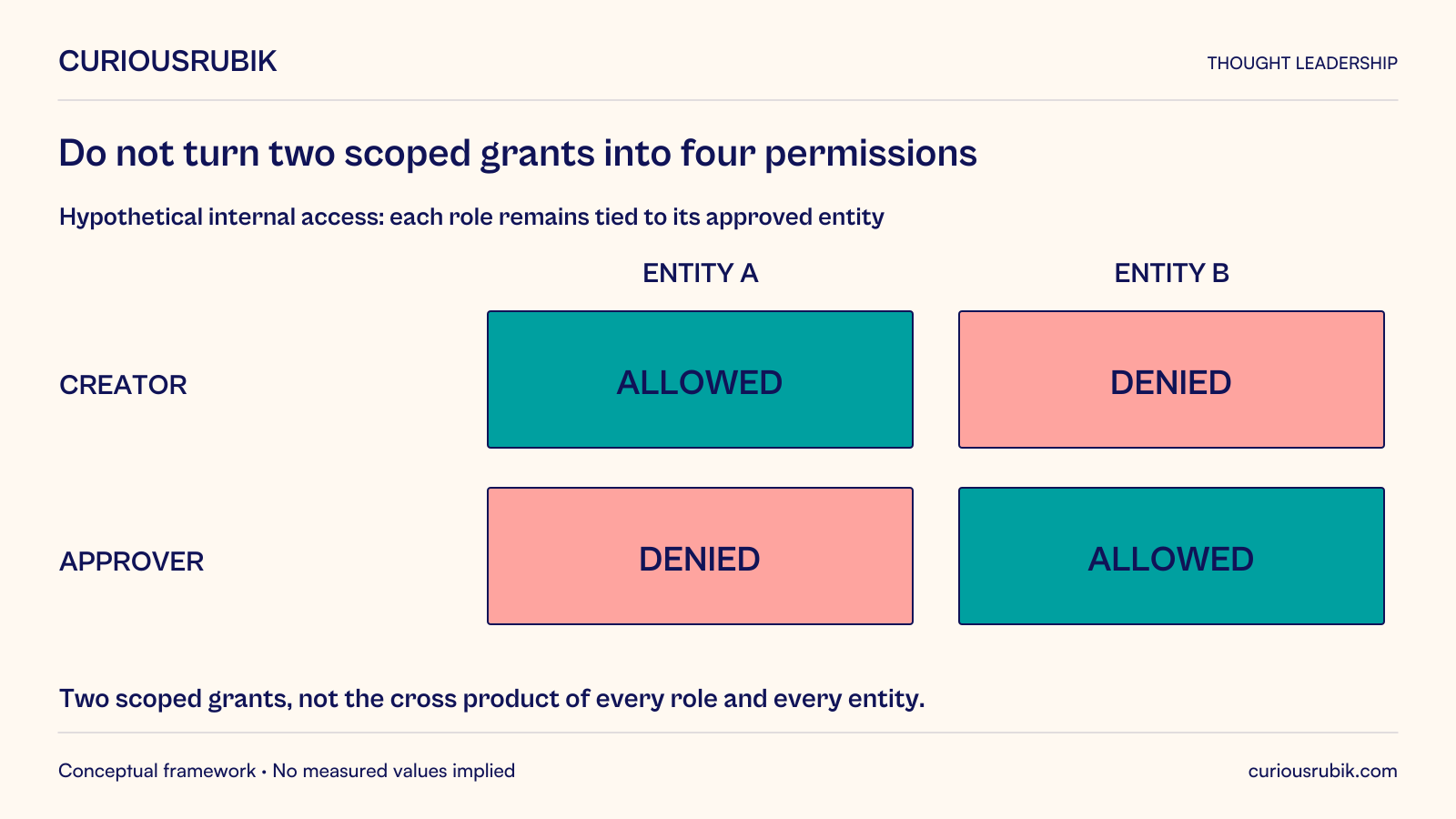
Consider a hypothetical employee, Mira, who may create purchase requests for Entity A and approve purchase requests for Entity B. The authorized combinations are Creator with A and Approver with B. The example does not establish whether any other duties or controls are appropriate for a real finance process.
If a system stores roles as Creator and Approver, scopes as A and B, and combines every role with every scope, it produces four combinations. Two are unintended: approval in A and creation in B. The defect is not that Mira has two roles; it is that the relationship between each role and its authorized scope was lost.
Represent the two grants explicitly or use a policy model that preserves equivalent relationships. Test the permitted combinations and the denied combinations. The application’s resource identity must reliably establish which entity owns the requested object; a user-selected entity label is not sufficient evidence by itself.
This hypothetical case illustrates why an access review that checks only role membership can miss consequential scope errors. Reviewers need to see the effective permissions a person can exercise, not merely a list of role names.
Use attributes without creating uncontrolled authority
Some organizations encode every combination of function and scope as a separate role. If four functions, six entities, and three business units all formed valid combinations, that would create seventy-two possible combined roles. This is hypothetical combinatorial arithmetic, not a claim that every organization needs those roles.
Separating reusable function roles from scope attributes can reduce duplication, but it does not eliminate the need to manage assignments and policy relationships. It should not be advertised as reducing the entire security model to thirteen simple objects. The relationships and exceptions still need control.
NIST’s ABAC guidance describes authorization based on subject, object, operation, and sometimes environmental attributes evaluated against policy. It offers a way to express additional conditions around roles, while making the reliability and governance of those attributes important. NIST SP 800-162, Definition and Considerations
Identify the authoritative source for each access-relevant attribute. Who can change an entity assignment, employment status, or resource classification? How quickly do changes reach enforcement? If an ordinary user can alter an attribute that grants wider access, the policy may be formally correct but operationally ineffective.
Enforce permissions where the protected action occurs
The interface can hide unavailable actions to improve usability, but the trusted service must enforce the actual rule. An API, background process, or alternate client should not obtain broader authority because it bypasses the visible screen.
Check the requested operation on the relevant resource and state. Permission to view a record does not imply permission to edit it, export its entire population, or change its approval status. Bulk operations deserve explicit consideration because they can enlarge the effect of a seemingly ordinary capability.
OWASP ASVS 4.0.3 calls for enforcement in a trusted service layer, protection of policy attributes, least privilege, and secure failure behavior. These are verification principles, not proof that a particular RBAC configuration is correct. OWASP ASVS 4.0.3, V4.1
Define what happens when role or scope information cannot be obtained. A cached decision may be suitable only within a carefully defined policy; uncertainty should not silently expand access. Test authorization-service failure and stale membership alongside the normal success cases.
Design the assignment lifecycle
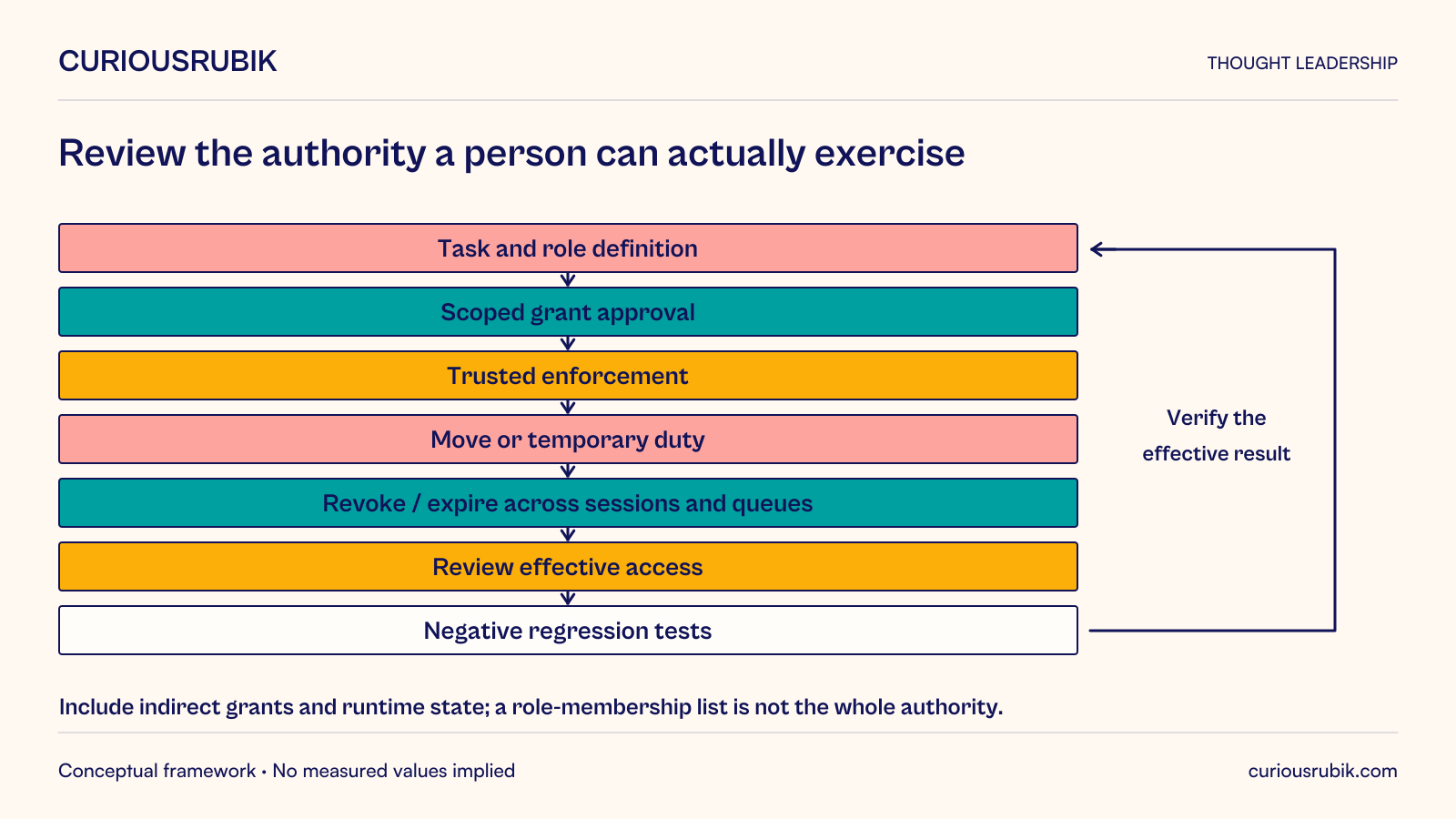
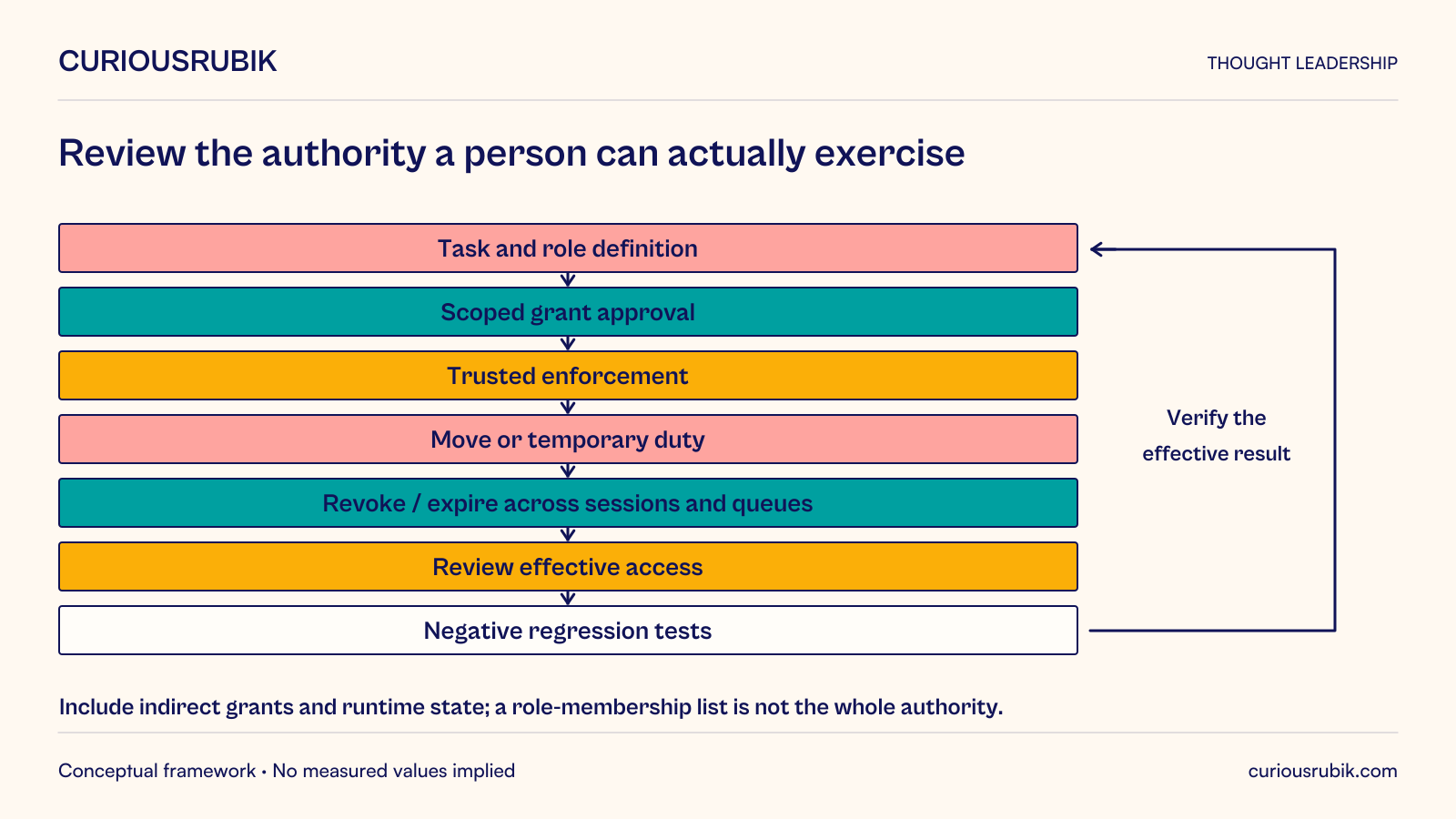
Access should follow actual responsibilities as people join, move, take temporary duties, and leave. A move is not simply an additional role request. Determine which prior grants should end, which must overlap temporarily, and who approves the exception.
For temporary duties, record purpose, scope, approver, start, end, and review conditions. Make expiry operationally dependable rather than relying on someone to remember a calendar note. Emergency access needs its own controlled route and post-use evidence, not a permanent broad role shared for convenience.
NIST SP 800-53 Revision 5’s account-management control addresses authorization, review, transfers, termination, and temporary or privileged account management. The control catalogue is tailored to organizational needs; it does not prescribe one review frequency for every enterprise. NIST SP 800-53 Revision 5, AC-2
Consider sessions, tokens, caches, and queued work when revoking access. Removing a role in the central directory may not immediately remove every effective permission. The system should define and test how the change reaches the components that can still act.
Review effective access rather than approving lists
An access review should show the role, scope, source of the grant, purpose, relevant conflicts, and evidence needed to assess continued need. A long spreadsheet of technical group names encourages superficial approval.
Ask reviewers to decide whether the person still performs the underlying responsibility and whether the scope remains appropriate. Route unclear permissions to the role owner instead of expecting every manager to understand every technical capability.
Inspect inherited and indirect permissions. Nested groups, administrative roles, service accounts, and application-local exceptions can produce effective access beyond the central role assignment. A review limited to one identity system can miss those paths.
Use denied test cases as regression evidence. In Mira’s hypothetical example, approval in Entity A and creation in Entity B should remain denied after a role refactor, scope migration, or application release. A test suite that verifies only expected success cannot establish the boundary.
Keep the model understandable as it grows
Review roles when processes change, not only when the number of roles becomes uncomfortable. A role that once matched a coherent job may become a bundle of unrelated privileges after several application expansions.
Retire obsolete grants and consolidate genuinely equivalent roles through an approved process. Do not merge roles merely because their names are similar or their users overlap. The relevant comparison is the protected capability and scope.
There are tradeoffs between a small role catalogue and a highly expressive policy system. Too few roles can encourage broad access and manual restraint. Too many narrowly tailored roles can become hard to approve and maintain. Attribute-based conditions add flexibility while creating dependencies on trustworthy data and policy evaluation.
Choose the simplest model that expresses the real boundaries and remains reviewable. Document exceptions separately, with an owner and reassessment trigger, rather than allowing them to disappear into an increasingly broad “power user” role.
Treat a role-definition change differently from assigning an existing role. Adding one permission to a widely used role changes the effective authority of every current member, potentially across many scopes. Review the permission delta, affected principals, conflicts and tests before release. The person authorized to assign a role is not necessarily authorized to expand its definition.
Test resource reclassification too. If a record moves from Entity A to Entity B, determine whether access should change immediately, whether historical visibility remains, and which approvals govern the move. A policy that correctly checks current entity membership can still expose information if the resource ownership field is changed without suitable authority. These tests connect role design to the integrity of the attributes it relies on.
Begin with one application and a small set of consequential operations. Build roles from tasks, preserve role-scope relationships, and test what must be denied. RBAC becomes a dependable foundation when the organization can explain a person’s effective authority and can change that authority reliably as their responsibilities change.