The promotion changes. The supplier’s plan does not.
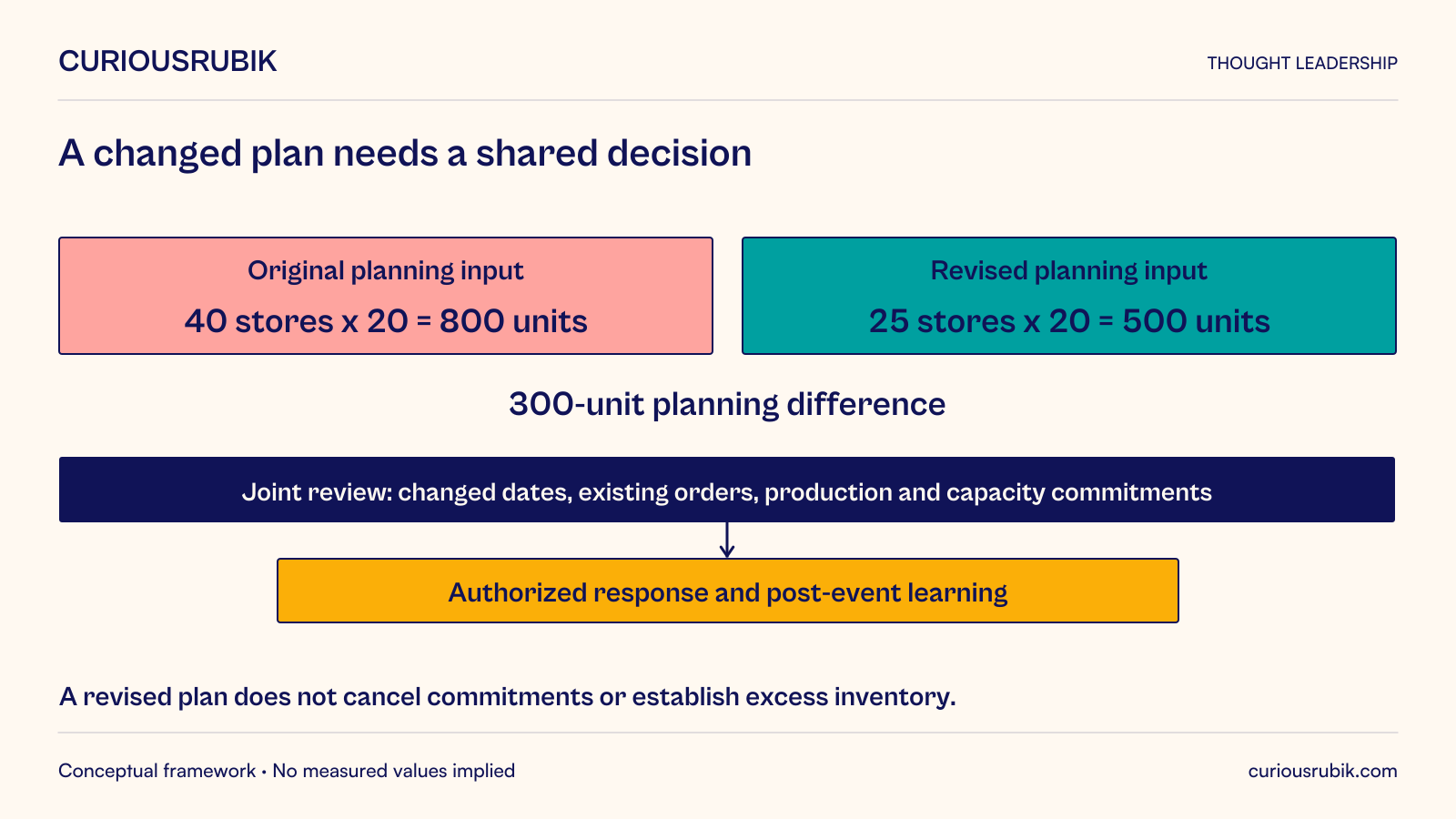
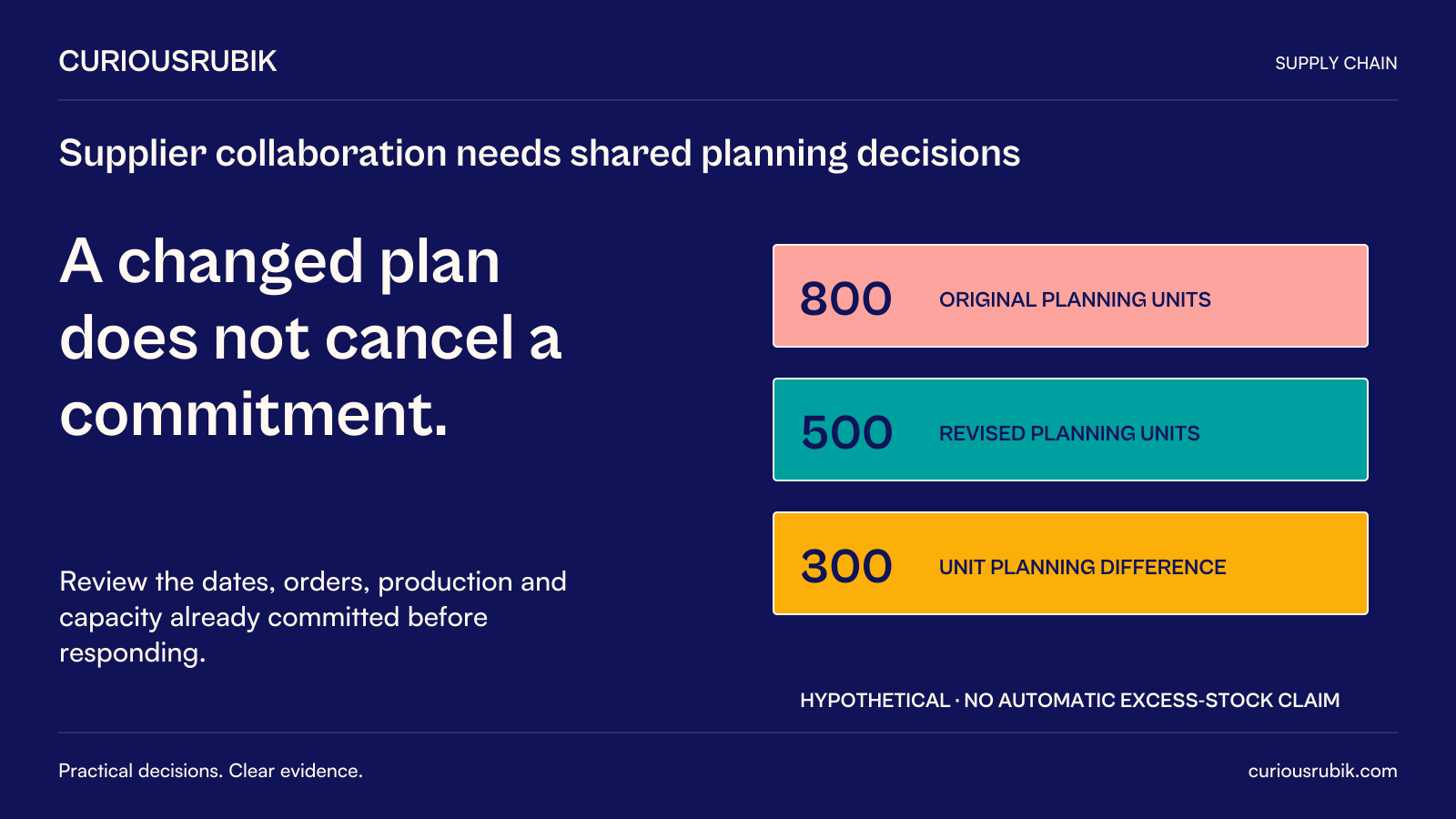
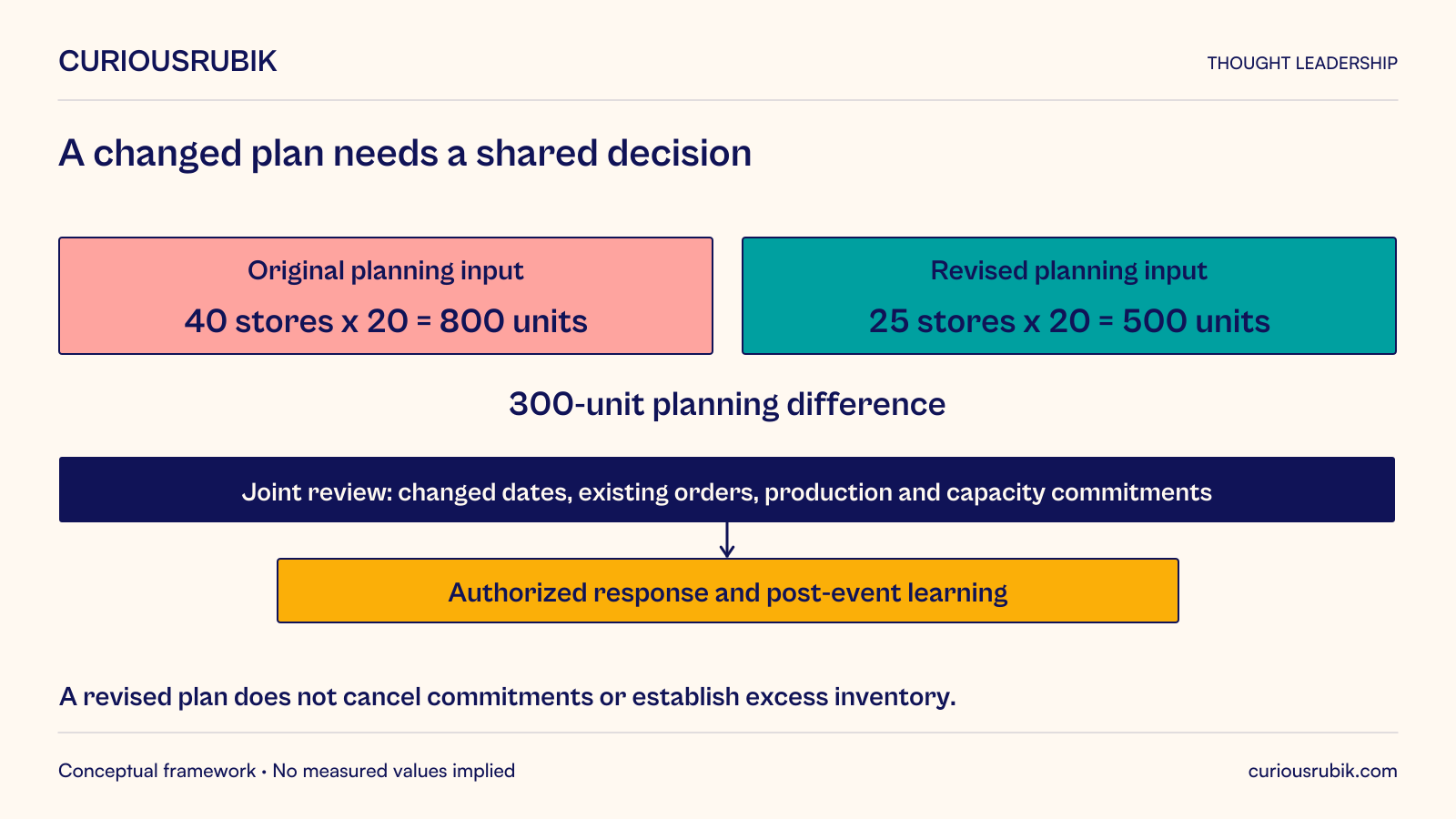
In a hypothetical retail campaign, a supplier and retailer initially plan for forty participating stores at twenty units per store, giving a planning quantity of 800 units. The retailer later reduces participation to twenty-five stores, implying 500 units under the same simplified assumption. If the supplier continues planning against the old scope, the partners now carry a 300-unit difference in their planning inputs.
Those figures are not a demand forecast, purchase order or guaranteed excess-stock outcome. They illustrate a coordination problem: a business assumption changed, but the parties responsible for acting on it did not reach a shared, current interpretation.
Supplier collaboration can create an advantage by resolving that kind of mismatch earlier and learning from it systematically. The advantage comes from better joint decisions and execution, not from more meetings or unrestricted access to each other’s systems.
Choose a shared problem worth solving
A useful collaboration has a bounded purpose. The parties might want to reduce repeated forecast surprises, improve launch readiness, resolve quality issues faster or make a constrained production schedule more dependable.
Define the problem in terms both parties can influence. A buyer’s request for perfect delivery is not a shared improvement plan if it ignores late changes, unclear specifications or demand volatility introduced by the buyer itself.
Identify the consequence and the current evidence. Are revisions arriving after production decisions? Are exceptions repeatedly discussed without an owner? Does each party use a different definition of the requested delivery date? These mechanisms give the collaboration something concrete to change.
Select partners and scope proportionately. A strategic or constrained relationship may justify deeper joint planning than a routine low-complexity purchase. Collaboration effort is a resource, and not every supplier needs the same meeting cadence or information exchange.
The starting agreement should make clear what success would look like and which decisions remain with each organization. Shared work does not eliminate commercial independence or authorize one party to make the other’s commitments.
Keep planning information separate from firm commitments
The campaign example needs more than a revised spreadsheet total. Both parties need to understand which stores and dates changed, what the planning quantity means and whether any firm orders or capacity commitments are already in place.
A forecast can inform preparation without becoming an order. A supplier’s capacity indication can support planning without guaranteeing that capacity indefinitely. The process should label those meanings explicitly.
When the campaign falls from 800 to 500 planned units, the supplier may already have produced materials or reserved a constrained slot. The appropriate response is a joint review of options and responsibilities under the actual arrangements, not an assumption that an updated forecast cancels every earlier commitment.
Similarly, a delayed campaign can change when stock is needed without changing its ultimate quantity. The parties need to distinguish demand timing, shipment timing and the customer’s required availability date.
The 2004 VICS Retail Event Collaboration Business Process Guide, hosted by GS1 US, describes coordinated planning, forecasting, exception handling and post-event assessment. Its retail-event scope is a useful reference for structuring this work; it is not evidence of a guaranteed improvement for every supplier relationship. VICS, Retail Event Collaboration Guide.
Exchange the context that changes a decision
More data is not automatically better collaboration. Share the information needed for the agreed purpose, with clear definitions, timing and access conditions.
For the campaign, useful context could include participating locations, event dates, applicable products, planning assumptions and the status of material changes. The supplier may contribute feasible capacity, production constraints or the point after which a change becomes difficult.
Define the information’s owner and meaning. A sales projection, replenishment proposal and confirmed order should not appear as interchangeable numbers in a shared file. State the period, unit, version and relevant uncertainty.
Discuss what the source cannot establish. Observed sales during a stockout may understate demand. A supplier’s recent average lead time may not represent its capacity during a peak. A planning process that ignores these limits can create confidence without improving the decision.
Protect confidential and commercially sensitive information. Agree the legitimate scope of bilateral sharing and involve the appropriate specialists where the proposed exchange raises legal or contractual questions. Do not collect information simply because the technology makes it available.
The test is whether the recipient can make a better, authorized decision from the information. If not, reduce the burden or change the content.
Design an exception conversation with an outcome
A recurring collaboration meeting should focus on decisions and unresolved differences, not a presentation of every metric. Give participants a concise view of the issue, evidence, options and consequence of waiting.
For each exception, identify who can decide and who must contribute. Commercial terms, technical suitability, production capacity and logistics can require different expertise. A meeting attended only by account managers may not resolve a manufacturing constraint.
Record the decision, owner, next action and date or condition for review. If the issue remains uncertain, state what evidence is needed and who will obtain it. Avoid recording agreement when the parties have only agreed to investigate.
Set thresholds for routine handling and escalation according to the relationship’s needs. These are working management rules, not universal standards. Review them when they generate too much noise or miss consequential changes.
Make it possible to disagree constructively. A supplier should be able to explain why a requested change is infeasible, and the buyer should be able to challenge an unsupported assumption. Collaboration loses value when the process rewards reassuring answers over accurate ones.
Align incentives with the behavior you need
The buyer and supplier may optimize different local measures. A buyer can reward a low unit price while imposing frequent urgent changes. A supplier can optimize long production runs while the customer needs smaller, more responsive deliveries.
Bring those tradeoffs into the discussion. The parties may choose a different ordering rhythm, a clearer change window or a bounded capacity arrangement. The appropriate terms depend on the relationship and should be agreed through authorized commercial processes.
Do not assume a technology platform resolves conflicting incentives. A portal can transmit a late change instantly without making it economical or feasible. Shared visibility exposes the issue; management must still decide how to handle it.
Recognize the supplier’s effort. Maintaining detailed forecasts, attending reviews and investigating exceptions consumes resources. A collaboration design that shifts all administrative burden to one party may be difficult to sustain.
Equally, avoid treating every supplier request as a reason to relax necessary controls. A dependable relationship combines practical cooperation with clear responsibilities, evidence and boundaries.
Review the event without rewriting what was known
After the campaign or operating period, compare the agreed plan, material revisions, actual execution and observed outcome. Preserve what each party knew at the relevant decision points.
A forecast revised after demand becomes visible should not be compared with the original as though both were equally early predictions. A delivery measure should use a clearly defined commitment date and record authorized changes rather than silently replace the baseline.
Separate causes that the collaboration can influence. A late internal approval, missing product information and a transport disruption may all affect the result, but they require different responses. Do not assign the whole outcome to the party with the most visible final event.
Keep service, cost and effort measures distinct. Reduced clarification time can be useful without being a direct cash saving. Additional buffer inventory may improve service while creating another cost. The review should show the tradeoff rather than select only favorable measures.
Ask what should change next time. The answer may be a clearer planning assumption, a better exception trigger or a revised responsibility. A post-event meeting that produces no change in practice is unlikely to create a lasting advantage.
Build a relationship that remains useful under pressure
Collaboration is tested when the plan becomes difficult. People need to know whom to contact, which information is trustworthy and who can authorize a response. Establish those arrangements before the urgent exception arrives.
Maintain the shared definitions and working records as staff and systems change. A process dependent on two individuals’ personal knowledge can deteriorate when either moves on. Keep enough documentation for qualified replacements to understand the commitments and unresolved issues.
Use technology to support the working relationship: versioned plans, clear exception queues, traceable decisions and appropriate access. Do not measure success by the number of messages exchanged or the percentage of suppliers registered on a portal.
The competitive benefit is conditional but concrete. A business that notices changed assumptions earlier, resolves them with the right people and learns from execution can make more dependable commitments. Supplier collaboration becomes valuable when it repeatedly produces those outcomes, with evidence that both parties can understand and use.