The most consequential change AI could bring to CRM is a change in who initiates work. A traditional system waits for a person to search, interpret, and act. An AI-enabled system can help identify a relevant issue, assemble evidence, propose a response, and potentially execute a bounded action.
That possibility changes the enterprise’s design problem. The organization must decide which judgments can be assisted, which actions can be delegated, and what evidence is required before the system acts in a customer’s relationship.
This article presents a forward-looking design argument, not a forecast of specific product releases or guaranteed business outcomes. The durable opportunity is to reduce the effort between understanding a customer situation and taking a useful action. The durable risk is allowing plausible output to acquire more authority than the evidence and controls justify.
A useful AI interface might help a salesperson ask which commitments need attention before a meeting, help a service agent reconstruct an unresolved issue, or help a success manager identify accounts requiring a contextual review.
These tasks involve different kinds of intelligence. Retrieval finds relevant records. Summarization compresses them. Prediction estimates a future outcome. Recommendation proposes an action. Execution changes external state. Treating all of them as one “AI capability” makes evaluation and governance imprecise.
An accurate summary does not establish that a recommended discount is appropriate. A useful risk estimate does not authorize customer contact. A well-written message does not prove that its factual claims or commitments are correct.
Buyers should therefore evaluate the task chain rather than the fluency of the interface. What information can the system access? How does it represent uncertainty? Which person or policy grants authority for the next action? What happens when the evidence is incomplete or contradictory?
A conversational interface may reduce the need to navigate screens, but it does not remove the need for controlled records. Contracts, permissions, customer identities, approved terms, and service events still need clear ownership and history.
In fact, easier information access can increase the consequences of weak data boundaries. A user may receive a confident summary assembled from stale, contradictory, or unauthorized sources. The interface can make uncertainty less visible if it presents every retrieved fact in the same voice.
Build a clear distinction between source records and generated interpretations. Preserve references to supporting evidence and indicate where information is missing. When a user corrects a summary, decide whether the correction changes only the output or initiates an authorized update to the underlying record.
Avoid allowing generated text to become a new source of truth simply because another workflow later retrieves it. A speculative account assessment should not be repeatedly summarized until its uncertainty disappears. Store its origin, status, and relevant limitations.
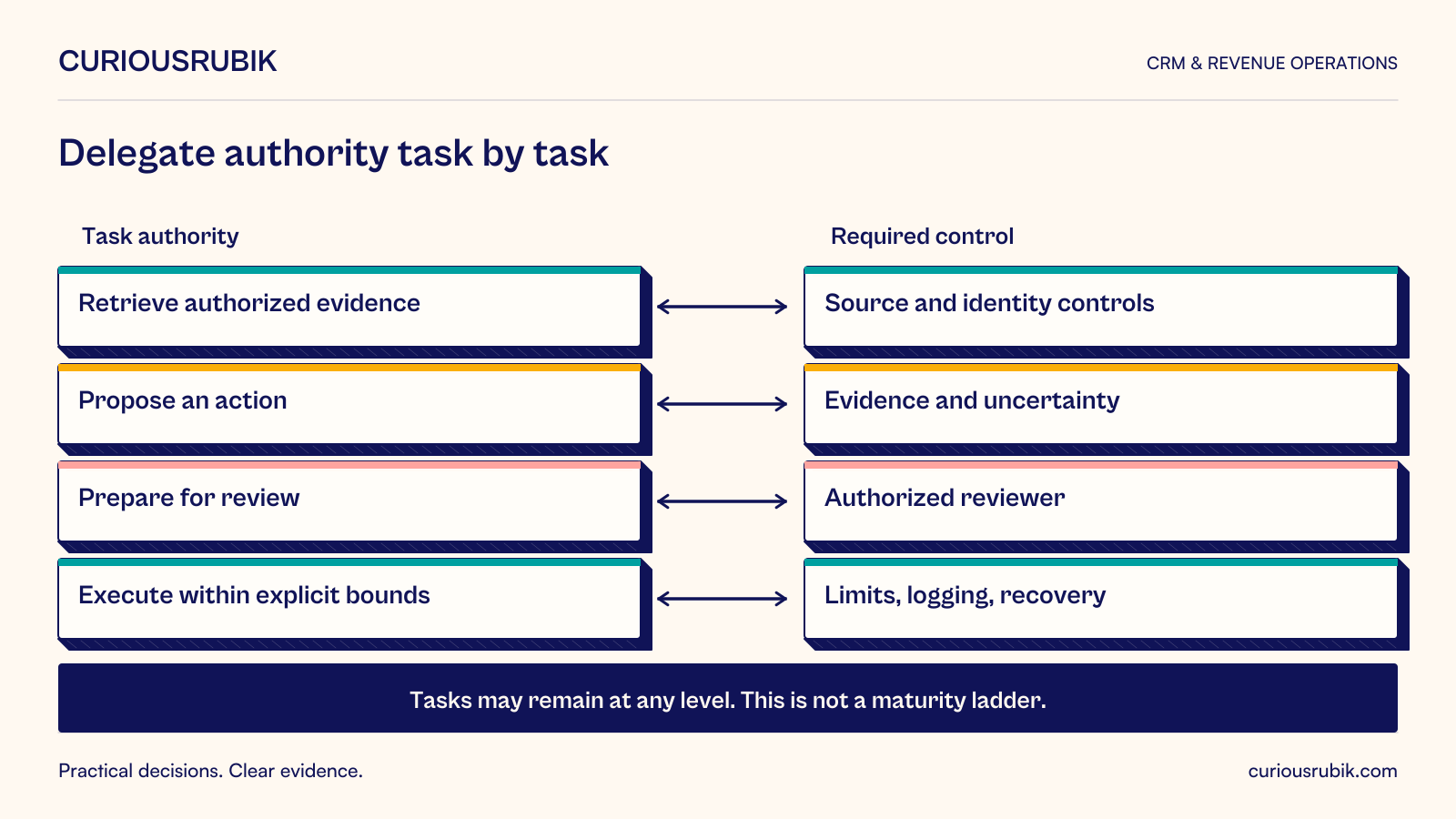
A useful working heuristic is to consider four levels of authority: retrieve, propose, prepare, and execute. This is a proposed enterprise design tool, not a maturity ladder every organization must climb.
At the retrieve level, the system finds information within the user’s access rights. It still needs relevance, identity, and confidentiality controls. Read-only access can expose sensitive information if permissions are poorly implemented.
At the propose level, it recommends an action and presents evidence. The person remains responsible for deciding whether the recommendation fits the customer’s situation. The interface should support disagreement and correction.
At the prepare level, it creates a draft or structured transaction for review. The system can reduce mechanical effort while leaving a consequential commitment with an authorized person. Review must show material facts and effects clearly enough to be meaningful.
At the execute level, it performs a bounded action under explicit policy and authority. The boundary should include eligible cases, allowed effects, spending or concession limits where relevant, communication rules, and escalation conditions. Some actions should remain outside this level regardless of technical capability.
Different tasks can remain at different levels indefinitely. A business may automate an internal reminder while requiring approval for a service-credit offer. That is a coherent design, not evidence of incomplete adoption.
Consider a hypothetical business providing contract logistics services. An account manager prepares for a renewal by reviewing service incidents, agreed improvement actions, billing disputes, and the customer’s expected volume changes.
A proposed AI assistant assembles a briefing from authorized records. Each material statement links to its source, with unresolved conflicts highlighted. The assistant can distinguish a confirmed customer request from an internal forecast and identify an improvement action whose completion has not been verified.
The first pilot remains at retrieval and preparation. The assistant drafts a meeting agenda and proposed questions. It cannot change the renewal price, promise additional capacity, close a service issue, or send a customer message without the required approval.
The evaluation includes a customer with two similarly named subsidiaries, a service incident later corrected, an expired proposal, and a document containing instructions that conflict with the assistant’s authorized task. Retrieved customer content is treated as evidence to interpret, not authority to expand access or take unrelated actions.
The reviewers assess whether the brief omits a material obligation, attributes a statement to the wrong entity, or presents an unsupported commitment as agreed. They also measure the time needed to verify and correct the brief. A fast draft that requires extensive checking may offer little practical benefit.
If the pilot is useful, the next step could allow creation of internal follow-up tasks from approved meeting notes. That would require duplicate prevention, ownership checks, and clear cancellation behavior. The organization need not authorize autonomous commercial negotiation to gain value from the earlier capabilities.
Model performance is only one part of the outcome. Retrieval, permissions, prompts, source quality, user interface, approval design, and downstream integrations all affect whether the system behaves responsibly.
NIST’s AI Risk Management Framework 1.0 organizes risk management through Govern, Map, Measure, and Manage. These functions support ongoing, context-sensitive risk work rather than a one-time declaration that a model is safe. The CRM approach described here is an application of that principle, not a claim of NIST certification. NIST AI RMF 1.0.
Build an evaluation set from representative tasks and known difficult cases. Include incomplete evidence, contradictory records, unusual account structures, and requests outside the system’s authority. Define unacceptable failures before testing.
Measure useful completion, factual support, inappropriate disclosure, unauthorized action attempts, correction effort, and exception handling as relevant to the task. Do not collapse all failures into one accuracy percentage if their consequences differ materially.
Reevaluate when the model, retrieval sources, business rules, or workflow changes. A configuration that performed well in one customer segment may not transfer safely to another with different contracts or service obligations.
An explanation is useful when it helps a reviewer understand the basis and limits of an output. A persuasive narrative can create confidence without providing reliable evidence.
NIST’s Four Principles of Explainable Artificial Intelligence distinguish explanation, meaningfulness, explanation accuracy, and knowledge limits. For CRM, these principles suggest that explanations should fit the user’s task, faithfully describe the basis of the result, and acknowledge when the system lacks sufficient knowledge. NISTIR 8312.
Prefer inspectable sources and clear uncertainty over a long generated justification. A service agent needs to know which contract clause supports entitlement and whether an amendment exists. A sales leader needs to distinguish observed customer behavior from a model’s inference.
Source links alone are insufficient. Verify that the cited material supports the actual claim and that the user is authorized to access it. A citation can be real while the statement attached to it is unsupported or overstated.
“Human in the loop” is incomplete without specifying who reviews, what they see, how much time they have, and what authority they can exercise. A reviewer facing a large queue of polished outputs may approve mechanically.
Give reviewers the information necessary to challenge the result. Highlight material changes, uncertain facts, and proposed external effects. Allow them to reject or correct the output without losing useful work.
Set workload limits and escalation paths. If a workflow creates more review work than the team can handle, narrow its scope or improve the preparation quality. Do not treat growing review queues as proof that people are resisting automation.
Record decisions at a useful level of detail. Preserve the approved action and important changes without collecting unnecessary personal information or creating an unreadable audit trail. The objective is accountability and learning, not exhaustive logging for its own sake.
The economic case should include preparation time saved, verification effort, exceptions, monitoring, and ongoing maintenance. It should also consider whether released capacity can be used productively.
A system that drafts a response in seconds can still be uneconomic if the user must spend longer checking it than writing it. Conversely, a modest time saving across a reliable high-volume task can be useful without an ambitious autonomy claim.
Compare with simpler alternatives: better search, structured templates, clear business rules, or improved source data. AI should justify its additional complexity in the specific workflow. Some tasks will remain better served by deterministic logic.
Avoid assigning speculative revenue gains to every recommendation. As with other customer-intelligence tools, identifying an opportunity and demonstrating that an intervention creates incremental value are separate questions.
The technology will change, but the enterprise can preserve useful control points. Keep business permissions separate from model instructions, maintain a representative evaluation set, retain authoritative records, and define interfaces that allow components to be replaced.
Review supplier terms, data handling, model changes, and service dependencies with the appropriate specialists. A low-cost demonstration can become a significant operational commitment once employees depend on it for daily work.
The future CRM may feel less like a database and more like an assistant to customer-facing teams. Its reliability will still depend on disciplined records, bounded authority, and accountable decisions. Enterprises that establish those foundations can adopt useful capabilities as they mature without making customer trust dependent on an unexamined promise of intelligence.