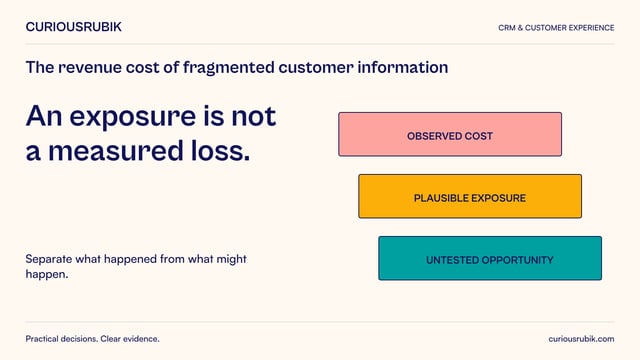
A customer has opened fewer support tickets this month. That observation might indicate a smoother experience, reduced use, a change of contact, or a decision to stop asking for help. The data point does not choose among those explanations.
Customer intelligence begins when evidence is interpreted for a specific decision, with uncertainty visible and a useful action available. More records, more dashboards, and more sophisticated models can contribute. None is sufficient by itself.
For a commercial leader, the important distinction is between knowing something about a customer and knowing enough to act responsibly. A useful intelligence program must connect observation, interpretation, decision, intervention, and learning. Otherwise, the organization produces increasingly elaborate descriptions while customer-facing teams continue to rely on intuition at the moment of action.
Define the decision before selecting the signal
Start with a decision such as which accounts need a service review before renewal. Define the action, owner, capacity, and time horizon. A prediction is of limited use if it arrives after the customer has already decided or if nobody can provide the proposed intervention.
Next identify signals that could change that decision. Usage patterns, unresolved commitments, contact changes, and payment disputes may be relevant in different contexts. Their meaning depends on the product and customer relationship.
A monthly customer with seasonal activity should not be judged against a weekly usage pattern. A low-ticket customer may be highly successful or disengaged. A support escalation can signal risk, but it can also reflect a healthy customer’s willingness to invest effort in solving a problem.
Write down alternative explanations. This simple discipline prevents a dashboard label from turning an ambiguous observation into a presumed cause. It also helps identify what additional evidence the account owner should seek before acting.
Keep facts, interpretations, and recommendations separate
A fact might be that three agreed onboarding tasks remain incomplete. An interpretation might be that the customer is struggling to implement. A recommendation might be to offer a focused setup session.
Store these as distinct objects or clearly labeled fields. Include the source, observation time, interpretation method, and review status. If the underlying fact changes, the interpretation may need to be revisited. If an employee rejects the recommendation, record a meaningful reason rather than treating rejection as user failure.
A model score is an estimate produced under assumptions. It should not become a permanent customer characteristic merely because it is displayed prominently. The same applies to human judgments such as “difficult account” or “strong champion.” Require useful context and avoid unsupported personal characterizations.
NIST’s AI Risk Management Framework emphasizes context, measurement, governance, and ongoing risk management across the AI lifecycle. For customer intelligence that uses AI, this supports evaluating the system in its actual decision setting rather than treating model output as self-validating. NIST AI RMF 1.0.
Use a decision-evidence chain
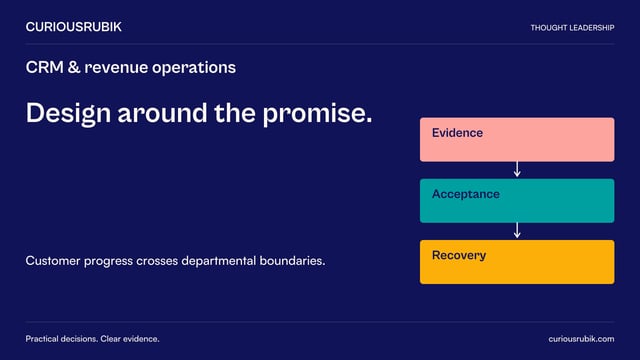
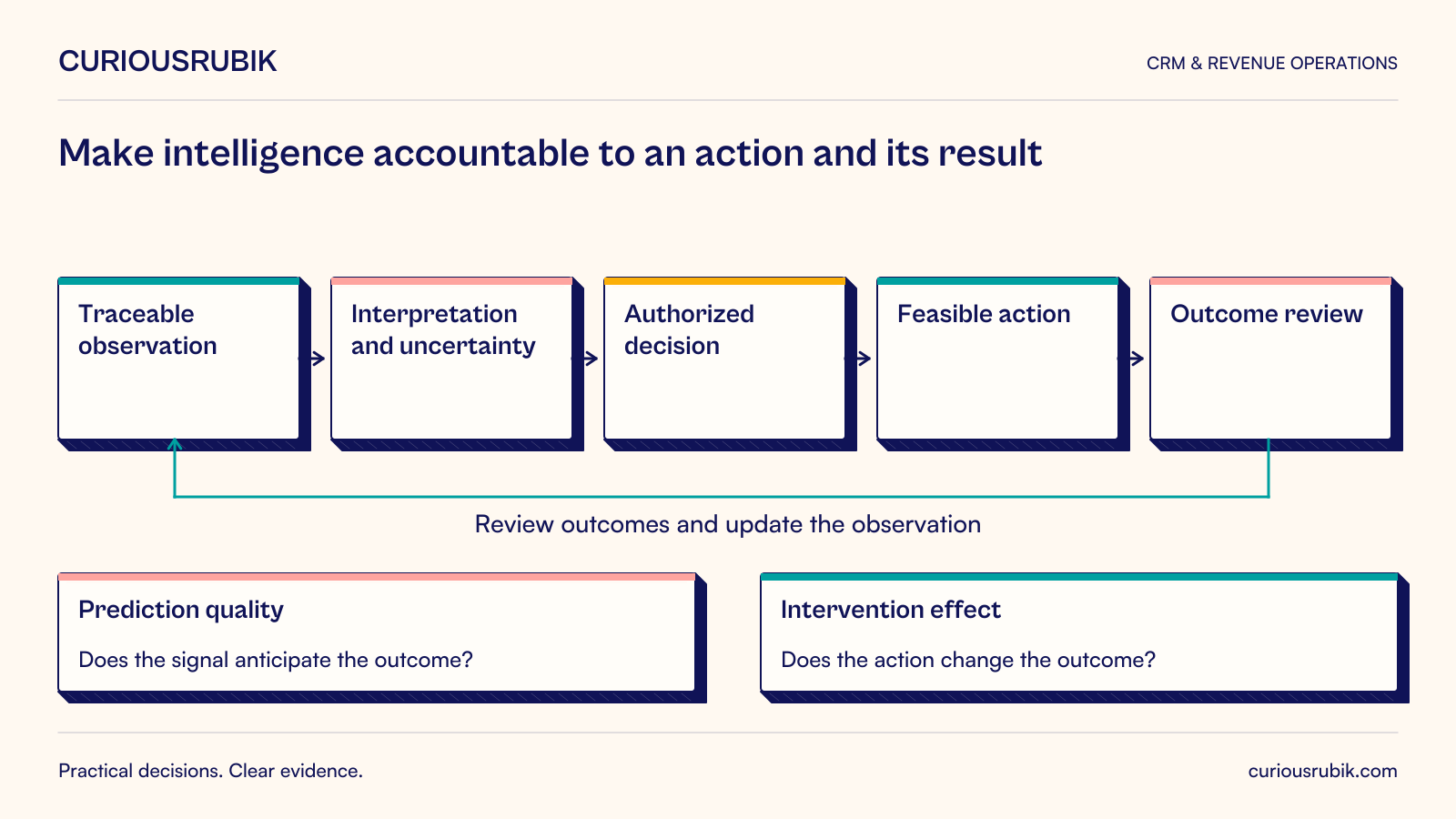
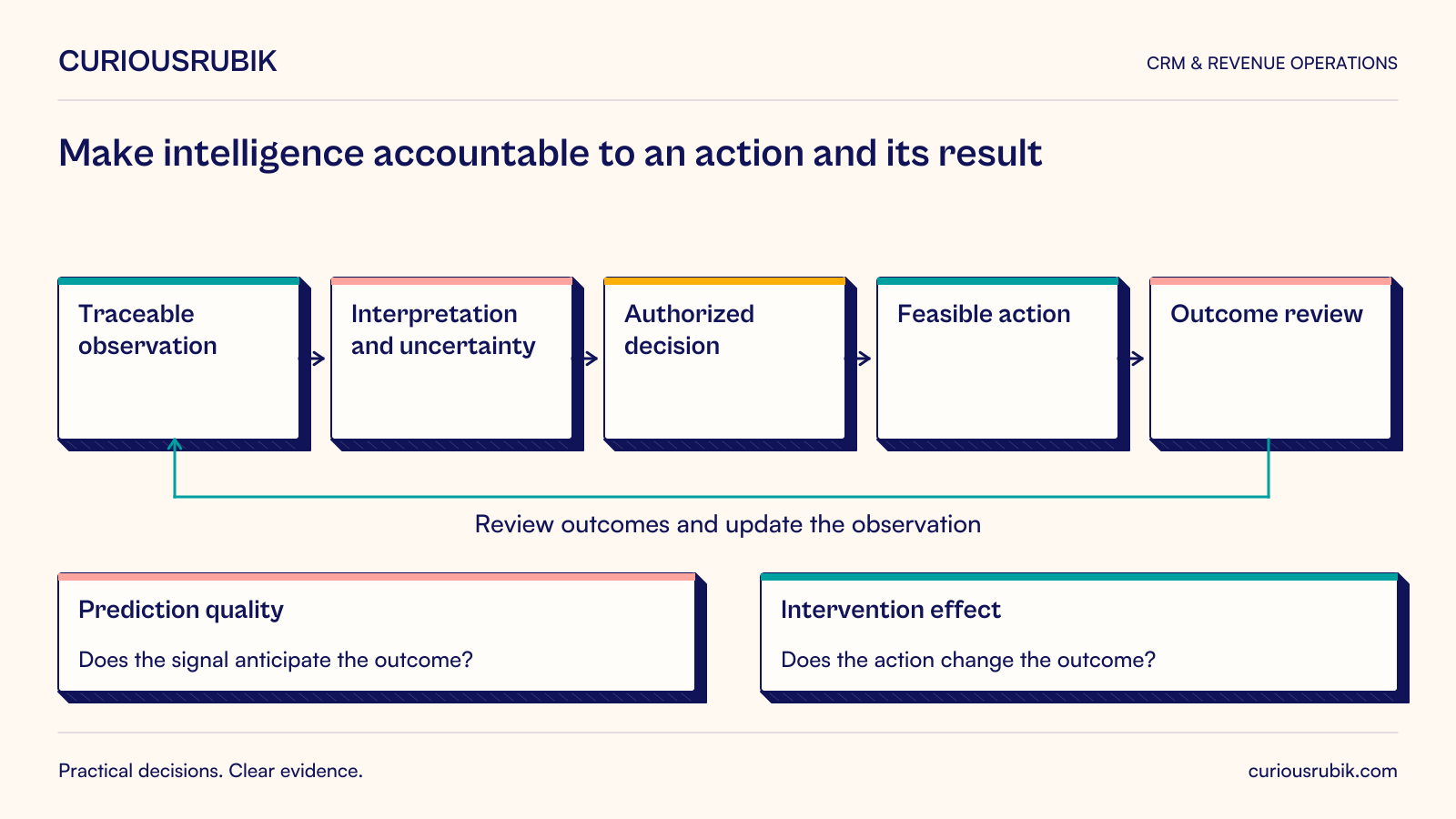
A practical working heuristic connects five elements: observation, interpretation, decision, action, and outcome review. It is a proposed operating method rather than a standard or a validated scoring model.
The observation must be traceable and relevant. The interpretation must state what the evidence suggests and what remains uncertain. The decision must belong to an authorized role. The action must be feasible and appropriate. The outcome review must test whether the intervention helped, not merely whether somebody followed the recommendation.
This chain exposes several common weaknesses. An accurate prediction may have no useful intervention. A sensible recommendation may arrive too late. A successful action may be recorded so poorly that the organization learns nothing from it.
Before adding a new model, inspect the weakest link. If account managers cannot see whether a promised service review occurred, a more sophisticated risk score may increase the volume of untracked work rather than improve retention.
A learning platform tests what low usage actually means
Consider a hypothetical corporate learning provider. Its customer-success team uses falling login counts to flag renewal risk. The signal identifies several accounts, but account reviews reveal different situations: one customer has completed a time-limited program, another is waiting for new content, and a third has lost its internal coordinator.
The same signal calls for different responses. A completed program may need an appropriate next offering. A content gap requires a product or delivery decision. A coordinator change may require an introduction and a revised implementation plan. Sending every account the same “engagement” email would ignore the actual problem.
The provider changes its process. A usage decline becomes a prompt for a short contextual review. The account owner confirms the program’s intended cadence, current objective, and known blockers. The system then suggests a relevant action with supporting evidence, while allowing the owner to record why no action is appropriate.
The team also separates predictive evaluation from intervention evaluation. It asks whether the signal identifies accounts likely to lapse, then asks whether the chosen response changes outcomes. Those are different questions. A strong predictor can identify customers whose decisions are difficult to influence.
For a bounded pilot, the business defines eligible accounts and a consistent review period. Where appropriate and feasible, it compares randomly assigned intervention and usual-service groups, with safeguards so contractual service obligations are never withheld. If randomization is impractical, it documents selection differences and limits the strength of causal conclusions.
The hypothetical example does not claim a retention uplift. Its purpose is to show why useful intelligence requires context and a testable action, even when the initial signal is easy to measure.
Prediction does not prove the value of intervention
A churn model estimates an outcome under the conditions represented in its data. It does not automatically estimate which customers will benefit from a call, discount, training session, or service repair.
This distinction matters commercially. A business can spend heavily on customers who would have renewed anyway, or target customers whose departure cannot realistically be prevented. It can also harm a relationship by offering an irrelevant intervention at the wrong time.
Evaluate the intervention using a design appropriate to the question, volume, and operational constraints. The NIST/SEMATECH statistical handbook connects experimental-design choice to the objective and the factors being studied. Its methods were developed for broad scientific and engineering use; a customer experiment needs domain-specific design and appropriate statistical expertise. NIST/SEMATECH, Selecting an experimental design.
Define the primary outcome before examining results. Include the cost of the intervention and possible harms, such as unnecessary concessions, repeated contact, or diversion of scarce specialist capacity. A higher response rate is not necessarily a better commercial or customer outcome.
Evaluate intelligence at the point of use
Overall model accuracy can conceal important operational differences. Examine performance for the customer groups, products, and situations where the recommendation will be used, subject to lawful and appropriate data handling.
Consider false positives and false negatives separately. A false risk alert may waste a low-cost review or trigger an inappropriate discount. A missed alert may leave a material service issue unattended. The acceptable balance depends on the action, not on a universal accuracy target.
Assess timing. Information that arrives just before renewal may be too late for a service intervention. A slightly less precise signal available earlier can sometimes be more useful, provided the action is proportionate and the uncertainty is understood.
Test whether users can inspect the evidence and correct mistakes. A recommendation that cannot be challenged may encourage automatic acceptance or complete rejection. Both reduce the opportunity for informed judgment and learning.
Build feedback that does not reinforce its own assumptions
Customer intelligence changes the environment that produces future data. If a high-risk score causes more service attention, subsequent outcomes reflect both the original risk and the intervention. Treating those outcomes as if nothing changed can distort later analysis.
Record which recommendation was shown, whether it was accepted, what action occurred, and when. Preserve the model or rule version and the information available at the time. Avoid reconstructing past predictions from records that have since been updated.
Capture reasons for overrides in a concise, usable form. A seller may know a legitimate fact absent from the model, or may reject a useful signal because it conflicts with expectations. Review patterns rather than assuming either the human or the model is consistently correct.
Monitor for changes in the business. A new pricing model, altered customer mix, or changed support process can reduce the relevance of historical patterns. Define who can pause the recommendation and how the team falls back to a simpler process when confidence is inadequate.
Respect the boundary of appropriate knowledge
Information can be predictive without being appropriate to collect or use. Customer intelligence should have a defined purpose, a legitimate information basis, and controls against inappropriate disclosure or profiling.
Avoid inferring sensitive personal characteristics or using opaque labels where a direct operational fact is sufficient. A documented service interruption is usually a more defensible basis for outreach than speculative conclusions about a contact’s personality or personal circumstances.
Give staff clear guidance about the difference between operational observations and personal judgments. Review automatically generated summaries before using them in consequential decisions. The availability of a signal does not establish permission to use it for every commercial purpose.
Where decisions affect legal rights, access to essential services, or other high-impact outcomes, involve qualified legal and risk specialists. The lightweight commercial methods in this article do not replace domain-specific obligations.
The buyer’s test for an intelligence capability
Ask a supplier to demonstrate the complete chain. What evidence produces the recommendation? What uncertainty remains? Who can act? How is the action recorded? How will the business determine whether it helped?
Request evaluation on representative cases, including stale data, an unusual customer, and a rejected recommendation. Compare the proposed approach with a simple rule or existing process. Sophistication should earn its additional cost through better decisions and manageable risk.
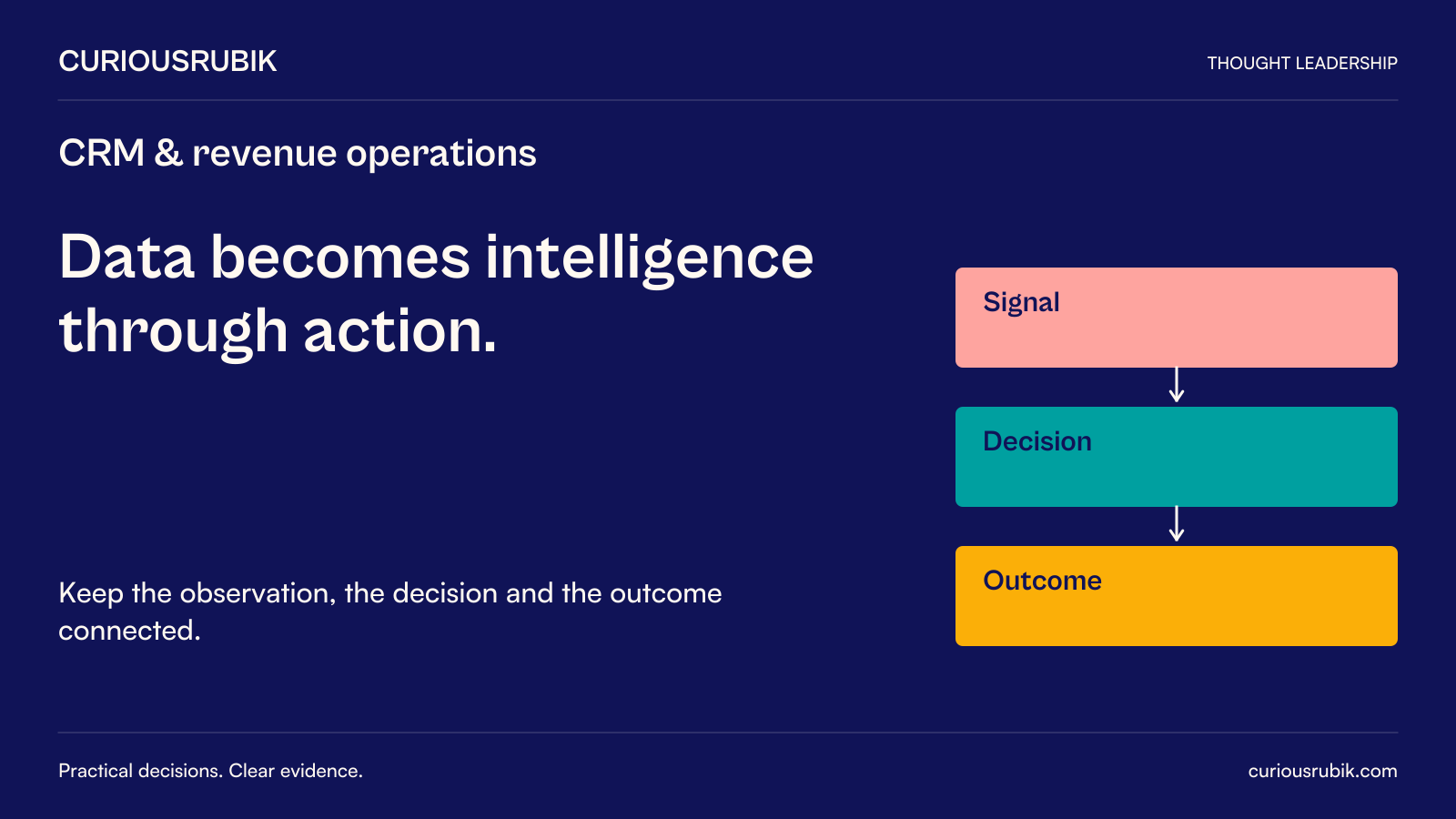
The distinction between data and intelligence is ultimately operational. Data describes something observed. Intelligence helps a responsible person choose and evaluate an action in context. When the action and learning loop are missing, adding more data may improve the view while leaving the business’s decisions unchanged.