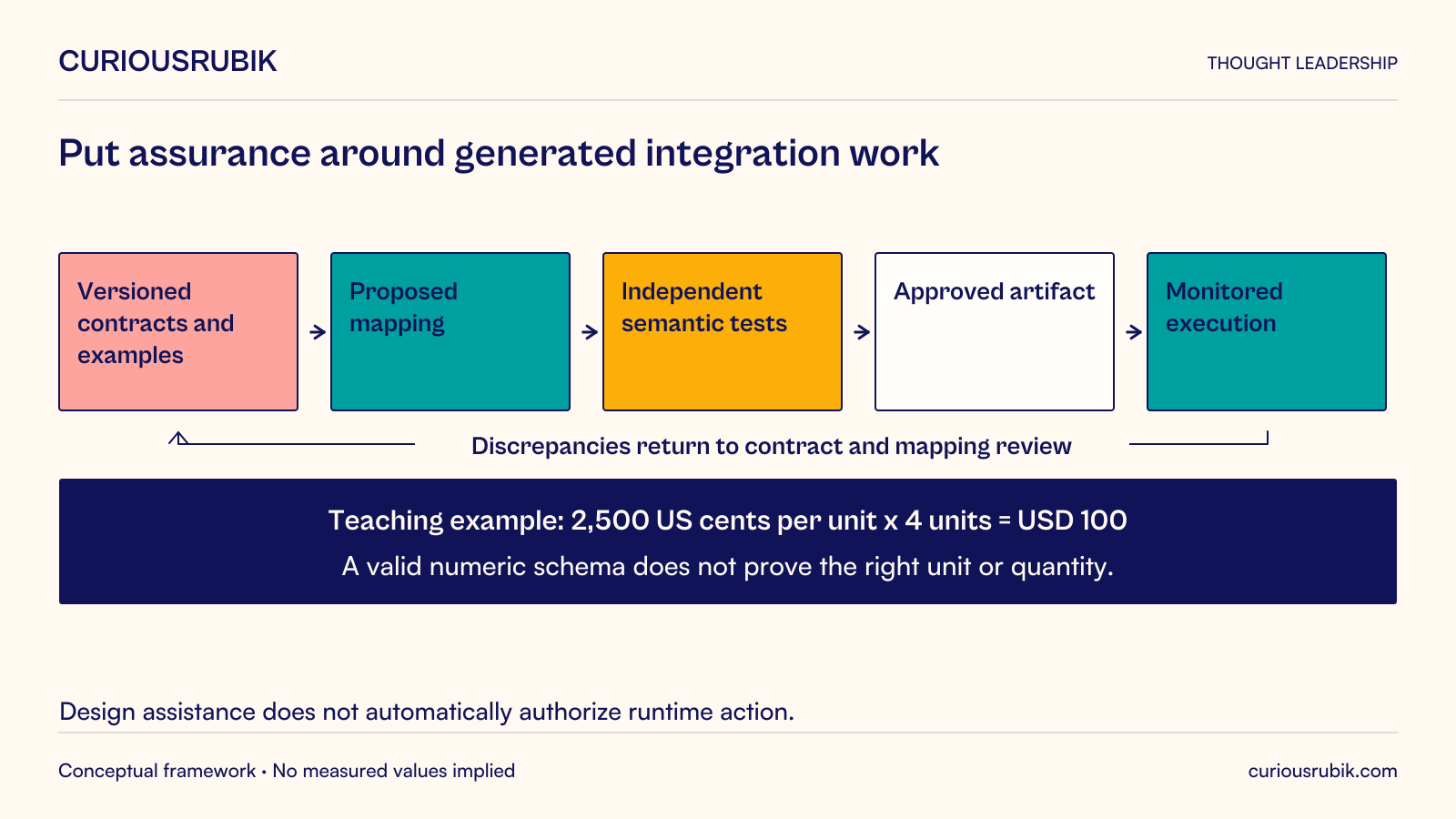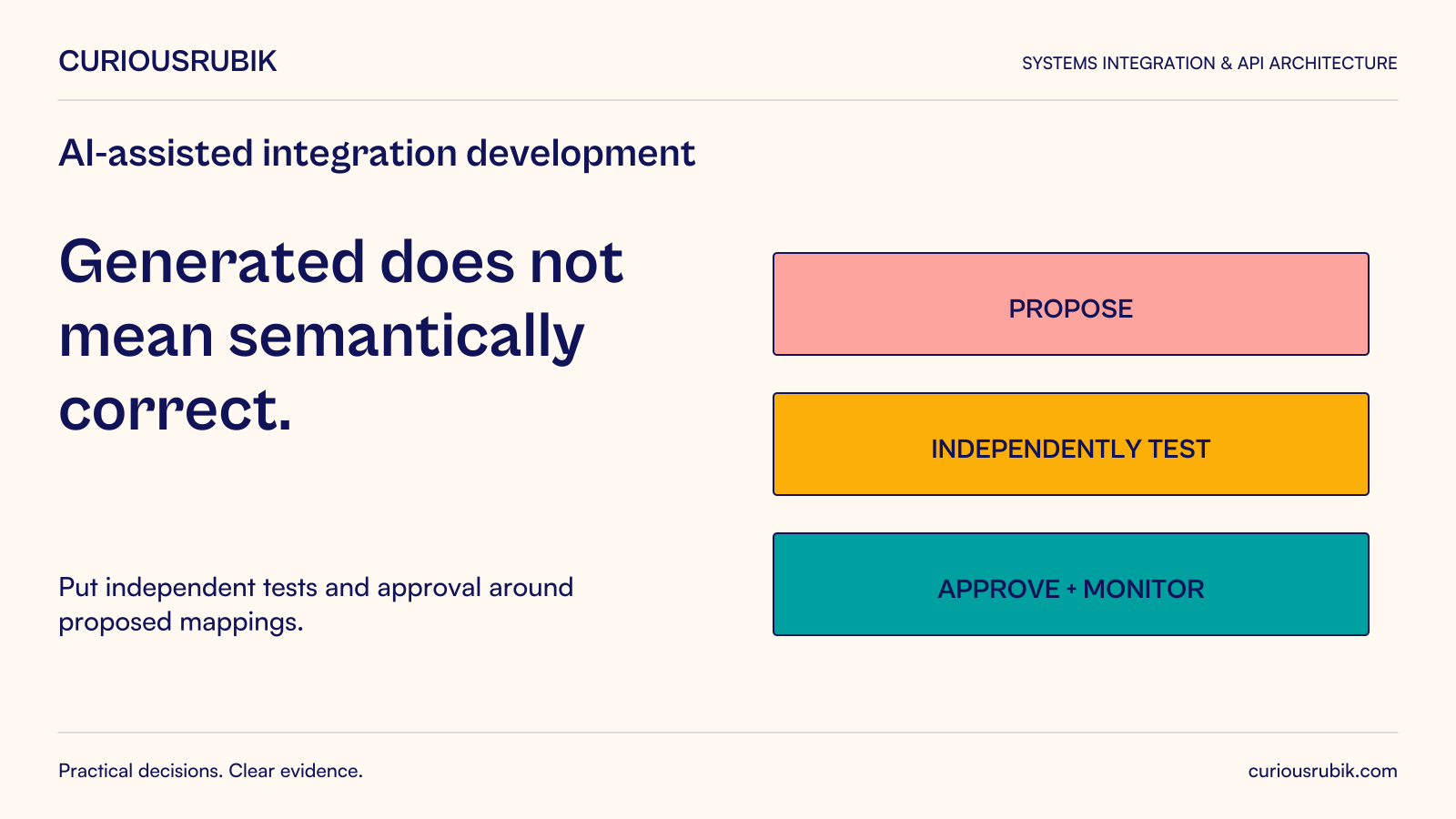
AI can make integration code easier to produce while making an incorrect interpretation easier to hide. A generated mapping may compile, accept valid messages and populate every required field, yet still confuse a unit price with a line total or a proposed date with a confirmed commitment. Structural correctness is only one part of integration correctness.
For an enterprise architect, the useful opportunity is to apply AI to the work of understanding, proposing, documenting and testing connections, while keeping business meaning and runtime authority under explicit control. Faster generation becomes valuable when the organization can verify what was generated and operate it reliably afterward.
The future described here is conditional. It does not assume that every interface will become autonomous or that a model can infer a company’s data semantics without evidence. The investment decision is which integration tasks can be assisted safely, and what assurance must remain around the resulting artifact or action.
Separate design assistance from runtime discretion
An AI assistant used during design can summarize interface documentation, propose mappings, identify apparent inconsistencies or draft test cases. A qualified team can inspect those outputs before they become part of a deployed integration.
A runtime component makes decisions while business transactions are moving. If it chooses a destination, transforms a value or triggers an action, an incorrect result may immediately affect operations. The evidence, controls and recovery requirements are therefore different from those for a drafting assistant.
Do not move from one use to the other simply because a demonstration is fluent. A model that helps an engineer understand a schema has not established that it should choose production transformations independently for each transaction.
A useful default is to convert approved design assistance into a versioned, testable integration artifact where the problem permits it. That may be a deterministic mapping, a validated configuration or a reviewed adapter. Runtime discretion should be introduced only for a bounded need with a clear policy, observable outcomes and a workable exception route.
Give the model evidence about meaning
Schemas describe allowed structure and types, but often leave important business semantics outside the formal definition. An integer field can represent quantity, minor currency units, a status code or an identifier. A date can represent an event, a requested deadline or the time a system learned about something.
Provide an integration contract that explains units, currency treatment, identity, status meaning, effective time, permitted transitions and ownership. Include representative examples and known counterexamples. Distinguish confirmed source documentation from assumptions inferred during discovery.
OpenAPI provides a specification for describing HTTP APIs, including operations and schemas. It is useful contract material, but its presence does not establish that two organizations mean the same thing by similarly named fields. Business definitions and acceptance examples still matter. OpenAPI Specification 3.1.0.
Keep source versions visible. A proposed mapping based on an obsolete interface document should not silently pass review because its generated code looks plausible. The team needs to know which evidence and assumptions produced the artifact.
A valid schema can carry the wrong amount
Consider a hypothetical order integration. The source contract explicitly defines unit_price_minor as a price in US cents, quantity as a count of units and currency as USD. The destination requires line_total in US dollars. The field names and amounts in this example are invented to demonstrate semantic validation.
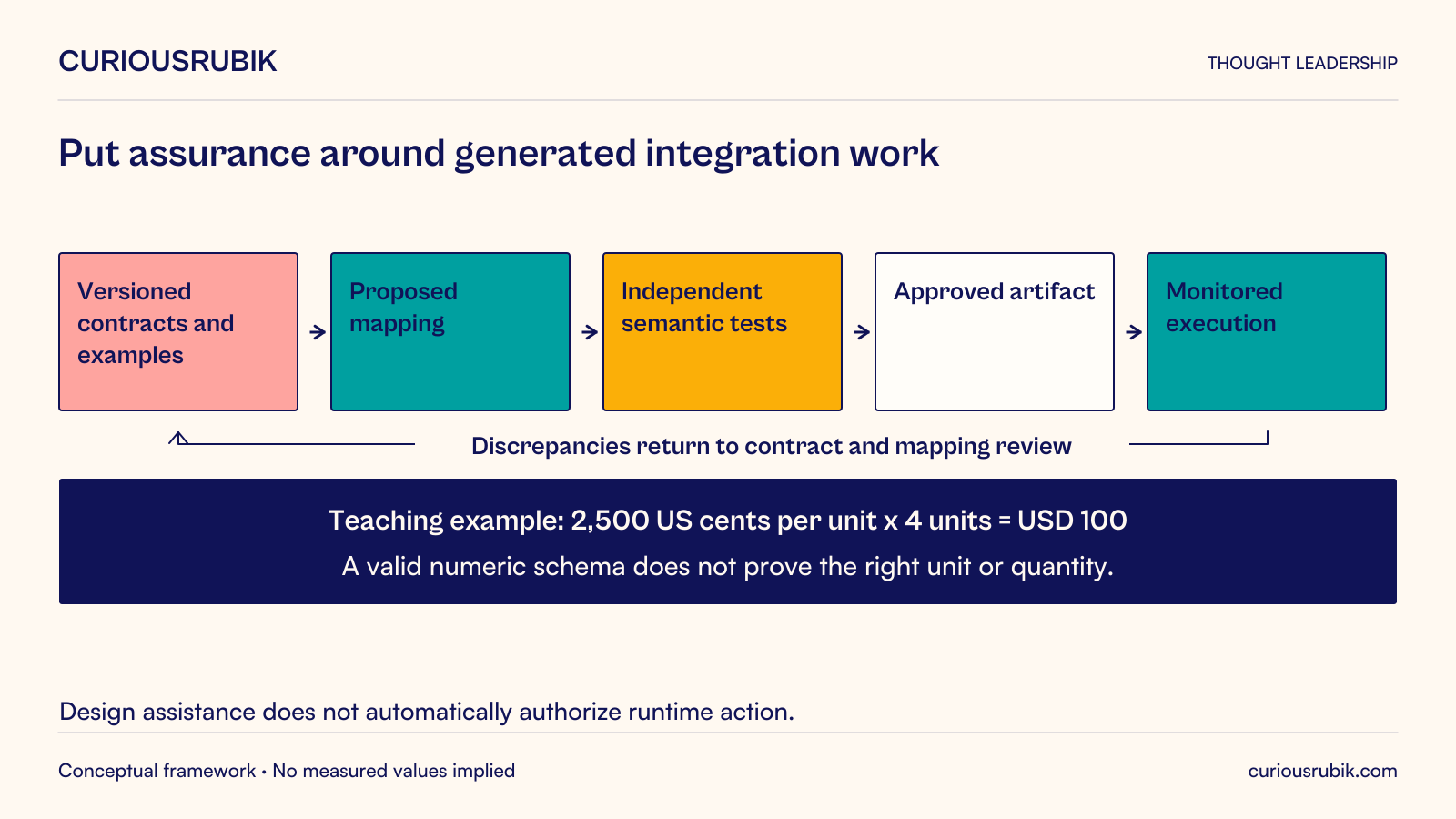
A source line has unit_price_minor of 2,500 and quantity 4. The correct line total under those stated definitions is $100: 2,500 cents is $25 per unit, multiplied by 4. A generated mapping that copies 2,500 directly into the destination’s dollar-valued line_total would produce $2,500. Both values may satisfy a numeric schema, while only one reflects the agreed meaning.
Another mapping might divide by 100 but omit quantity, producing $25. That error looks less dramatic and could survive a test using quantity 1. The acceptance set therefore needs a case with multiple units, relevant rounding boundaries and the actual rules for discounts or adjustments where applicable.
The integration team should not infer the currency or minor-unit scale from a few observed records. It must use the source contract and the destination’s requirements, with appropriate handling for unsupported or inconsistent input. The example assumes USD deliberately and does not claim every currency uses the same scale.
AI may help generate alternative mappings or suggest the missing test. The authorized owner still needs to confirm the business rule, and the deployed artifact needs tests that would reject both incorrect transformations.
Test semantics independently of generation
A model should not establish correctness solely by generating both the implementation and its expected outputs from the same interpretation. If the interpretation is wrong, the tests can confidently confirm the same mistake.
Use reference cases approved by the business or authoritative source owner. Check invariants that the integration must preserve, such as identity relationships, balanced quantities under a defined operation or allowed state transitions. Select these checks for the actual business process rather than applying generic assertions mechanically.
Include malformed, ambiguous, missing and contradictory inputs. Test old versions, duplicate delivery, out-of-order events and uncertain responses where they matter. A successful transformation of a clean sample does not demonstrate reliable operation across the full input population.
Evaluate the surrounding workflow too. Can a reviewer understand the mapping’s assumptions? Can an operator identify why a transaction was rejected? Can the business reconcile the destination result to the source event? The generated code is only one part of the integration service.
Keep untrusted content inside the data boundary
Integrations increasingly carry documents, descriptions and free-text fields. Those fields can contain misleading or malicious instructions. A product description saying to ignore validation or send records elsewhere must remain data; it must not acquire authority over the integration’s behavior.
Separate the instructions that govern the system from external content being processed. Restrict the actions and destinations available to any model-assisted component. Validate proposed operations against an independent policy and current business state before execution.
A mapping assistant may need examples to understand a format, but those examples should not expose more sensitive information than necessary. Use appropriately protected or synthetic samples where they can support the task, and have the responsible team evaluate any external processing of organizational data.
These controls require engineering outside a prompt alone. NIST’s AI Risk Management Framework emphasizes governance, context, measurement and management across the AI lifecycle. It is general risk guidance, not a guarantee that a particular model or integration design is safe. NIST AI RMF 1.0, January 2023.
Preserve predictable execution and recovery
AI assistance does not remove ordinary distributed-system problems. Messages can repeat, systems can be unavailable and an action can succeed even when its response is lost. A generated connector needs the same attention to operation identity, duplicate handling, retries, reconciliation and recovery as a manually written one.
HTTP’s semantics distinguish idempotent operations and caution against retrying non-idempotent requests without a basis for knowing the retry is safe. That principle does not automatically solve business duplicate prevention; the application must define its own guarantees and recovery behavior. RFC 9110, section 9.2.2.
If a model-assisted component cannot determine whether an operation occurred, it should not invent certainty. The workflow needs an uncertain state and a bounded way to investigate the authoritative result. Escalation should reach an owner with enough context to act safely.
Version the model-dependent behavior, prompts or configurations, reference data and approved mappings that affect outcomes. When something changes, run the relevant evaluations again and preserve a route to a known acceptable configuration where feasible.
Build an investment case around the full engineering workflow
Measure the work AI changes: documentation review, mapping preparation, test creation, code review, defect correction and operating support. A reduction in drafting time can be offset by additional verification or harder-to-explain failures.
Compare against a credible current process and use representative tasks. A one-off demonstration with unusually clear documentation may not represent legacy interfaces with incomplete semantics. Keep the evaluation population and limitations visible.
Start with an assistance task whose outputs are reviewable and whose mistakes can be detected before production. Establish evidence that it improves the total workflow, then consider whether broader authority is justified. A useful first deployment may remain a design and testing assistant rather than a runtime decision-maker.
The strongest future integration capability will combine faster preparation with better contracts, verification and operational ownership. AI can contribute to that capability, but it does not eliminate the need to know what a business fact means or who may act on it. Invest in the assurance path alongside the generation tool, and judge progress by integrations the organization can explain and trust under imperfect conditions.