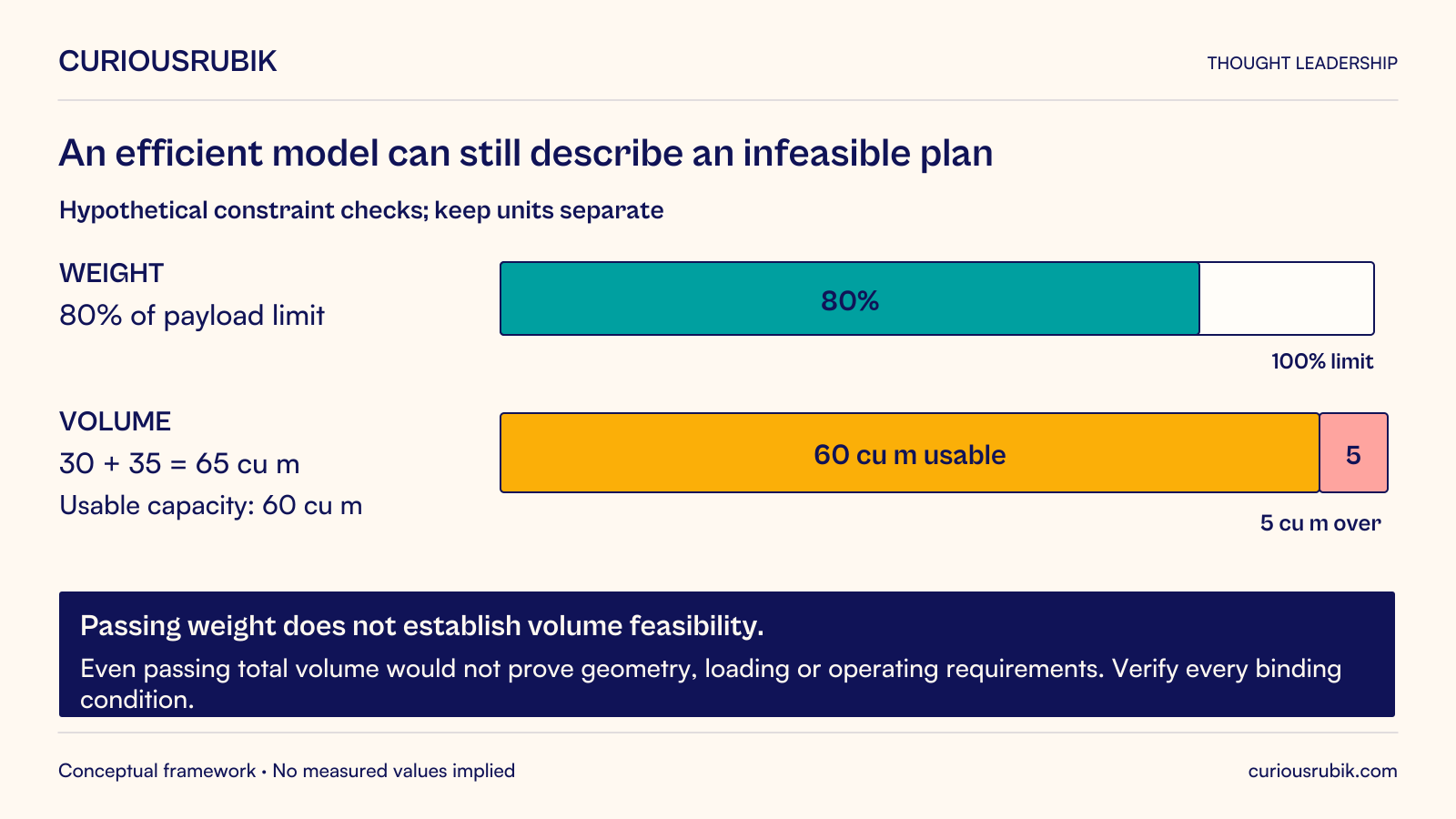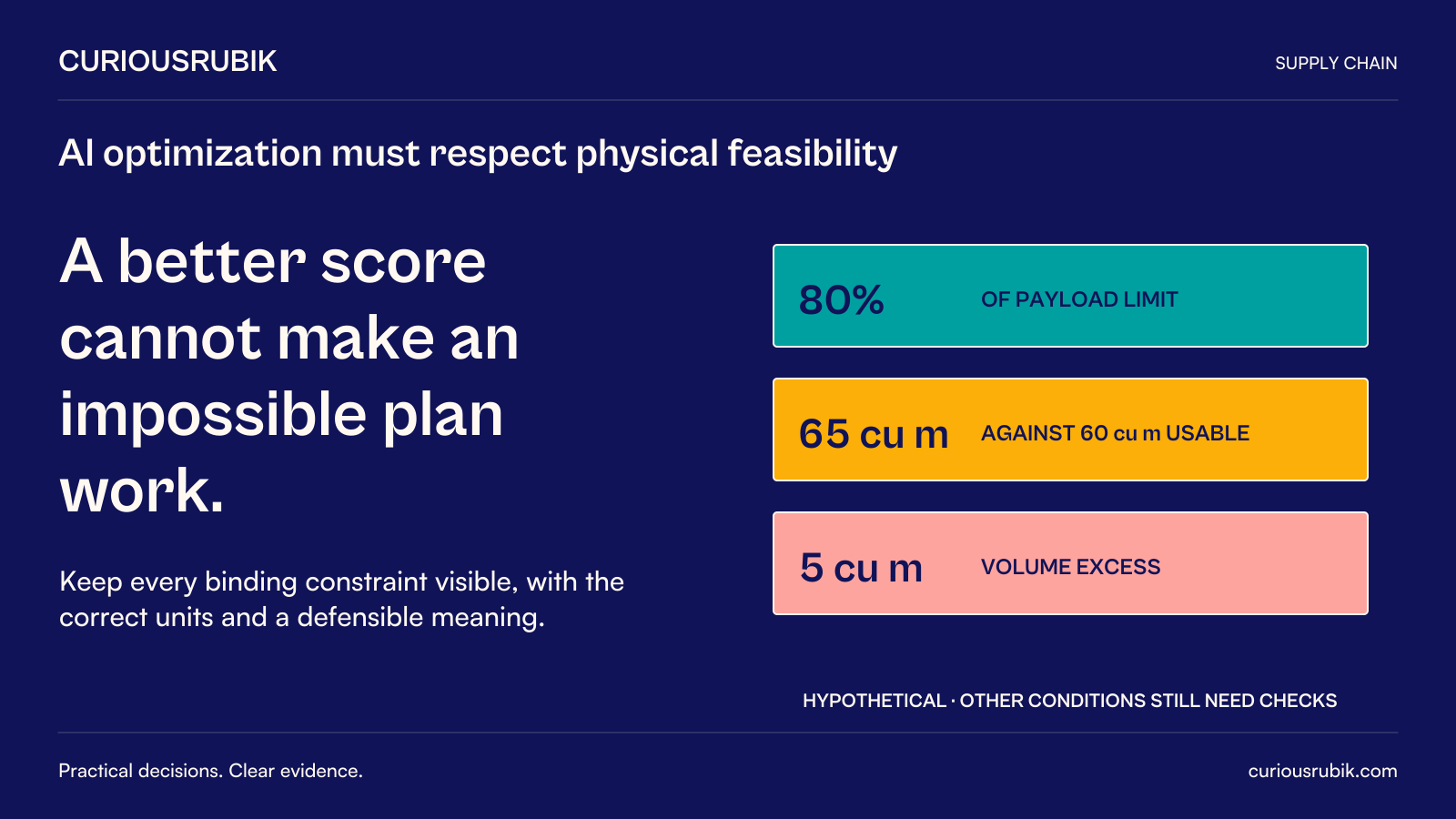
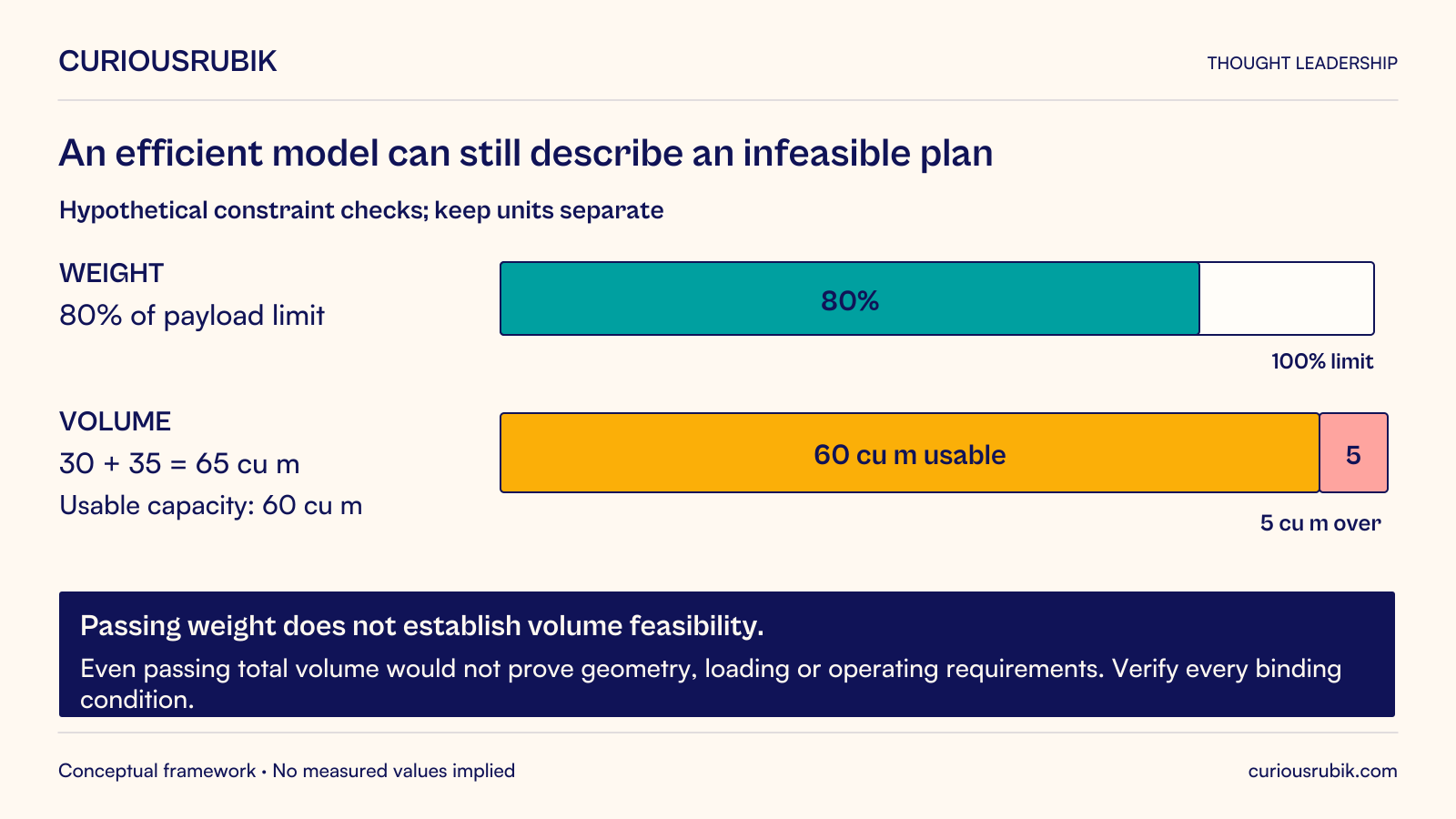
A planning model combines two shipments into one vehicle and reports an efficient result: the combined weight uses only 80 percent of the assumed payload limit. But the shipments occupy 65 cubic metres and the hypothetical vehicle has 60 cubic metres of usable space. The plan is infeasible before any further packing or operating constraints are considered.
The arithmetic is simple. The lesson is not. An intelligent system can optimize a problem precisely while the problem itself is missing a condition that matters in the physical operation.
Future supply-chain intelligence will be useful to the extent that it connects reliable observations, credible models and executable decisions. More predictive power or a more fluent planning interface does not remove the need to establish what the model represents, what it omits and when its recommendation can be trusted.
Ask what kind of intelligence the decision needs
Different capabilities answer different questions. A forecast estimates what may happen. An optimization model selects an option under stated objectives and constraints. A simulation explores how a modeled system may behave. A conversational assistant can help a planner find information or understand a proposed change.
Those capabilities can complement one another, but their outputs should not be confused. A likely delay is not automatically a recommendation to expedite. A low-cost modeled plan is not necessarily feasible. A clear explanation does not establish that the underlying evidence is correct.
Start with a decision that has an identifiable owner and outcome. Specify what information or analysis is missing from the current process and how an improvement could change the result.
The answer may be a relatively simple rule, a better data relationship or a focused model rather than a broad autonomous platform. Intelligence should be judged by the quality of the supported decision, not by the sophistication of the technology label.
Make the model’s physical meaning inspectable
The shipment example uses fictional quantities solely to illustrate model completeness. Assume one load occupies 30 cubic metres and the other 35, for 65 in total, against 60 of usable volume. Their combined weight is assumed to remain within the payload limit.
A model considering weight alone would miss the volume constraint. Adding total volume is necessary for this example, but still not sufficient to prove a real load can be carried. Dimensions, access, compatibility and other applicable operating conditions may matter. Responsible logistics specialists must define and verify the actual requirements.
The system should reveal which constraints were included and which remain unresolved. It should not present a recommendation as fully executable when physical feasibility has only been partially assessed.
This is one reason digital-twin and simulation claims need careful evaluation. A representation of the operation is not the operation itself. The model’s detail should fit its intended decision, with evidence that its behavior is credible within that scope.
A 2022 paper by Shao, Hightower and Schindel on manufacturing digital twins emphasizes verification, validation and uncertainty assessment throughout the model lifecycle. Its manufacturing focus does not validate a supply-chain product, but the credibility principle is relevant when using models to support physical operating decisions. Shao, Hightower and Schindel, Credibility Consideration for Digital Twins in Manufacturing.
Keep observations, assumptions and predictions separate
An intelligent planning service may combine physical events, supplier commitments, forecasts and inferred relationships. Preserve the origin and status of those inputs.
A confirmed receipt, an estimated arrival and an assumed supplier capacity are not equivalent evidence. Their age and uncertainty can affect the decision in different ways. The planner should be able to identify which inputs drive a recommendation and which deserve confirmation.
Connect identifiers across the network. A model cannot reason reliably about a component shortage if the supplier’s part, the internal item and the production requirement are linked incorrectly. More advanced analysis can amplify that error rather than expose it.
Use versioned planning inputs where material. A recommendation generated before an order cancellation or capacity change may no longer apply. The service needs a way to determine whether the decision basis is still valid when the user acts.
Do not convert missing data into a convenient default without considering the consequence. An unknown dimension in the consolidation example should remain an unresolved feasibility condition, not become zero volume.
A useful interface makes these distinctions available without overwhelming the user. It can summarize the recommendation while retaining a route to the evidence, assumptions and exceptions that matter.
Evaluate decisions against alternatives and actual outcomes
A model should be tested for the task it is intended to support. Use representative cases, difficult operating conditions and independently established expected constraints. Include cases where the appropriate result is that no feasible option has been established.
Historical evaluation needs care. A past decision may have depended on information that was not recorded, and a proposed alternative may never have been executed. Do not present a model’s simulated improvement as an observed business result.
Compare with a meaningful baseline. That could be the current planning method, an established rule or another feasible policy. Evaluate the same scope and constraints so that the comparison does not reward the new model for ignoring difficult cases.
Measure the business tradeoffs, not only prediction accuracy. A forecast can become more accurate without improving the decision if the available actions remain unchanged. An optimizer can reduce one cost while increasing delay, risk or workload elsewhere.
Use controlled pilots where appropriate and safe, with the necessary authorization and oversight. Keep rejected recommendations and corrections in the evaluation record. If only accepted outputs are reviewed, the evidence can hide the system’s most important limitations.
The aim is a credible account of when the capability helps, where it fails and what operating conditions invalidate the result.
Design intervention around the planner’s real work
Human oversight should contribute a defined judgment. A planner may need to verify a missing constraint, compare alternatives, assess an unusual customer commitment or decide that the evidence is insufficient.
Give the reviewer the information and time needed to perform that role. A recommendation accompanied by a dense explanation but no clear change summary can make oversight difficult. A queue larger than the team can review can turn approval into a ritual.
For the consolidation example, the reviewer should see the proposed combination, the capacity assumptions and the unresolved physical conditions. The task is not to endorse a generic statement that the model is confident.
Make intervention affect execution. Rejecting or modifying a proposal should prevent the superseded plan from being released through another path. The system should record what was authorized and which version of the plan was used.
Keep correction and recovery practical. A planning error discovered after an external commitment may require an operational response, not merely a model rerun. The responsible team needs to know what has already happened and which actions remain available.
Limit autonomous scope to demonstrated capability
Some routine decisions may eventually support more automated execution when their conditions are clear, outcomes observable and consequences controlled. Other decisions will continue to need specialist judgment or cross-functional agreement.
Define the boundary at the task level. A capability that recommends a transfer should not automatically gain permission to change customer commitments, approve a substitute or issue a purchase. Each action has its own authority and evidence requirements.
Recheck current conditions before committing a consequential action. A sound recommendation can become unsuitable when inventory, capacity or permissions change. Preserve identity and outcome checks so that retries do not create duplicate commitments.
Maintain an explicit pause or escalation path when the system is outside its demonstrated scope. Unfamiliar demand, missing data or a changed network can be a reason to narrow automation rather than force a result.
Expansion should follow evidence from the combined technology and operating process. A successful demonstration in one lane or product group does not establish readiness across the entire supply chain.
Build a learning system without rewriting its evidence
The organization should retain enough history to connect the input state, proposed plan, authorized action and observed outcome. That makes it possible to investigate errors and improve the policy or model.
Distinguish learning from silent policy change. Updating a model can alter recommendations, and the effect needs review, testing and controlled release appropriate to the use. The business should know when its decision logic changes.
Review whether the environment has moved beyond the conditions used to establish credibility. New suppliers, products, transport arrangements or customer promises can invalidate previous assumptions. Monitoring should look for those changes as well as technical failures.
Protect shared information and respect the boundaries under which partners provided it. More connected planning increases the importance of permissions, purpose and responsible handling of sensitive business data.
The future intelligent supply chain is not necessarily the one with the fewest human decisions. It is the one that combines evidence and models well enough to make dependable choices, recognizes when it does not know enough and can learn from the consequences of what it actually does. That foundation is useful whether the next improvement is a simple rule, a digital twin or a more capable planning assistant.