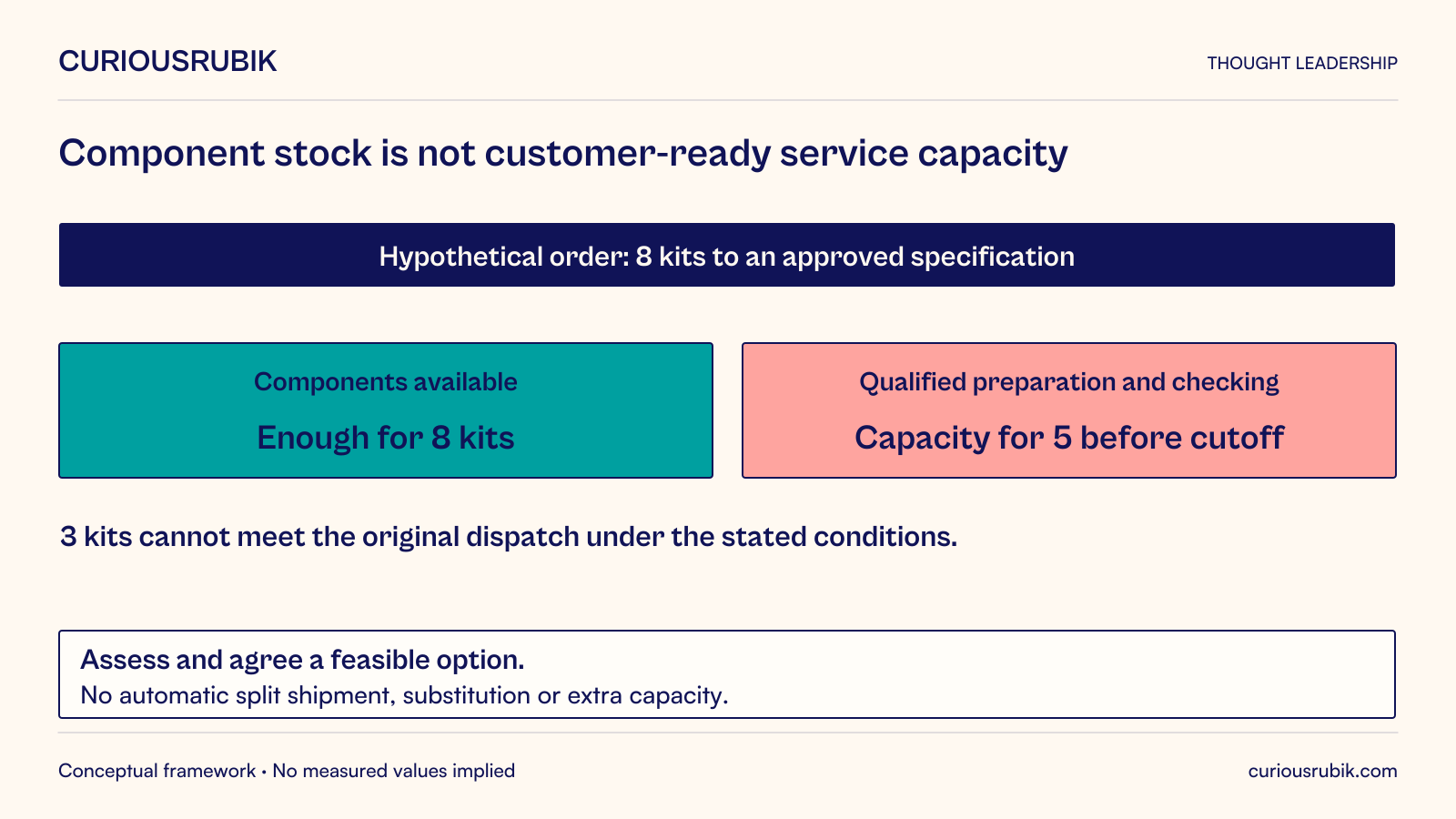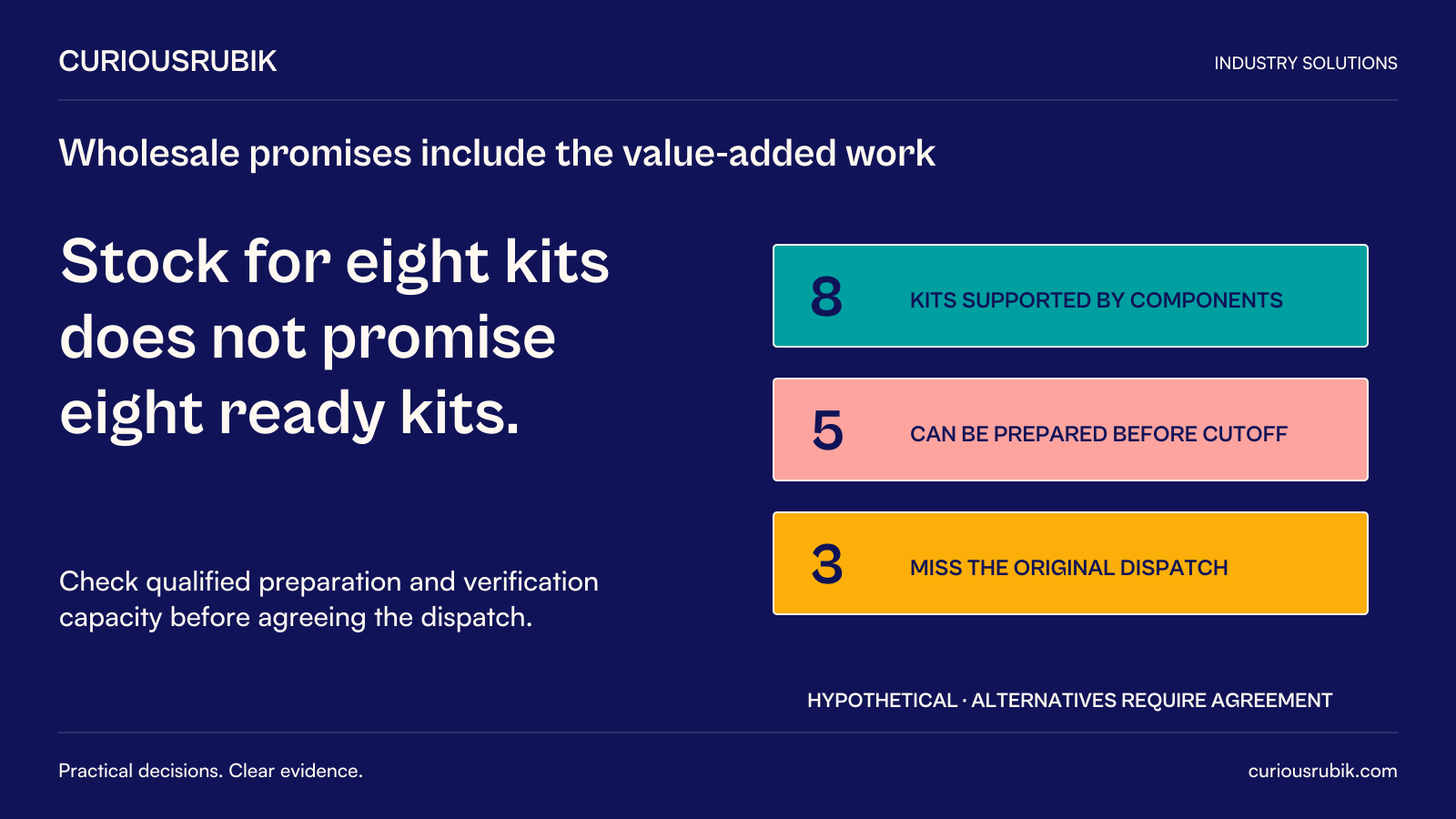
A contractor requests eight installation kits for dispatch on Thursday. The distributor has all the specified components in stock, so its ordering screen shows the request as available. The preparation team can assemble and verify only five kits before the carrier cutoff. Three kits cannot meet the requested dispatch even though no component is missing.
This hypothetical failure exposes a limit of treating wholesale distribution as product availability plus transport. A customer-specific service also depends on preparation capacity, an approved specification, verification and the time required to complete the work.
The future described here is a strategic possibility, not a forecast that every distributor will adopt the same model. Businesses can use technology to provide more dependable value-added services, but the advantage depends on representing those services as real operating commitments rather than attractive labels in a catalogue.
Promise the prepared service, not just its components
Assume each of the eight kits must follow a customer-approved component list, be assembled, checked and labeled before dispatch. The example does not establish technical suitability: that remains with the qualified people responsible for the specification and its approval. The distributor’s task is to fulfill the agreed preparation service accurately.
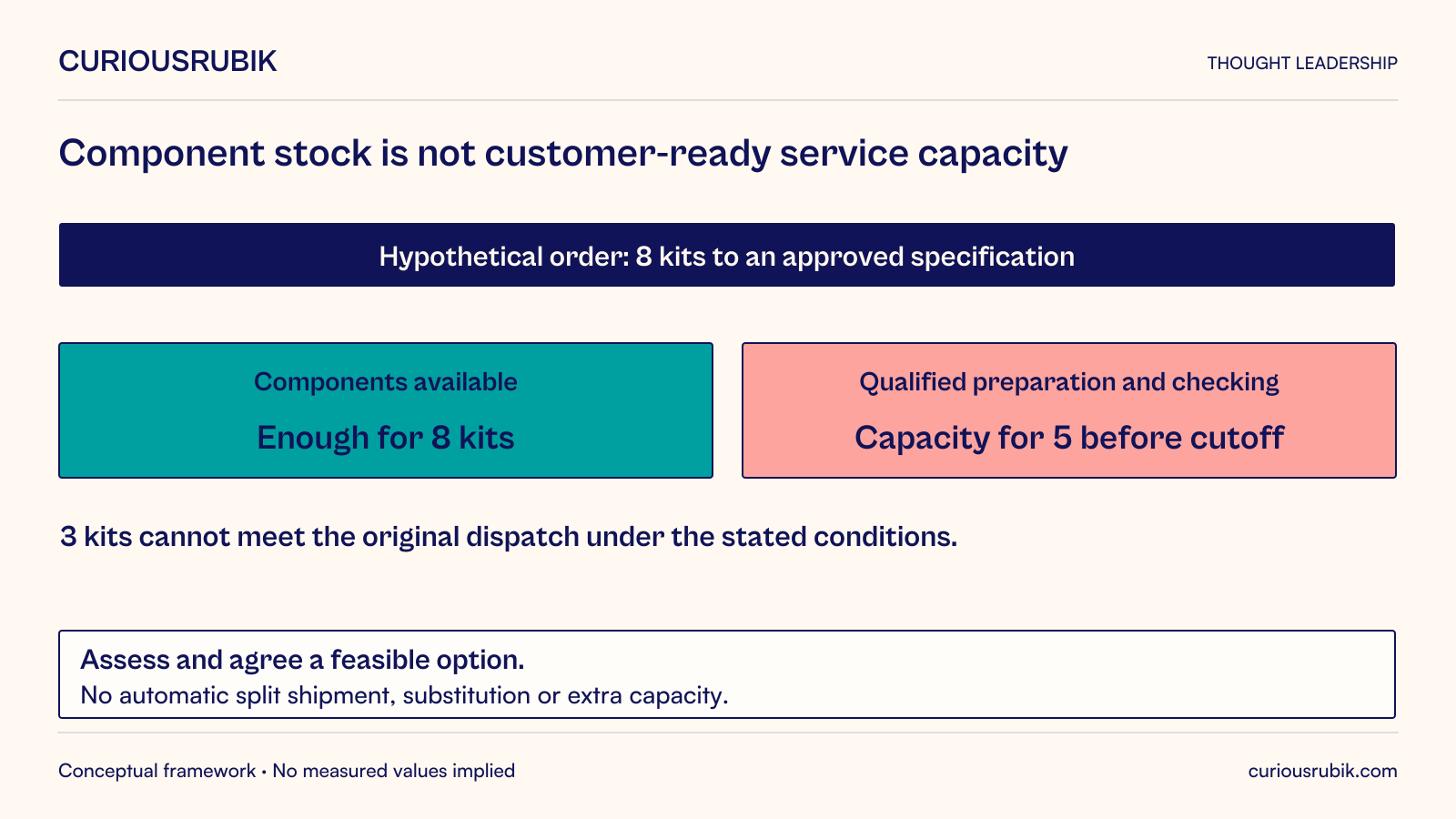
Component stock is sufficient for eight kits. Available preparation and checking capacity before the dispatch cutoff is sufficient for five. The immediate deliverable quantity is therefore no more than five under these assumptions. The remaining three need a different date or another authorized operating arrangement; a stock lookup alone cannot resolve the constraint.
There may be several legitimate responses. The customer could accept five kits first and three later, choose a later complete dispatch, or consider separately supplied components if that is genuinely acceptable for the job. A supervisor might assess additional qualified capacity. None of these alternatives should be substituted automatically for the original request.
A split dispatch can create additional receiving effort or disrupt the customer’s installation sequence. Extra capacity may require different staffing and verification arrangements. Sending loose components transfers work to the customer. Present these consequences alongside the option rather than treating every alternative as an equivalent fulfillment success.
The digital promise needs linked evidence: the applicable kit specification, available components, feasible preparation and verification capacity, and a dispatch window. Reserve the resources required under the business’s chosen process so simultaneous orders do not consume the same apparent capacity. If the specification changes, reassess the affected work instead of assuming the previous estimate still applies.
This is a working service-design example, not a universal scheduling formula. Real operations may have setup times, batch preparation, shared staff or multiple constraints. The useful principle is to demonstrate a feasible route from stock to the customer-ready service before confirming the commitment.
Build customer services around repeated purchasing decisions
A distributor can learn where customers repeatedly need help: identifying a suitable product, ordering against an agreed list, consolidating deliveries, understanding a backorder or replacing an unavailable item. Those decisions provide a better starting point for digital investment than a catalogue of fashionable features.
For a maintenance customer, a saved equipment-related product list may reduce selection effort if someone owns its accuracy. For a project buyer, a staged delivery schedule may matter more than a faster checkout. For a small trade account, reliable confirmation and accessible human help may be the strongest improvement.
Do not assume that every historical purchase is a recommendation for the next job. A product bought for one installation may be unsuitable for another. Preserve the conditions that justify a recommendation and let the customer or an authorized specialist resolve requirements that the system cannot establish.
Substitution deserves a clear policy. An alternative may differ in dimensions, compatibility, warranty, specification or customer approval requirements. Technology can identify candidates and expose differences; it should not turn similarity into permission to substitute. The relevant customer or qualified role needs a reviewable decision where the conditions require it.
A useful service also explains its boundaries. If the distributor offers product selection support, specify what evidence it uses and when specialist review is needed. A broader digital relationship should not create an accidental promise of engineering, installation or regulatory assurance that the business has not agreed to provide.
Connect trading messages without flattening their meaning
A distributor exchanges information with customers, suppliers, carriers and financial processes. These connections can remove repetitive handling, but only if the parties agree what each message means and what response it requires.
GS1’s January 2012 UN/CEFACT XML profiles list separate messages for orders, order responses, despatch advice and invoices. That separation is a useful reminder that the documents serve different purposes. The reference is to the published message families, not a claim that a particular implementation conforms to them. GS1 message profiles.
An accepted order response is different from a customer request. A despatch message provides shipping information; it does not by itself prove receipt or resolve a discrepancy. An invoice is not evidence that every operational condition has been satisfied.
Keep the identifiers and relationships needed to connect these records while retaining their distinct states. If a supplier changes the expected date, show which customer commitments depend on that supply and route the exception to someone who can evaluate alternatives. Merely copying the changed date into several systems can leave a customer unaware that the original promise is no longer supportable.
Trading partners have different technical capabilities. A structured connection may be worthwhile for a high-volume partner, while a controlled portal or assisted process is more proportionate elsewhere. The objective is dependable exchange and exception handling across the actual partner population, not forcing every relationship into one interface model.
Treat service economics as part of the design
Additional digital services can create value and additional work. A customer-specific assortment, frequent small deliveries or detailed project reporting may strengthen a relationship, but each requires ownership, data maintenance and operating capacity.
Make those costs visible before promising the service widely. Identify which activities are common across customers and which are genuinely account-specific. A configurable service may scale well when it reuses dependable product and fulfillment information; a collection of undocumented exceptions may simply transfer work from sales to operations.
Measure the relevant contribution and service effort under the company’s chosen management definitions. Include returns, special handling, delivery patterns and support where they affect the decision. Avoid judging a customer or channel solely by sales value while ignoring the cost of the commitments made to generate it.
The digital channel can also change demand patterns. Easier ordering might produce more small orders rather than fewer large ones. That is not inherently bad, but warehouse and transport capacity need to be considered alongside conversion and revenue. A successful website metric can coexist with a more expensive fulfillment pattern.
For a proposed service, compare a bounded pilot with the current process using equivalent customers, products and conditions where feasible. Record exclusions and external changes. Do not call staff time a cash saving unless an actual expense can be removed or avoided; available capacity may instead support better service or additional volume.
Use intelligence where the evidence supports a decision
Search, forecasting and exception prioritization can help distributors navigate large product ranges and variable demand. Their usefulness depends on the quality of product relationships, transaction history and the decisions that follow the output.
A demand forecast should be evaluated at the horizon and product grouping used for replenishment, with awareness of stockouts, promotions and unusual orders. Historical sales are not always the same as underlying demand. A model that learns only what was available to sell may miss requirements that went unfulfilled.
An exception assistant can summarize affected orders and possible responses, but it needs access to current commitments and permitted actions. Suggested alternatives should retain their assumptions. A confident summary based on stale availability can make an already difficult shortage harder to manage.
Keep customer-specific terms and information properly scoped. An assistant serving one account should not expose another account’s prices, purchasing history or commercial arrangements. Test those boundaries across searches, exports and messages, not only on the first account page.
There is no requirement to automate the final decision in order to gain value. Improving the evidence available to a buyer, planner or account manager may be the more useful first step, especially where the consequences of a wrong substitute or unsupported delivery promise are significant.
Develop the operating capability in a deliberate sequence
Start with one important customer journey and the promise it makes. Map the product meaning, commercial conditions, availability evidence and fulfillment events needed to support it. Identify where the existing process relies on personal knowledge or re-entry and decide which gaps must be resolved before exposing the service more widely.
Then test the complete journey with difficult but plausible cases: a changed kit specification, a constrained preparation slot, an unacceptable substitute, an amended delivery request and a discrepancy at receipt. Include the person who will handle the exception, not only the people demonstrating the normal flow.
Release the capability with explicit ownership for product relationships, customer terms and operational evidence. Review whether customers receive a correct, useful answer and whether the business fulfills the commitment with a sustainable level of effort. Do not treat successful account registration or message transmission as the final result.
Expansion should follow demonstrated fit. A service that works for replenishment accounts may need different controls for project sales or technically complex products. Retain the common definitions while allowing the operating model to reflect those differences.
Technology-enabled distribution can become more than a digital ordering channel. It can make the distributor a more dependable source of product meaning, purchasing support and fulfillment coordination. The advantage comes from promises that survive contact with the warehouse, the supplier and the customer’s receiving process.