The cost of poor data quality is often distributed across the teams that work around it. An order-entry clerk corrects a unit, a warehouse team repicks a shipment, customer service explains the delay, and an analyst repairs the report. Each team may treat its effort as ordinary work, leaving the underlying defect without an owner or an investment case.
An operations or finance leader should build that case from traceable incidents and actual consequences. Generic estimates that assign a large percentage of revenue to “bad data” are rarely useful for deciding what to fix next. The immediate decision is which preventable defect family justifies source-process improvement, and what evidence supports that choice.
Start with a recurring failure whose path can be followed across functions. Preserve the distinction between the original defect, the transactions it affects, the work required to resolve them, and the business outcomes that remain uncertain. That distinction prevents both understatement and double counting.
Follow one defect through the operating process
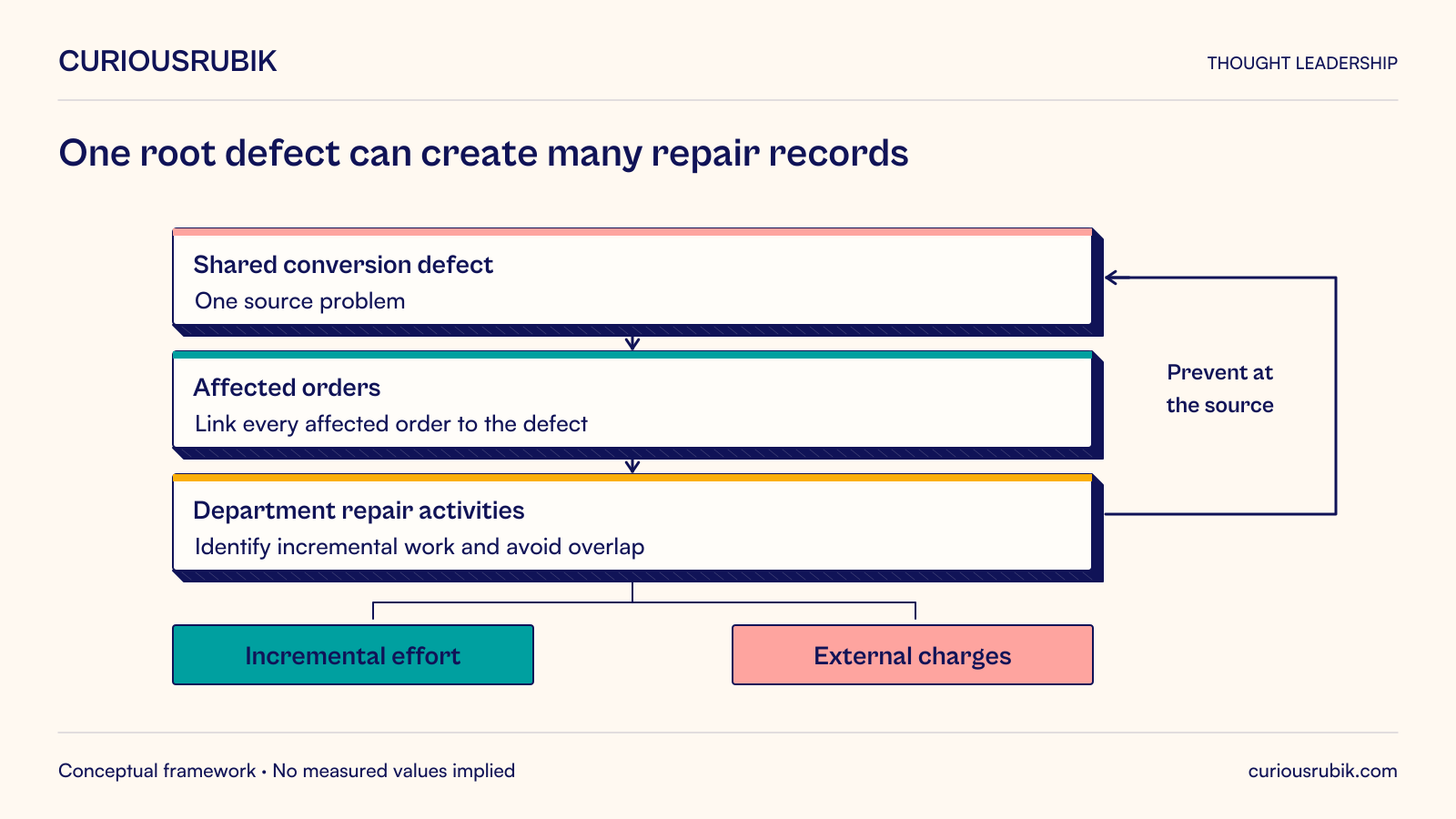
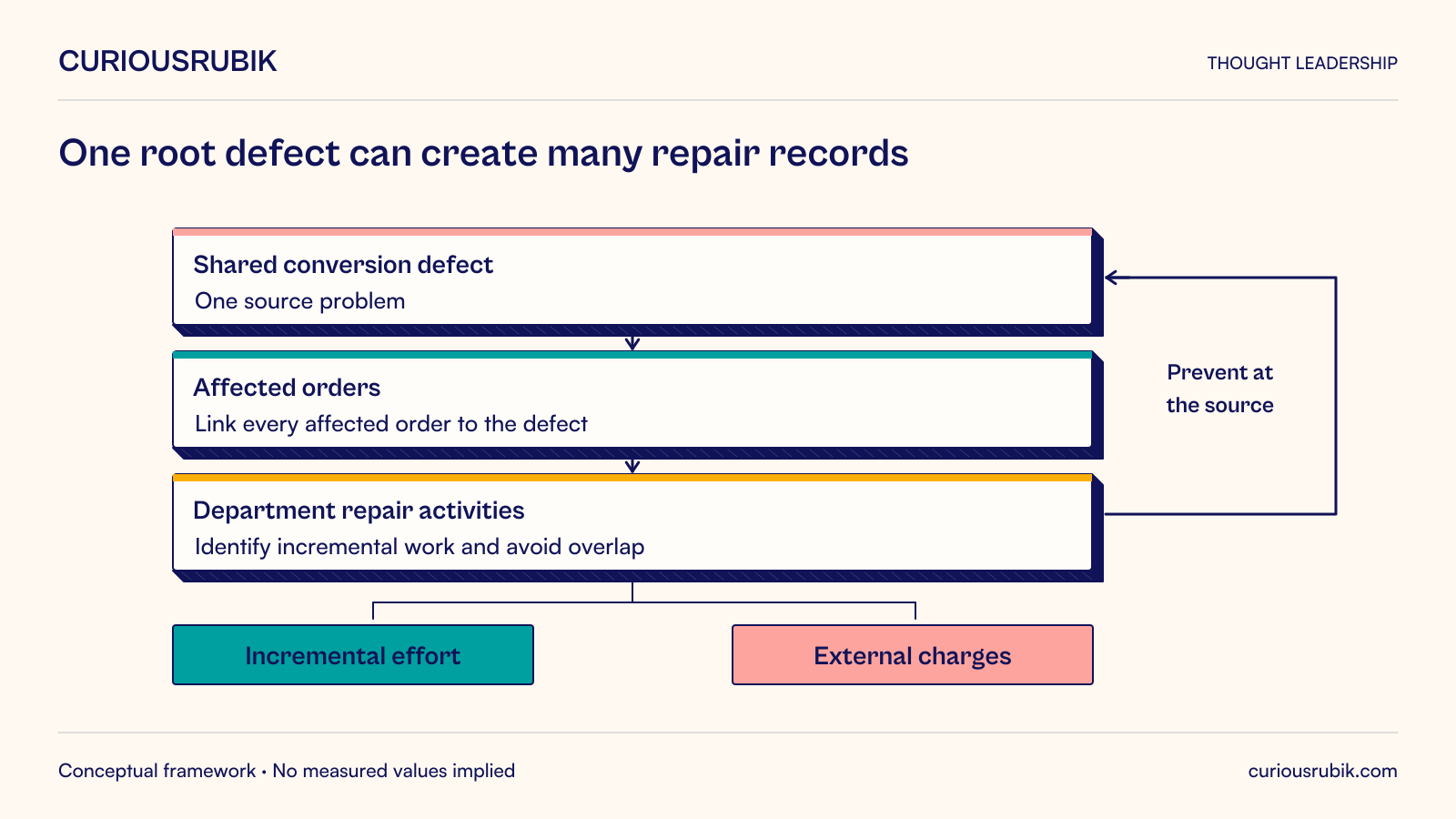
A defect is not necessarily one bad field in one record. An incorrect packaging conversion in a product master can affect many orders, each of which may create several support tickets. Counting records, orders, and tickets as separate defects without linking them can exaggerate the problem and obscure its cause.
Create an incident identifier for the affected transaction and link it to the suspected source defect. Record where the error was introduced, where it was first detected, and which teams performed corrective work. Keep a root-cause identifier so many incidents can be traced to one master-data or process problem.
Classify the consequence in operational terms. Was work delayed, repeated, abandoned, or performed incorrectly? Did the organization incur a new external charge? Was an amount refunded that had previously been collected? Did a decision change? Some effects can be measured directly; others require a separate estimate or cannot yet be established.
The aim is not to make every employee account for every minute. A bounded investigation with representative cases can reveal the mechanism. Use enough detail to distinguish a real recurring burden from a memorable but exceptional event.
Separate the types of cost before adding them
Labor effort measures capacity consumed. External charges measure cash expenditure. Lost contribution, customer harm, and decision risk are different categories that need their own evidence. Combining them indiscriminately creates an impressive total with little decision value.
For labor, record the role, activity, and incremental time attributable to the defect. Work that would have occurred anyway should not be counted as rework. If a support interaction includes both a data correction and an unrelated service issue, allocate time only where the evidence supports it or label the estimate as uncertain.
For cash, distinguish gross movements from economic cost. A refund may reverse revenue rather than create a new expense of the same amount. A replacement shipment may involve additional freight and handling, but the value of the goods cannot automatically be added if the original goods are recovered or otherwise accounted for. Appropriate finance review is needed for the organization’s cost model.
Avoid double counting escalation. If the warehouse’s twelve-minute repair estimate already includes a supervisor’s review, do not add the same review again from the supervisor’s ticket. A shared incident timeline can reveal overlaps that departmental summaries miss.
A hypothetical packaging-data cost ledger
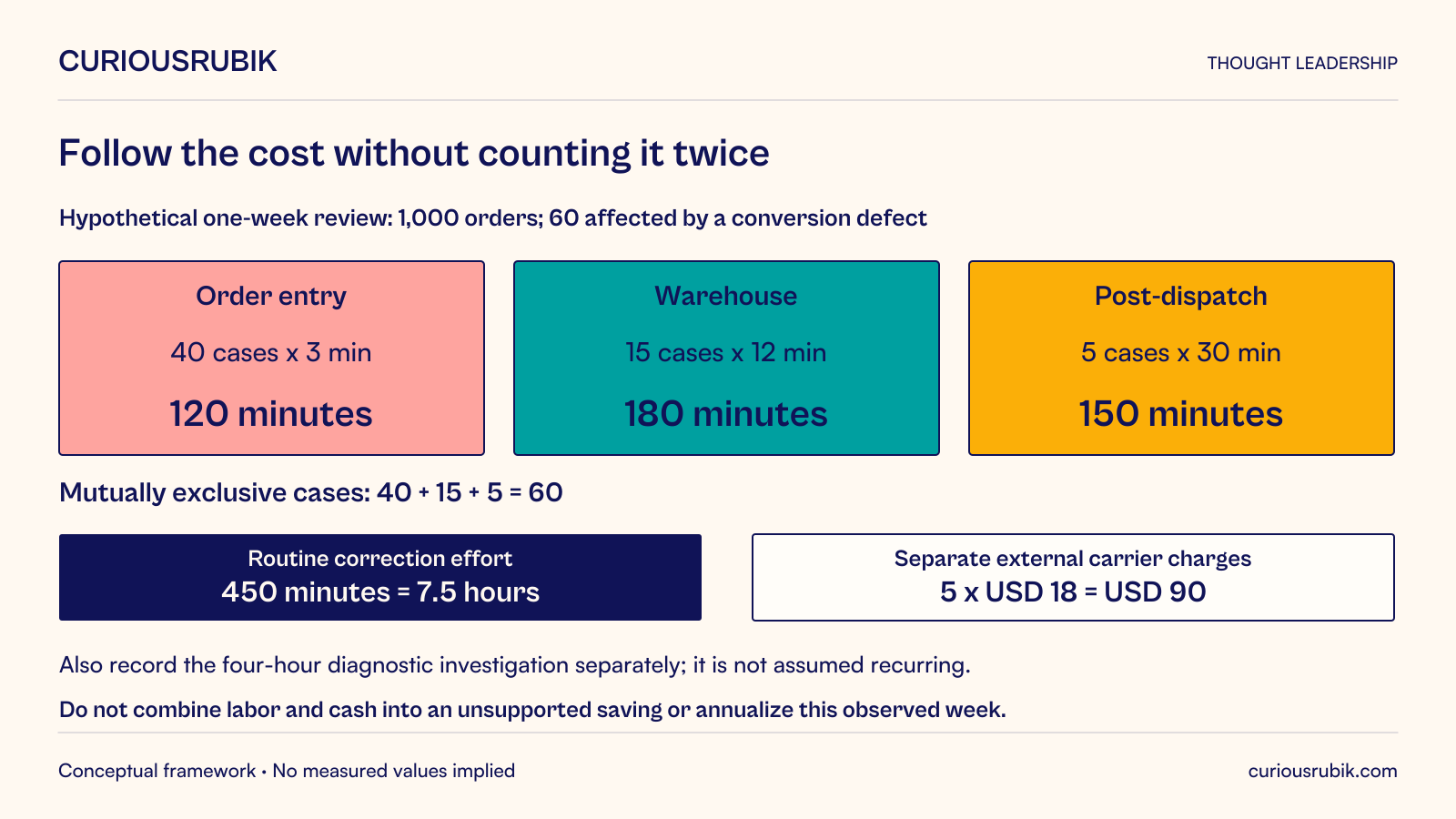
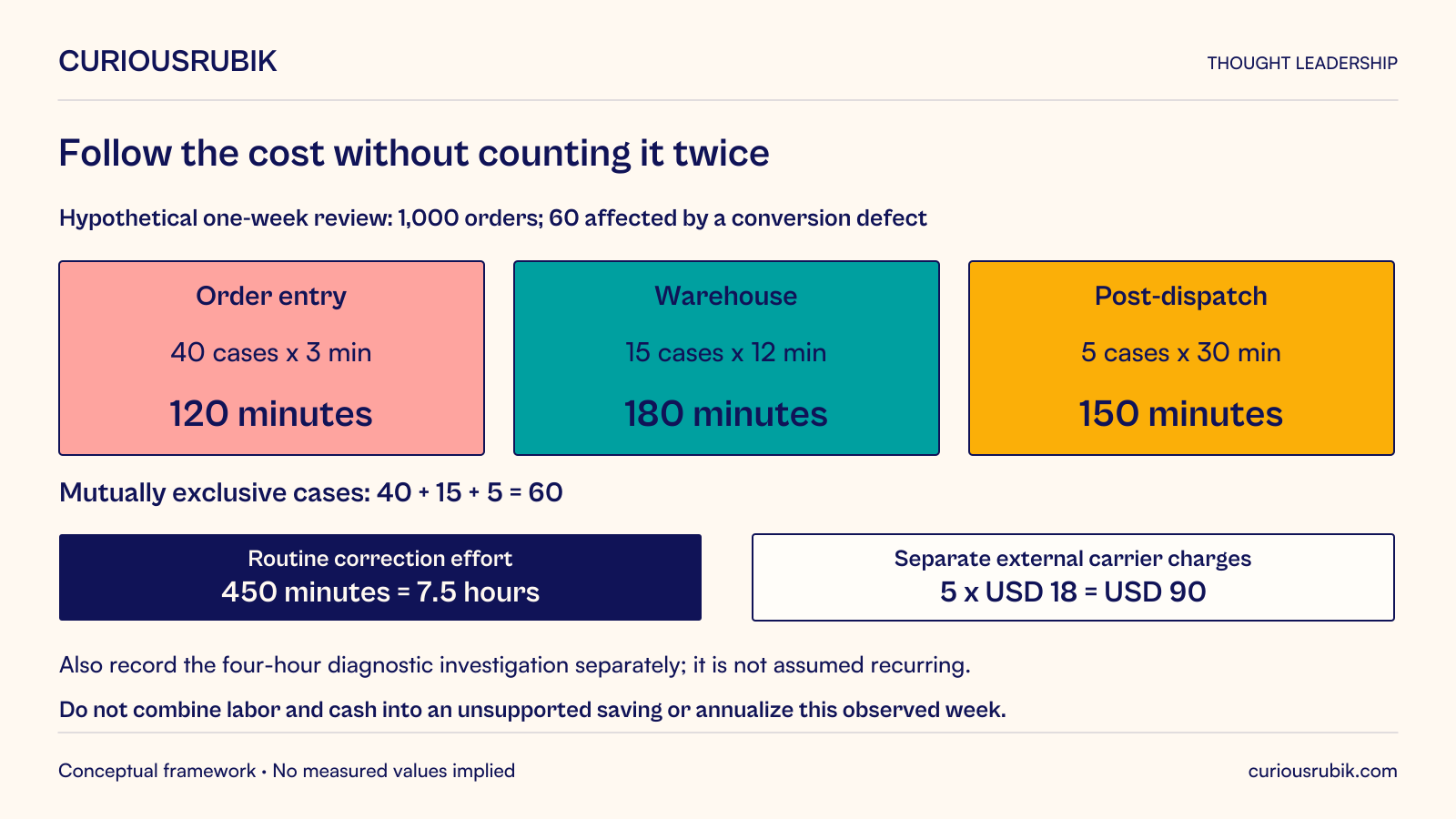
Consider a hypothetical distributor reviewing one week’s one thousand orders. Sixty orders were affected by an incorrect case-to-unit conversion. Forty were caught at order entry, fifteen during warehouse preparation, and five after dispatch. These groups are mutually exclusive and account for the sixty affected orders in the example.
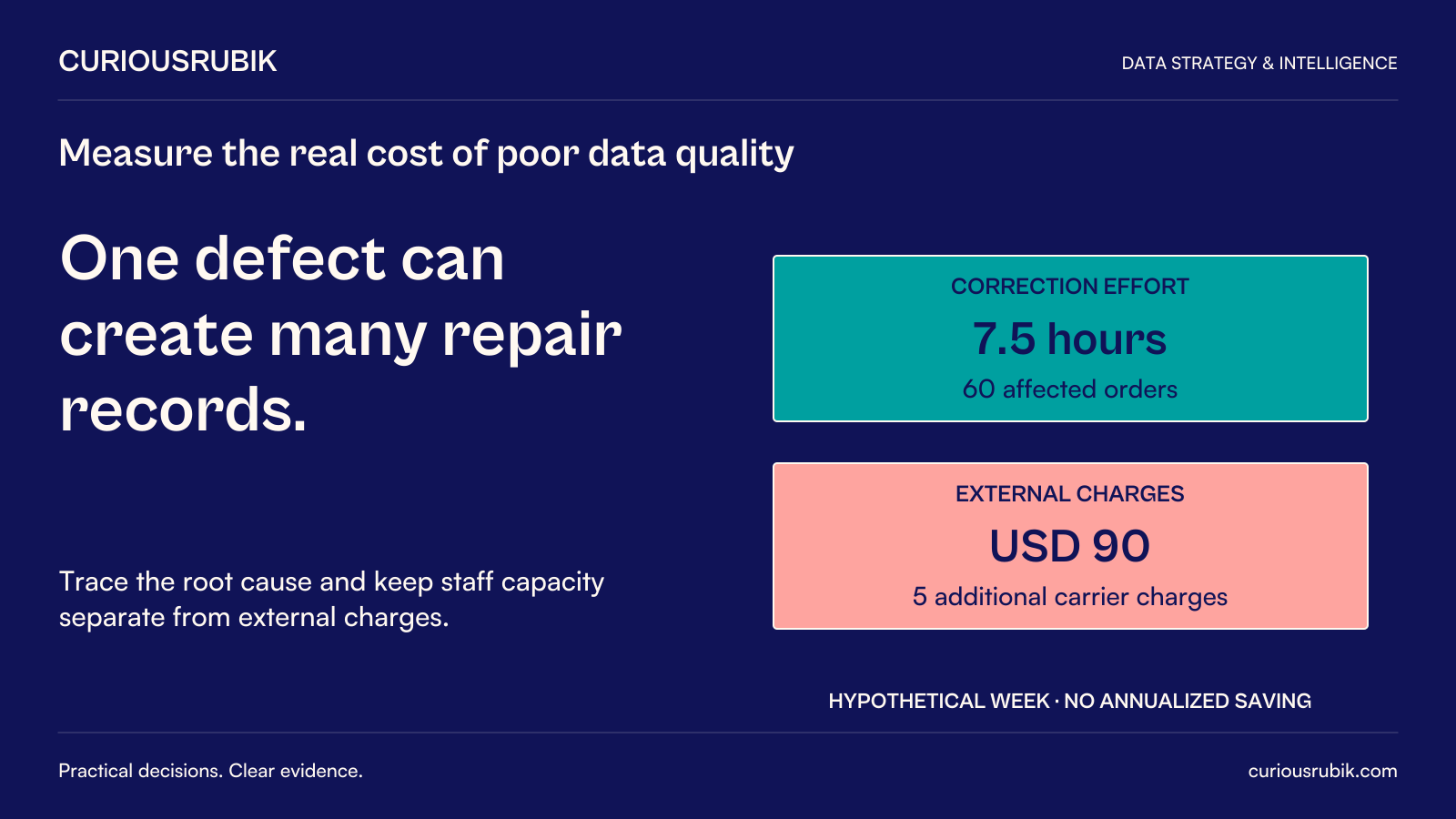
Assume the incremental correction effort is three minutes for each order-entry case, twelve minutes for each warehouse case, and thirty minutes for each post-dispatch case. The labor totals are 120, 180, and 150 minutes respectively: 450 minutes, or seven and a half hours.
Assume each of the five post-dispatch cases also incurs an additional USD 18 carrier charge. That adds USD 90 of hypothetical external expenditure. The ledger should report seven and a half hours of effort and USD 90 of charges separately. Multiplying the hours by a loaded labor rate can support a capacity valuation, but it does not prove that eliminating the defect will reduce payroll.
The investigation also takes four analyst hours to identify and verify the shared conversion error. Record that effort separately from routine incident handling. It is a diagnostic cost for the observed investigation, not automatically four hours that recur every week.
The example does not include lost sales or customer-retention effects because no evidence has established them. It also does not annualize the week. Seasonal volume, product mix, detection practices, and the persistence of the defect could change the result substantially.
The ledger provides a bounded cost estimate under these assumptions and a clear prevention question: what would it take to validate the conversion at source and propagate the correct version before orders use it?
Measure reliability for the use that matters
A field can pass format validation and still be wrong. A case quantity of twelve may be a valid positive integer while the actual package contains ten. A database completeness score would not detect that semantic error if every field is populated.
Choose checks that address the failure mechanism. Verify packaging evidence, distinguish base units from cases, identify the effective version, and test whether downstream systems use the same conversion. A control total over order counts cannot establish that every quantity has the correct unit.
GAO’s Assessing Data Reliability guidance defines reliability in relation to accuracy, completeness, and applicability for an audit’s purpose. Its risk-based approach is a useful reference for this investigation, although enterprise defect costing is not the audit framework’s formal purpose. GAO-20-283G, Assessing Data Reliability
State the population and limitations. A review of one warehouse’s exceptions may miss orders that failed without generating a ticket or defects absorbed by another team. If the data cannot support a representative estimate, present the observed cases and explain the gap rather than manufacturing an enterprise-wide number.
Locate the preventable cause
Once the cost path is visible, distinguish source capture, transformation, propagation, and use. The conversion may have been entered incorrectly, changed without effective dating, mapped incorrectly in an interface, or interpreted differently by the receiving application. Each cause requires a different remedy.
Assign the preventive action to an owner who can change the relevant process. Asking analysts to clean the final report does not prevent the next incorrect shipment. Likewise, asking warehouse staff to check every order indefinitely may be a costly substitute for correcting one shared reference value.
A proportionate remedy could include evidence-based master-data approval, a versioned conversion, a contract check at ingestion, and an exception route for an unfamiliar packaging code. Test it on new products, changed packages, returns, and historical orders that legitimately used the prior version.
Preserve operational continuity during correction. Updating a shared conversion can affect open orders differently from future ones. The business must decide which populations require reassessment and which historical records should retain their original context. A bulk overwrite is not automatically a safe repair.
Compare prevention with continued detection
Preventing a source defect can reduce repeated downstream work, but prevention also has a cost. Additional validation, stewardship, and approval can slow product introduction or create a new queue. The appropriate design balances consequence, frequency, and the effort required to maintain the control.
Build a bounded comparison. Estimate implementation effort, recurring operation, likely defect coverage, and residual exceptions. Keep the assumed reduction separate from the observed baseline. A control that detects only one failure mechanism should not be credited with eliminating all data-quality incidents.
Pilot the change and measure newly created transactions. A historical cleanup can make the database look better without improving current capture. Compare the same defect definition and relevant population before and after, while checking whether volume, mix, or detection changed.
Do not treat an increase in reported exceptions as automatic deterioration. A better check may reveal errors that previously passed silently. Examine whether harmful downstream effects fall and whether the newly visible exceptions are resolved effectively.
Turn the ledger into a management routine
Keep a small portfolio of consequential defect families with an accountable owner, observed impact, preventive action, and verification date. Review recurrence and unresolved consequences rather than collecting an ever-growing catalogue of low-impact anomalies.
Share findings across the affected teams. Order entry may not know that a recurring correction later produces freight costs. Finance may not know that a report repair reflects a source problem affecting customers. The cross-functional view creates a reason to invest where the defect begins.
Avoid using the ledger primarily to blame people who detect errors. If teams believe reporting a defect worsens their performance score, they may conceal the work or reclassify it as routine. Reward effective detection and prevention while retaining accountability for recurring causes.
There are limits to measurement. Some consequences will remain uncertain, and the cost of exhaustive tracking can exceed its value. Use transparent ranges where supported, leave unsupported effects unquantified, and prioritize high-consequence failures even when their frequency is low. A precise-looking cost is not a prerequisite for addressing an unacceptable risk.
For the next month, choose one recurring defect family and follow its transactions across departments. Record incremental effort, external charges, and unresolved effects without overlap. Then fund the smallest source-level change that can be tested against that evidence. The hidden cost becomes actionable when it is connected to a preventable mechanism rather than left as a broad complaint about data quality.