An implementation can have individually sound workstreams and an incoherent overall solution. The portal team models customers one way, the finance team uses another, the integration team translates between them and the support team inherits exceptions that nobody designed. Each local choice may be reasonable until the choices meet in production.
Solution architecture makes those cross-boundary decisions explicit before they become expensive dependencies. Its value is the coherence of business behavior, data, controls, interfaces and operations, not the number of diagrams produced.
For a sponsor deciding how much architectural work to fund, the practical question is which decisions affect several teams, are costly to reverse or determine whether a critical business scenario works. Those decisions deserve early analysis and continuing ownership. Routine implementation detail can remain with the delivery teams operating within the agreed boundaries.
Start with consequential scenarios
Begin with the business actions the solution must support, including meaningful exceptions. Follow each action across people, systems and data. Identify where responsibility changes, where a fact becomes authoritative and where an incorrect result would matter.
A scenario should be specific enough to expose design choices. “Customer self-service” is too broad. “An authorized customer representative downloads invoices for the locations they manage after a change in account responsibility” raises identity, permission, data ownership, update timing and support questions.
Add quality conditions to the scenario. What happens when a dependency is unavailable, a record is corrected, access changes or the workload increases? These conditions help determine the architecture needed for the business outcome.
Do not select only attractive demonstration paths. Architecture is most useful where normal operation meets an uncertain boundary: a partial transaction, a delayed update, a cross-entity relationship or a recovery decision.
Decide which responsibilities belong where
Assign responsibility for important capabilities and facts. Which component authorizes an action? Which system owns the accepted order? Which team governs the customer relationship model? Which process reconciles uncertain outcomes?
The goal is a clear logical responsibility, not necessarily one physical server or one vendor product. A capability can be implemented redundantly while retaining a consistent authority model. Conversely, placing everything on one platform does not automatically resolve conflicting definitions or ownership.
Define the contracts between responsibilities. An interface should explain the business meaning of its inputs and outputs, allowed states, error behavior and operating expectations. Avoid relying on field names and successful message delivery as proof that the receiving team understands the same event.
NASA’s 2016 Systems Engineering Handbook connects requirements, logical decomposition and design-solution evaluation, including alternatives and interfaces. An enterprise project can use that discipline to keep design choices tied to needs and constraints without adopting the full aerospace lifecycle. NASA Systems Engineering Handbook, sections 4.2–4.4.
Use architecture to resolve a customer-access boundary
Consider a hypothetical equipment-service company building a customer portal alongside a finance-system implementation. The example is illustrative. Some customer organizations have a headquarters account and several service locations. A headquarters representative may be authorized to see invoices across selected locations, while a local manager should see only their assigned location.
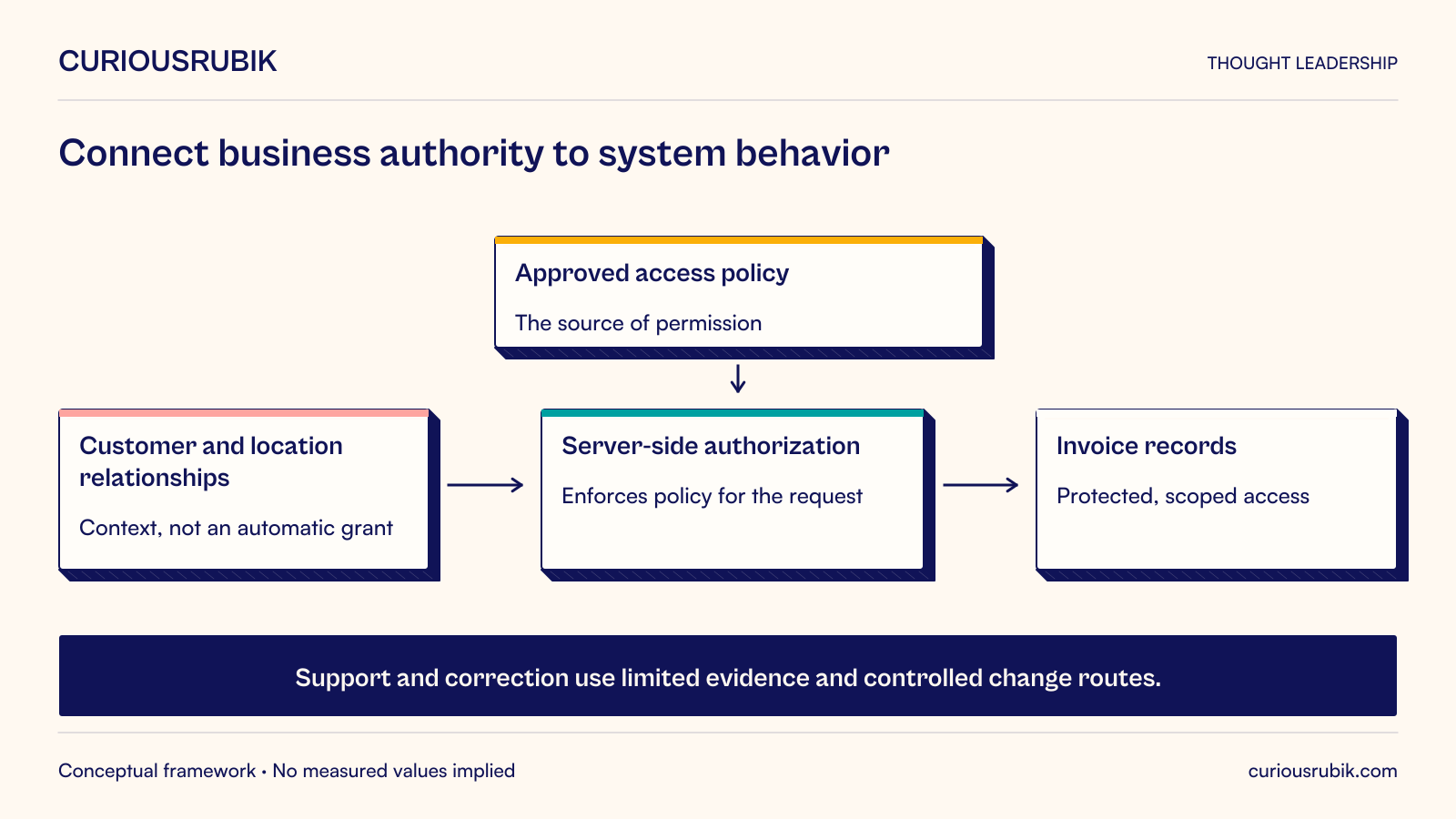
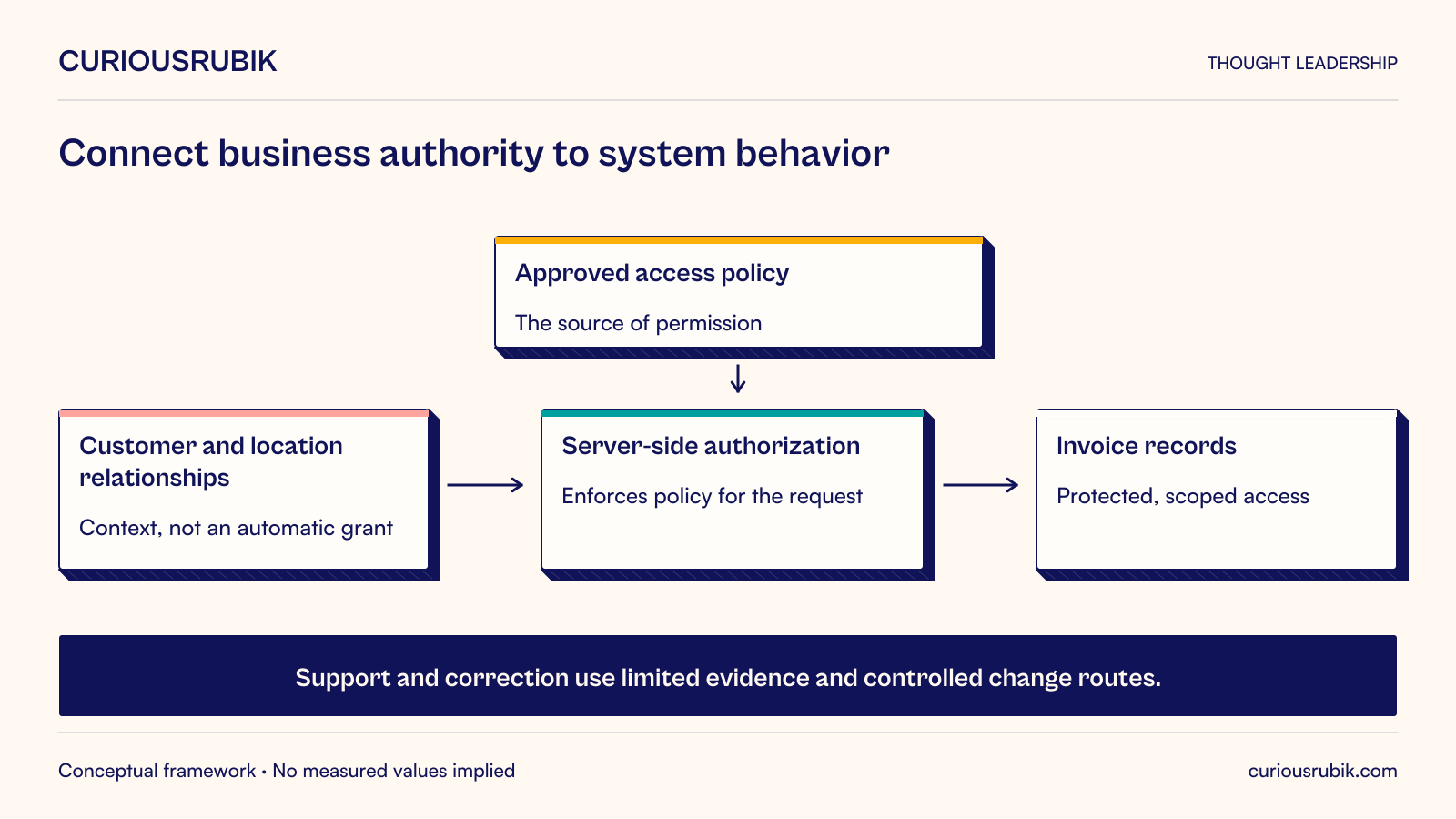
The portal team initially proposes one generic customer role. The finance team stores billing accounts separately from service locations. The integration team plans to copy invoices into a portal database. Without a shared design, the implementation could incorrectly assume that membership in a customer group grants access to every related invoice.
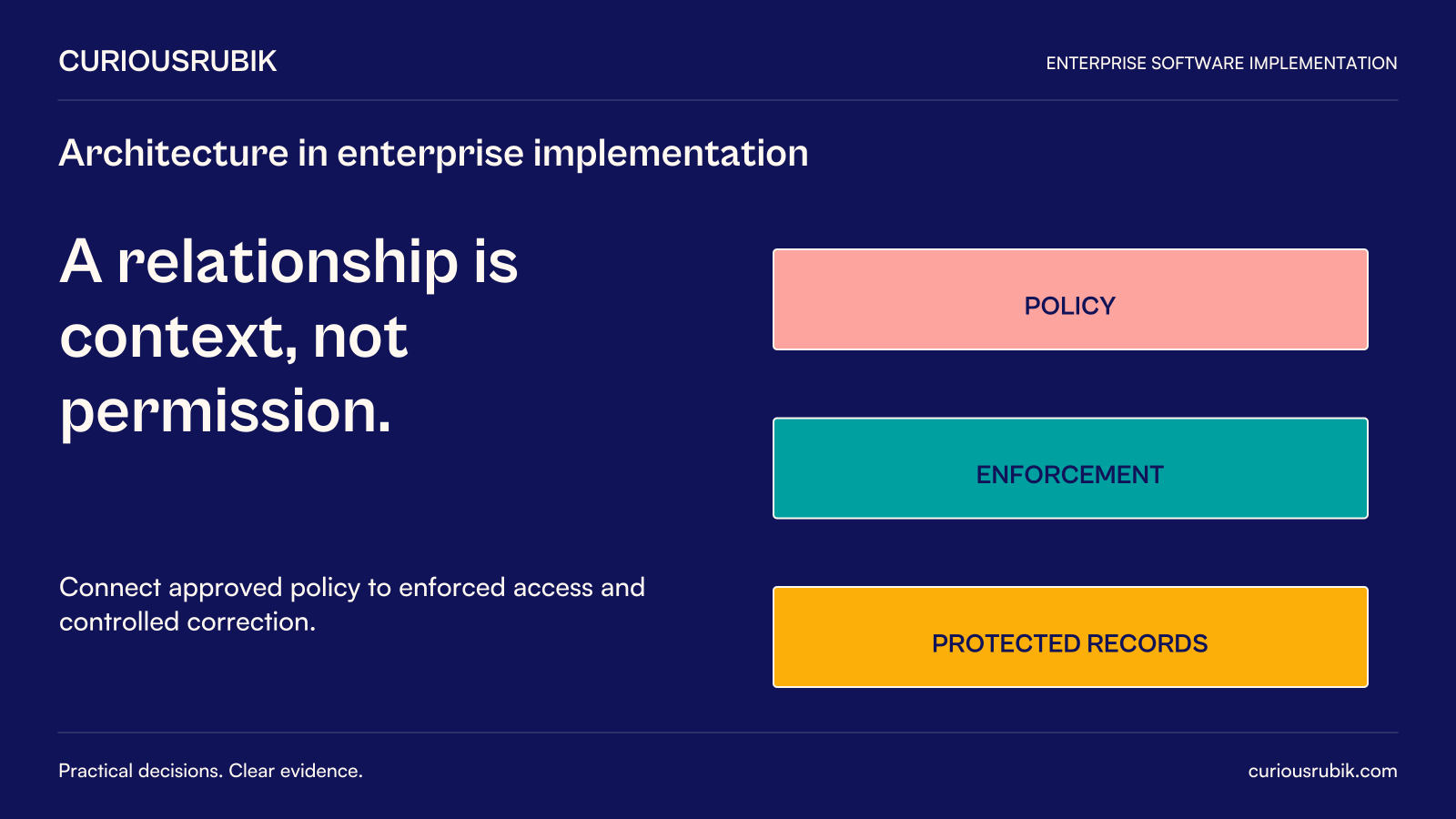
The architectural decision begins with the actual authorization policy, established by the appropriate business and security owners. It defines which relationships grant access, how they are approved, where they are maintained and how revocation reaches the consuming service. A corporate relationship in master data is not automatically an access entitlement.
The design then assigns responsibility for enforcing that policy on the server side for each protected resource. Hiding a button or filtering a list in the browser is insufficient if a user can request an invoice outside their permitted scope. OWASP’s 2021 guidance on broken access control emphasizes trusted server-side enforcement, default denial for nonpublic resources and record-level ownership controls. OWASP Top 10:2021, Broken Access Control.
The project must also decide how current the authorization relationship needs to be, what happens during a delayed update and how support investigates a denied request without exposing another customer’s information. These choices affect data migration, interfaces, testing and operational procedures.
A useful architecture review ends with testable decisions: permitted representatives can retrieve the right records, unauthorized requests are denied regardless of the interface path, and a role change follows the approved update and recovery behavior. It does not end with a diagram labeled “secure portal.”
Record decisions with their tradeoffs
An architecture decision record should state the problem, relevant constraints, credible options, chosen approach, rationale and consequences. Include unresolved assumptions and the conditions that would justify revisiting the decision.
The record should be concise enough for the teams affected to use. Its purpose is to preserve the reasoning that a diagram alone cannot show. For example, a decision to replicate a read model may improve responsiveness but introduce freshness and reconciliation obligations. Those obligations need owners.
Avoid documenting only the chosen solution as if no alternatives existed. Future teams need to know whether an option was rejected because of a permanent constraint, a temporary limitation or insufficient evidence. That distinction affects whether the decision should be reconsidered later.
Also avoid turning every implementation detail into an architectural ceremony. Focus on decisions with cross-team consequences, significant risk or high reversal cost. The discipline should accelerate local work by clarifying boundaries, not make the architect a bottleneck for routine changes.
Prove difficult assumptions with bounded tests
Some choices cannot be resolved adequately through discussion. A performance requirement may need a representative load test. A migration strategy may need a rehearsal with difficult records. An integration design may need a failure-and-recovery experiment against the actual dependency.
Define what the test can establish and what remains unknown. A small prototype can demonstrate a mechanism without proving production-scale reliability. A test using synthetic data can expose structural problems while missing variations in the real population.
Use the results to change a decision when necessary. An architectural experiment that produces a report but leaves an invalid assumption embedded in the plan has not reduced the program’s exposure.
Keep business and technical evidence connected. If a design meets a response-time target but gives users an outdated or unauthorized result, it has not satisfied the scenario. Architecture quality is judged through the combined behavior the business needs.
Maintain coherence as delivery changes
Architecture cannot be a one-time document completed before implementation. New evidence, scope changes and vendor constraints can alter the design. Maintain a lightweight route for evaluating changes that cross the agreed boundaries.
Review the effect on related requirements, data, interfaces, controls, tests and support. A local workaround can be reasonable, but its consequences should be visible and its duration governed. Temporary solutions need an owner and a condition for retirement or formal adoption.
Use regular end-to-end demonstrations to detect divergence. Ask teams to show how the latest implementation supports representative scenarios, including exceptions. Compare the actual behavior with the decision records and update either the implementation or the approved design when needed.
Do not equate consistency with uniformity. Different capabilities may legitimately use different technologies or delivery methods. The important question is whether their interfaces, authority and operating expectations fit together.
Make architectural completion demonstrable
At a design checkpoint, ask the team to connect a consequential scenario to the decisions that enable it. In the portal example, a reviewer should be able to identify the approved access rule, the authoritative relationship source, the enforcing component and the test that challenges unauthorized access. If those links cannot be shown, approving a polished architecture presentation does not establish readiness.
Also verify the commercial and operating assumptions behind the design. A proposed interface may depend on a supplier entitlement, environment or support arrangement that the project has not secured. Record the evidence and owner rather than assuming a technically possible connection is available under the actual service agreement.
Architectural completion is therefore conditional on the commitment being made. Early discovery may justify proceeding with a bounded prototype. A production release needs stronger evidence about the implemented boundaries and their operation. The review should state what is established and what remains to be proved.
Transfer the architecture into operations
The support team needs more than a system inventory. It needs to understand authoritative sources, dependency behavior, recovery routes, access boundaries and the rationale behind unusual decisions.
Include operational owners in the design of monitoring and reconciliation. Decide which signals reveal a business failure rather than only a technical outage. A service can be available while delivering stale data or leaving transactions incomplete.
Maintain a usable record of configuration and dependencies after launch. If changes occur without updating the relevant design and support information, the organization gradually loses the ability to explain its own system.
Solution architecture earns its place when it prevents incompatible local decisions and makes difficult tradeoffs testable. Choose one consequential scenario, trace it across the proposed solution and identify the decisions no individual workstream can safely make alone. Resolving those boundaries gives implementation teams a coherent foundation on which to deliver.