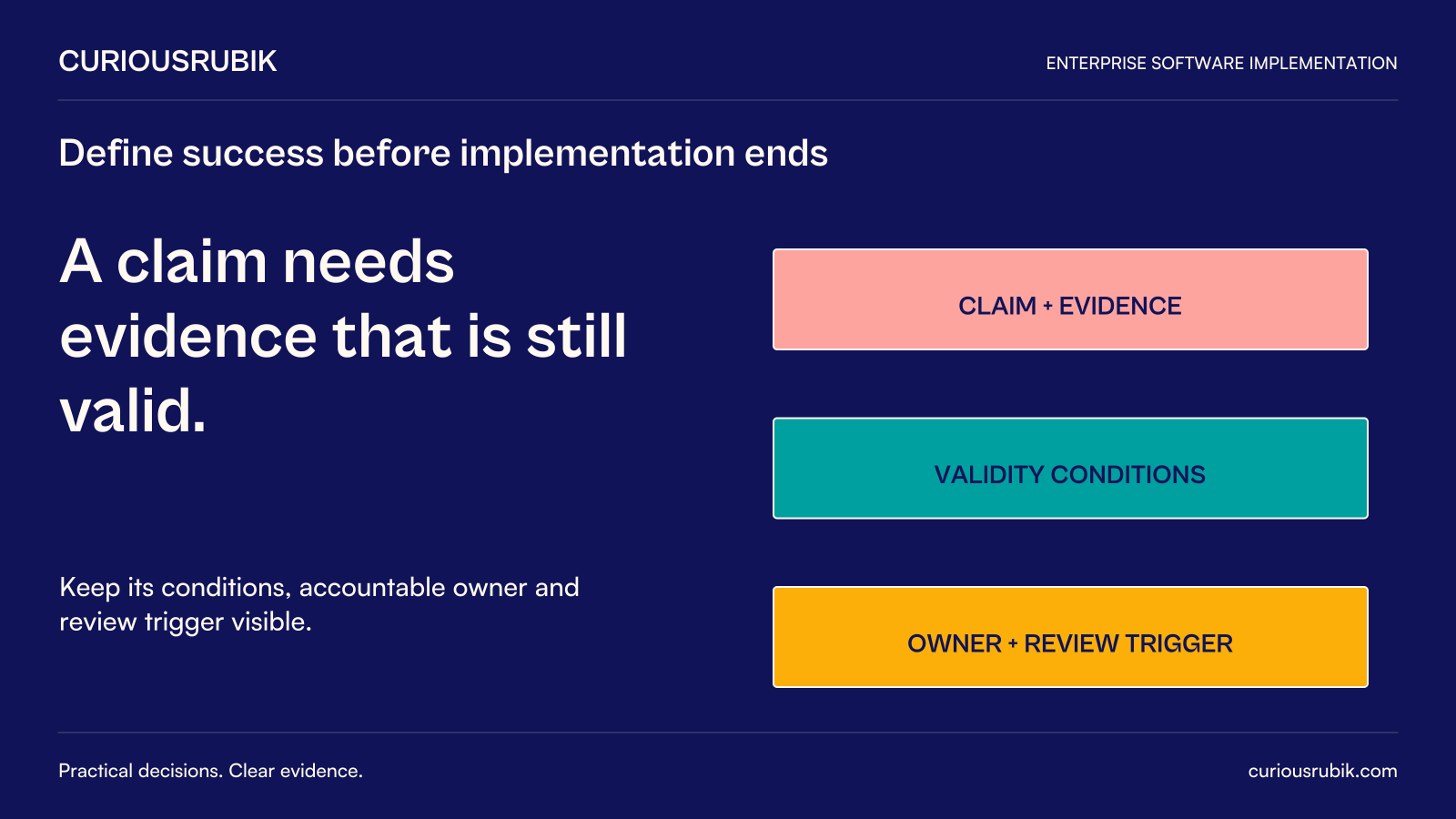
A delivery team can accumulate approvals, test results and training records while gradually losing confidence in what those records prove. Configuration changes, data changes and operating decisions can make earlier evidence obsolete. A green status remains on the report even though the conditions behind it no longer exist.
For a buyer, a useful definition of implementation success includes a working business capability, accepted operating responsibilities and a credible path to the intended benefits. One practice supports all three: keeping evidence connected to the current commitment as the solution changes.
This is a practical management recommendation, not a claim that one checklist guarantees success or that a controlled study has ranked every implementation method. The question for a sponsor is whether the program can explain what is true now, what proves it and what would require the decision to be revisited.
Keep claims smaller than the evidence
A demonstration can establish that a mechanism works under selected conditions. A migration rehearsal can establish results for a defined population and rule version. A user test can establish that particular roles completed particular scenarios in a recorded environment.
Problems arise when the program turns those bounded observations into broader claims. “The interface passed” may conceal that only the normal response was tested. “Users are ready” may refer only to a few experienced champions. “Data is clean” may mean required fields were populated, without checking their meaning.
State the claim at the level the evidence supports. Then identify what remains untested or assumed. This makes the next investigation visible and prevents an early success from becoming an unjustified release guarantee.
The practice also improves executive decisions. A sponsor can authorize a bounded pilot on narrower evidence than a large irreversible transition. The evidence should match the commitment being requested, rather than every review using the same generic completion checklist.
Preserve the conditions under which a result is valid
For consequential evidence, record the configuration, data, permissions, interface versions and operating conditions that matter to the result. The exact detail depends on the scenario, but someone should be able to determine whether a later change invalidates the earlier conclusion.
NIST’s security-focused configuration-management guide emphasizes managing and monitoring system configurations while supporting desired business functionality and controlling organizational risk. Its scope is federal information-system security; the broader implementation lesson here is an analytical extension: confidence depends on knowing which configuration the evidence describes. NIST SP 800-128, 2011 with 2019 updates.
Do not require exhaustive metadata for every low-consequence observation. Focus on the conditions that could change the decision. A test of invoice authorization needs relevant roles and relationship rules; a performance test needs workload and environment. The record should be useful to a future reviewer, not merely complete a template.
Link changes to affected evidence. A minor visual change may leave most acceptance results valid. A changed status definition, access rule or transformation may require targeted retesting and updated operating guidance. The program should be able to explain the difference.
Use a current evidence record for the next commitment
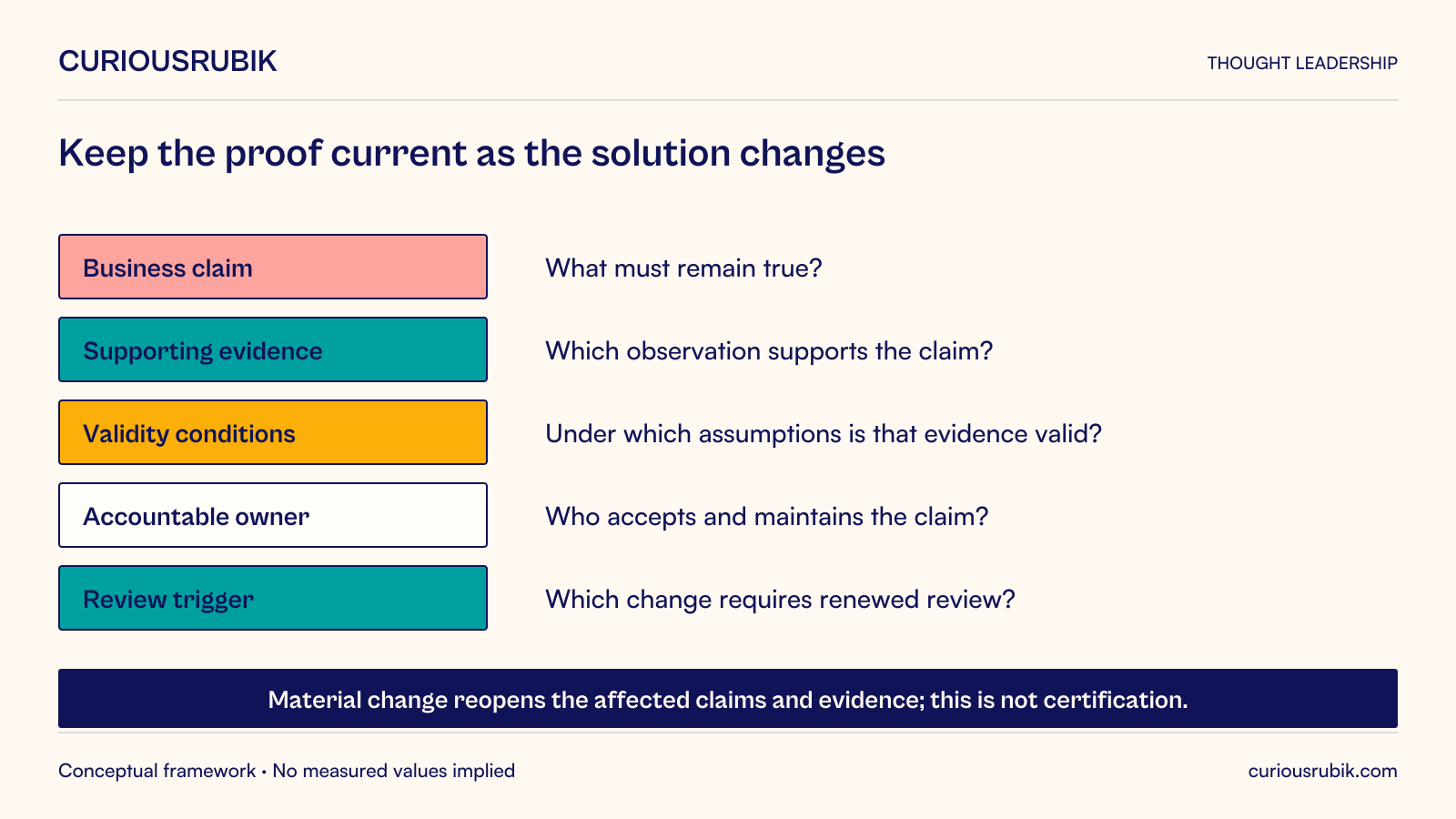
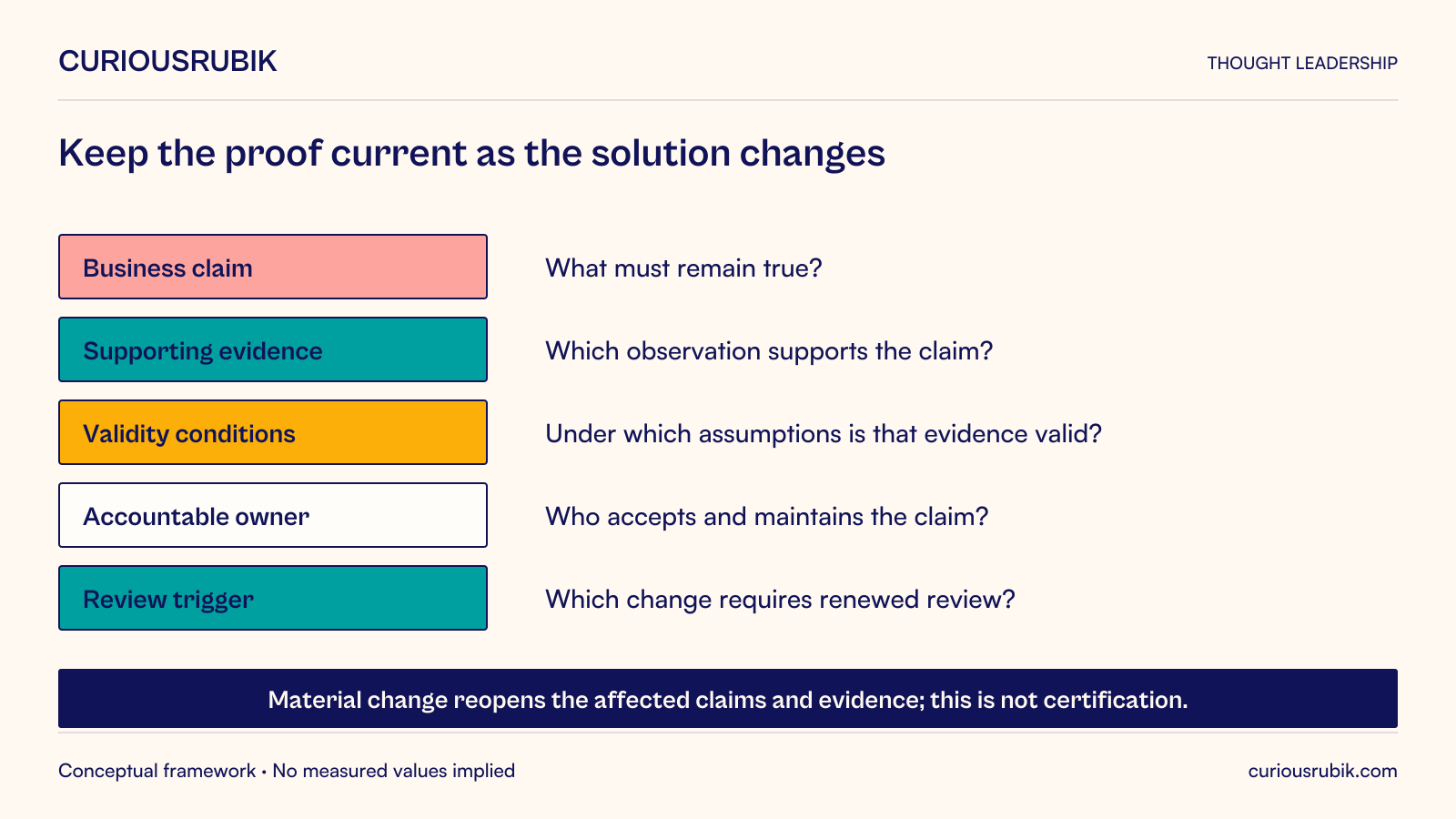
A compact record can connect five elements: the business claim, supporting evidence, validity conditions, accountable owner and triggers for review. This is a proposed working aid, not an established certification or maturity index.
For example, a claim that a process is ready for a limited release should link to the relevant scenario results, unresolved exceptions and operating ownership. A change in scope or configuration should trigger review of the affected parts. The record can reference existing artifacts rather than duplicate them.
Keep evidence status distinct from task status. A development task can be complete while its acceptance evidence is pending. Evidence can exist but be stale. An exception can be understood but not yet accepted by the appropriate owner.
This distinction helps the program avoid binary reporting that compresses uncertainty into “done.” It also makes the work remaining more specific: rerun a scenario, resolve an exception, confirm an owner or revise a commitment.
A status change shows how evidence can become stale
Consider a hypothetical hospitality group implementing a room-turnover application. The example concerns software status and coordination, not a prescription for physical inspection or safety procedures. The group’s approved operating process determines who can mark work complete and who can release a room for the next use.
An early test confirms that the front-desk view shows rooms only after the required release state is reached. Later, the project introduces a separate “cleaned” state before the authorized release step. The application configuration changes, but the reporting team continues using the earlier mapping that treated cleaning completion as readiness.
The original test result is still stored and marked passed. It does not establish that the revised state model produces the correct front-desk view. The issue is not necessarily a lack of testing effort; it is the failure to connect a changed definition to the evidence and consumers that depended on it.
A current evidence record makes the dependency visible. The status-model owner identifies the affected report, interface, migration mapping and user instructions. The team updates the approved mapping and reruns the relevant scenario, including a room that is cleaned but not yet released. It verifies the operational view and the exception route under the revised configuration.
The sponsor does not need to reopen every unrelated test. They need evidence that the affected claims have been re-established and that operating owners understand the changed states. The program can then make a release decision based on the current solution rather than a historical green indicator.
Treat exceptions as information about the operating model
An implementation gains useful knowledge when users encounter difficult cases. Some exceptions reveal missing requirements or poor design. Others represent legitimate business variation that needs an owned route.
Record the consequence and response instead of treating every exception as a ticket to close. Does it require a different role, better data, a policy decision or a temporary workaround? Who will handle it after the project team leaves? What capacity does that work require?
Test the exception route as part of the capability. A workflow that handles ordinary transactions but leaves uncertain outcomes in an unmonitored queue is incomplete for operations, even if the normal path is technically sound.
Keep temporary treatments visible. A manual bridge can be a rational release choice when its risk, workload and retirement condition are understood. It becomes a hidden failure when its continued operation depends on a project specialist who will soon leave.
Transfer responsibility alongside knowledge
Handover is stronger when the receiving team demonstrates that it can operate the process, investigate an issue and make the decisions assigned to it. Attendance at a knowledge-transfer session does not establish that capability.
Give operational owners access to the decision rationale, current configuration information, support routes and recovery evidence appropriate to their responsibilities. Restrict sensitive information and privileges according to the organization’s controls; knowledge transfer does not justify indiscriminate access.
Make acceptance of responsibility explicit. A support team should know which tasks it owns, which require specialist escalation and what remains with a supplier or business process owner. A list of names is insufficient if those people have not accepted the work or lack capacity.
Preserve continuity when people change. The record should allow a new owner to understand why a decision was made and what would justify changing it, without reconstructing the program from informal conversations.
Keep benefit claims connected to operational action
A successful launch does not automatically realize the business case. Benefits may depend on retiring duplicate work, changing decisions, adopting a common process or redeploying released capacity. Each action needs an owner after implementation.
Establish a baseline and a sensible review period for the intended outcome. Define the measure, population, exclusions and relevant contextual changes. A before-and-after improvement can be useful evidence without proving that software alone caused it.
Keep cash effects, capacity and service outcomes distinct. Reduced handling time may create capacity for growth rather than a payroll saving. A quicker report may improve a decision only if someone uses it differently. The benefit record should explain the mechanism and the management action needed.
If the evidence does not support the expected value, investigate and adjust. The program should not defend its original business case by redefining metrics after the fact or counting the same effect several ways.
Ask for a demonstration of the delivery discipline
When evaluating an implementation partner or reviewing a live program, ask to see one consequential decision traced through its evidence and subsequent changes. What claim was made? Which version was tested? What changed afterward? Which proof was renewed? Who owns the result in operations?
This request is more revealing than a methodology presentation alone. It shows whether the team can keep its commitments, evidence and operating responsibilities coherent under change.
Use the answer to improve the next release rather than build an ever-larger reporting bureaucracy. The objective is a small, trustworthy set of information that enables timely decisions. Implementation success becomes more dependable when the organization can explain what it is accepting today and maintain that understanding after the project has ended.