Middleware is justified when it provides shared integration capabilities more reliably or economically than the alternatives, without obscuring business ownership. It becomes unnecessary complexity when the organization buys a broad platform to solve a narrow interaction, or centralizes logic that remains poorly understood. The right question is what responsibility the additional layer will own and how that responsibility will be tested.
For an enterprise architect evaluating an integration platform, the decision should begin with a portfolio of actual flows. Identify repeated needs such as protocol adaptation, scheduling, routing, transformation, access handling, deployment, monitoring, and recovery. Then compare a shared service with a supported direct implementation or capabilities already available in the applications.
A connector catalogue is useful evidence of possible compatibility. It is not proof that a connector supports the required business operation, error semantics, volume, or recovery behavior. Those details need to be demonstrated on representative work.
Name the kind of intermediary you need
“Middleware” covers several different responsibilities. An API gateway can manage aspects of request access and routing. A message broker can support asynchronous delivery. An integration runtime can execute transformations and workflows. A data pipeline can move and prepare analytical populations. One product may combine these functions, but their design questions remain different.
Avoid purchasing a full workflow platform when the requirement is a small, stable file transfer with adequate controls. Conversely, do not expect a routing gateway to provide a complete business-process state machine merely because it can call several services.
The Message Bus pattern combines shared messaging infrastructure, interfaces, and adaptation between applications. It is one architectural pattern, not a requirement that all enterprise interactions pass through one physical hub. Enterprise Integration Patterns, Message Bus
Write a capability boundary for the proposed intermediary. Specify what it handles, what remains in the applications, and what belongs to business owners. This prevents an attractive platform from gradually becoming the default home for every rule that no other team wants to own.
Look for repeated mechanisms, not merely repeated nouns
Several flows may involve “customers” while having very different semantics. Sharing authentication and deployment mechanisms may be sensible; combining every customer-related rule into one transformation may not be. Reuse should follow a genuinely common responsibility.
Candidates for shared mechanisms include supported connector lifecycle management, secrets integration, execution scheduling, logging conventions, correlation, deployment promotion, and standard exception routing. Business mappings still need accountable owners and representative tests even when a platform makes them easier to configure.
Assess the current implementation honestly. A set of small, well-tested services using common libraries may already provide much of the desired reuse. A platform may add value through operations, supportability, and connector maintenance rather than through the mere presence of a visual editor.
The Messaging Gateway pattern separates messaging-specific operations from domain-facing application methods. Its principle can help limit dependence on a particular middleware interface without pretending that a future replacement will be cost-free. Enterprise Integration Patterns, Messaging Gateway
A hypothetical workload that changes the cost discussion
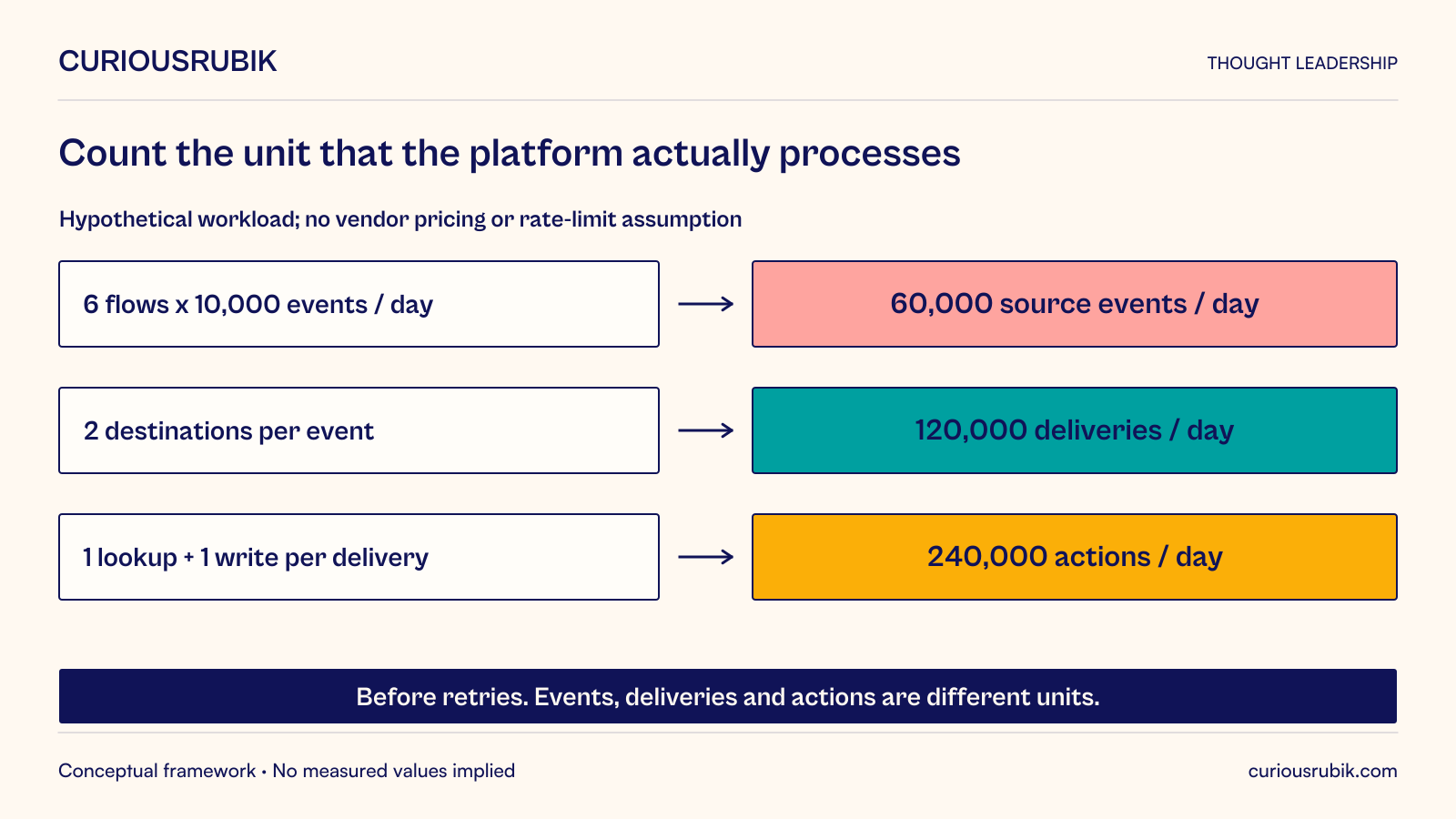
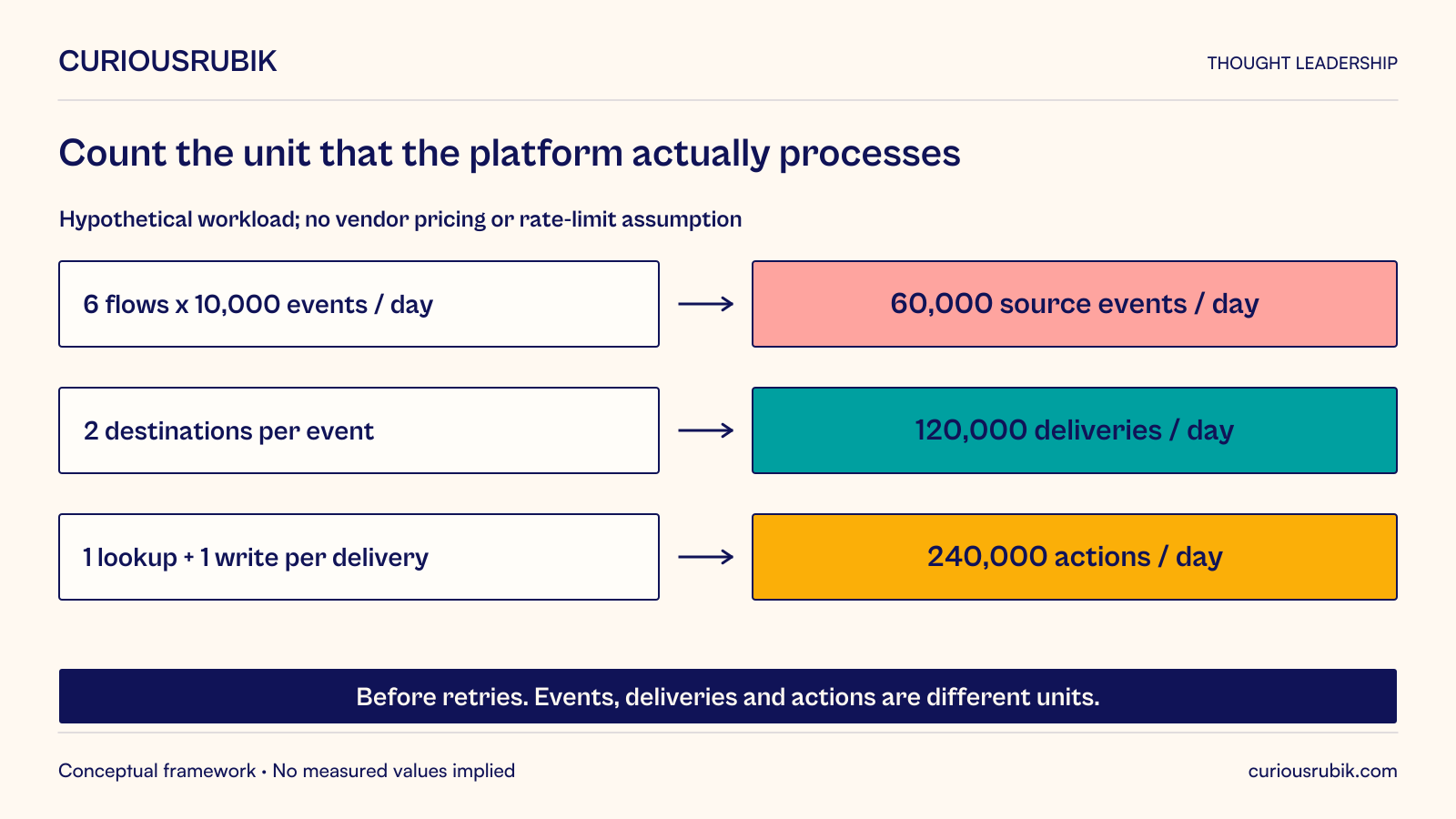
Suppose a hypothetical portfolio has six flows, each receiving ten thousand source events per day. That produces sixty thousand source events. Assume each event is delivered to two destinations, giving one hundred twenty thousand destination deliveries before retries.
If each destination delivery requires one reference lookup and one write, there are two hundred forty thousand such application actions per day under the simplified model. Transformation steps, polling calls, retries, logging, and reconciliation may add more activity. These quantities describe different units of work; they are not interchangeable.
A supplier’s price may be based on source events, workflow runs, connector operations, execution time, data volume, or another measure. The organization must obtain and verify the actual commercial definition. A quote sized for sixty thousand “transactions” can be misleading if the relevant billable unit is closer to individual actions. This example contains no vendor price assumption.
The performance model also needs the correct unit. A destination limited to a certain request rate must handle lookups and writes, not merely the source-event count. A shared runtime cannot remove the destination’s constraint by accepting work faster; it may simply accumulate a queue.
The architect should request a representative load and failure test, then reconcile observed platform and destination metrics with the workload model. Include peak periods and catch-up after interruption. Daily totals alone can conceal short bursts that control capacity and operational cost.
Require a failure demonstration before selecting the platform
A useful evaluation follows one business operation from source to destination. Demonstrate invalid input, a rate-limited destination, a lost response, a stopped worker, and a configuration rollback. Ask the team to show what remains pending, which effects already occurred, and who can resolve the difference.
Inspect retry behavior. Does the platform preserve the original operation identity? Can it distinguish a permanent rejection from a transient problem? Can an operator replay a bounded population without repeating external side effects? A retry button is not proof of safe recovery.
Inspect transformation versioning. The team should be able to identify which rule processed a given record and reproduce or explain the output. Changes need review, tests, and controlled promotion between environments. A low-code mapping is still executable logic with business consequences.
Inspect observability at the intended operating scale. A searchable execution history may be useful during a demonstration but insufficient if retention, permissions, or volume limits prevent real incident investigation. Confirm the behavior that will exist in the selected service arrangement rather than relying on an unrestricted trial environment.
Keep the business process visible outside the tool
Document domain rules and state transitions in a form the responsible business and application teams can review. The platform configuration should implement those decisions, not become the only place they are knowable.
Long-running workflows need particular care. If a process waits for approval, an external event, or a deadline, it carries durable business state. Define the owner, cancellation behavior, version handling, and recovery obligations. Moving the workflow to middleware does not make the application teams irrelevant to its outcome.
Avoid concentrating broad credentials in one place without an appropriate security design. Connections should have the permissions needed for their scoped work, with accountable management of access and changes. Central execution can simplify oversight while increasing the consequence of a compromised or misconfigured integration service.
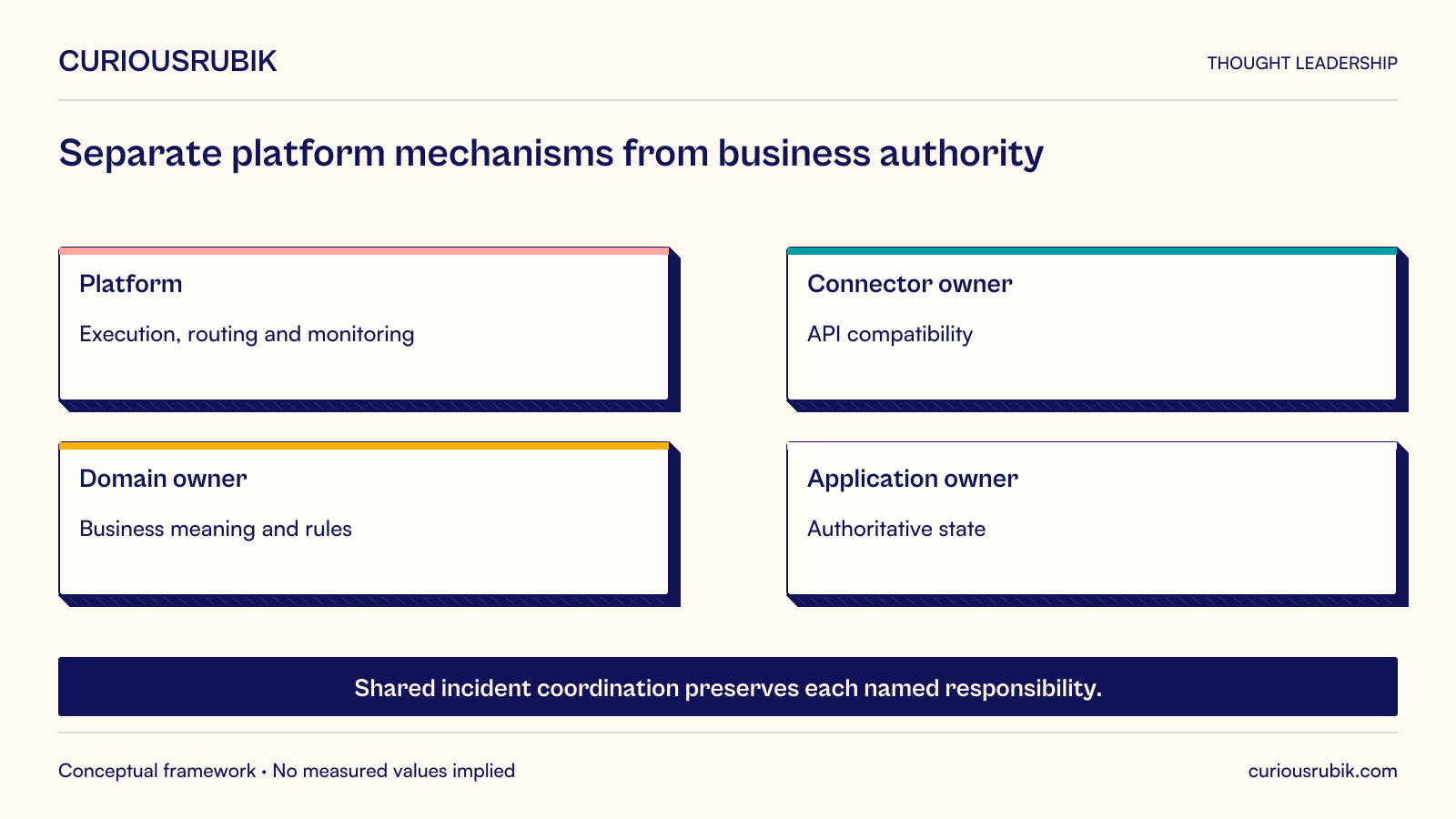
Define who supports each layer. The platform team may restore the runtime. The connector owner may resolve an API compatibility issue. The domain owner may correct an invalid business mapping. A single support queue can coordinate those responsibilities, but it should not blur them.
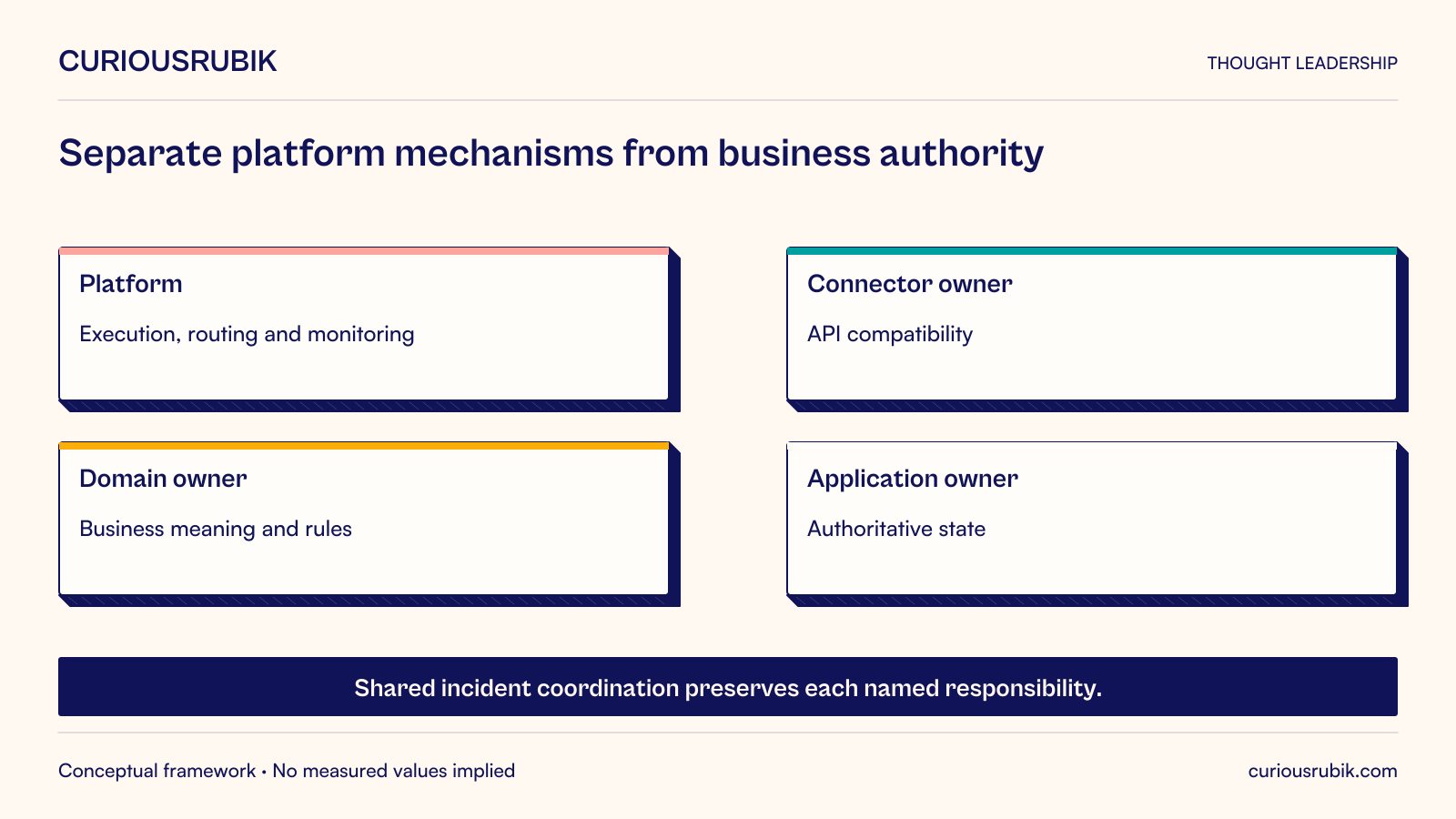
Assess concentration and exit costs
A shared intermediary can become a common failure point for previously independent flows. Examine isolation, capacity allocation, deployment blast radius, and recovery. A change to a shared component should not unexpectedly interrupt unrelated critical processes.
Ask whether one noisy flow can exhaust shared resources or consume a destination’s limits. Establish quotas or isolation where the architecture supports them, and test the consequence of a backlog. The required controls should follow the portfolio’s actual risks rather than a generic requirement for maximum redundancy everywhere.
Consider what must be retrieved or rebuilt if the platform is replaced: mappings, workflow state, connection definitions, test cases, logs, schedules, and operational knowledge. Exported configuration may not run elsewhere, but preserving explicit contracts and tests can make a future migration more understandable.
Do not promise portability solely because the platform uses standard protocols. HTTP at the boundary can coexist with proprietary workflow semantics and transformation code inside. Conversely, a proprietary component may still be a reasonable choice when its benefits and exit obligations are understood.
Make the selection through a bounded portfolio pilot
Choose several flows that represent the difficult requirements, not only the simplest connectors. Include at least one meaningful transformation, one asynchronous or scheduled interaction, and one consequential recovery case if those exist in the portfolio. Compare the shared-platform approach with a credible simpler alternative.
Measure implementation effort, ongoing operational work, source and destination load, failure diagnosis, recovery, and the effort to change a contract. Separate one-time learning from recurring work without assuming that every inconvenience will disappear after adoption.
There are legitimate reasons to choose less middleware. A narrow stable integration may be easier to understand and support directly. A team with strong existing engineering and operations capabilities may gain little from another runtime. A complex platform can also impose a skill bottleneck if only a few specialists can safely change it.
There are equally legitimate reasons to choose it: many flows share mechanisms, application teams need a supported execution environment, connector maintenance is costly, or current operations lack consistent visibility and recovery. The benefits should be demonstrated on the portfolio’s actual constraints.
Check environment separation during the pilot. A developer should be able to test a mapping against appropriate nonproduction data without accidentally invoking a production destination. Promotion should preserve the reviewed logic while applying the correct environment-specific configuration. Demonstrate this separation with an intentionally blocked production call from the test environment. It tests an operational promise that a connector demonstration alone cannot establish.
Before approving the platform, write a one-page responsibility statement and prove it with a difficult flow. If the intermediary removes repeated technical work while preserving clear business ownership and manageable recovery, it has a defensible role. If it mainly changes where the same ambiguity is stored, simplify the design before expanding the platform.