An implementation team can design a workflow, estimate the work and explain the consequences of a choice. It cannot always decide whose business priorities should prevail. When departments disagree about a common process, scarce staff or the acceptable level of disruption, the program needs authority beyond the project manager’s mandate.
That is the practical purpose of executive sponsorship. The sponsor keeps the implementation connected to a business outcome, resolves decisions that cross organizational boundaries and commits the resources and operating changes needed to realize the result. Visible enthusiasm helps, but a supportive kickoff speech cannot substitute for those decisions.
For an executive considering whether they can sponsor a program effectively, the question is not whether they believe in the technology. It is whether they can provide the authority, attention and accountability that the program will require when tradeoffs become uncomfortable.
Define the decisions that require a sponsor
Start with the decisions the project team cannot legitimately make. These may include changing enterprise policy, reallocating business capacity, resolving conflicts between functions, accepting material residual risk or deciding that a release no longer justifies its cost.
Keep technical decisions with the appropriate technical authority. A sponsor does not need to choose every configuration or integration pattern. They need enough understanding to assess the business consequence, ask for credible evidence and ensure the right person is accountable for the decision.
Similarly, sponsorship does not remove specialist responsibilities. Finance, legal, security and operational owners retain their authority within the organization’s governance. The sponsor should resolve gaps and conflicts between those roles rather than pretending one executive can replace all professional judgment.
Create a short decision charter naming the sponsor’s reserved decisions, delegated decisions, escalation route and expected response conditions. The charter is a proposed working tool, not a universal governance standard. Its value is demonstrated when a real issue reaches the person able to resolve it.
Protect the business case from becoming a historical document
The sponsor should be able to explain what operating change makes the investment worthwhile. “Implement the platform” is a delivery activity. Reducing a particular source of rework, supporting a new operating model or creating a dependable group reporting process describes a business intention that can guide choices.
Assign owners to the intended benefits and identify the actions required to realize them. If a benefit depends on retiring an old process, who will authorize and complete that retirement? If it depends on employees using a common definition, who resolves local objections and maintains it after launch?
Revisit the business case when material assumptions change. A smaller release may still be worthwhile, but its expected value should reflect what it will actually enable. Continuing to report the original benefit after removing its main supporting capability creates false confidence.
The sponsor must also retain the option to stop or redirect. Prior expenditure can explain how the program reached its position, but does not by itself justify the next commitment. Ask what value remains achievable and what additional cost and risk are required from this point forward.
Make business capacity a real commitment
Implementation plans often assume access to experts who already have full operating responsibilities. The sponsor is needed when those competing priorities cannot be resolved within the project team.
Identify the required skills and calendar windows, not just a list of named people. A finance expert needed for data decisions during close may be unavailable even if their department nominally allocated them to the project. A regional manager may attend workshops but lack time to test exceptions or train colleagues.
Decide what work will be deferred, backfilled or simplified to create capacity. Adding a project responsibility without changing any existing obligation is an assumption about extra effort, not a resource plan.
The same principle applies to management attention. If important decisions routinely wait several weeks for an executive meeting, the schedule should show that dependency. Better still, establish delegated authority for decisions that do not need to wait.
A capacity conflict requires an executive tradeoff
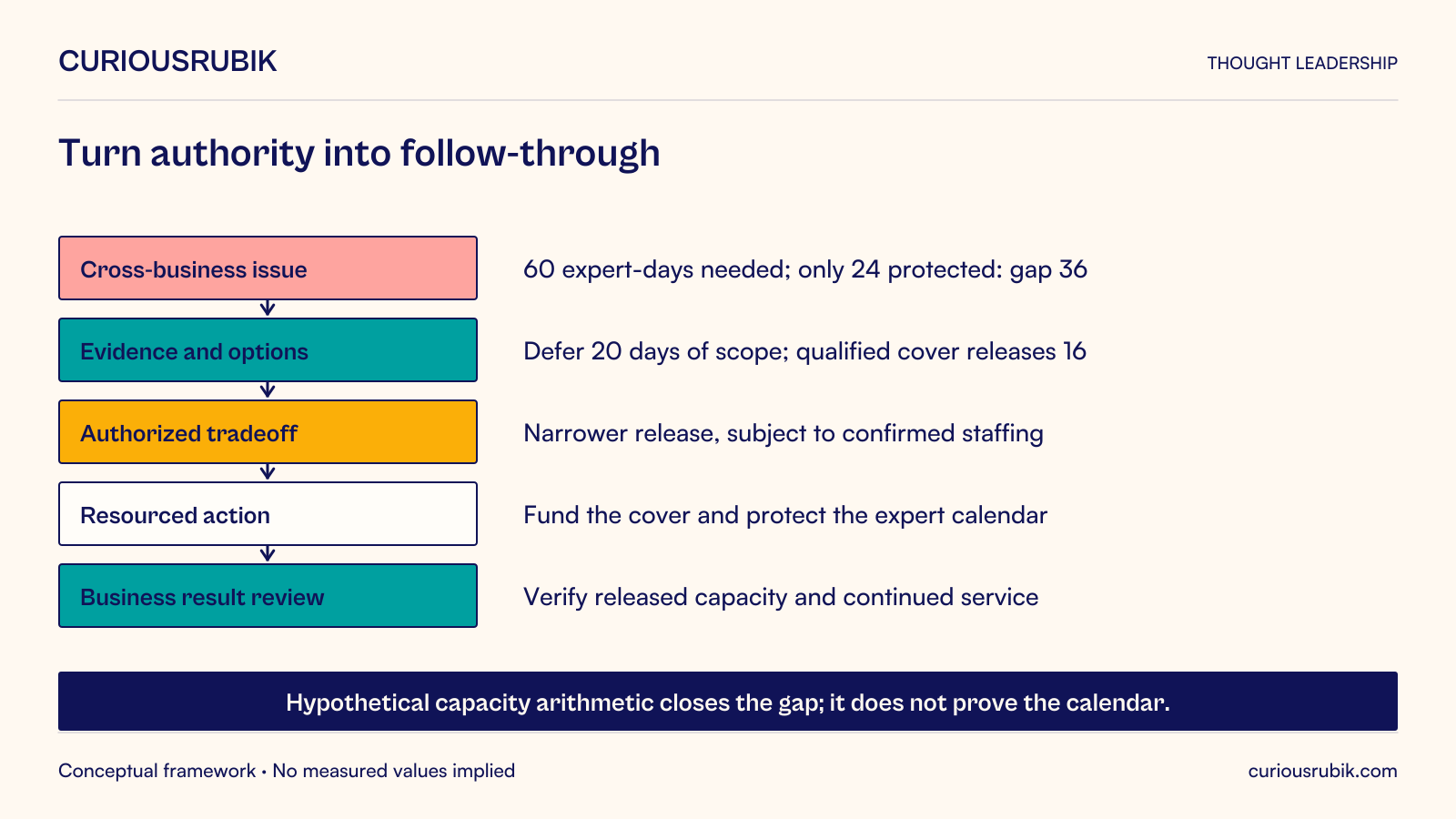
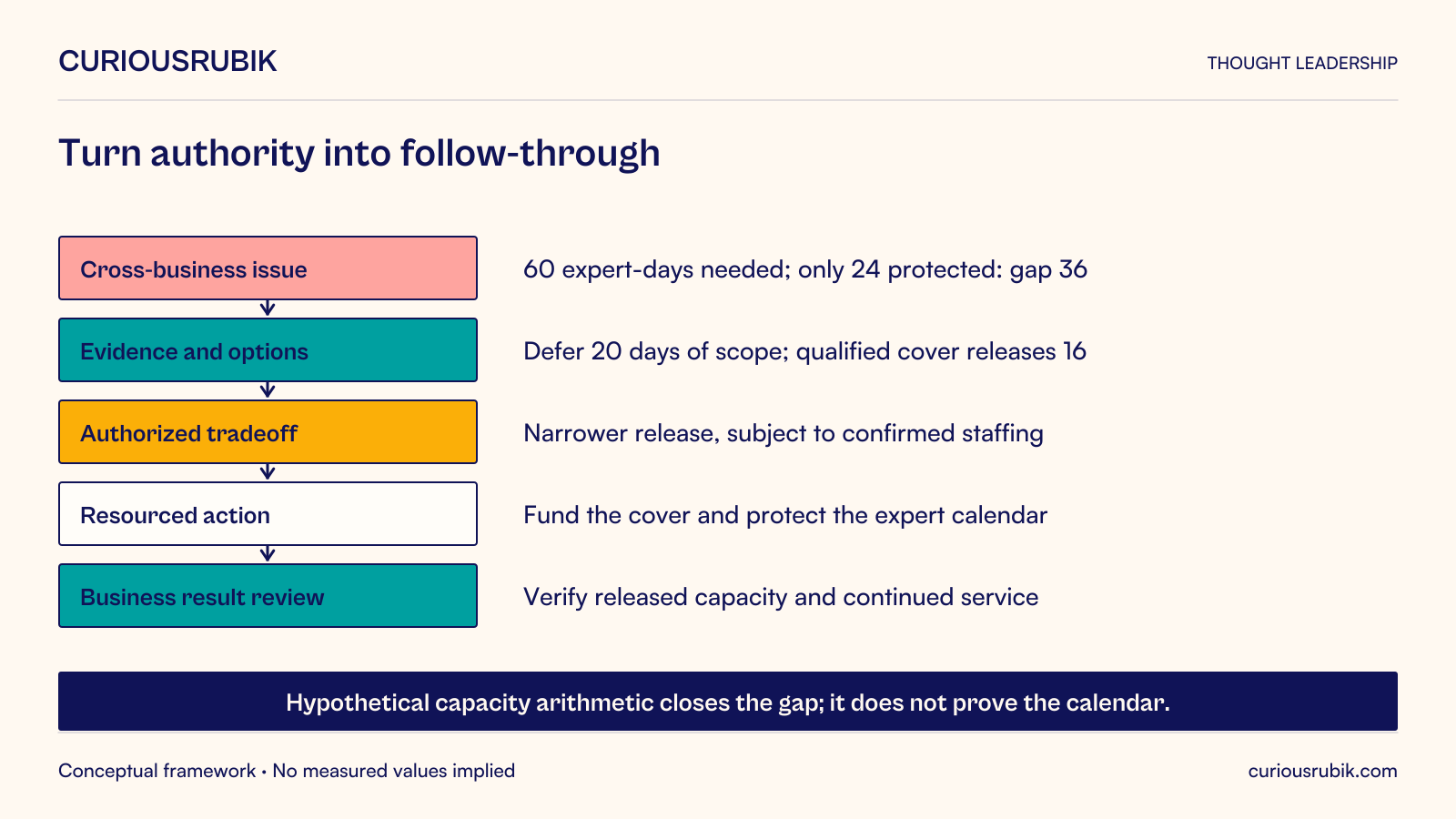
Consider a hypothetical equipment-rental business replacing its operations platform before its busiest season. The figures are invented planning quantities, not a client result. The implementation plan requires 60 days of experienced business-user effort for decisions, testing and training. Operations can protect only 24 days without leaving essential customer work uncovered. The program has a 36-day capacity gap.
The project manager can describe the missing work but cannot require operations to abandon its service commitments or authorize additional operating expenditure. The sponsor must compare genuinely different business choices.
One option is to preserve the full release and date by funding qualified operational cover that demonstrably frees the required expert time. The cover performs suitable routine duties; it cannot simply replace the experienced people in complex acceptance decisions. This option requires evidence that recruitment, training and handover can happen in time without creating a new service risk.
A second option preserves the date but narrows the release. Assume the team can defer a capability requiring 20 expert-days and obtain operational cover that releases another 16. Together those changes address the 36-day gap in this simplified capacity model. They do not automatically prove the schedule, because the released people and timing must match the remaining dependencies. The sponsor must also acknowledge the benefits deferred with the smaller release.
A third option retains full scope but moves the release beyond the peak period. That may protect operating capacity while extending parallel-system costs and delaying benefits. None of these options is costless, and the project team cannot legitimately choose the enterprise priority on its own.
Suppose the sponsor selects the narrower release with 16 days of qualified cover, subject to a confirmed staffing plan. The decision must become an approved scope change, a funded operating commitment and protected calendar time. The sponsor then reviews whether the cover actually released expert capacity and whether normal service remains within agreed limits. If either condition fails, the program revisits the commitment instead of assuming the resource problem was solved by a budget approval.
This is sponsorship in action: choosing a business tradeoff and ensuring the promised resources exist in practice.
Ask for evidence that makes decisions possible
A sponsor should not need to inspect every project artifact. They do need a view that distinguishes completed work, unresolved assumptions and decisions requiring attention.
For a material issue, request the observed condition, business consequence, credible options, recommendation and latest useful decision date. Include what happens if no decision is made. This makes the cost of delay visible without treating every issue as an emergency.
Challenge status that is based only on activity. A workstream can complete planned tasks while its end-to-end process remains unproven. Ask which representative scenarios work, what evidence supports the next milestone and which operating responsibilities remain unassigned.
The National Audit Office’s 2021 review of digital change found that public-sector digital leaders could struggle to obtain the understanding and support they needed from senior decision-makers. The report concerns government and should not be treated as a private-sector success-rate study. Its relevant lesson is that executives need enough digital understanding to engage with the risks they own. The challenges in implementing digital change.
An executive can develop that understanding through concise briefings, demonstrations of difficult scenarios and candid specialist advice. They do not need to become the program’s lead engineer.
Create a rhythm that matches decision urgency
Use regular steering reviews for material choices and a faster route for time-sensitive decisions within defined bounds. The cadence should follow the program’s dependencies rather than an inherited monthly meeting schedule.
Protect the quality of escalation. Teams should know that identifying a serious problem early is useful behavior. If every escalation is treated as failure, issues may remain hidden until the options are more expensive.
At the same time, require preparation. The sponsor should not become the default resolver of every minor uncertainty. Ask teams to bring analysis and a recommendation when appropriate, and delegate repeatable decisions to qualified owners.
Record decisions and conditions for revisiting them. Communicate the outcome to all affected workstreams. An executive agreement made in a meeting but not reflected in scope, resources or acceptance criteria leaves the program operating under two realities.
Plan for continuity and eventual handover
Sponsorship is vulnerable when it depends entirely on one person’s informal relationships. If the executive changes roles or becomes unavailable, the program still needs authority and access to its decision history.
Document the mandate, current business case, material decisions, unresolved risks and benefit ownership. Identify who acts temporarily and who can appoint a replacement. A handover should include the uncomfortable tradeoffs, not only the latest status presentation.
The sponsor’s responsibility also extends beyond the launch ceremony. Confirm who will own the process, support the system, review benefits and retire temporary arrangements. The project can close only when those responsibilities are accepted under the organization’s criteria.
Executive sponsorship is critical because implementation eventually reaches decisions that software and project management cannot legitimately make alone. Before accepting the role, identify those decisions, establish how they will reach you and commit the capacity to act. The strongest evidence of sponsorship is a program that can make difficult business choices and carry them through into dependable operations.