To shorten a financial close, find the sequence of unresolved dependencies that determines when the accounts can be trusted. Adding reminders or automating the busiest accountant’s task may make work easier without changing the finishing date. The controller’s first decision is which upstream failure or review dependency to remove, while preserving the evidence needed for reliable reporting.
A long close can contain several different problems: transactions arrive late, accounting questions remain unresolved, reconciliations expose inconsistent records, reviewers lack context, or completed work is repeatedly reopened. Each mechanism needs a different remedy. Treating all of them as “manual effort” leads to automation projects that move the same uncertainty around faster.
The objective should therefore specify both time and quality. For example, management might seek a dependable reporting pack by a defined working day with reconciliations completed, significant judgments approved, and unresolved items explicitly assessed. The actual acceptance criteria must follow the organization’s reporting requirements and accounting framework. A shorter calendar is not progress if errors migrate into later corrections or become invisible.
Reconstruct the close from evidence
Start with the last completed close. For each significant deliverable, record when the necessary inputs became available, when work started, when it finished, when review began, and whether it was reopened. Capture the reason for waiting in ordinary language. “Waiting for operations” is too broad; “delivery team had not confirmed whether 12 milestones were accepted” suggests an actionable dependency.
Distinguish working time from elapsed time. An accountant may need two hours to reconcile an account but wait two days for an unexplained difference to be assigned. Another task may genuinely require a day of technical analysis. Adding capacity can help the latter; it may do little for the former unless ownership and escalation change.
Draw dependencies between outputs. The final pack may depend on entity submissions, which depend on reconciliations, which depend on complete subledger feeds. Some judgment papers can be prepared before period end. Some balances cannot be finalized until relevant activity stops. Map those differences instead of forcing every task into the same timetable.
Ask reviewers to reconstruct their own queue. A completed preparer task is not complete for the reporting process if the only authorized reviewer is unavailable. Several nominally parallel workstreams can converge on one person and become sequential at the final stage.
Use the critical path to choose the first intervention
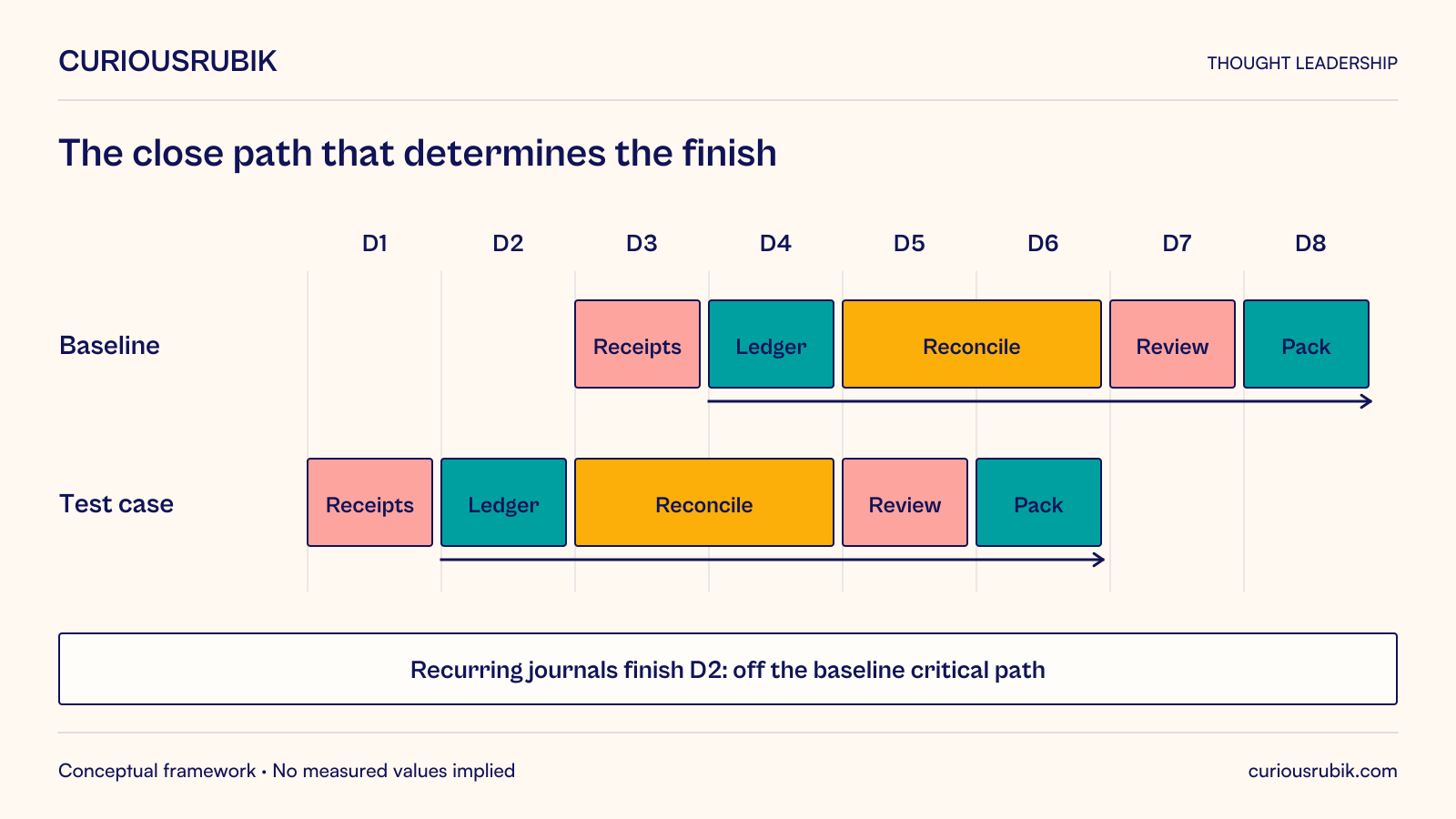
The critical path is the dependency sequence that currently determines completion. It can change when a bottleneck is removed, so the map needs to be recalculated after improvement.
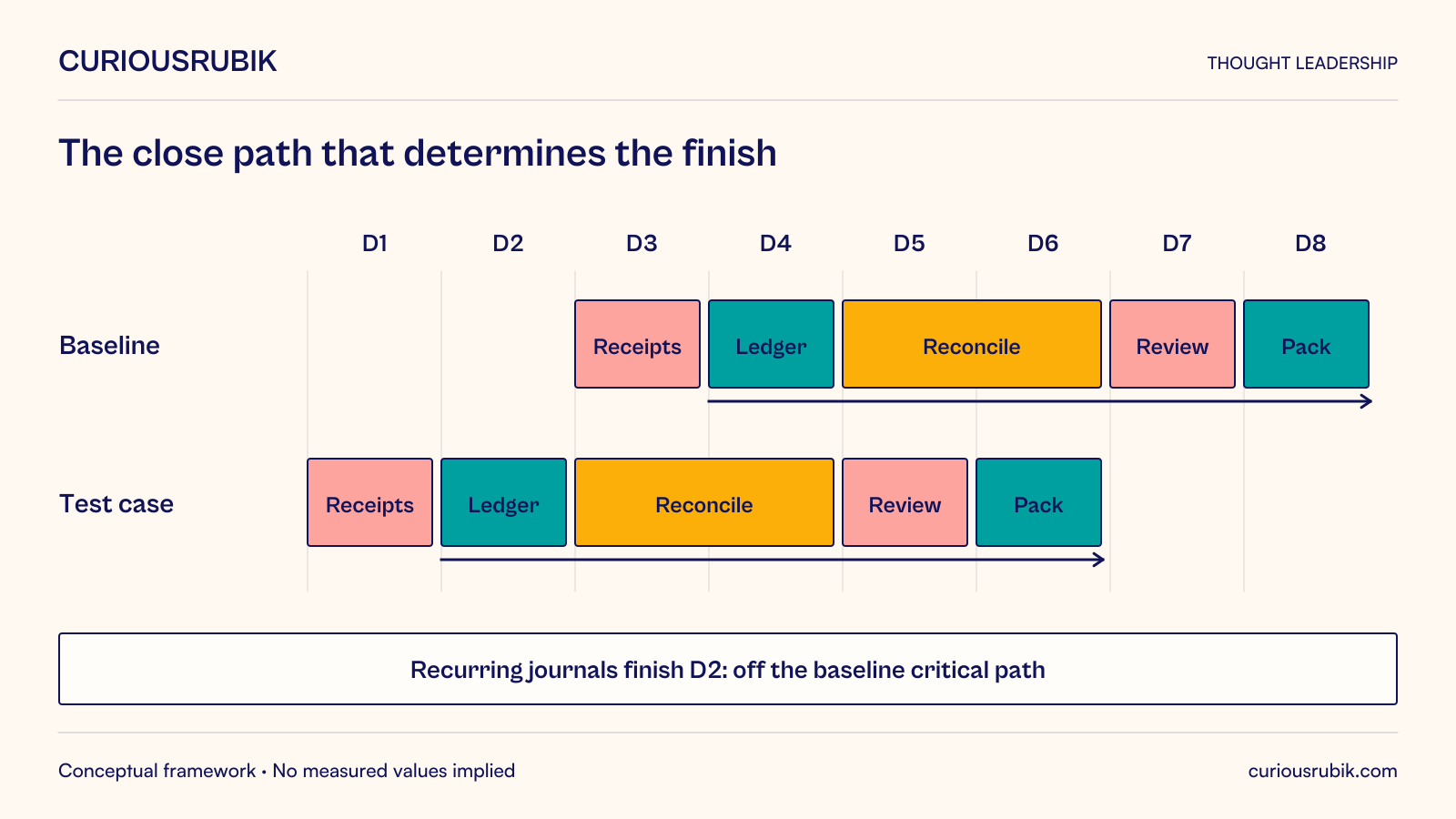
Consider a hypothetical company that releases its monthly management pack at the end of working day eight. Receipt confirmations become complete at the end of day three. The related ledger load and checks take day four. Reconciliation occupies days five and six. Review takes day seven, and pack assembly and final approval take day eight. Meanwhile, recurring journal preparation finishes on day two and waits for later inputs.
Automating those recurring journals might reduce workload but will not, by itself, shorten this eight-day sequence. The controlling chain begins with the receipt confirmations. Suppose a tested receiving process can provide complete evidence by the end of day one. Holding all other durations constant for illustration, the downstream chain could finish on day six. That is a scheduling calculation, not a promised two-day benefit.
The controller must test the assumption behind the improvement. If confirmations arrive earlier but are unreliable, reconciliation may take longer. If the ledger load runs only once on day four, earlier confirmations provide no calendar benefit until that dependency changes. If the reviewer remains unavailable until day seven, the final date may remain unchanged.
This is why a close-acceleration proposal should show the whole changed path, including people and system schedules. A local efficiency estimate is insufficient evidence of a shorter close.
Move uncertainty earlier when the evidence permits
Some period-end work exists because finance first hears about transactions at close. Establish earlier checkpoints for unusual contracts, new entities, significant disputes, changed cost arrangements, and nonroutine transactions. The purpose is to resolve interpretation and information requirements before the final number must be produced.
A pre-close review can identify what is known, what remains uncertain, and which evidence will resolve it. It should not force premature recognition or encourage unsupported estimates. The accounting treatment remains a professional judgment under the relevant framework. Operationally, the review ensures the right people are available and the required facts are being collected.
Reconciliations can also be prepared progressively where appropriate. For example, resolving old unmatched items during the month reduces the unresolved population at period end. Yet a reconciliation prepared early still needs a controlled update for subsequent activity. Labeling it “complete” before the population is final creates false assurance.
Create an explicit handoff contract with each upstream team: what evidence is required, the cutoff it relates to, who provides it, how corrections are communicated, and who resolves an exception. A service-level target without these details encourages teams to send incomplete files on time and transfer the delay to finance.
Make review easier without weakening it
A reviewer should receive a coherent evidence package: the balance or conclusion being assessed, the source population, the work performed, relevant thresholds, unresolved differences, and the preparer’s explanation. Review slows when the person must reconstruct those elements from scattered messages.
Define the review objective for each task. For a reconciliation, the reviewer may need to establish that the correct populations were compared, differences were explained, and proposed adjustments were appropriate. For a judgment paper, the question may be whether the facts and policy analysis support the conclusion. A generic “approved” checkbox cannot communicate what was actually examined.
A useful design reference is COSO’s emphasis on selecting control activities in response to risk. It does not set a universal close duration or mandate identical review for every account. COSO Executive Summary, Principle 10
Allocate review effort using the nature and significance of the risk, not only the account balance. An apparently small account can signal a broader process failure. Conversely, repeating the same low-value check at three management levels can consume time without adding a distinct challenge. Remove a review only after identifying what it was meant to detect and showing how that risk will remain addressed.
Control reopening and late changes
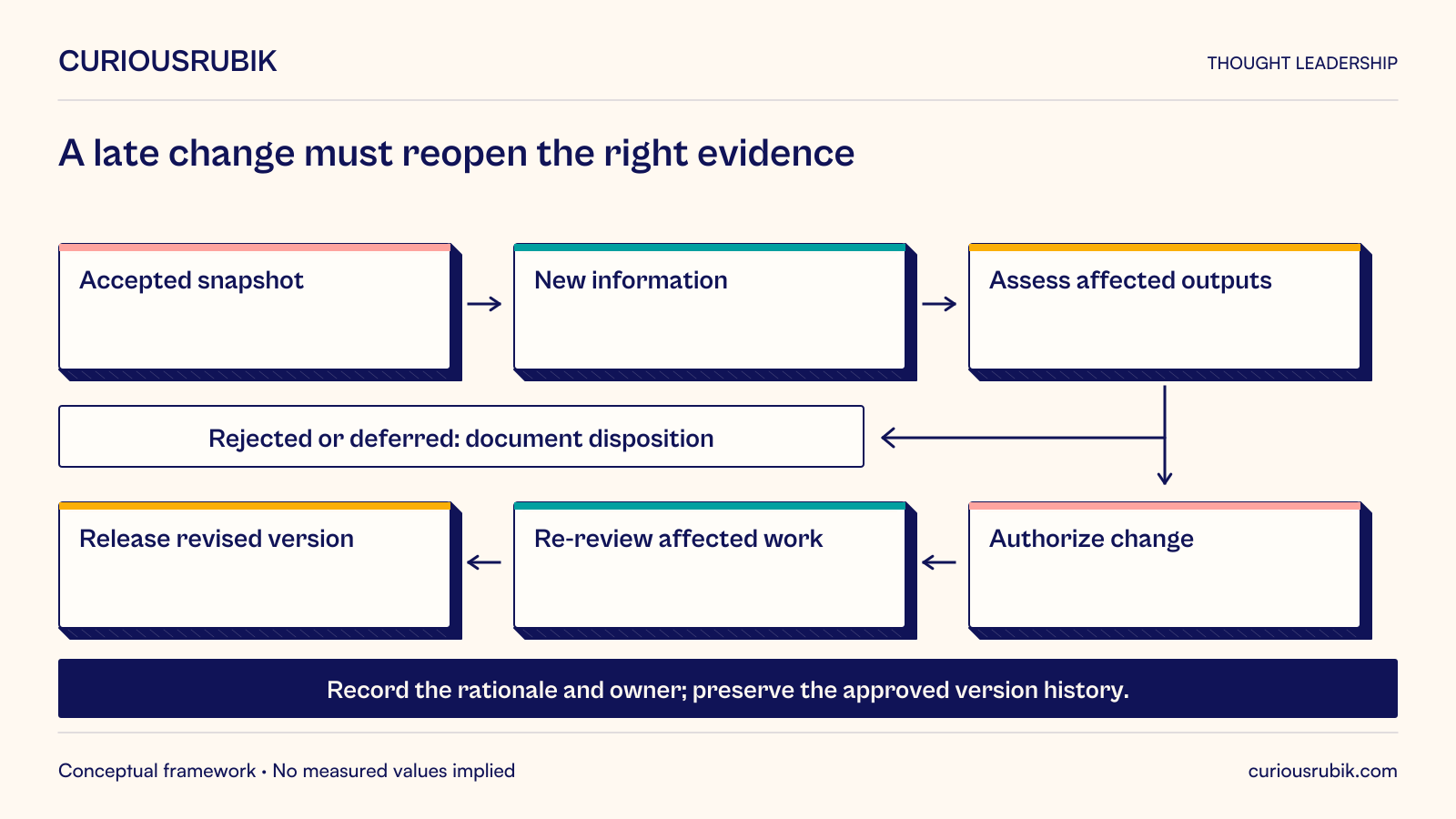
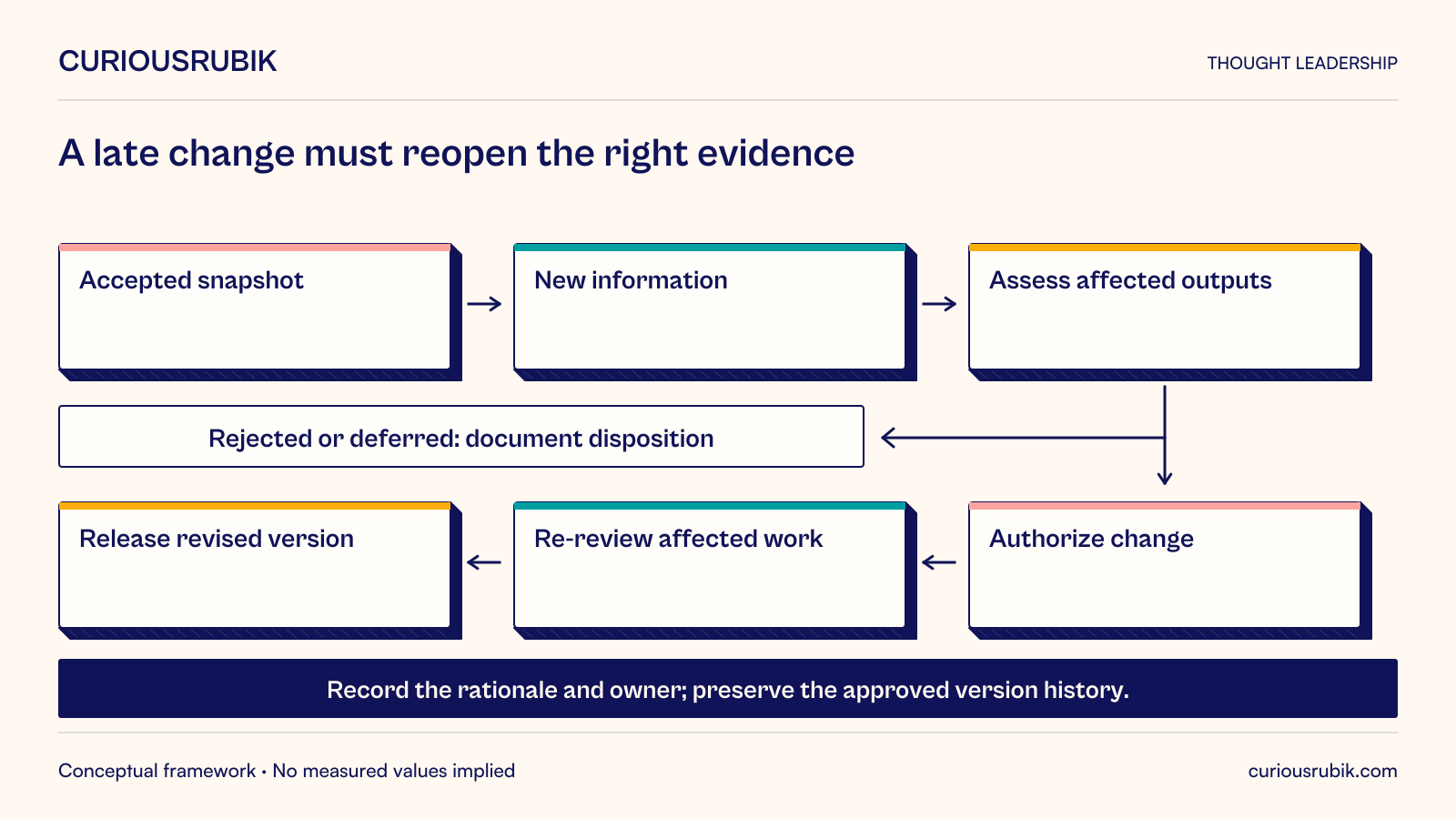
Every close needs a way to handle new information. The damaging pattern is uncontrolled reopening: a source file changes, a report refreshes, and previously approved numbers move without anyone realizing the evidence has changed.
Use versioned snapshots at important handoffs. If an entity submission changes after acceptance, record the reason, affected outputs, owner, and required re-review. Keep an exception register that distinguishes proposed adjustments, approved adjustments, unresolved factual questions, and items carried forward with a documented assessment. An item should never disappear merely because a reporting deadline has arrived.
Late changes should have a route proportionate to their consequence. A correction affecting a key executive decision may require an immediate revised pack. Another issue may be handled through the organization’s established correction process. The controller and appropriate specialists must determine treatment, including any external reporting obligations; the workflow must preserve the facts and decision trail.
Measure reopening separately from initial completion. A team that marks tasks finished early and repeatedly reopens them can look fast on a simple tracker. The more useful measure is when the output became stable and reviewable, alongside the number and significance of changes after that point.
Build an improvement backlog from failure causes
Classify delays by cause: unavailable evidence, rejected input, unresolved accounting judgment, capacity constraint, system timing, or review rework. These are operational categories for analysis, not a standard taxonomy. Maintain enough detail to select an intervention without turning every exception into its own category.
For each recurring cause, name a process owner, describe the change, state the expected effect on the dependency path, and define a test. A missing supplier code might need a master-data fix. Repeated disputes about service completion may need a new operational acceptance record. Slow reconciliation could require a better matching design, but only after checking source completeness.
Choose a small set of measures. Track the finishing day, late input volume, unexplained differences, review waiting time, reopened work, and post-close corrections. Interpret them together. A faster finish with increasing corrections calls for investigation. More recorded exceptions after introducing better detection may reflect improved visibility rather than deterioration.
There are legitimate limits to acceleration. Complex transactions, valuation work, local reporting requirements, external confirmations, or constrained specialist capacity may create necessary elapsed time. The answer may be to release a clearly labeled preliminary management view while retaining a later formal close. That choice requires explicit distinctions between provisional and approved information, not a claim that every figure is final sooner.
For the next close, select one chain that genuinely controls the finishing date. Agree on one upstream intervention, its evidence standard, and the downstream changes needed to benefit from it. Keep the original quality criteria visible. A reliable close becomes faster when uncertainty is resolved and dependencies are redesigned, not when the calendar is made more demanding.