The first support call after launch may describe a simple symptom: “The customer completed the form, but the service is not active.” Resolving it can require tracing identity, payment status, workflow state, an integration message, and a permission decision across several systems.
If the implementation never created the necessary identifiers, logs, operating views, or recovery tools, the hypercare team must investigate through guesswork and specialist intervention. Adding more people after launch does not repair missing supportability.
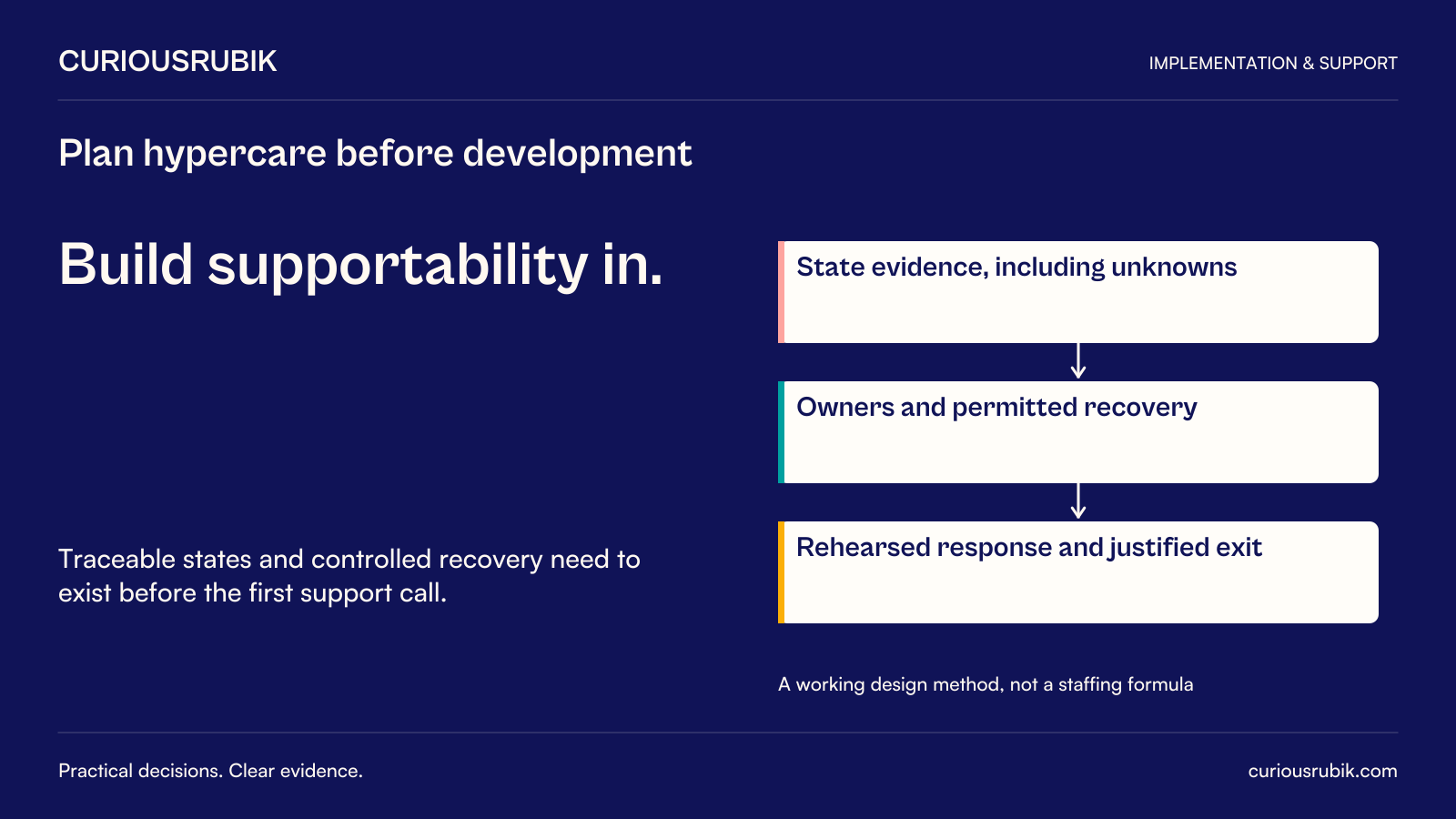
Hypercare is the period of concentrated support around early operation. Planning it before development means designing the evidence, access, authority, and recovery capabilities the team will need. The central decision for a program sponsor is to treat supportability as part of the delivered product, with acceptance criteria and funding, rather than as a staffing exercise scheduled after testing.
Begin with the questions support must answer
For each critical business transaction, identify what an operator needs to establish when something appears wrong. Did the request arrive? Was it accepted? Which step completed? Is the result incorrect, delayed, or unknown? Has an external effect already occurred?
These questions expose design requirements. A shared transaction reference can connect records across systems. Meaningful status history can distinguish waiting from failure. Reconciliation can identify a missing downstream result even when no technical error was reported.
Define the business context needed without collecting excessive sensitive data. Support may need a customer reference and the relevant state, not unrestricted access to every document or personal detail associated with the account.
Write these needs into the requirements and architecture. A support team should not have to request direct database access simply because the normal application provides no safe way to understand a failed transaction.
Create a supportability contract for priority transactions
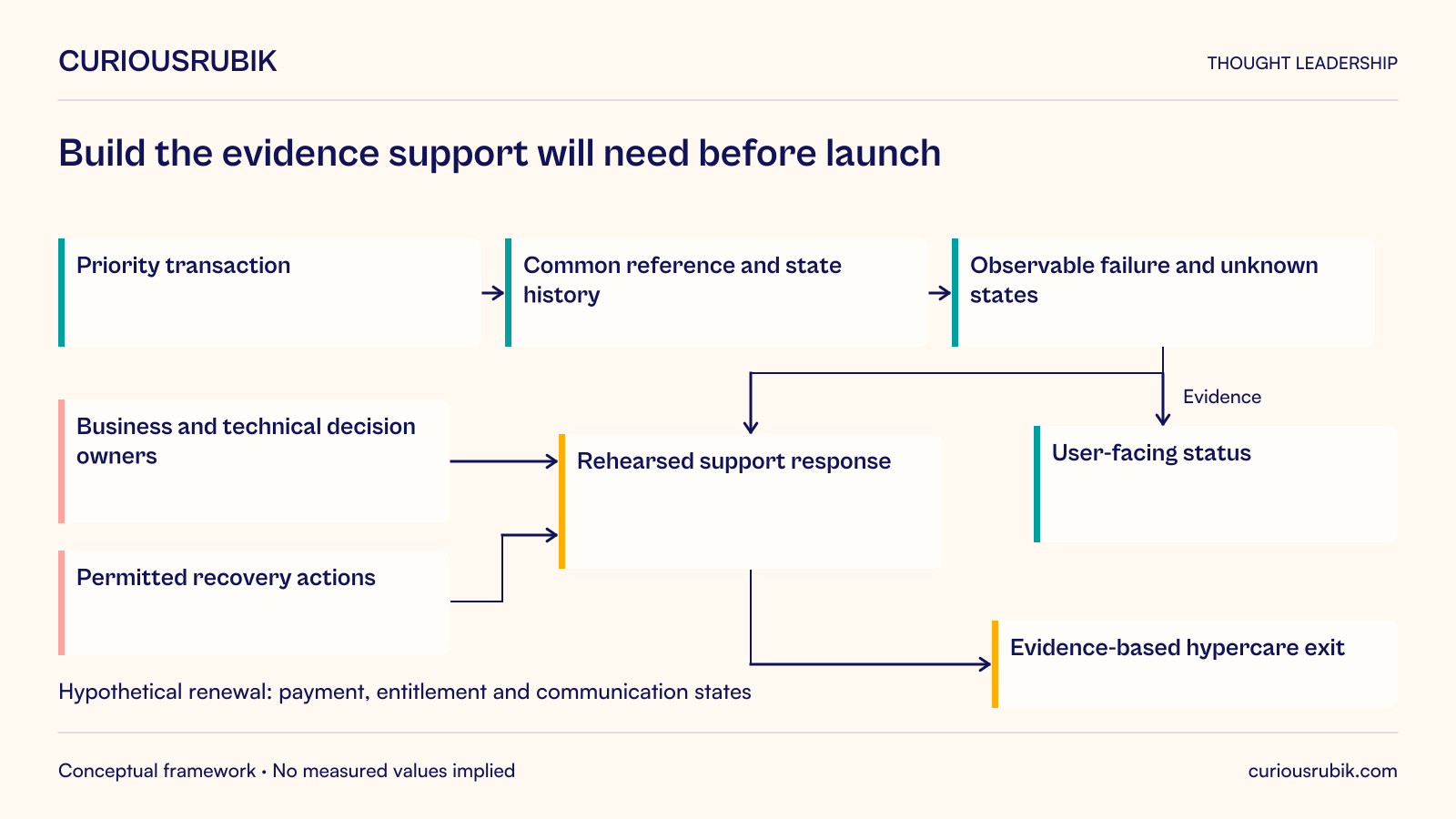
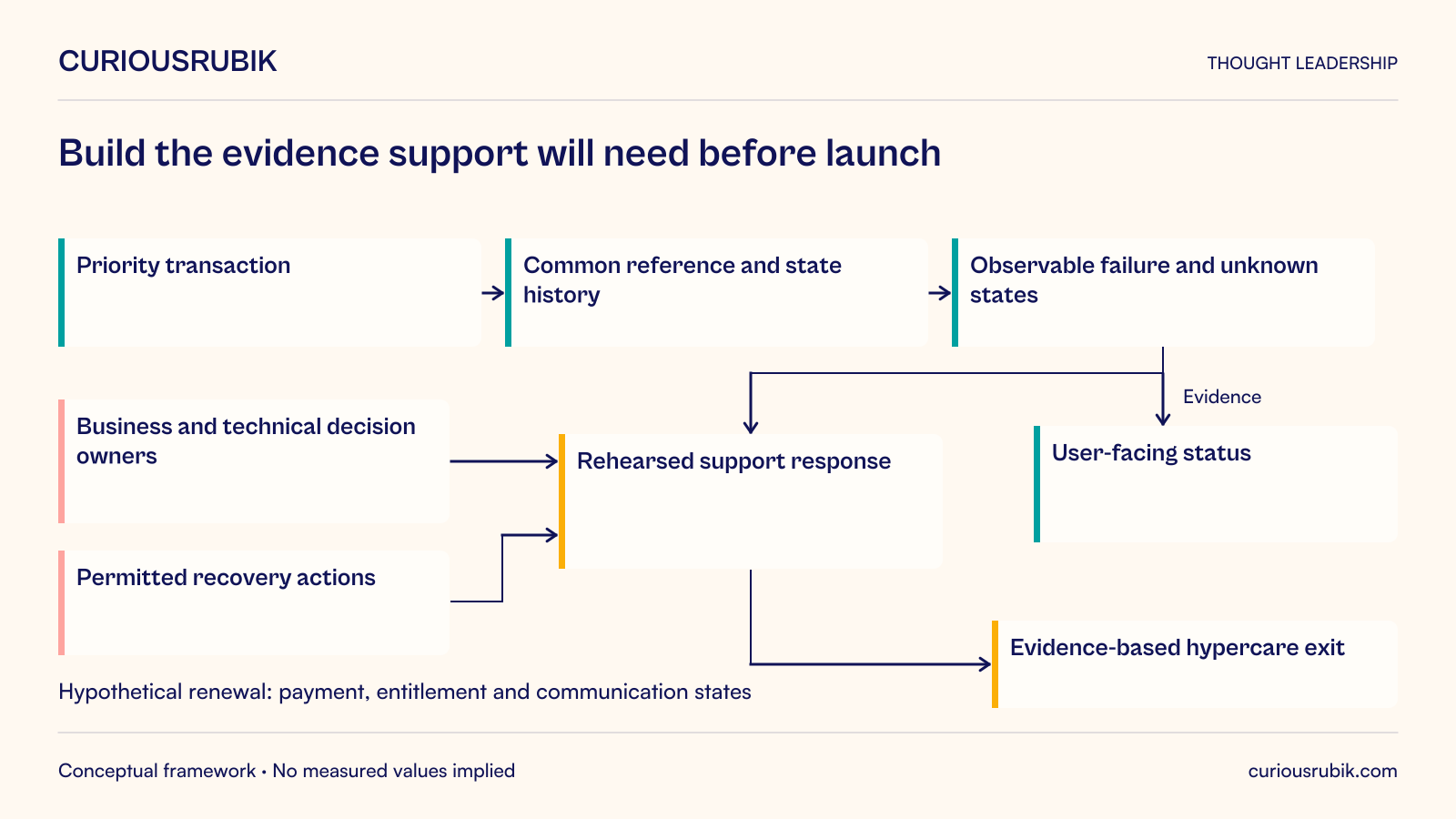
A practical working artifact records the transaction’s expected path, observable states, identifiers, likely failure modes, decision owners, and permitted recovery actions. This is a proposed design method, not an industry standard.
For each failure mode, specify how it will be detected and what evidence the first responder can inspect. Identify when the case moves to a business owner, a technical specialist, or a supplier.
Describe recovery limits. Can the step be retried safely? Must the operator check whether a previous attempt succeeded? Does the action require approval because it changes a commercial or financial record?
Include the customer’s or employee’s experience. A backend status can be technically accurate while leaving the user with no explanation or next step. Supportability includes the ability to communicate a truthful status, not only to diagnose the system.
Design observability for business questions
Technical monitoring should reveal service health, but business support often needs transaction-level evidence. An interface can be available while a subset of records fails validation or waits indefinitely.
The Site Reliability Engineering text distinguishes external observation of behavior from internal instrumentation and emphasizes monitoring that supports action. The enterprise application of that principle is to combine technical signals with evidence that priority business outcomes are occurring. Site Reliability Engineering, Monitoring Distributed Systems.
Define what should appear in a support view: current state, last successful step, source and receipt times where relevant, responsible queue, and a reference to the underlying evidence. Use consistent identifiers across integrations.
Avoid turning logs into an uncontrolled copy of business data. Apply appropriate access, redaction, retention, and audit requirements. More detail is not automatically better if it exposes unnecessary information or makes the important event difficult to find.
A membership organization prepares for activation failures
Consider a hypothetical professional membership organization launching a new renewal portal. A completed renewal may involve an account update, a payment response, an entitlement change, and a confirmation message.
The initial design treats each connection separately. Hypercare planning asks how support will respond if the member sees success but the entitlement remains inactive. The answer requires a common renewal reference and a state history across the components.
The team adds a support view showing the submitted request, verified payment status from the authoritative source, entitlement update, and message outcome. It distinguishes “payment not confirmed” from “payment confirmed but entitlement pending.” A missing response remains an unknown state until reconciled.
Recovery tools are narrow. An authorized operator can retry a failed entitlement update after verifying the prerequisite, but cannot simply rerun the entire renewal and risk another charge or duplicate message. Financial corrections follow the organization’s approved authority and procedure.
The team rehearses a delayed payment response, a duplicate submission, an existing account with conflicting identity details, and a failed confirmation message after successful activation. The runbook tells support how to explain each state without promising an outcome that has not been confirmed.
The hypothetical example shows why hypercare requirements belong in development. The key capabilities are traceability and controlled recovery, not a larger launch-week help desk. No improvement rate or client result is asserted.
Define triage by the decision required
Early support demand includes several kinds of work. An incident interrupts or degrades an agreed service. A data issue requires correction of a business record. A usage question requires guidance. An enhancement asks for a changed capability.
The categories should help route work, not become a debate that delays assistance. A coordinating owner can restore the immediate outcome while the root cause is classified later.
Set severity according to business impact, affected scope, and urgency. A large number of minor questions should not obscure one issue blocking a critical process. Conversely, a dramatic individual complaint does not necessarily establish an enterprise-wide incident.
Prepare escalation paths with names, roles, coverage, and expected response. Include the business authority needed for policy or transaction decisions. A technical team should not be left to decide whether a customer commitment can be changed to work around a defect.
Prepare the response organization before the launch window
Define the hypercare lead, technical coordination, business-process leads, communications role, and supplier responsibilities. In a small launch, people may hold several roles, but the responsibilities should remain clear.
Plan shift coverage and handover. A long cutover followed by an immediate support shift can leave the most knowledgeable people fatigued when the first operating problems appear. Account for actual availability, deputies, and rest.
NIST’s 2012 incident-handling guide treats preparation as part of the response lifecycle. This historical edition addresses computer-security incidents; its preparation principle illustrates the importance of having people, procedures, and resources ready before an event. The hypercare design here is a broader operational application. NIST SP 800-61 Revision 2.
Check access in advance. A named specialist who cannot enter the approved support environment or inspect the relevant evidence is not ready to provide cover. Do not solve that problem at launch by granting unnecessarily broad privileges.
Rehearse support scenarios during testing
Testing should include the support team’s response, not only the application’s behavior. Deliberately create a representative failure and ask the intended first responder to identify it, assess impact, and follow the runbook.
Observe where the responder needs undocumented knowledge. Improve the support view, instructions, or ownership model before launch. A developer explaining every step during the rehearsal can conceal a handover gap.
Test ambiguous completion. If an integration times out after the receiving system has acted, can support determine the result without repeating an irreversible action? If a correction is made, can the team verify all affected records?
Include communication. The support team should be able to tell users what is known, what remains uncertain, and when the next update will occur. Avoid rehearsing technical recovery while leaving customer-facing teams unaware of the scenario.
Plan a manageable demand model
Estimate likely questions and incidents from training results, test findings, process novelty, and user population. Use ranges and identify uncertainty rather than promising a precise ticket count.
Separate predictable learning demand from technical failure. Role-specific guides, visible known issues, and accessible support routes can reduce repeated questions. They should not be used to discourage reporting genuine defects.
Create one way to identify related cases. Several user reports may reflect one underlying problem. Linking them helps the team assess impact and communicate consistently without losing the individual users’ needs.
Protect specialists from constant interruption. A triage role can gather evidence and coordinate priority, allowing engineers and business experts to work on the cause. The design should speed resolution rather than add an administrative barrier.
Define how concentrated support will end
Hypercare needs evidence-based exit conditions. These may include completion of priority operating cycles, controlled incident demand, usable runbooks, accepted residual risks, and a staffed ongoing support model.
Set those conditions before launch. If they are invented near the planned exit date, commercial and staffing pressure can dominate the assessment.
Allow a phased exit. A stable process may move to ordinary support while a specific integration retains specialist coverage. Keep the remaining scope and decision owner explicit.
Do not require zero tickets or an arbitrary quiet period without context. A service can be sustainable with some open work, while a quiet queue can conceal low usage or unreported problems. Evaluate the ability to operate and recover.
What to include in the delivery agreement
Require supportability artifacts and capabilities as deliverables: transaction traceability, safe recovery methods, operational views, runbooks, role access, rehearsed escalation, and handover evidence.
Clarify who owns defects, who performs data correction, and how a cross-supplier issue is coordinated. Avoid a contract structure in which each supplier can close its part while nobody verifies the business outcome.
Hypercare works best when the team can understand and act on early production behavior without improvising the foundations. Planning it before development turns launch support from an expensive emergency response into a designed capability of the system and the organization.