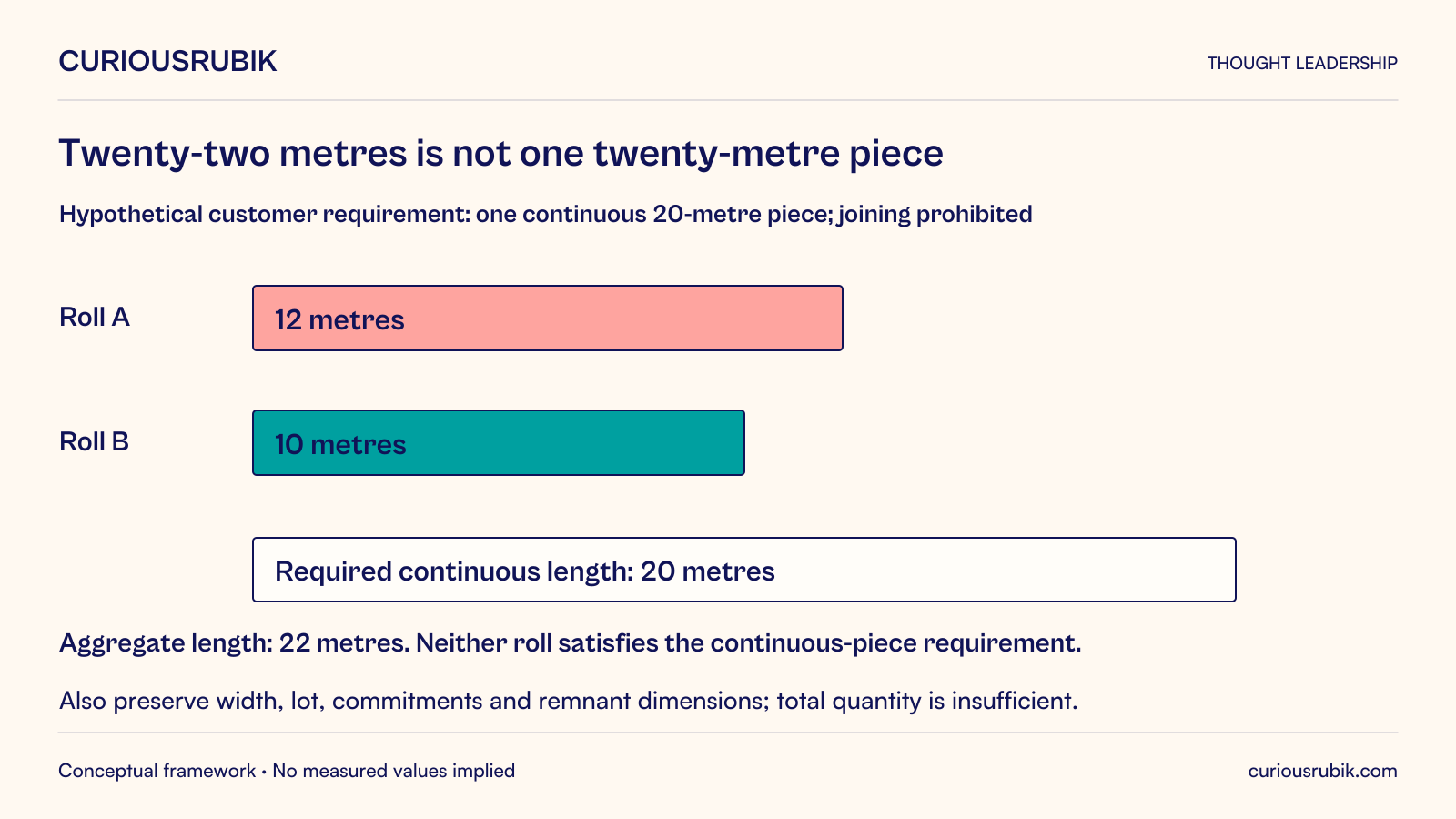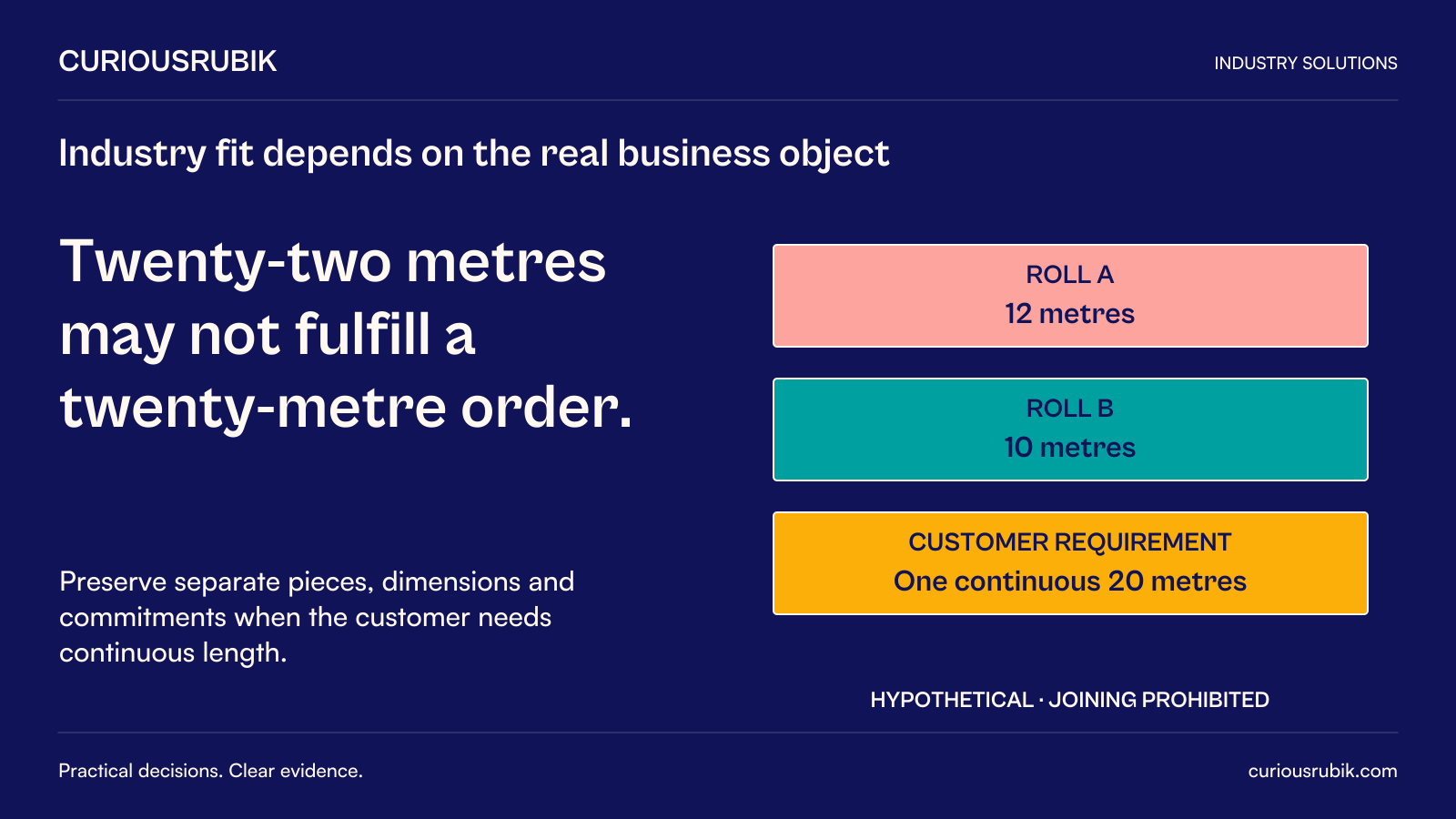
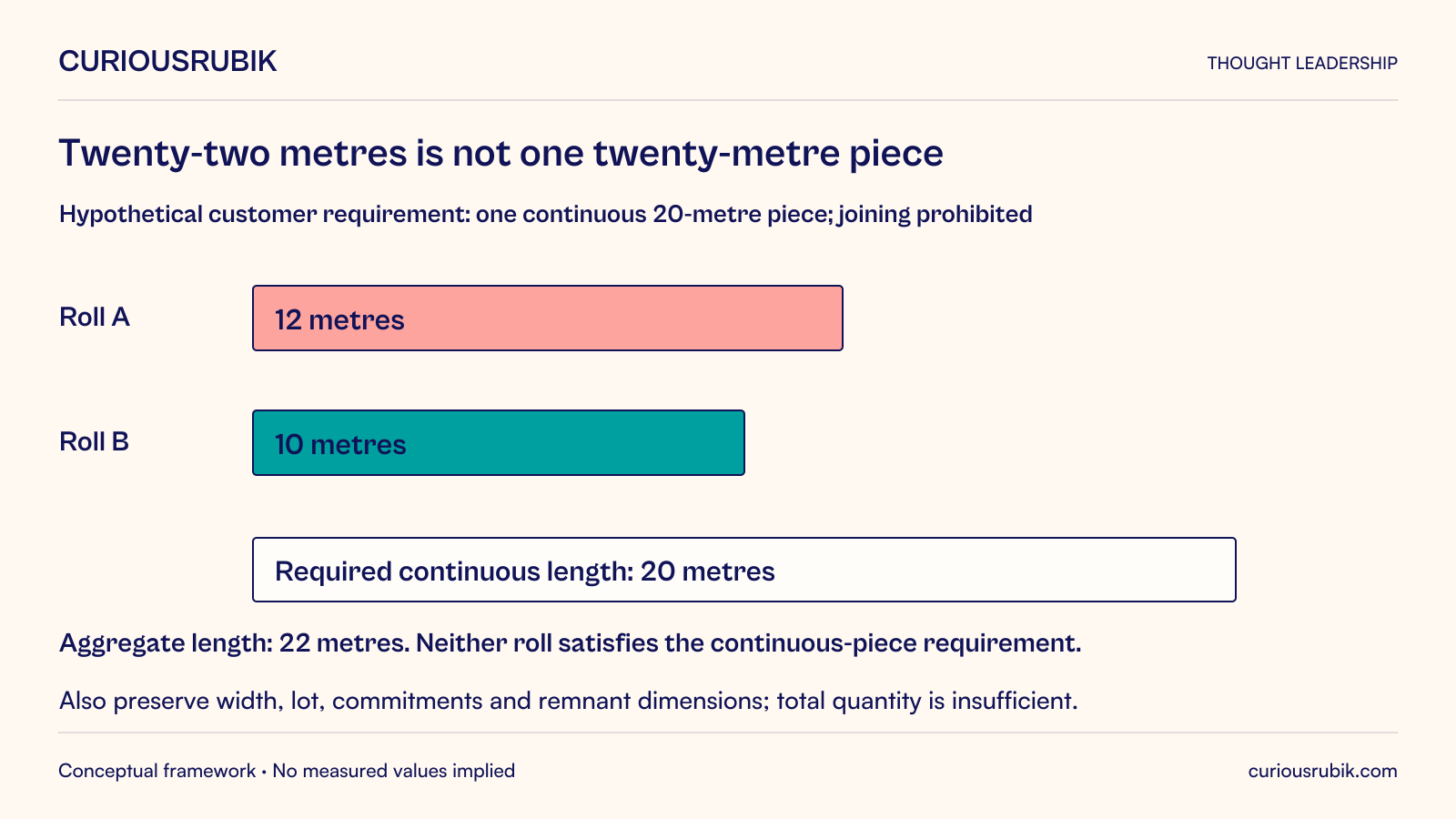
Twenty-two metres of fabric can be insufficient for a twenty-metre order. If the stock consists of separate twelve-metre and ten-metre rolls, neither can satisfy a customer requirement for one continuous length. A system that checks only the aggregate quantity can approve an order the warehouse cannot fulfill as specified.
That difference matters when selecting or designing enterprise software. A feature checklist can establish that a product has forms, workflows and reports, but it may not show whether the product represents the objects and decisions on which the business depends.
Industry fit is not a reason to preserve every local habit or commission a custom application. It is a reason to test the actual work before assuming that a familiar software category means the requirement has been met.
Follow the physical object the business actually sells
Consider a hypothetical fabric distributor holding two rolls of the same nominal product, one twelve metres long and one ten metres long. A customer requests one continuous twenty-metre piece, with specified width and lot requirements. Assume joining pieces is not permitted for this order.
The aggregate stock is twenty-two metres, but that total does not establish fulfillment feasibility. The application needs to know the length and relevant attributes of each roll, any existing reservations and which physical piece can satisfy the requested cut.
A different order for several shorter pieces may be feasible, but the cutting plan can leave remnants whose lengths matter for future orders. Subtracting the total metres sold without preserving the remaining pieces can progressively destroy the information needed for the next commitment.
The buyer should therefore examine the system’s object model, not just its unit-of-measure support. Can it distinguish product type, roll identity, continuous dimensions, lot and remaining pieces? Can an authorized user determine that no eligible piece exists even when aggregate quantity exceeds demand?
GS1’s 2019 General Specifications distinguish variable-measure trade items and relevant measures such as quantity, weight or dimensions. This supports the need to preserve measurement meaning, but does not itself define a fabric-cutting or allocation algorithm. The continuous-length constraint in this example comes from the stated customer requirement. GS1 General Specifications, Release 19.1, Section 2.1.10.
Translate industry language into observable behavior
Terms such as available, completed, accepted and closed need explicit definitions. Their meaning can change with the process, the object and the person making the decision.
In the fabric example, available means that an eligible physical piece can meet the requested length, width, lot and other applicable conditions, after existing commitments are considered. Sales and warehouse users may need different views, but they must not use contradictory allocation rules.
Write requirements as observable outcomes. Instead of saying supports fabric inventory, describe what happens when the total metres are sufficient but no continuous piece qualifies, or when an approved cut changes the remaining lengths. State who can decide on a substitute and what evidence is retained.
Include commitment state. A long enough roll may already be reserved for another order, while an expected incoming roll may not yet be available for a current promise. The system should preserve those differences rather than merge them into one optimistic quantity.
The aim is to make the business rule testable without tying it prematurely to one vendor’s screen or terminology. That gives the buyer a fairer basis for comparing configurations, extensions and alternative products.
A provider that understands the industry should be able to discuss these distinctions and ask where the organization’s process differs. Familiar vocabulary alone is not evidence of that understanding.
Separate genuine industry requirements from inherited workarounds
Some process details reflect the economics, physical constraints or obligations of the industry. Others exist because an old system could not support a better approach. Treating both as nonnegotiable can preserve unnecessary complexity.
Ask why each important step exists. What decision or risk does it address? Who uses its output? What would fail if the step were removed or changed? The answers should come from the people responsible for the work and the relevant specialists.
For the fabric order, continuous length and relevant lot requirements serve the stated customer need. A requirement to retype roll measurements into three separate spreadsheets may be a workaround rather than an essential industry characteristic.
Classify requirements accordingly. Preserve necessary meaning and controls; challenge duplicate entry and obsolete routing; investigate rules whose purpose is unclear. Do not remove a safeguard merely because it is inconvenient, but do not automate an unexplained step without examining it.
Where legal, regulatory or contractual obligations apply, verify them with the responsible qualified people and current authoritative sources. A software vendor’s industry label does not determine the organization’s obligations or prove compliance.
This distinction is where industry expertise becomes valuable: it helps the team recognize which differences matter and which practices can be improved.
Build a scenario pack before the sales demonstration
Select a small set of representative transactions that reveal the difficult parts of the process. Include the ordinary path, a frequent exception and a consequential edge case. Use synthetic or appropriately protected information.
For the fabric operation, the pack might ask the provider to demonstrate:
- A continuous-length order that aggregate stock cannot satisfy
- Selection of an eligible roll with the required width and lot
- A cut that creates correctly identified and measured remnants
- An authorized alternative when the original requirement cannot be met
- A traceable correction when a recorded roll length is wrong
Ask for the result, the configuration required and the operating responsibilities created. A demonstration completed through an undocumented database edit is different from a supported process that ordinary authorized staff can perform.
Record gaps precisely. Distinguish a missing capability from a configuration choice, a training issue or an unresolved business policy. Those differences affect cost, risk and the implementation plan.
Include the downstream consequences. A changed cut or remnant measurement may affect availability, customer communication and inventory records. The demonstration should show the relevant connections without giving every department unrestricted editing access.
The scenario pack becomes useful acceptance evidence later. It keeps the project anchored to the work that justified the selection rather than a progressively longer feature list.
Compare the complete operating fit
A product can support the core scenario but require extensive effort to maintain it. Evaluate the configuration, integrations, extensions, reporting and support model needed for the actual solution.
Ask who owns changes to the industry rules. Can a qualified administrator update an approved process safely, or does every change require custom development? How are changes tested, documented and released?
Check whether the data model preserves the history the business needs. Overwriting a roll balance without recording its cuts and resulting remnants can remove the evidence needed to explain later availability. A report cannot recover history the system never retained.
Consider the people who will operate the system. A sophisticated capability can fail in practice if its interface or required sequence does not fit the physical work. Observe the process with users rather than relying only on a project-room demonstration.
Evaluate lifecycle cost and dependency. An industry-specific extension may provide strong fit but create a maintenance obligation. A generic platform may be adaptable but require the organization to own more design and testing. Neither choice is automatically better.
The comparison should state which requirements are satisfied, how they are satisfied and what remains conditional. Do not let a high aggregate score conceal failure on an essential operating condition.
Use implementation to validate the understanding
Industry knowledge should continue to shape the project after selection. Test the configured solution with real roles, representative data and the conditions that make the process difficult.
Verify that the agreed distinctions survived translation into configuration. A continuous-length rule can be described correctly in a workshop and still be bypassed through a bulk order import, mobile interface or support function.
Include operating owners in acceptance. Technical success does not establish that the team can make the required decisions or recover when information is wrong. They should be able to explain what the system knows, what remains uncertain and who can act.
Preserve evidence of deliberate process changes. If the organization adopts a new way of recording cuts, remnants or substitutions, train the relevant users and update the supporting policies and data. Otherwise, the software and the operating model can diverge immediately after launch.
Use exceptions discovered during testing to improve the design rather than automatically expand scope. Some require a product change; others need a clearer rule or a bounded manual path. The decision should be explicit and owned.
Ask for expertise that can be demonstrated
A credible industry specialist should be able to explain the business objects, important state transitions, common failure modes and tradeoffs behind the process. They should also be willing to identify what they do not know about the organization’s specific arrangements.
Ask how they would test the difficult scenario, what assumptions they would verify and which decisions belong to the customer rather than the implementation team. Those answers are more useful than a claim that the solution is built for the industry.
The same discipline applies to internal teams. Familiarity with current practice is valuable, but it should be combined with evidence and a willingness to challenge workarounds.
Generic software capabilities remain necessary. Their value depends on how well they support the business’s actual meaning. Industry-specific process understanding gives the organization a way to test that fit, preserve the distinctions that matter and avoid discovering after launch that a feature was present but the work was not truly supported.