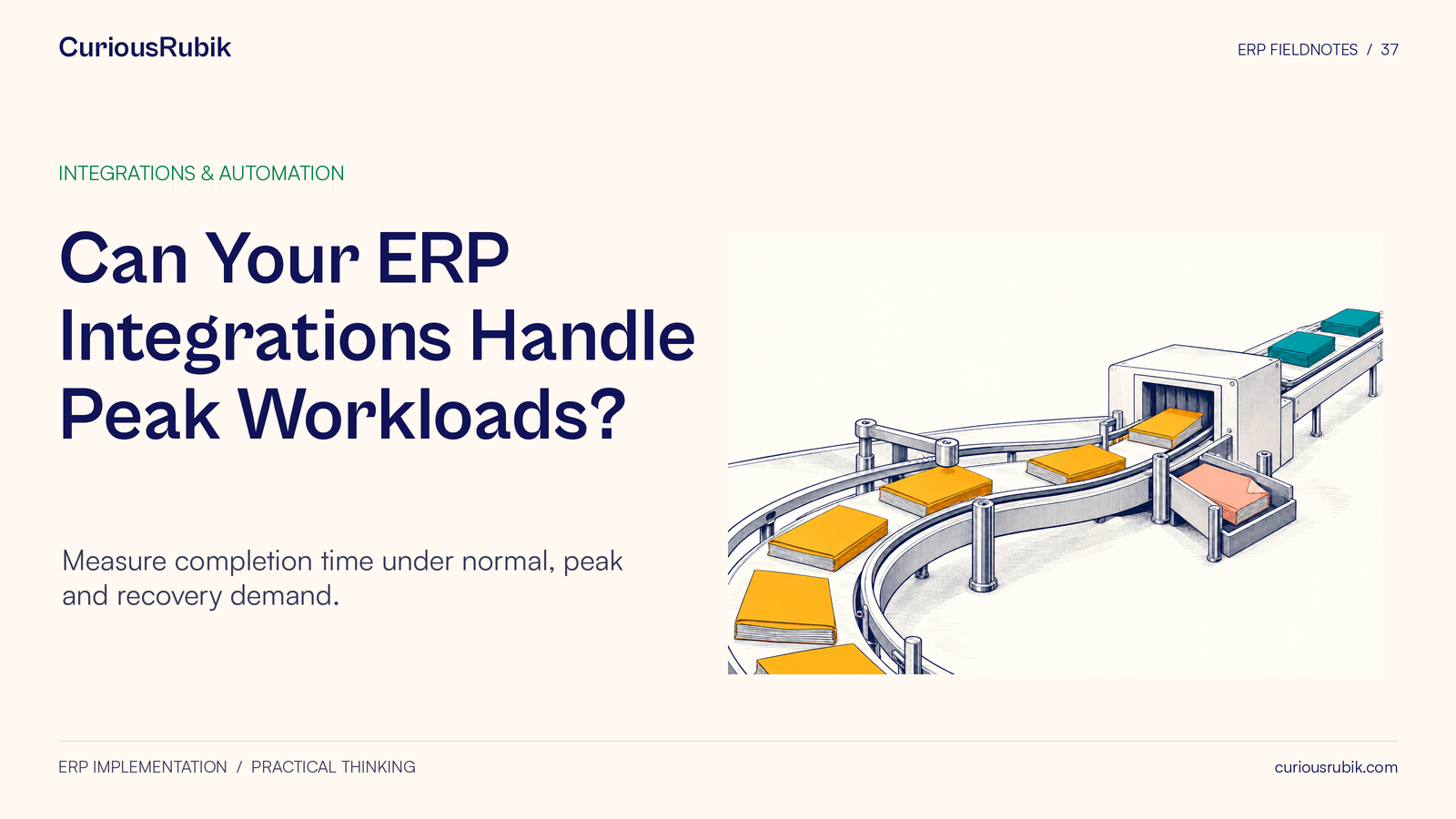
Can Your ERP Integrations Handle Peak Workloads? Measure completion time under normal, peak and recovery demand.
An interface can transfer a sample transaction correctly and still be unable to support the business at launch. The problem may appear only when a day's accumulated work arrives together, a downstream service slows, or recovery traffic competes with new transactions.
Test whether the complete flow reaches a usable business result inside its operating window. That window might end at dispatch release, a financial processing cutoff, or the point when another team must begin work. The acceptance question concerns completed business work, including acknowledgment and reconciliation, rather than the number of messages accepted by one component.
Build three connected artifacts: a workload model, an end-to-end timing budget, and a throughput acceptance worksheet. They let technical and business owners agree what must finish, under which demand and failure conditions, and what evidence supports the decision.
Define the result and its deadline
Name the business event that starts the clock and the condition that stops it. A source export finishing is different from the target accepting the data, and both may precede the point when the transaction is usable by operations.
Identify the deadline's reason. If warehouse work cannot begin until orders are validated and released, that operational dependency defines the relevant completion point. If the business can safely process a partial set, specify which subset and how the remainder will be controlled.
Record the operating window, time zone, relevant calendar, and upstream availability assumptions. Include late-arriving inputs and overlaps with other scheduled work. A nightly schedule may behave differently on a peak trading day or during a period-end cycle.
Let the accountable business owner determine acceptable delay and incomplete work. Technical teams can explain capacity and failure behavior, but should not silently convert a missed business cutoff into a successful interface test.
Turn demand into a representative workload
Describe the units that matter: transactions, lines, attachments, messages, or processing steps. One business transaction may produce several technical operations, and different transaction shapes may require different amounts of work.
Use observed operating data where authorized and available, then document any forecast assumptions. Include arrival pattern, transaction mix, payload size, concurrent users or jobs, and expected growth relevant to the rollout decision. Distinguish a steady flow from a burst with the same total volume.
Check data diversity. Repeating one small, clean record may omit expensive validation, complex transformations, multiple lines, or references that are common in real operation. Include representative valid and invalid inputs without using unnecessary personal or sensitive data.
Record uncertainty explicitly. If demand estimates depend on a new business channel or a changed batch schedule, test plausible scenarios and show how the capacity conclusion changes. A precise throughput figure is less useful when the workload behind it is poorly understood.
Map limits across the complete path
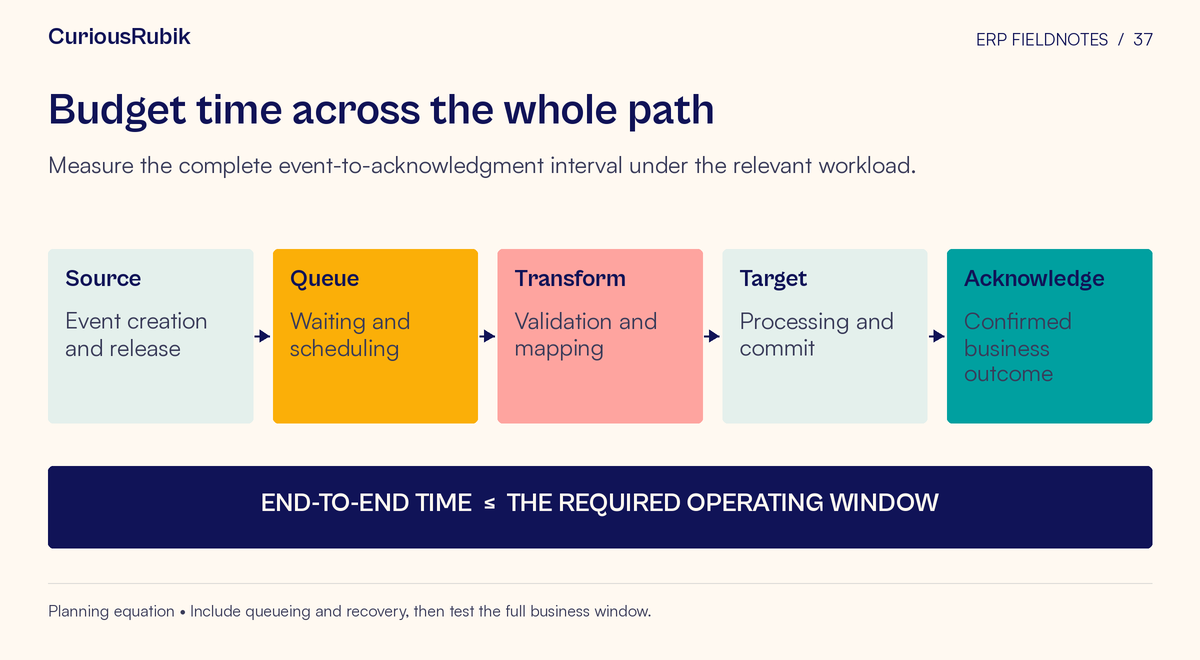
List the relevant stages: source preparation, transport, queueing, transformation, validation, target processing, acknowledgment, and business reconciliation. Include external dependencies and any manual review that lies inside the operating window.
For each stage, record documented constraints and measured behavior. Relevant limits may involve request rates, concurrent work, batch sizes, supported formats, payload sizes, processing schedules, or reserved operating windows. Verify the actual configuration and service agreement rather than relying on a limit remembered from another environment.
Identify where work can accumulate and what happens when a limit is reached. Does the flow wait, reject, retry, split a batch, or require operator action? A successful response from an upstream stage may mean only that work was queued.
Plan tests with environment and dependency owners. Use an authorized test setting, agreed load limits, and stop conditions. A test designed to discover overload must not unexpectedly disrupt a shared service or send real business transactions to an external party.
Allocate an end-to-end timing budget
Break the operating window into the activities that must fit within it. Include setup, processing, validation, decision time, and any recovery allowance the owners require. Show dependencies and parallel work rather than adding every duration as though all activities were sequential.
Measure both overall completion and the delays within the path. Queue age helps reveal how long work has waited. Completion-time distributions show variation that an average can hide. Error, retry, and rejection counts explain whether apparent throughput includes work that never reached an acceptable business state.
Use consistent timestamps and transaction identifiers so that records can be followed across components. Confirm what each timestamp means and account for clock differences. Otherwise a timing chart can attribute delay to the wrong stage.
Do not spend the entire window on the nominal transfer in the plan. The business still needs evidence that processing completed correctly and time to decide what to do if it did not. The amount of allowance belongs to the accountable owners and should be informed by rehearsal.
Test four distinct demand conditions
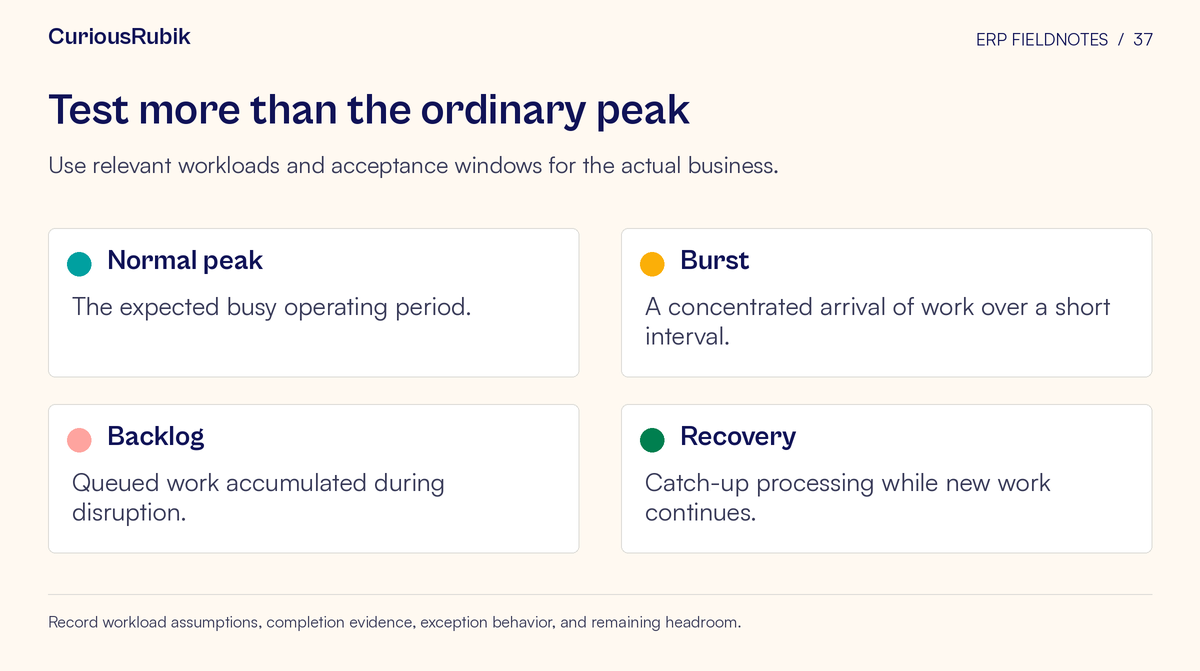
Use the workload matrix to organize conditions that reveal different limitations.
- A normal peak tests the expected busy operating pattern with representative concurrent work.
- A burst tests a concentrated arrival of work and the resulting wait before completion.
- A backlog tests the ability to process accumulated work while ordinary arrivals continue.
- A recovery scenario tests a controlled interruption, resumed processing, and confirmation that the final business state is correct.
Add duration where it matters. A short successful burst does not establish that the flow remains stable through a long operating cycle. Observe whether processing slows, errors accumulate, or manual intervention becomes necessary over time.
Repeat relevant tests after material changes to batching, validation, concurrency, infrastructure, or downstream configuration. A faster individual stage can shift the bottleneck elsewhere. The acceptance result should apply to the configuration and workload actually intended for operation.
An illustrative backlog calculation
Suppose a hypothetical interface begins with 6,000 queued items. New work continues to arrive at 40 items per minute, while the tested flow completes 100 items per minute under the same workload conditions. The net reduction is 60 items per minute, so clearing the initial backlog would take about 100 minutes.
Now suppose the business window is 90 minutes and the owners reserve 20 minutes for final validation and decision-making. Only 70 minutes remain for processing. The simplified calculation exposes a mismatch even though the headline completion rate of 100 items per minute may sound adequate.
This example assumes constant rates, comparable items, and no additional interruptions. It is a planning check, not proof of real capacity. Actual acceptance requires measured end-to-end behavior, representative transaction mix, error handling, and confirmation that the final records are usable.
Possible responses include changing the arrival schedule, increasing proven processing capacity, reducing the approved workload in that window, or changing the business arrangement. Each requires its own evidence and owner; the calculation does not decide which tradeoff is acceptable.
Prove recovery preserves the business result
Throughput during recovery matters only if work remains correct. Test the behavior of retries, duplicate submissions, partial batches, out-of-order arrivals, and missing acknowledgments where those conditions are relevant to the design.
Check whether a repeated request can create a second business effect. Where the design uses a duplicate-prevention mechanism, prove that it works for the relevant transaction boundary. A message identifier alone may not establish whether a downstream action already occurred.
Define how operators distinguish failed, pending, completed, and uncertain work. An uncertain outcome needs investigation before replay if duplicate effects would be consequential. Preserve the evidence needed to reconcile source and target states.
Measure recovery alongside incoming demand. A flow that catches up only after new work stops may not meet the real operating requirement. Include the staffing and decision time needed for any manual exception handling in the recovery result.
Complete the acceptance worksheet
For each workload scenario, record the business deadline, initial backlog, arrival pattern, transaction mix, environment, configuration, and dependencies. Attach measured completion time, queue age, error behavior, reconciliation result, and any intervention required.
State the limitations of the test. A reduced environment, simulated dependency, or missing transaction type changes how far the result can be generalized. Identify what additional evidence is needed before accepting the production operating window.
The technical owner confirms what was measured. The operations owner confirms whether the result supports the business need. Relevant control and service owners review the exceptions and residual risks within their authority. Record conditions on acceptance and the trigger for retesting.
Begin with the operating deadline and work backward through the complete path. When the workload, timing budget, and recovery evidence agree, the program has a defensible throughput decision. A fast sample transfer is then one useful piece of evidence inside a much more complete test.