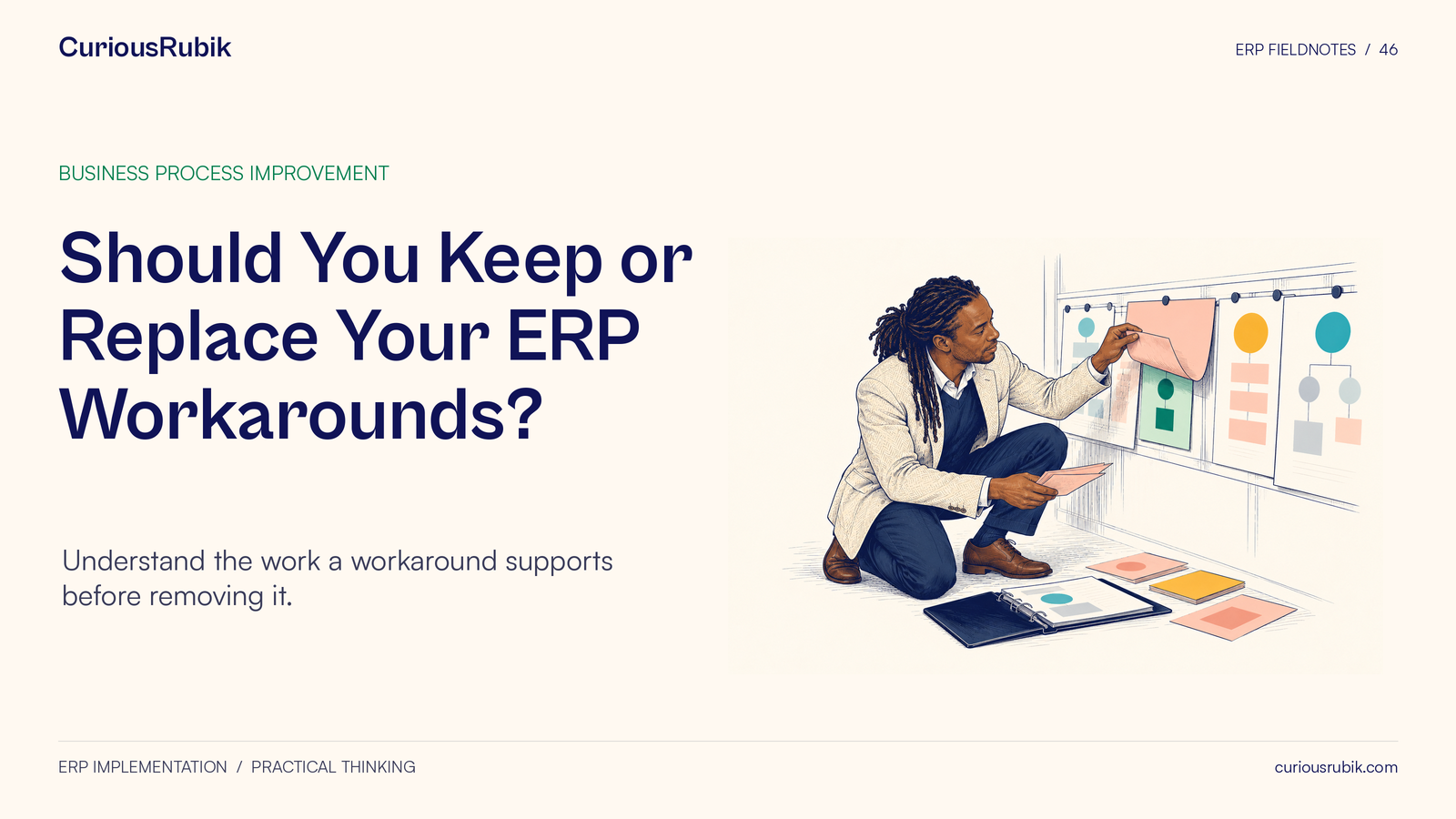
Should You Keep or Replace Your ERP Workarounds? Understand the work a workaround supports before removing it.
A spreadsheet beside the ERP may be an unnecessary duplicate. It may also be the only place a team can see unresolved commitments, connect incomplete records, or coordinate a legitimate exception. Removing it before understanding its purpose can remove useful operating capability along with the risk.
Treat each material workaround as evidence of an unmet need. Observe the work, identify the decision or handoff the workaround supports, and assess how it affects control and continuity. Then decide whether to retain, improve, integrate, replace, or retire it.
The goal is a reliable process with clear ownership and trustworthy information. A workaround inventory and a controlled retirement test help the organization reach that outcome without assuming that every off-system activity deserves the same response.
Ask what the workaround makes possible
Start with the person using it. Ask them to demonstrate a real task, the information they need, and what happens when the official process cannot supply it. Look at both the ordinary case and the exception that originally motivated the workaround.
Useful questions include: what decision does this help you make, who relies on the result, what would stop if it disappeared, and which part takes the most effort to maintain? Avoid opening with a demand to justify why the person has not followed the system.
Trace where information enters and leaves the workaround. It may be a personal analysis, a shared coordination record, a source of instructions to another team, or a competing record of transactions. Those roles carry different implications.
A report export used for one approved analysis is not automatically the same problem as a privately maintained order status used to promise delivery dates. Examine the purpose and dependency before assigning a label or remedy.
Build an inventory around business dependency
Record the workaround's name, owner, users, business purpose, inputs, outputs, frequency, and storage location. Add the authoritative source for each important data element and identify any changes made outside that source.
The inventory should also show:
- The process or scenario the workaround supports
- The missing capability, unclear rule, or operating obstacle it addresses
- The decisions, transactions, and downstream teams that depend on it
- The manual effort and specialist knowledge needed to maintain it
- The access, review, retention, and continuity arrangements
- Known errors, unresolved differences, and previous attempts to replace it
- The proposed disposition, accountable process owner, and next evidence check
Use enough detail to distinguish superficially similar tools. Two teams may both maintain an order tracker, but one could be compensating for missing status data while the other coordinates approvals that have no agreed owner.
Prioritize discovery where the business already sees reconciliation effort, unexplained delays, repeated corrections, or dependence on one person. The first inventory does not need to find every personal worksheet. It should locate the workarounds whose failure or withdrawal would materially affect the operation.
Diagnose the need rather than the file type
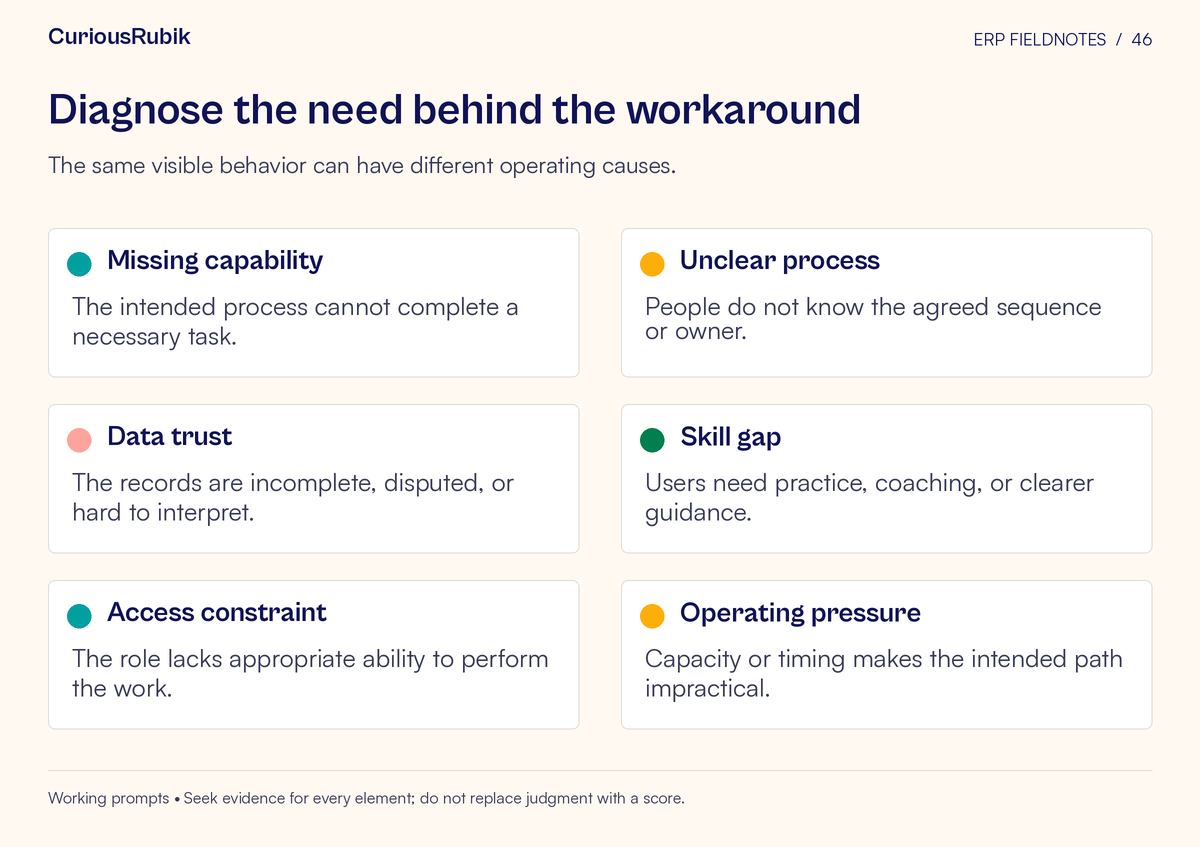
Classify the primary cause and record supporting evidence. A useful starting set is:
- Missing capability: The intended process cannot represent or execute a required business scenario.
- Unclear process: Rules, responsibilities, or handoffs have not been agreed.
- Data trust: Information is incomplete, late, inconsistent, or difficult to reconcile.
- Skill: People do not know how to perform an available, appropriate task.
- Access: The assigned role cannot reach the information or action it legitimately needs.
There may be several causes. A team can lack both a clear exception owner and a reliable view of the exception population. Fixing only the screen or report may leave the underlying coordination problem intact.
Ask what evidence would disprove the first explanation. If the team says the system cannot do something, test the specific scenario with approved access and representative data. If the team says training is missing, observe whether the intended workflow actually supports the work before assigning another course.
Assess risk while preserving useful capability
Evaluate the consequence of an error, an unavailable owner, unauthorized access, or inconsistent information. Identify whether the workaround can create or change a business commitment, influence a financial result, expose restricted data, or bypass a required approval.
Assess detectability as well as severity. An error that is immediately reconciled has a different exposure from one that silently shapes decisions for weeks. Consider concentration risk when only one person understands the logic or the record lives in a location the team cannot reliably access.
Use proportionate interim controls while designing the longer-term response. Examples include a named owner, controlled access, clear source references, review of consequential changes, and reconciliation to the authoritative record. The relevant security, records, and business owners should determine appropriate requirements.
Interim control should have a review event. A workaround can become more deeply embedded while a replacement is under discussion. Track changes in volume, scope, and users so the accepted exposure does not expand without a decision.
Do not confuse visibility with endorsement. Documenting a risky workaround helps the organization act on it; it does not automatically approve continued use. If the exposure is unacceptable, the accountable owner should choose a safe operating alternative while remediation proceeds.
Choose among several legitimate dispositions
Retirement is one possible outcome. A useful analysis tool may remain appropriate if its purpose, source data, access, and review are clear. A coordination record may need a better owner and an agreed process more than a new technical component.
For each workaround, compare the feasible responses: retain with controls, simplify, replace with an existing capability, redesign the business process, or integrate a necessary specialist function. Assess ongoing effort, control implications, maintenance, user burden, and the risk introduced during transition.
Avoid building a permanent interface merely to automate an unresolved disagreement about which record is authoritative. Automation can move inconsistent data faster while preserving the uncertainty. Decide ownership and business rules first.
Likewise, avoid forcing a legitimate analytical need into the transaction system solely to eliminate a spreadsheet. The better criterion is whether information and decisions remain reliable, controlled, and supportable. The process owner should be able to explain why the chosen arrangement serves the business better.
Prove the replacement through a retirement test
Before withdrawing the workaround, define its essential jobs and the evidence that a replacement must provide. Include the exceptions and downstream uses discovered during observation. A replacement that covers only the obvious task can leave the most important hidden dependency unresolved.
Run a bounded pilot with a representative group. Specify the authoritative record during the pilot and how differences will be handled. Uncontrolled parallel operation can create two conflicting versions of the truth, so dual recording should have a limited purpose, clear reconciliation, and an end condition.
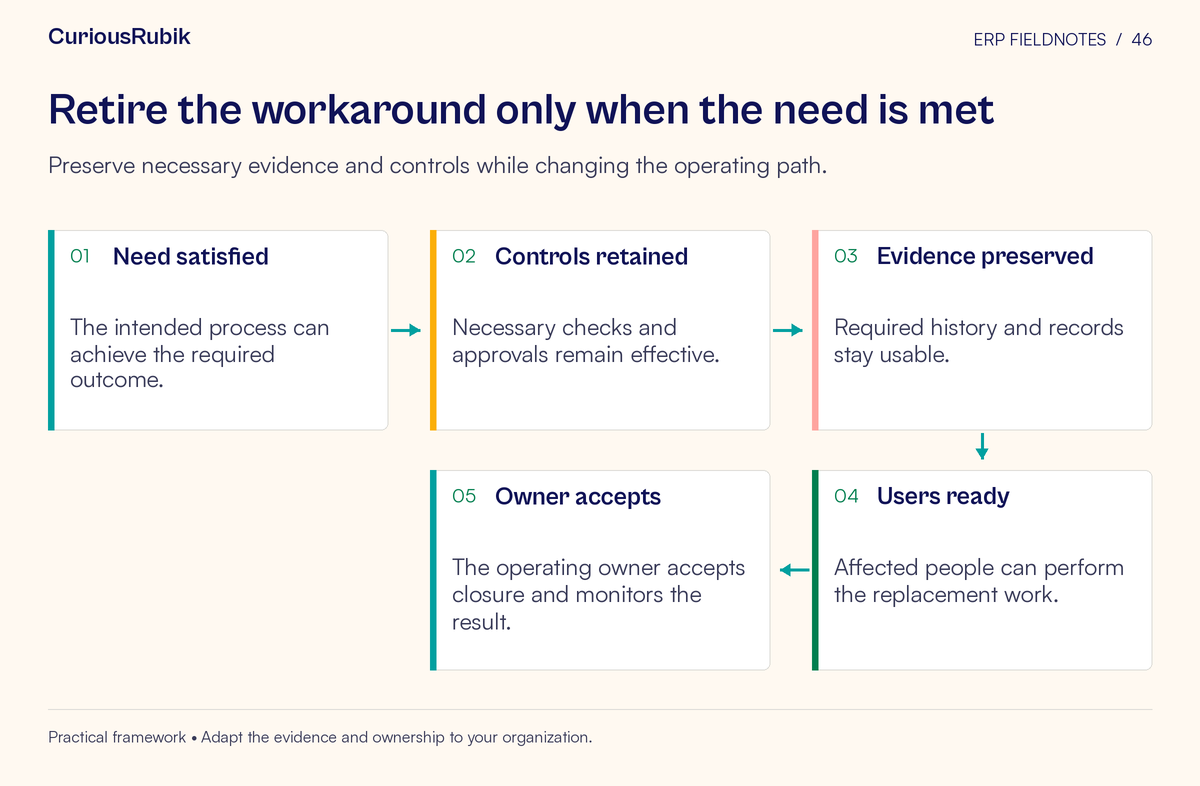
Use a retirement gate with five checks:
- The legitimate business need is satisfied for ordinary and consequential exception scenarios.
- Required controls and review responsibilities remain effective.
- Existing evidence and records are preserved under applicable retention rules.
- Users and downstream teams can perform their work through the replacement.
- The process owner accepts the result, remaining limitations, and recovery arrangement.
Failure of a check should lead to a specific correction or a revised disposition. It should not become a reason to declare the original workaround permanent without further review.
A hypothetical returns tracker
Imagine a hypothetical distributor whose returns team uses a shared tracker alongside the ERP. Leaders initially see duplicate entry and ask the team to stop using it.
Observation reveals that the tracker connects three events: receipt of returned goods, approval of a replacement, and confirmation that the original issue has been resolved for the customer. Each event exists elsewhere, but no role owns the complete case. The tracker has become the team's coordination mechanism.
The process owner maps the handoffs and assigns responsibility for closing the case. The team tests a revised case view and a controlled exception queue. During the pilot, it discovers that partial returns need a separate rule because the replacement and received quantities do not always match.
That rule is clarified before retirement. Downstream service staff confirm they can find the status they need, and the team reconciles open cases. The old tracker becomes read-only under an approved retention arrangement rather than being immediately deleted. A defined fallback remains available if the new view fails, with controls to prevent conflicting updates.
The example illustrates why duplicate entry alone is an incomplete diagnosis. The durable improvement comes from replacing the coordination function and its controls, not merely removing the file.
Watch for the need returning in another form
After retirement, inspect the work again. Look for new private trackers, repeated requests for exports, unexplained manual notes, or the same exception returning through support. These signals may indicate an omitted need, a changed requirement, or a replacement that creates too much friction.
Give users a clear route to raise that problem without treating the reappearance of a workaround as automatic misconduct. At the same time, keep ownership and approved controls explicit so temporary improvisation does not silently become the operating model.
Choose one consequential workaround and ask its users to show the last difficult case it helped resolve. That demonstration is the best starting point for deciding what must be preserved, what should change, and what can safely disappear.