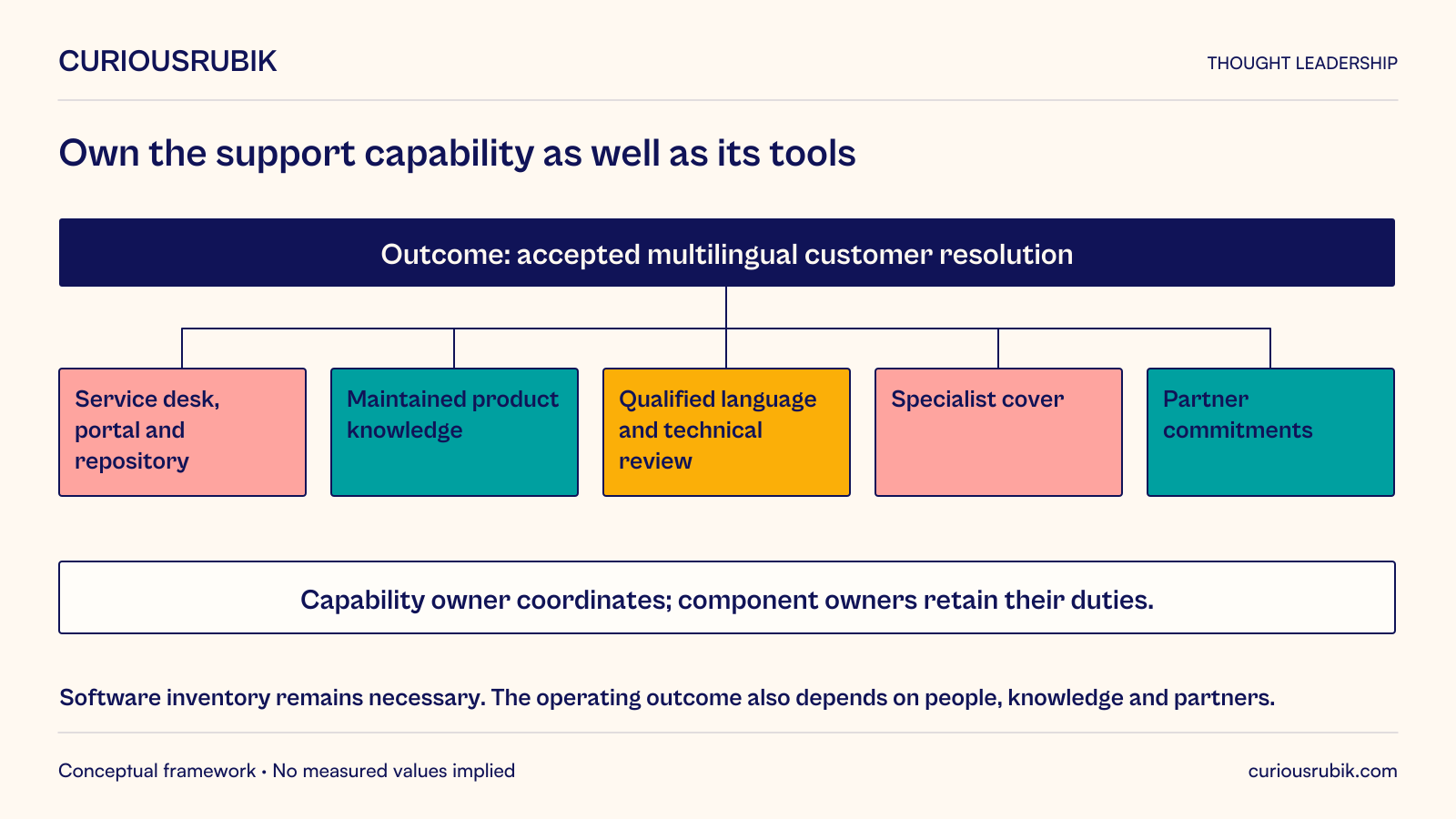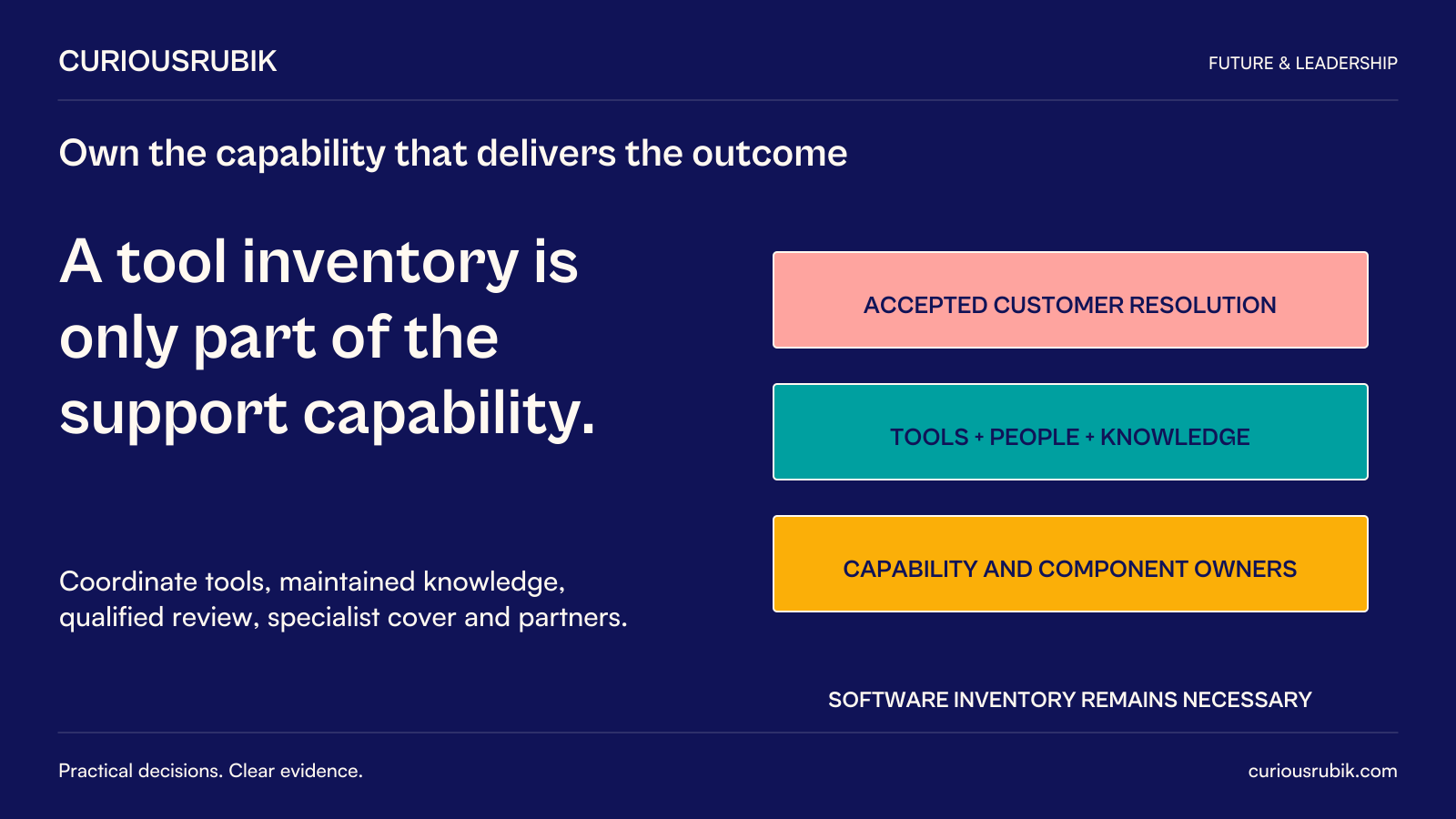
The renewal list is complete: a service desk, a knowledge repository, a translation tool, and a customer portal. Every application has an owner and an approved budget. Yet a customer asking a difficult question in a supported language can still wait because nobody owns the combined service’s knowledge, specialist coverage, and resolution path.
That hypothetical situation exposes a gap between owning software and maintaining a business capability. An asset inventory tells the enterprise what it licenses, runs, and protects. A capability view explains what the organization can reliably accomplish for a defined user, under stated conditions, and who keeps that outcome workable.
The strategy shift is therefore one of stewardship and funding. Keep the asset discipline, but connect it to continuing responsibility for the service those assets support. The multilingual-support example below shows how that changes renewal, improvement, and retirement decisions without turning every capability into a new centralized department.
Define the capability as a usable outcome
A capability describes an ability the business needs. “Operate a service-desk application” is an activity. “Resolve eligible customer issues in the languages and service conditions the company has committed to support” describes an outcome that depends on people, information, processes, and technology.
State the scope. Which issue types, customers, languages, and operating hours are included? What counts as an accepted resolution? Which matters require a specialist or another authority? A broad phrase such as global support can hide substantial differences in what the organization can actually deliver.
Describe the demand and quality conditions that matter. A service that works for routine questions at low volume may not support a complex product incident or a sudden peak. The capability record should distinguish demonstrated operation from an intended future scope.
Name the accountable owner and the necessary partners. Ownership means maintaining the conditions for the outcome and resolving cross-boundary gaps, not personally performing every activity. Technical and specialist owners retain their own responsibilities within that arrangement.
A hypothetical multilingual-support capability
Imagine a business-software provider that supports customers in three languages. Its applications are available and its license inventory is accurate. Routine questions are usually resolved through the portal, but complex questions in one language depend on a small group of specialists and a separate translation partner.
The annual technology review asks whether the tools are used and whether their prices are competitive. It does not ask whether approved product knowledge is current in each language, whether specialists have cover, or whether translated answers preserve the required qualifications.
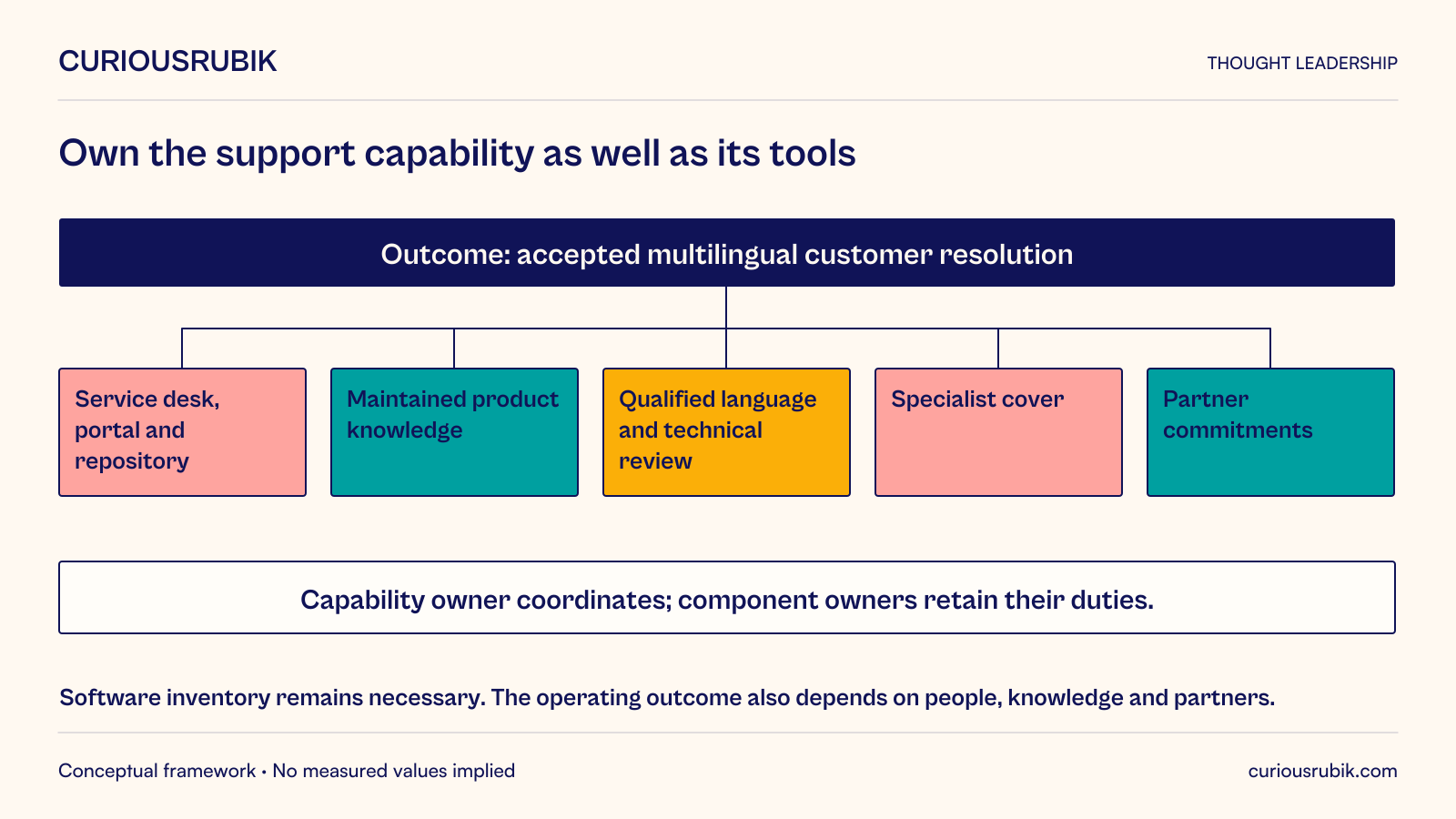
A capability review reconstructs a difficult customer case. The service desk records the request correctly, the repository contains relevant material, and the translation tool produces a draft. The remaining delay comes from an unclear route for technical verification and insufficient specialist availability. Renewing the same tools alone does not address it.
The business assigns a support-capability owner who works with product, language, technical, and supplier owners. The operating plan defines eligible scope, maintained knowledge responsibilities, review requirements, cover, and escalation. Any use of automated language assistance remains subject to the evidence and authority appropriate to the task.
The investment discussion now includes several options: improve the knowledge-maintenance process, provide qualified cover, change partner support, or replace a tool that creates unnecessary handoffs. The preferred option depends on the actual constraint. The capability view prevents the renewal calendar from deciding the strategy by default.
No service improvement is assumed in this example. The company must demonstrate that eligible customers receive accurate, supported resolutions under the stated conditions. Application availability and usage remain useful evidence, but they are no longer mistaken for the entire capability.
Build a capability record that supports decisions
Keep a concise record of the outcome, scope, owner, service conditions, key dependencies, operating measures, and known limitations. Link the relevant applications and contracts rather than replacing their detailed inventories. The record should help an executive understand what is being funded and what would fail if a dependency changed.
Include information stewardship. Approved knowledge, definitions, mappings, and access rules can be as important as the software that stores them. Identify who maintains them and what events trigger review. A repository full of outdated answers is an owned asset but a weak support capability.
Record the people and decisions the service needs. Specialist review, policy interpretation, and exception resolution should have capacity and cover. Avoid a diagram that shows human judgment as an unlimited box between two automated steps.
The 2021–2022 Baldrige Excellence Builder uses a systems perspective linking organizational approaches and results. Applied here, that encourages reviewing the service as an integrated operation; it does not establish a universal capability template or guarantee performance. NIST, Baldrige Excellence Builder, 2021–2022
Fund operation and change together
A capability needs resources to run, improve, and eventually transition. Separate those obligations in the budget so routine maintenance is not crowded out by new features and necessary change is not treated as an unexpected project every time.
Tie improvement funding to the observed constraint and intended outcome. If complex-language cases wait for verification, another portal feature may have little effect. The capability owner should explain how the proposed expenditure changes the service and what evidence will establish that result.
Make retained work visible when a supplier performs part of the capability. The enterprise may still need policy ownership, quality review, customer communication, and incident coordination. Outsourcing an activity does not automatically transfer the full business outcome or remove internal effort.
Avoid a blank-check capability budget. Continuing ownership should come with priorities, measures, and review. The business needs a way to stop low-value work, narrow scope, or retire a capability when strategy changes.
Use asset decisions to improve the capability
Application consolidation can be valuable when it reduces unnecessary handoffs, duplicated data, or support burden. It can also remove a feature or workflow on which a small but important part of the service depends. Test the actual capability before retiring the old asset.
A replacement decision should include current and future operating evidence. Can the new tool support the required knowledge, permissions, review, and recovery? Can the team migrate relevant records and continue service during transition? A favorable feature comparison is only part of the answer.
Keep the option to retain a modest asset that supports an important outcome. A low-use specialist tool may be justified if it serves a necessary case that cannot be handled appropriately elsewhere. Conversely, high usage does not make a tool valuable if it sustains avoidable work.
Review vendor concentration and exit obligations at the capability level. Several applications may rely on the same identity service, data source, or partner. An apparently diverse software portfolio can still have a concentrated operating dependency.
Map dependencies shared by several capabilities before changing them. The same product knowledge may support customer service, sales preparation, and training. A change funded by one owner can affect the others, while separate budgets may each assume another team maintains the source. Establish a clear stewardship agreement for the shared dependency and test material changes with the relevant consumers. This keeps the capability view from becoming another set of isolated ownership boxes.
Measure the outcome and the supporting conditions
For multilingual support, measure accepted resolution, correctness, timeliness, escalation, and customer effort under consistent definitions. Segment where language or issue type changes the work, without using a broad average to hide a poorly supported population.
Use component measures diagnostically. Tool availability, search success, queue age, and specialist coverage help explain the outcome. They should not become independent green indicators that imply the customer service is healthy when the complete result is weak.
Observe work outside the normal path. Manual translation, informal specialist calls, and repeated customer explanations may be sustaining the service at an unrecognized cost. Decide whether to support, redesign, or retire those arrangements deliberately.
Keep uncertainty explicit. A capability can be dependable within a limited scope and unproven outside it. Growth should follow evidence about the new population and operating conditions rather than a claim that an existing platform makes expansion automatic.
Preserve capability through change and succession
A key employee’s departure, a partner change, or a new product release can weaken the capability without changing the application inventory. Review those events as operating changes and identify which knowledge, cover, or evaluation needs updating.
Document enough rationale for a successor to maintain the service. The organization should understand why a review step exists, which limitations matter, and what evidence would justify changing them. Avoid dependence on one person’s informal memory.
Plan retirement with the same outcome focus. If a product line or support offer ends, determine what obligations and records remain, what customers need, and how access and supplier commitments are closed through approved processes. Turning off a tool may be only one step.
Change the next portfolio conversation
At the next renewal review, choose one important business capability and bring its outcome evidence alongside the asset list. Ask what the organization can reliably deliver, which dependency currently limits it, and what expenditure would improve or preserve that result.
The software provider can then make a more informed choice than renewing every tool or consolidating everything by default. It can maintain a service whose responsibilities, costs, and limitations are understood. Software ownership remains an essential discipline, but the technology strategy becomes stronger when the enterprise also owns the ability to produce the business outcome those assets were meant to support.