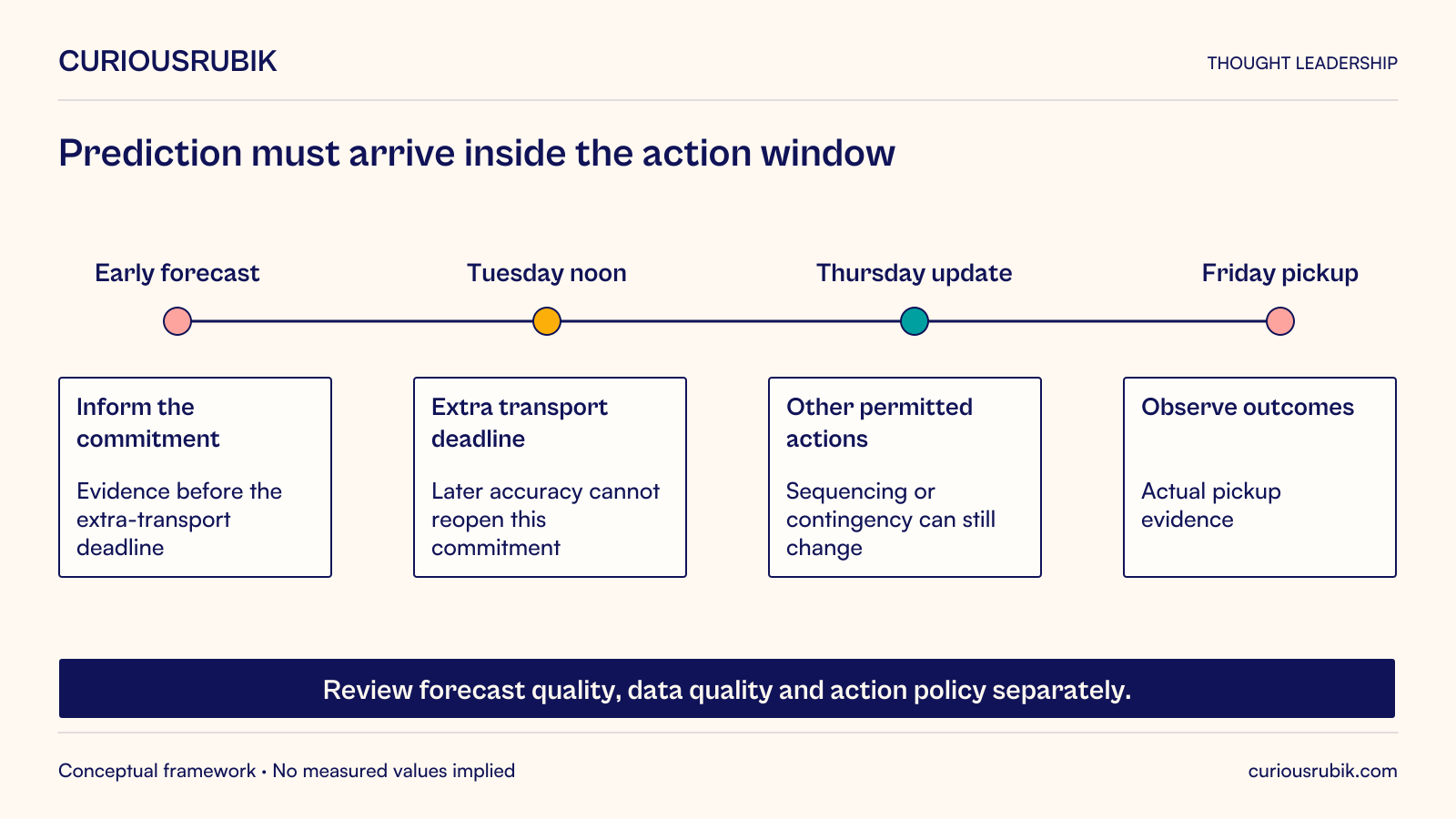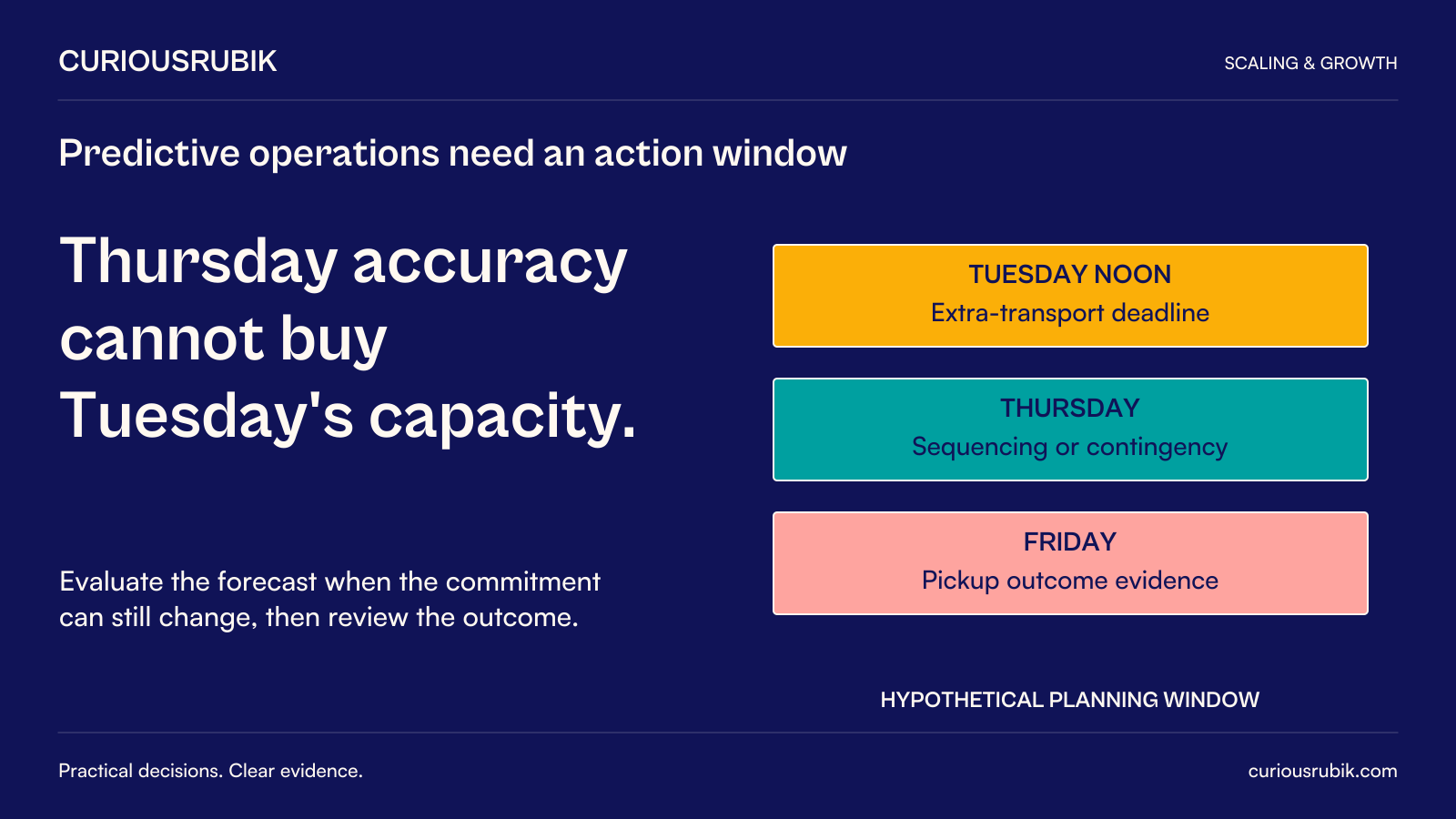
The forecast correctly identifies a Friday pickup surge on Thursday. Unfortunately, the laundry operator had to confirm extra transport capacity by Tuesday noon. The prediction is informative, but it arrived after the decision it was supposed to improve.
This hypothetical example shows why predictive operations requires more than a model. The organization needs a useful forecast horizon, an available action, an owner with authority, and evidence that acting on the signal improves the service. A more accurate prediction can have little operating value if any of those conditions is missing.
The shift from reactive management is therefore a redesign of the decision window. Start with a recurring intervention the business could take earlier, then determine which information would justify it. The commercial laundry example below focuses on that connection without assuming that forecasts eliminate uncertainty or that every action should execute automatically.
Work backward from the last useful decision time
Identify the action that could change the outcome. It might be reserving additional capacity, adjusting a work plan, obtaining missing information, or contacting a customer through an approved process. A warning without a feasible response is an observation, not a predictive operating capability.
Record the action’s lead time and constraints. Additional transport may need advance confirmation, while changing the order of already planned work may remain possible later. The same forecast can support one action and arrive too late for another.
Define the decision owner and permitted scope. A planner may recommend a capacity adjustment but need an authorized manager to commit expenditure or change a customer promise. The forecast should reach that decision route with enough time and context to be useful.
Specify what happens when the signal is missing or uncertain. The business may continue with a baseline plan, seek confirmation, or use a conservative contingency under its approved policy. It should not treat absence of a forecast as evidence that no problem is expected.
A hypothetical laundry planning window
Imagine a commercial laundry serving hotels and event venues. Friday pickups vary with customer activity. The operator can obtain additional transport capacity if it confirms the requirement by Tuesday noon, while routine work sequencing can still be adjusted on Thursday.
The initial forecasting project is evaluated on next-day pickup-volume accuracy. It performs well enough in a demonstration to attract interest, but that horizon does not support the Tuesday capacity decision. The project has optimized a prediction without first specifying its operating use.
The revised design separates two forecasts. An earlier forecast supports the Tuesday decision about Friday capacity. A later update supports Thursday sequencing and identifies whether the earlier plan needs an authorized contingency. Each is evaluated at the time it would actually be available.
The early decision also needs information about existing commitments and available alternatives. A forecast above routine capacity does not establish that extra capacity can be obtained, that the cost is acceptable, or that the customer volume is confirmed. The manager must consider the permitted options and the consequences of acting or waiting.
Suppose a large event booking is canceled after Tuesday. The earlier decision may still have been reasonable based on the evidence then available. Evaluation should distinguish an unavoidable change in demand from a model defect, stale source information, or a poor action policy.
Conversely, if the booking was already canceled but the forecasting feed had not incorporated it, the issue is data timeliness. Improving the model’s mathematical complexity would not directly repair that missing update. The operating review needs to identify which part of the forecast-to-action chain failed.
Define the prediction in operational units
State the target, time period, location, and unit. Pickup weight, number of stops, and processing workload are related but different quantities. A forecast of one should not be used as a substitute for another without a supported conversion and its limitations.
Preserve the distinction between expected demand and committed demand. Customer schedules, confirmed orders, and inferred activity can contribute different evidence. The decision-maker should know which parts of the forecast are established and which remain uncertain.
Choose a baseline method before evaluating a more complex one. An existing planning rule or a suitable simple historical forecast can provide a meaningful comparison. The question is whether the candidate improves the decision enough to justify its additional maintenance and operating burden.
Document the intended use and exclusions. A model tested on routine venue pickups may not support a new customer segment or a major exceptional event. Outside-scope conditions need a clear referral or planning route rather than a confidently extended estimate.
Test with information that would have existed at the time
Reconstruct the forecast origin and data cutoff for historical evaluation. Use only the information that would have been available before the relevant decision. Later corrections, cancellations, or confirmed volumes can otherwise make the test unrealistically easy.
Evaluate the required horizon. A model that forecasts one day ahead well has not established its performance several days ahead. Compare candidate methods on the same origins, target periods, and available information, and keep an independent test period where appropriate.
Separate fitting error from prospective performance. A close match to historical observations can reflect a flexible model that has learned that sample rather than a dependable forecast. The operating trial should observe forecasts recorded before outcomes are known.
Choose error measures that fit the data and decision. Hyndman and Koehler examine limitations of common forecast-accuracy measures, including percentage errors when actual values are zero or near zero. A zero-volume day can therefore make a familiar percentage measure misleading or undefined. Another look at measures of forecast accuracy, 2006; author manuscript
For the laundry, errors in relevant workload units can be useful alongside measures of persistent over- or underprediction. No single accuracy statistic establishes whether the resulting capacity decisions are good. Evaluate the operating consequences separately.
Turn uncertainty into a deliberate action policy
A point forecast is one estimate, not a promise. Present uncertainty in a form the manager can interpret and that the evaluation supports. If a range is a planning scenario rather than a calibrated probability interval, label it accordingly.
Compare the consequences of acting too early, too late, or unnecessarily. Extra capacity may create avoidable cost when demand is lower; insufficient capacity may affect service. The appropriate decision depends on the business’s actual costs, alternatives, and commitments, not a universal confidence threshold.
Define the action policy independently from the forecast method where practical. The model estimates demand; the policy establishes which evidence and conditions justify a particular response. Keeping them distinct makes it easier to understand whether a poor result came from prediction or decision design.
Start with a recommendation route when the policy or consequences remain uncertain. Broader automatic execution requires a separate decision about authority, controls, and recovery. Predictive management does not require an unattended system to make every commitment.
Build the receiving operation
Ensure the forecast reaches the owner before the useful deadline, with the target, assumptions, uncertainty, and relevant current commitments. An alert that arrives in a general inbox may fail operationally even if the model is accurate.
Record the decision and reason. The manager may follow the recommendation, choose another option, or decline because capacity is unavailable. Those distinctions matter when evaluating the system. A prediction cannot be credited with an action that never occurred.
Plan for competing alerts. Several locations may request the same scarce resource. Local forecasts then need a coordinated allocation decision rather than independent responses that overcommit shared capacity.
Provide a fallback for data or model failure. The business should know when to use its established planning process and how to communicate limitations. A predictive layer should improve preparedness without making ordinary operation dependent on an unexplained score.
Learn from outcomes without confusing them with forecast quality
Review forecast error, decision timeliness, action feasibility, and service outcome separately. A reasonable forecast can lead to a poor decision, and a poor forecast can be followed by a good outcome through luck or an effective fallback.
Include the cost of false alarms and missed interventions. Evaluate cases where no action was taken as well as those that received attention. Otherwise, the organization may learn only from the most visible successful interventions.
Account for the effect of the intervention on later data. If the company changes customer pickup arrangements, the observed volume may no longer represent what would have occurred under the original plan. Preserve the action record so future analysis can interpret that feedback.
Review changes in the operating environment. New customers, revised service terms, seasonal patterns, and different capacity options can alter both forecast performance and the value of acting. Assign ownership for reassessment rather than assuming the initial pilot remains representative indefinitely.
Move the decision earlier only when it helps
The laundry’s next experiment should record a forecast before Tuesday noon, capture the authorized capacity decision, and evaluate Friday’s result with the information available at the time. The Thursday update remains useful for another decision, but should not be credited with enabling an earlier commitment.
That discipline changes the management conversation. Instead of asking whether the model predicted the event, the business asks whether it supplied usable evidence while a worthwhile action was still available. Predictive operations becomes credible when that complete loop works repeatedly, with uncertainty, authority, and recovery kept visible. The objective is better preparation and decisions, not the disappearance of every surprise.