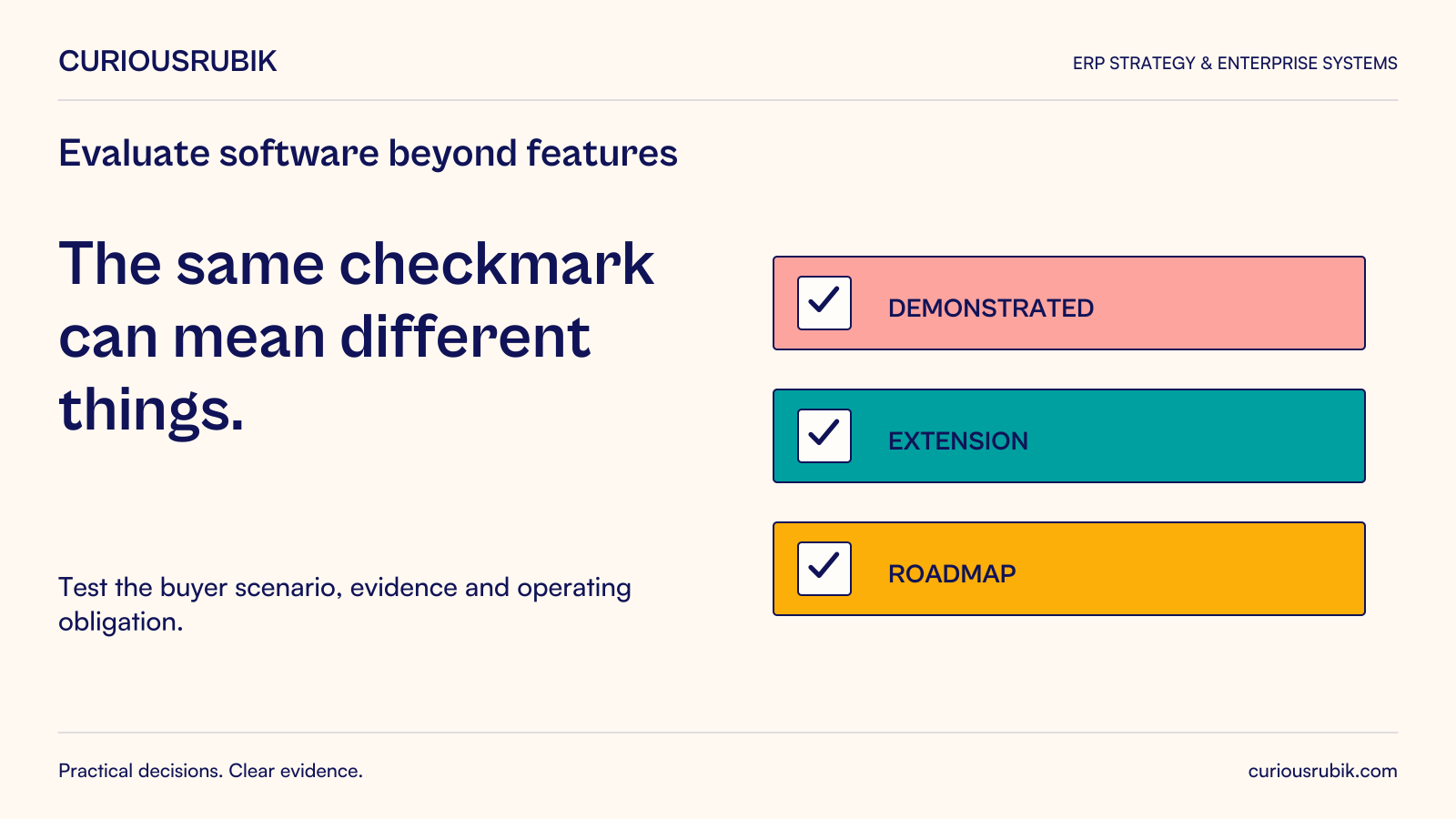
A feature comparison can make a software selection look objective while concealing the decisions that matter. Two products may both offer “contract billing,” yet handle amendments, partial delivery and disputed charges very differently. A checked box establishes that a capability has a name. It does not establish that the company can operate its business with it.
The evaluation should therefore be organized around consequential business scenarios, supported by evidence that is strong enough for the decision being made. Features still matter, but they should answer a defined operational question rather than become the agenda.
The buyer’s task is to reduce uncertainty about fit, operating effort and future dependence. A polished demonstration can contribute to that work. It should not substitute for it.
Decide what would make the purchase worthwhile
Before inviting vendors, agree the small number of outcomes the investment must enable. These might include supporting a new service model, closing financial records with fewer unresolved exceptions or handling acquisitions without rebuilding reporting each time. Specify the relevant scope and the people who will use the result.
Translate each outcome into scenarios. “Manage projects” is broad. “Amend a fixed-price project after partial billing, preserve approval history and show the effect on remaining margin” is testable. Scenarios reveal the relationships among capabilities that a feature list separates.
Include the current problem and the alternative to buying. If better configuration or an integration could meet the requirement, that option belongs in the analysis. Selection should not assume replacement is justified simply because a shortlist exists.
NASA’s Systems Engineering Handbook, Revision 2 describes decision analysis in terms of intended outcomes, criteria, alternatives, evaluation methods and uncertainty. Its aerospace context is different, but the decision discipline transfers: agree what matters before comparing solutions. This article’s selection process is a practical adaptation, not a NASA-endorsed enterprise procurement method.
Separate non-negotiable constraints from preferences
Some requirements determine whether an option is viable. Examples include an essential accounting treatment, a contractual data-location condition, an integration that must operate within a specific window or a control that cannot be compromised. Confirm the underlying obligation with its owner rather than accepting every department’s favorite feature as mandatory.
Other criteria are preferences with trade-offs. A less familiar interface might be acceptable if the process is substantially more reliable. A specialist module might justify additional integration cost. These judgments should remain visible rather than being mixed into a score that allows a fatal gap to be offset by attractive extras.
For each mandatory constraint, define acceptable evidence and the consequence of failure. A vendor statement may be sufficient for a low-risk screening question. A critical accounting or recovery requirement may need a working test, documentation and contractual clarification. The required proof should reflect the consequence of being wrong.
Make the distinction early. Adding new mandatory criteria after seeing demonstrations can unintentionally turn the evaluation into a justification for a preferred vendor.
Replace the standard demonstration with a buyer-owned script
Give every shortlisted vendor the same core scenarios and enough context to prepare honestly. Specify starting data, user roles, required actions and expected outcomes. Ask vendors to show how they would handle the scenario using the proposed product and commercial scope.
Include ordinary work, exceptions and reversals. A purchase receipt can appear simple until goods arrive partially, prices differ and an invoice has already been posted. Reversals expose the integrity of the underlying process. They also show whether users must create compensating spreadsheets to preserve an audit trail.
Ask presenters to identify what is standard, configured, extended, provided by another product or merely planned. Record that status beside the evidence. Roadmap capability should not be treated as available capability, and a custom demonstration should not be priced as standard functionality.
Allow vendors to propose a better process where appropriate. A rigid script that demands exact reproduction of the old system can prevent the buyer from seeing a genuinely better design. The vendor should still demonstrate the required business outcome and explain the changed responsibilities.
A hypothetical selection reveals the cost of a checked box
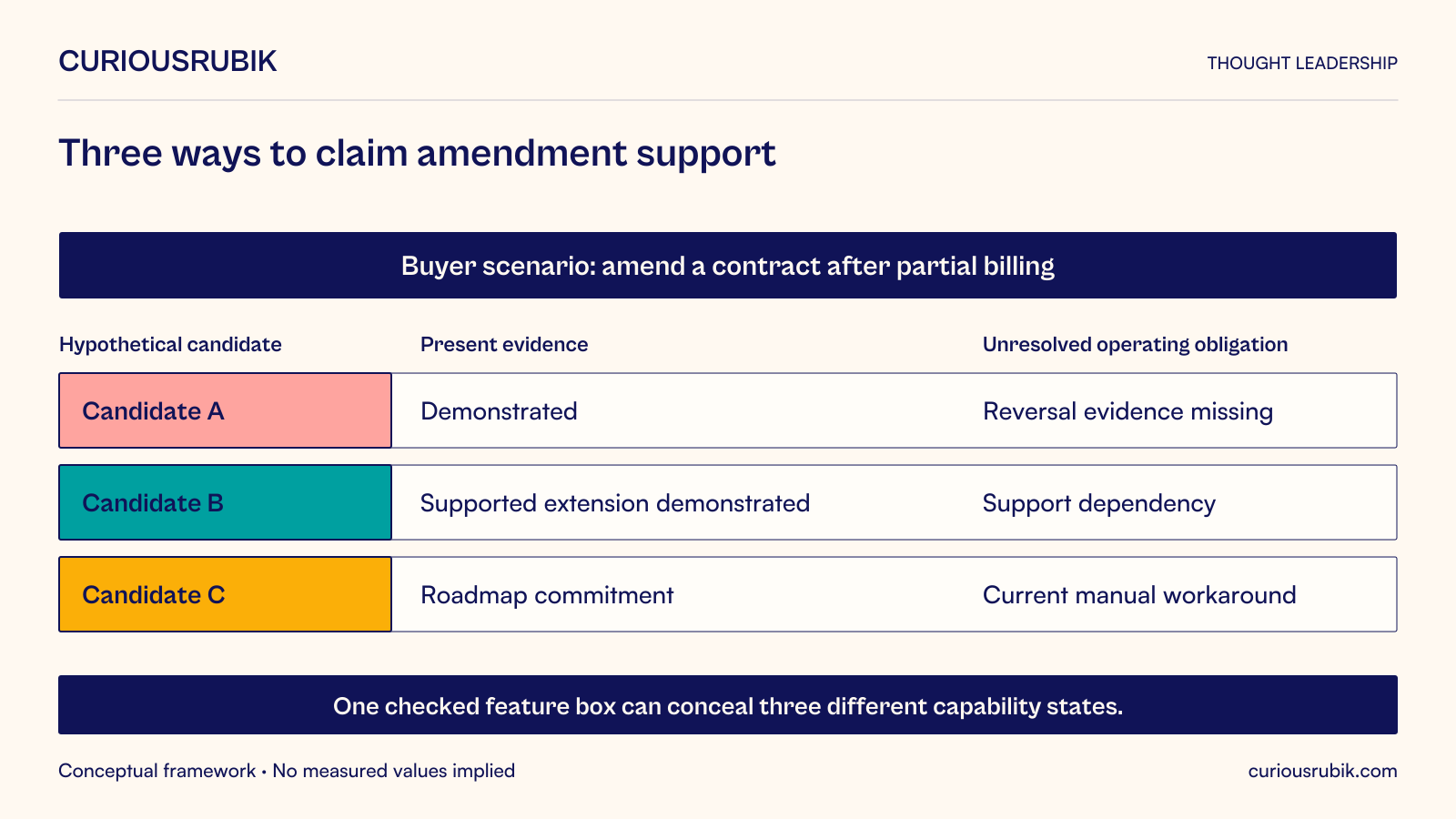
Consider a fictional professional-services company evaluating three enterprise platforms. Its most consequential scenario is a project amendment after the customer has received an invoice. It needs revised authorization, correct billing, a preserved history and updated project reporting.
Vendor A demonstrates a smooth amendment flow using standard functionality. When asked to reverse an already-approved amendment, the presenter uses an administrative correction outside the demonstrated workflow. The vendor agrees to provide a follow-up test showing permissions, history and accounting consequences. The original demonstration is useful evidence, but it is incomplete.
Vendor B handles the full scenario through a supported extension. The extension adds annual support cost and creates a dependency on a specialist partner. Its process is viable, but the buyer records the actual deployment architecture and ongoing obligation rather than scoring it identically to built-in capability.
Vendor C lists amendment support in its feature matrix. During the scenario, the team discovers that the relevant function is planned for a later release. The current alternative requires exporting billing information and manually reconciling changes. The buyer evaluates that workaround on its real effort and control implications. It does not award current capability based on the roadmap.
The company then asks ordinary project managers and billing staff to perform the scenario in a controlled trial. One participant misunderstands a status label and submits an amendment before the necessary approval. That finding leads to a usability and permissions test across the candidates. It is more informative than a general survey asking which interface participants liked best.
The final decision may still favor any of the three, depending on price, timing and risk tolerance. The improvement is that leadership can see the trade-offs: incomplete proof, a supported extension, or dependence on a workaround and future delivery. “All three support amendments” would have hidden them.

Record evidence strength separately from fit
An evaluation should distinguish what a product appears able to do from how confidently the buyer knows it. A high fit assessment based only on a sales assertion is different from a high fit assessment supported by a repeatable test.
A simple evidence register can classify each finding as asserted, demonstrated, tested by the buyer or contractually confirmed. These are working labels, not a universal ranking: a contract cannot prove usability, and a successful test cannot establish every commercial right. Different uncertainties require different evidence.
For each finding, record the product version, configuration, data used, participants, result and unresolved limitation. Capture the actual test artifact when feasible. “The demo went well” is too vague to support implementation planning several months later.
Keep open questions attached to the decision they affect. A missing answer about a minor report should not receive the same urgency as uncertainty about data export or financial controls. Fund deeper proof where a plausible answer could change the selection.
Evaluate the operating model behind the product
The company is buying a future way of operating, including administration, support and change. Ask who maintains roles, resolves integration errors, tests releases and manages data quality. Determine which tasks require scarce specialists and which the internal team can realistically own.
Test support with concrete situations. What happens when a transaction fails late in the day? Which party diagnoses the issue if an extension and the core platform disagree? What evidence must the customer provide? What remains the customer’s responsibility even under a managed service?
Evaluate implementation fit separately from product fit. A capable product can be undermined by an unrealistic delivery plan. Review the proposed team’s experience relevant to the specific scope without assuming that a brand name guarantees the skills of the assigned people. Verify references through appropriate channels and ask about situations comparable to the buyer’s own constraints.
Include exit considerations. Determine how business data, attachments, configuration and necessary history can be retrieved in usable forms. A generic export feature may not preserve relationships or the information needed for future audits and customer disputes.
Make costs comparable without manufacturing precision
Normalize proposals to the same scope, volumes, users, environments and time horizon. Separate subscriptions, implementation, extensions, integrations, internal effort, support and exit costs. Identify assumptions about future growth and vendor price changes.
The GAO Cost Estimating and Assessment Guide emphasizes baselines, documented assumptions and sensitivity analysis. Applied to software selection, that means asking how the comparison changes if transaction volume doubles, the implementation takes longer or a required specialist module is added. It does not mean that a five-year spreadsheet can remove uncertainty.
Avoid counting capability breadth as value unless the organization intends to use it. An inexpensive suite may still be costly if its necessary processes require substantial redesign. A more expensive specialized option may be justified if it materially reduces operating effort or protects an important service promise. Both claims require evidence.
If weighted scores are used, vary the important weights and inspect whether the preferred option changes. A ranking that reverses after a small adjustment should be presented as sensitive, not definitive. Record the executive judgment that resolves the trade-off.
Stop when the remaining uncertainty is acceptable
Exhaustive evaluation can consume months without improving the decision. Use staged selection: initial viability screening, scenario demonstrations, focused proof for consequential gaps and commercial validation. Eliminate options that fail genuine constraints rather than continuing to compare them for completeness.
Not every purchase requires a large pilot. For a small, reversible deployment, a limited trial and clear exit may be proportionate. For a business-critical platform, more substantial testing is justified. Match effort to consequence, reversibility and uncertainty.
The final recommendation should explain why the selected option best meets the required outcomes, which limitations remain, how those limitations will be handled and what assumptions could change the conclusion. Preserve the evaluation evidence for implementation; otherwise the project may rediscover questions the buyer believed were already settled.
Features deserve attention when they serve an operational purpose. The strongest selection process keeps that purpose in view, demands the right proof and leaves decision-makers with a clear understanding of the business they will actually be able to run.