For US project sponsors and internal leads who want the first two weeks of a NetSuite project to set a steady pace.
Last reviewed: 23 October 2026. Product details reflect this review date. Availability and behavior can vary by account, role and release.
A NetSuite implementation kickoff is the meeting and the first two weeks that turn a signed contract into a working project. In that time, the team agrees the goals, names the owners, sets the meeting rhythm, opens system access and books the first workshops. A good kickoff gives every later phase a clear owner and a steady pace.
Many project problems that show up in month three start in week one, as an unclear decision owner or a workshop nobody prepared for. The checklist below keeps the first two weeks tight.
What is a NetSuite implementation kickoff?
A NetSuite implementation kickoff is the formal start of the project, after the contract is signed and before design work begins. It is different from readiness work, which happens before you sign. Our NetSuite implementation readiness checklist covers that earlier stage.
The kickoff itself is usually one meeting of two to three hours with your sponsor, your internal project lead, the process owners and the partner team. The two weeks that follow are for setup: documents, access, data requests and the workshop calendar.
What should the kickoff meeting cover?
Keep the agenda short and send it a week ahead, so people arrive with answers instead of questions.
- The business goals for the project, in the sponsor's own words.
- What is in scope for the first go live and what is left for later.
- The target go live date and the reason for it, such as the start of a quarter.
- Who owns each process and who signs off each phase.
- How decisions are made, logged and escalated.
- The meeting rhythm for the whole project.
- The workshop calendar for the next four weeks.
- The data the partner needs from you, and by when.
End the meeting by reading back every decision made in the room. Anything left open goes straight into the decision log with an owner and a date.
Which documents should exist after kickoff?
Six short documents carry the project from here. None needs to be long. Each needs an owner who keeps it current.
| Document | What it holds | Owner |
|---|---|---|
| Project charter | Goals, scope, go live date and success measures | Executive sponsor |
| Team list | Every person on the project, their role and their time each week | Internal project lead |
| Decision log | Open and closed decisions, each with an owner and due date | Internal project lead |
| Risk and issue log | Top risks and open issues, each with a response | Partner project lead |
| Workshop calendar | Dates, attendees and preparation for each design workshop | Partner project lead |
| Data request list | Extracts needed from your current systems, with dates | Data owner |
Our guide to NetSuite implementation team roles and responsibilities helps you fill in the team list without gaps.
How do you set the project rhythm?
A fixed rhythm stops the project from depending on whoever chases hardest. Agree it at kickoff and keep it until go live.
- Weekly status meeting. Sponsor, internal lead and partner lead review progress, the decision log and the top risks in 30 minutes.
- Monthly steering meeting. The sponsor and senior leaders settle anything the weekly meeting could not, such as scope or budget. See how a NetSuite steering committee handles escalations.
- Decision deadline. Agree that most decisions are made within three working days. In our experience, late decisions are a common cause of slipped dates.
- Change requests. Any new requirement is written up with its cost and date impact before anyone builds it. Our post on NetSuite change control shows a simple process.
A hypothetical Ohio distributor's first two weeks
A hypothetical Ohio distributor with one entity and 40 users signs its NetSuite contract and targets go live on the first day of a quarter.
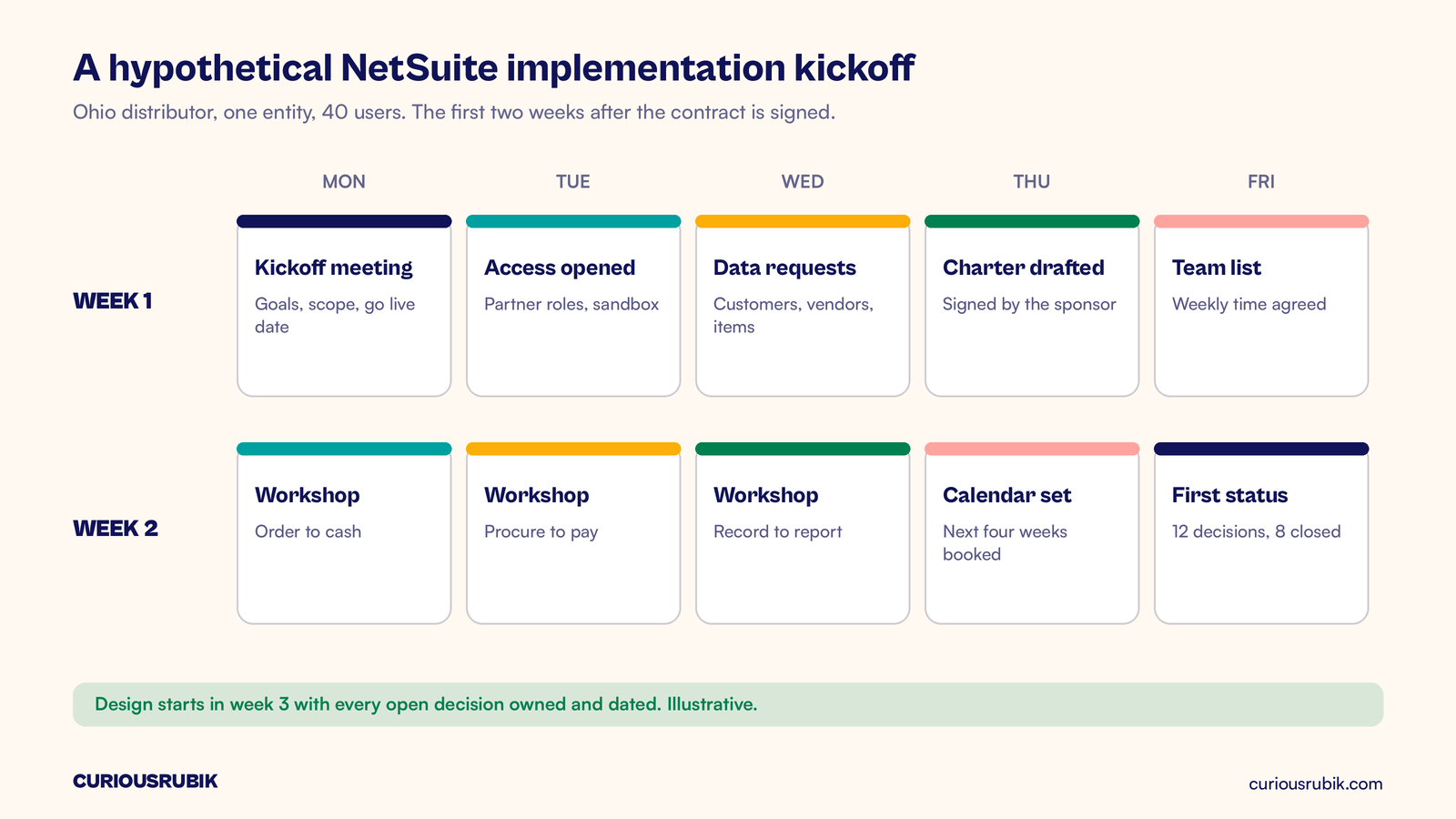
| Week | What happened | Result |
|---|---|---|
| Week 1 | Two hour kickoff meeting, charter drafted, team list filled | Go live date and scope agreed |
| Week 1 | Partner roles created in NetSuite, sandbox access opened | Consultants working in the account |
| Week 1 | Data request list sent for customers, vendors, items and balances | First extracts due in week 3 |
| Week 2 | Order to cash, procure to pay and record to report workshops held | Current process maps signed |
| Week 2 | Decision log reviewed at the first weekly status meeting | 12 decisions logged, 8 closed |
The four open decisions all had owners and dates, and the design phase started on time in week 3. These figures are illustrative.
What should be done by the end of week two?
Use this list at the status meeting at the end of week two. Every item should be a yes.
- The charter is signed by the executive sponsor.
- Every person on the team list has agreed their weekly time.
- The decision log is live, and every open item has an owner and a date.
- Partner consultants can log in with their own roles, and two factor authentication is on for administrator access.
- The workshop calendar covers the next four weeks, with attendees invited.
- The data request list has dates, and the first extracts are under way.
- The weekly status and monthly steering meetings are in everyone's calendar.
At CuriousRubik, we run the kickoff around one bounded first problem, so the team sees a working result early and the rest of the plan builds on it. Read about our NetSuite implementation approach and our NetSuite services in the United States.
Related reading
NetSuite Implementation Readiness Checklist for Teams
What your team should have ready before a NetSuite project starts.
20 NetSuite UAT Scenarios for Finance and Operations
Twenty test scenarios to run before you sign off a NetSuite go live.
NetSuite Procure to Pay Process for US Finance Teams
Each step of the NetSuite procure to pay flow, with owners and controls.