A portal business case can look attractive when every online task is counted as a saved service contact. The estimate becomes less convincing when some tasks still need help, the portal creates new support work and the supposedly avoided cost remains in the budget.
Measuring return requires a clearer chain: which behavior changes, which resources are affected, which financial consequences follow and who will make those consequences real. Activity in the portal is evidence for part of that chain, not proof of the whole return.
For a sponsor comparing customer or vendor self-service investments, a useful model separates incremental cash effects, internal capacity and other service outcomes. It states the time horizon and assumptions before presenting a single percentage. The examples below are educational illustrations, not a forecast or investment recommendation for a particular organization.
Define the comparison the decision requires
Start with the alternative to the proposed portal. It may be continuing the current process, improving an existing channel or implementing a smaller self-service capability. A comparison against an artificially unchanged baseline can overstate the portal’s value if the business would improve the process anyway.
Specify the task population and service boundary. Are you evaluating document retrieval, order-status enquiries, supplier confirmations or a whole account-management service? Include the work that moves between channels and teams.
Set a horizon that makes implementation and operating periods unambiguous. A model described as three years can mean three years from project start or implementation followed by three full operating years. Those produce different costs and benefits.
Record which costs are incremental to the decision and which are already committed or common to the alternatives. Historical expenditure may matter for context, but it should not be confused with cash that the current decision can still avoid.
Build a benefit chain for each claimed outcome
Describe the mechanism behind a benefit. For example, authorized customers retrieve a document themselves; fewer document requests require staff handling; the team releases capacity; an approved operating change then determines whether expenditure is reduced or the capacity is used elsewhere.
Each link needs evidence or an explicit assumption. If customers still call to confirm the document is correct, the handling reduction may be smaller than expected. If staffing remains unchanged, the immediate benefit may be capacity rather than cash.
For supplier self-service, a clearer order response may reduce clarification and improve planning. Do not assume that every minute of earlier information becomes a financial gain. Identify the decision it changes and the consequence that can be measured.
Assign a benefit owner who can influence the operating change. Technology delivery can enable a saving without having authority to remove an external service contract, change overtime arrangements or redeploy a team.
Keep three kinds of value visible
Incremental cash effects include expenditure that will actually be added or avoided because of the decision. They need a credible timing and realization plan.
Capacity effects describe staff time or other resources released or consumed. They can be valuable without producing an immediate cash change. The value depends on whether the capacity is usable, when it appears and what work can be done with it.
Service outcomes include correct completion, customer effort, supplier responsiveness and reduced uncertainty. Some can be monetized credibly; others should remain explicit nonfinancial considerations rather than receive a convenient invented dollar value.
Do not add overlapping benefits. If avoided outsourced handling already captures the cost of a task, counting the same hours again as an additional staff saving would inflate the result. If one improvement affects several measures, explain whether they represent distinct value or different views of the same effect.
Include the full cost of the chosen scope
Implementation costs can include design, configuration, integrations, data cleanup, identity setup, testing, content preparation, training and transition support. Internal effort should be recorded even when it does not require an incremental cash payment.
Operating costs can include subscriptions, hosting, support, accessibility maintenance, security testing, integration monitoring, content ownership and continuing changes. Customer and supplier onboarding can remain a recurring activity long after launch.
Include costs of coexistence with other channels. A portal may not replace assisted service, and reducing that capability too aggressively can undermine the intended outcome. Also consider eventual replacement or exit obligations where they are material to the comparison.
GAO’s 2020 Cost Estimating and Assessment Guide emphasizes defined scope, assumptions, data, sensitivity and risk analysis, and updating estimates with actual costs. Its public-program context does not supply a portal ROI benchmark; it provides useful disciplines for making an estimate reviewable. GAO, Cost Estimating and Assessment Guide.
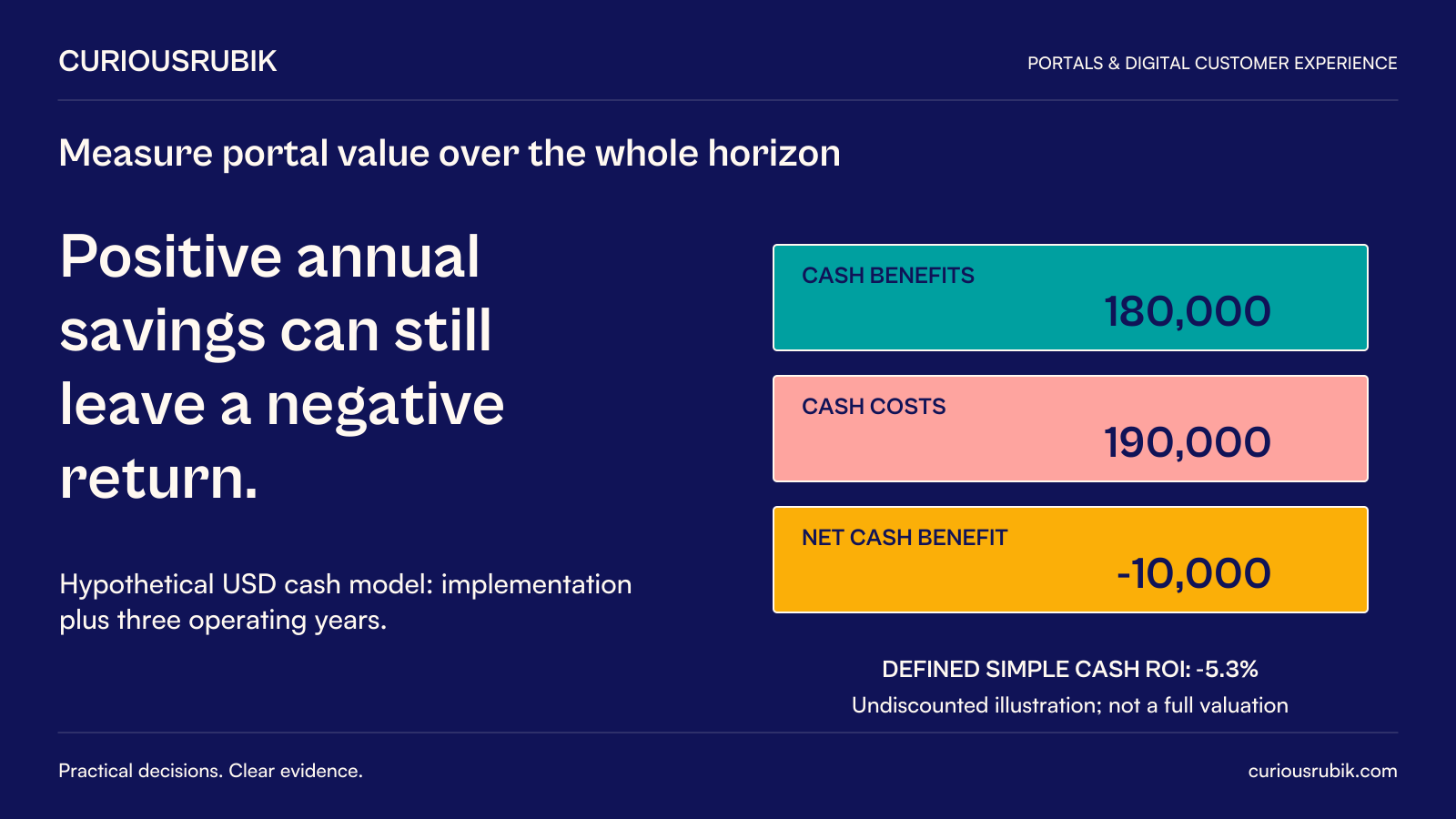
A positive annual saving can still leave a negative horizon result
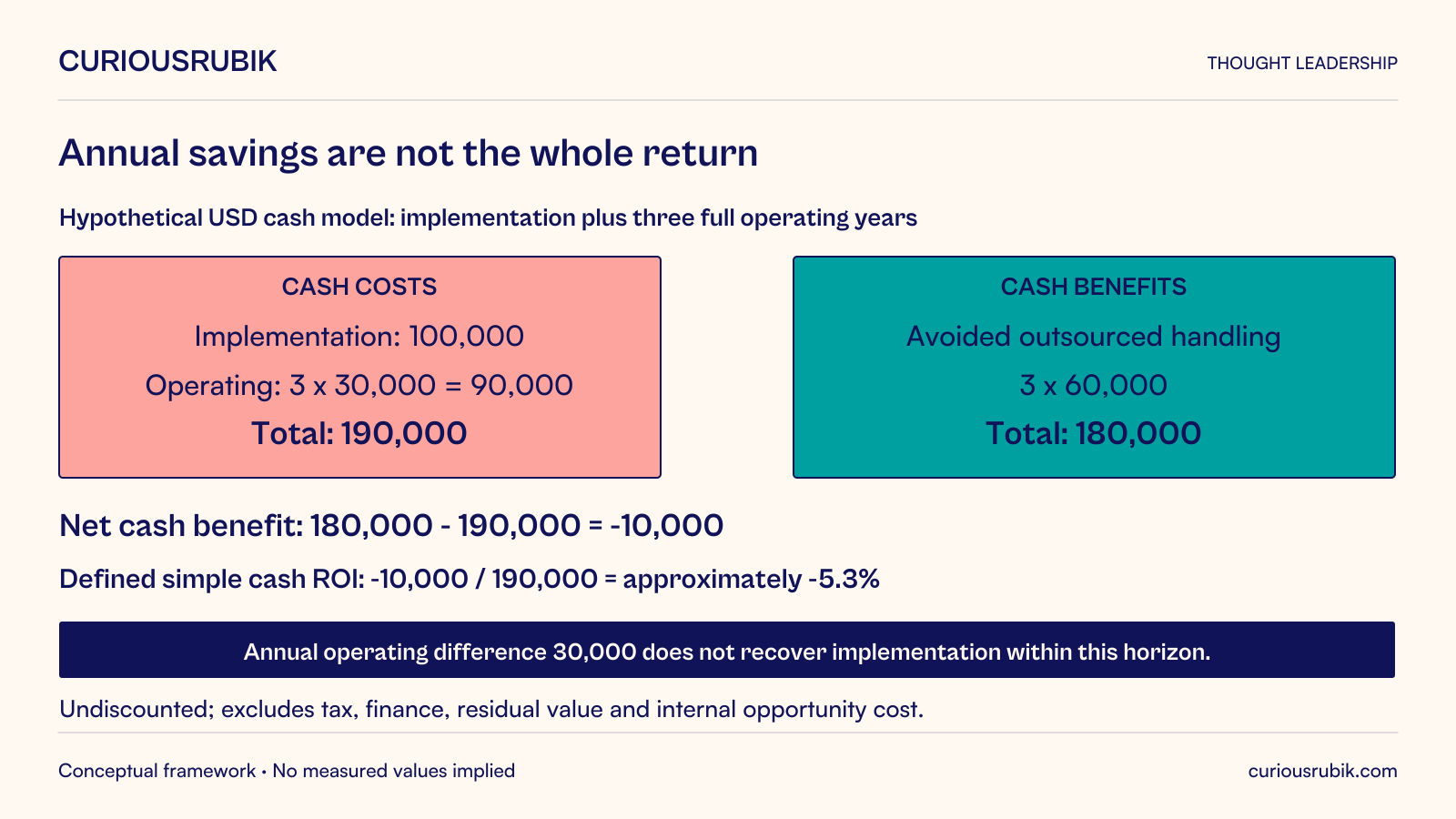
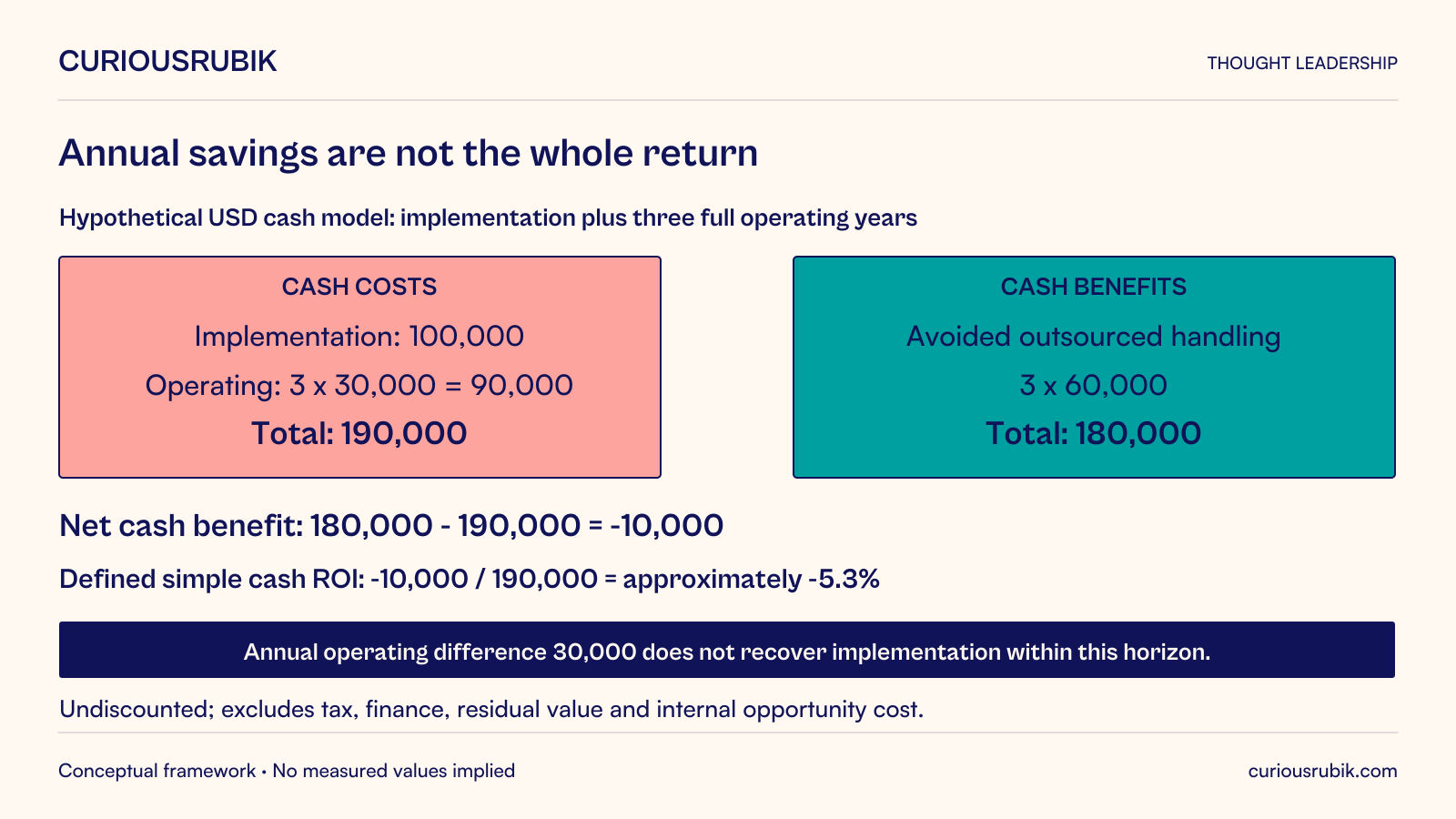
Consider a hypothetical self-service project with USD 100,000 of incremental implementation cash cost. Assume implementation is followed by three full operating years, with USD 30,000 of additional operating cash cost each year.
Suppose the organization expects to avoid USD 60,000 of outsourced handling expenditure in each operating year, and that this expenditure is genuinely removable. Over the stated horizon, cash benefits are USD 180,000 and cash costs are USD 190,000: USD 100,000 plus three times USD 30,000.
The undiscounted net cash benefit is therefore negative USD 10,000. If the organization defines a simple cash ROI as net cash benefit divided by cash cost, the illustrative result is approximately negative 5.3 percent. The model has a positive annual operating difference of USD 30,000, but it has not recovered implementation cost within the three operating years.
This is a deliberately limited cash view. It excludes tax, financing, discounting, residual value and internal opportunity cost. It is not a complete economic valuation. A finance owner should determine the appropriate method and assumptions for an actual decision.
The business might still choose the investment for important service or risk reasons. Those reasons should be visible alongside the cash result rather than used to disguise it.
Test assumptions that can change the decision
In the example, avoided outsourced expenditure is a major assumption. If it is only USD 40,000 per operating year while costs remain unchanged, three-year benefits become USD 120,000 and the undiscounted net is negative USD 70,000. If it is USD 80,000 per year, benefits become USD 240,000 and net benefit becomes positive USD 50,000.
These scenarios are illustrative, not probability estimates. They show that a claim about removable expenditure can determine the conclusion more strongly than small changes to the portal’s build price.
Other important assumptions can include the eligible task population, successful independent completion, assistance required, operating cost and timing of adoption. A delayed rollout may postpone benefits while some costs continue.
Vary assumptions coherently. A higher adoption scenario may require more onboarding or support capacity, and a broader feature scope may increase maintenance. Do not combine the most favorable value for every input if those values cannot reasonably occur together.
Use the sensitivity result to prioritize evidence collection. If one uncertain assumption changes the decision, a focused pilot or contract review may be more valuable than refining low-impact estimates.
Design a pilot that tests the benefit mechanism
Choose a task and audience that can provide evidence about the proposed change. Establish a baseline and identify related contacts, corrections and support work across channels.
Measure completed outcomes rather than submissions alone. A customer who downloads a file and then asks an employee to interpret it may still require substantial assistance. A supplier who enters a response that procurement must rekey has not eliminated the internal work.
Record changes outside the portal that affect the result, such as seasonality, staffing, policy or customer mix. Where practical, compare similar populations or periods and explain the limits of the comparison.
The pilot should also test the realization step. If the cash benefit depends on reducing a paid service, determine whether the contract and operating model allow that reduction. A modeled handling improvement is not evidence that the expenditure can actually be removed.
Avoid promising precision that the pilot cannot support. Small or selective samples can reveal important problems without establishing a reliable organization-wide percentage improvement.
Give capacity benefits an operating plan
Capacity released across many people in small intervals may not be fully redeployable. A concentrated reduction in a queue may create different opportunities. Describe where the time appears and which skills are involved.
If the plan is to improve response to complex cases, define the expected service outcome and the manager responsible for allocating the capacity. If the plan is to reduce overtime or external support, identify the conditions that must be met before expenditure changes.
Include new internal obligations created by the portal. Content maintenance, access administration and incident investigation can consume the same team’s time. Report the net capacity effect over a consistent boundary where it can be estimated credibly.
Do not value internal hours at a loaded rate and then present that amount as an automatic cash saving. It may be a useful economic measure under an agreed method, but the distinction should remain clear to decision-makers.
Update the case after release
Treat the approved business case as a set of commitments and assumptions to revisit. Track actual implementation cost, operating cost, completion behavior and benefit realization against the original scope.
When the result differs, identify the reason. Lower demand, slower adoption, more assistance or an unexecuted operating change call for different responses. The answer may be to improve the portal, narrow its scope, change the operating plan or revise the investment expectation.
Keep the original estimate visible so that learning is possible. Replacing it with a new forecast without explaining the change makes it difficult to distinguish improved evidence from moving the target.
A credible ROI assessment helps the organization decide what to fund and how to realize its value. Its strength comes from clear boundaries, explicit assumptions and honest separation of cash, capacity and service outcomes, rather than from an impressive percentage unsupported by the way the business actually operates.