A portal role tells the application something about a person’s responsibilities. It does not automatically establish that the person may approve every request visible to them. Approval can depend on the organization represented, the type of request, the current state, delegated authority and whether the person helped create the proposal.
When those conditions are left implicit, workflow configuration becomes a collection of exceptions. Teams add approvers to keep work moving, broaden administrator access to resolve delays and discover later that a convenient route bypassed the intended decision.
For a portal owner, the design task is to translate a business authority policy into clear, testable actions. The result should make legitimate work easier while ensuring that routing a request to someone never grants authority they do not possess.
Describe decisions before creating roles
Begin with the decisions the portal supports. For each, state the subject, possible outcomes, required evidence and role responsible for the judgment. Separate preparing a request, checking its completeness, approving it and executing the approved action.
Those responsibilities may belong to different people, or some may be combined under the organization’s policy. The point is to decide deliberately rather than let a default workflow template make the choice.
Define permissions as actions on a scope. A partner user may submit a proposal for their own organization. A commercial reviewer may assess proposals for assigned partners. An operations role may fulfill an approved request without changing the commercial decision.
Broad labels such as manager or administrator are insufficient when they conceal materially different authority. Keep roles understandable, but pair them with the business context needed to determine what the person may actually do.
Distinguish access from approval authority
A reviewer may need to see information to advise on a request without having permission to approve it. A requester may see the outcome without seeing confidential internal commentary. An administrator may maintain the workflow without being entitled to make its business decisions.
Design these permissions separately. Otherwise, granting visibility for collaboration can accidentally grant authority to change the result.
NIST SP 800-53 Revision 5 includes controls for separation of duties and least privilege. AC-5 calls for identifying duties that require separation and defining access authorizations to support that separation. These are useful control-design principles, not a universal prescription for how many approvers a particular business process needs. NIST SP 800-53 Revision 5, AC-5 and AC-6.
A second approval should have a defined purpose and competent owner. Adding signatures without distinct judgment can increase delay without providing the intended control.
A partner campaign request illustrates bounded delegation
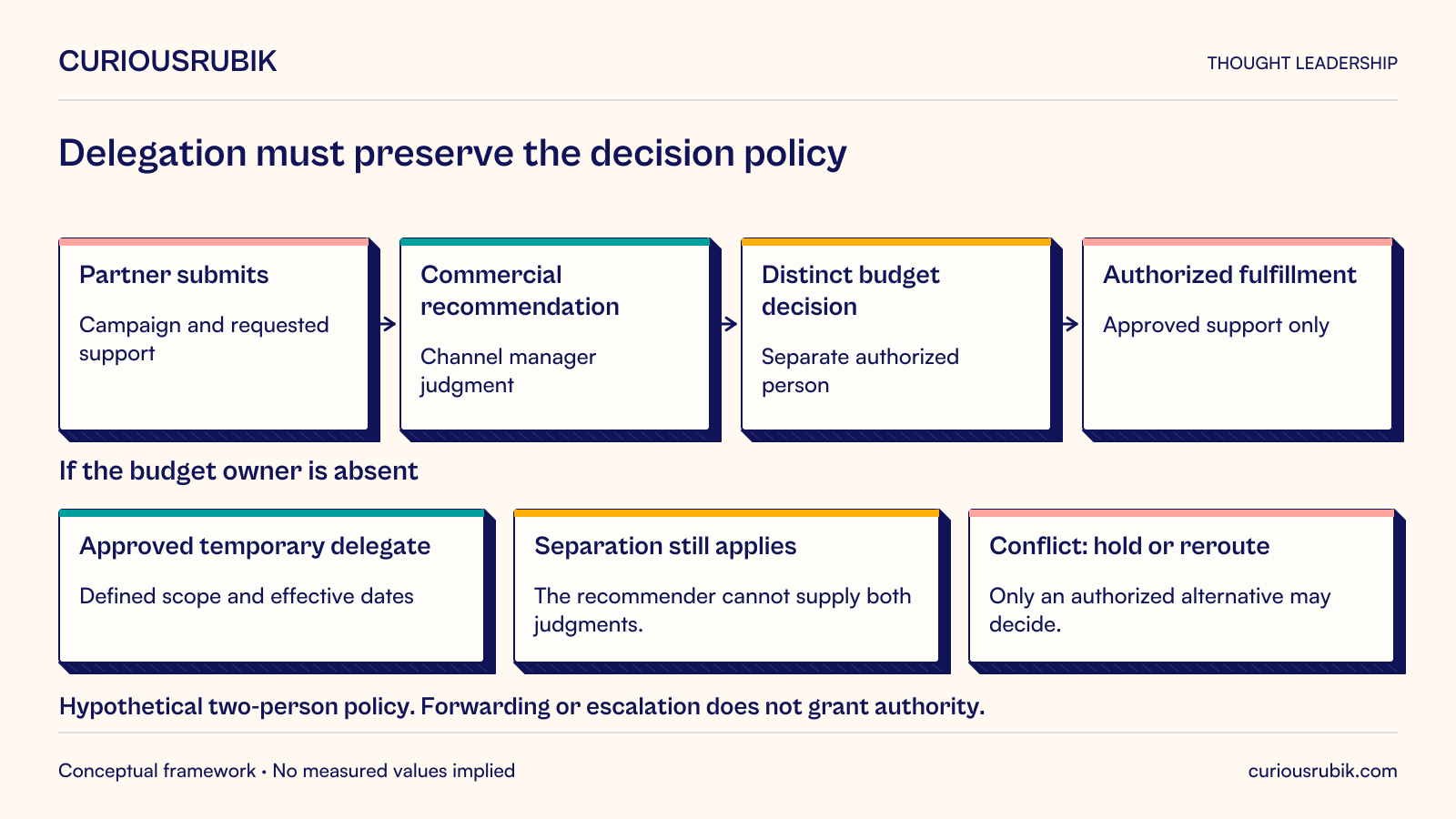
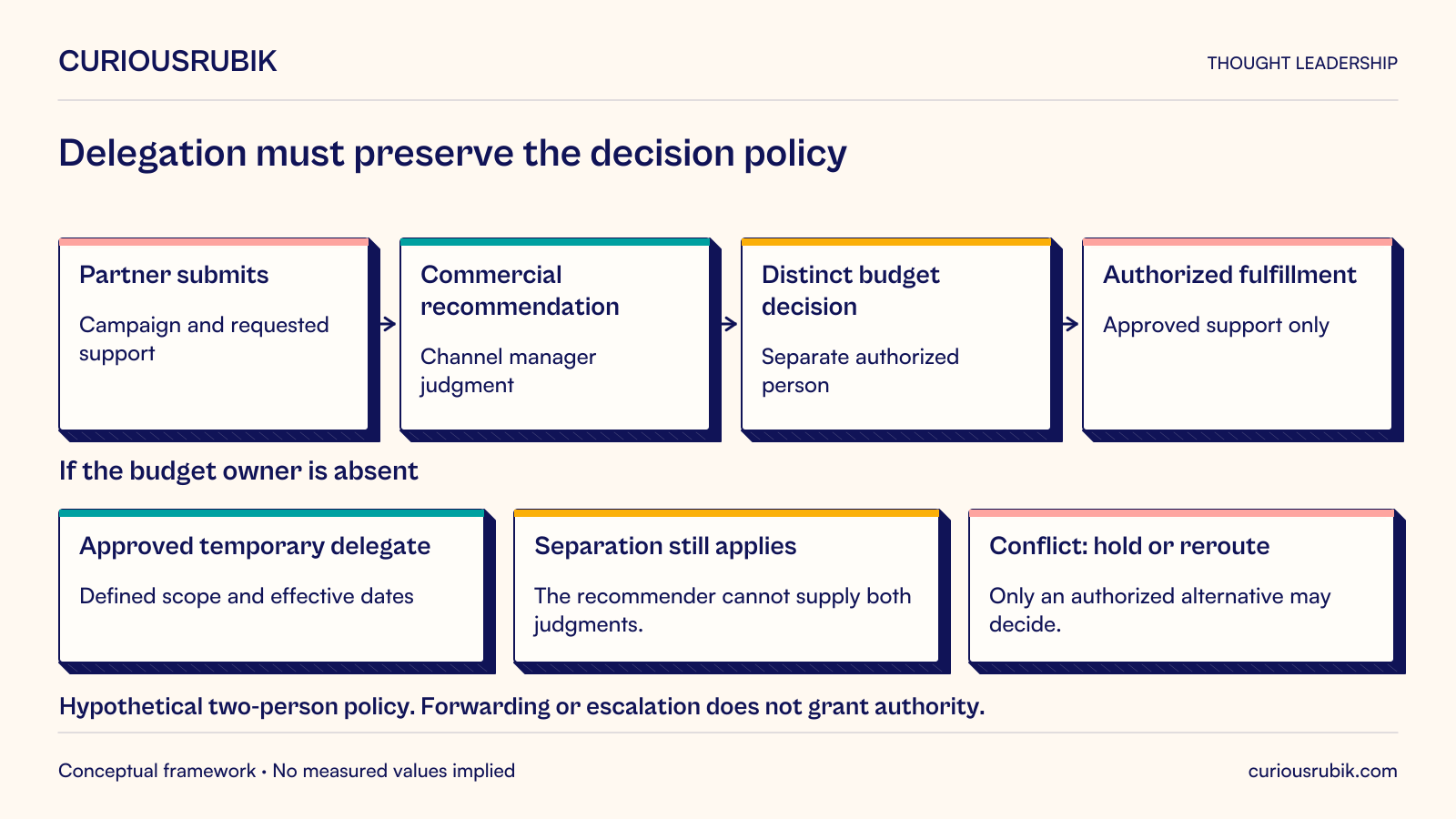
Consider a hypothetical manufacturer whose business partners use a portal to request support for local marketing campaigns. A partner submits the campaign description and requested support. An internal channel manager assesses its commercial fit, and a separate budget owner confirms that the proposed commitment is authorized under the company’s policy.
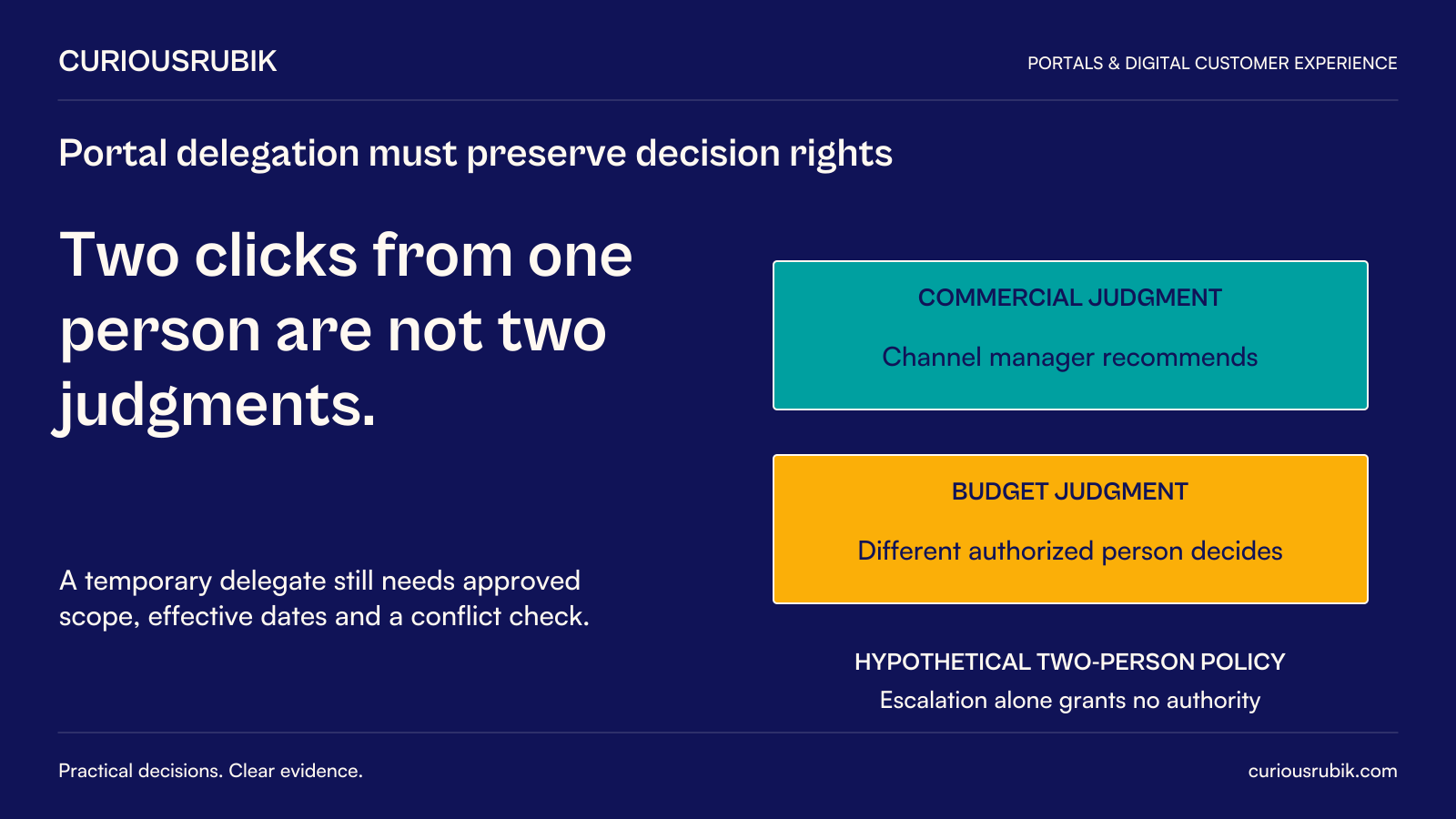
Assume the policy requires those two judgments from different people. A channel manager can ask for clarification and recommend support but cannot complete the budget decision. The budget owner can approve the commitment within their assigned scope without rewriting the partner’s proposal invisibly.
Now suppose the budget owner is absent. Forwarding the task to a colleague should not automatically make that colleague an authorized budget approver. A valid delegation needs an approved delegate, defined scope and effective period. It must also preserve the assumed separation requirement.
If the delegate is the channel manager who already made the recommendation, the workflow should detect the conflict rather than accept two clicks from the same person as two independent decisions. The request can be routed to an authorized alternative or held for resolution under the business’s escalation policy.
This is an operational design example, not a recommendation about a particular company’s spending authority or accounting treatment.
Make delegation a controlled object
Delegation should be explicit enough to test. Record who grants it, who receives it, the permissions covered, the applicable organizational or request scope and when it starts and ends.
Distinguish delegation of work from delegation of authority. A colleague can prepare evidence or monitor a queue without receiving approval rights. The portal should not collapse those assignments into one broad substitute role.
Check whether the delegator is allowed to delegate the authority in question and whether further delegation is permitted. A chain of informal substitutions can otherwise extend beyond the original decision.
When a delegation expires or is revoked, determine what happens to pending tasks and active sessions. A request already displayed in a browser should not remain approvable merely because the person opened it before their authority ended.
Give the delegate enough context to make the decision and show that they are acting under delegated authority. The audit record should preserve the actual actor and the authority used rather than pretending the absent person approved the request.
Express workflow states in business terms
Define states that explain what the request means and what can happen next. Draft, submitted, awaiting clarification, under review, approved, rejected and withdrawn may be useful, but their exact meaning must be agreed for the process.
Specify who may move the request between states and what conditions apply. A requester may withdraw an uncommitted proposal but need a different process after the business has acted on it. An operator may record fulfillment without changing the prior approval.
Do not use one generic completed state for every event. An approval can be complete while fulfillment remains pending. The user should be able to understand that distinction without reading the entire activity log.
Changes to material request details may require renewed review. Define which changes invalidate a decision and which are administrative corrections that can follow a different controlled path. Preserve the version or decision basis so that the organization can explain what was approved.
Keep escalation separate from permission expansion
A delayed request needs attention, but delay does not create authority. Escalation can notify an owner, move work to another authorized person or trigger a documented exception process. It should not silently bypass a required decision because a timer expired.
Set escalation rules according to consequence and operating capacity. A universal reminder interval may be inappropriate for requests with different urgency or evidence needs.
Make blocked work visible. If no eligible approver is available, show the reason and responsible owner rather than leaving the request in a queue that appears active. The business can then decide whether to appoint an authorized alternative, change the request or wait.
Emergency procedures, where needed, should be defined by the organization with appropriate limits, records and follow-up. They should not emerge as undocumented administrator actions during an incident.
Enforce the policy where the action is committed
The interface can guide users by showing relevant tasks and available actions. The application must still enforce authorization on the trusted side when the action is submitted.
Check the actor’s current role and scope, the request’s current state, applicable delegation and required separation conditions. Do not rely on a prior screen render or a client-supplied approved flag.
Handle simultaneous actions deliberately. Two reviewers may open the same request, or the requester may change it while a decision is pending. The system needs a consistent way to determine which action applies to which state and to reject or reconcile stale attempts.
Keep downstream execution tied to the approved scope. An integration should not turn approval for one campaign, quantity or period into a broader action. If execution cannot complete as authorized, return the issue to an appropriate owner rather than inventing a new business decision.
These checks connect the workflow diagram to actual control over the result.
Test combinations, not just happy paths
Create test cases from the authority policy. Include an authorized reviewer in the correct scope, a reviewer outside that scope, an expired delegate, a requester attempting self-approval and an administrator without business approval rights.
Test requests in different states and with changed information. Include absence, reassignment, withdrawal and duplicate submission. Verify that notifications and exports do not expose information beyond the recipient’s permissions.
For the campaign example, test the same person receiving both review tasks through delegation. The expected outcome should follow the stated separation policy, not the number of completed workflow steps.
Test policy changes as well. When roles or delegation rules change, examine existing requests and cached task lists. The team needs a controlled way to apply the new policy without losing the ability to explain decisions made under the old one.
Use synthetic or appropriately protected data in authorized environments. A successful functional demonstration is not a substitute for security testing of the implementation.
Maintain a policy that people can understand
Approval rules will change as the organization evolves. Assign an owner who can explain the business policy and a controlled process for updating its implementation.
Avoid configuration that only one specialist understands. Maintain a readable decision table or equivalent specification connecting actions, scopes, conditions and outcomes. This is a practical documentation choice, not a separate governance standard.
Review exceptions and overrides for recurring design problems. Repeated requests for broad access may indicate an unclear role model, inadequate delegation or a process whose authority structure no longer fits the work.
Measure both control and service outcomes: blocked unauthorized attempts, unresolved authority gaps, time waiting for decisions and rework caused by unclear evidence. Faster approval is useful only when the required judgment remains intact.
A well-designed portal workflow makes the business’s authority visible and enforceable. Roles provide a foundation, while scope, state, delegation and accountable decisions make that foundation useful in real operating conditions.