Procurement teams often spend time reconstructing what a supplier has actually committed to deliver. The purchase order says one date, an email proposes another and a shipment notice describes only part of the quantity. A shared portal can help, but only if it preserves those distinctions instead of turning every update into a single reassuring status.
The opportunity is to create a common record of requests, responses, accepted changes and actual events. That record should help both parties identify what needs attention and who has authority to act.
For a procurement leader, a vendor portal is therefore a collaboration design decision before it is a document-upload project. Its value depends on whether the information exchanged improves planning and resolves exceptions without creating another place to rekey the same facts.
Begin with the decisions that lack reliable information
Identify the recurring uncertainties that affect procurement and operations. Does the team need to know whether an order was received, whether the supplier accepted its terms, whether a proposed change has been approved or whether goods have actually arrived?
Those are different questions. A supplier opening a document does not establish agreement. A promised shipment is not a receipt. An uploaded invoice does not prove that the underlying goods or services were accepted.
Map the information each party needs to make the next decision. Include the buyer, supplier, receiving operation and any planning team that depends on the result. Define who owns each fact and who may propose a change to it.
This helps the team choose a coherent first scope. A portal that reliably manages order confirmations and exceptions may create more value than a broad supplier homepage with weak links to the purchasing process.
Preserve distinct commercial and operational events
A purchase order expresses the buyer’s request or commitment under the applicable business arrangements. A supplier response can accept, reject or propose changes. The portal needs to represent the meaning of that response rather than simply mark the order acknowledged.
The buyer’s authorized acceptance of a proposed change should remain distinguishable from the supplier’s proposal. Record the relevant version, actor and time so that both parties can determine which conditions are currently operative.
A despatch notice describes an intended or actual shipment according to the agreed process. Receiving records establish what the recipient observed. Differences between these events require reconciliation, not an assumption that one automatically proves the other.
GS1’s January 2012 UN/CEFACT XML profiles list separate standards for orders, order responses, despatch advice and invoices. That separation illustrates the importance of distinct business-message meanings; it does not require every portal to implement those particular schemas. GS1, UN/CEFACT XML profiles.
Agree the semantics before selecting labels and integrations. Otherwise, the same word can carry a different commitment for each participant.
A split delivery exposes the necessary distinctions
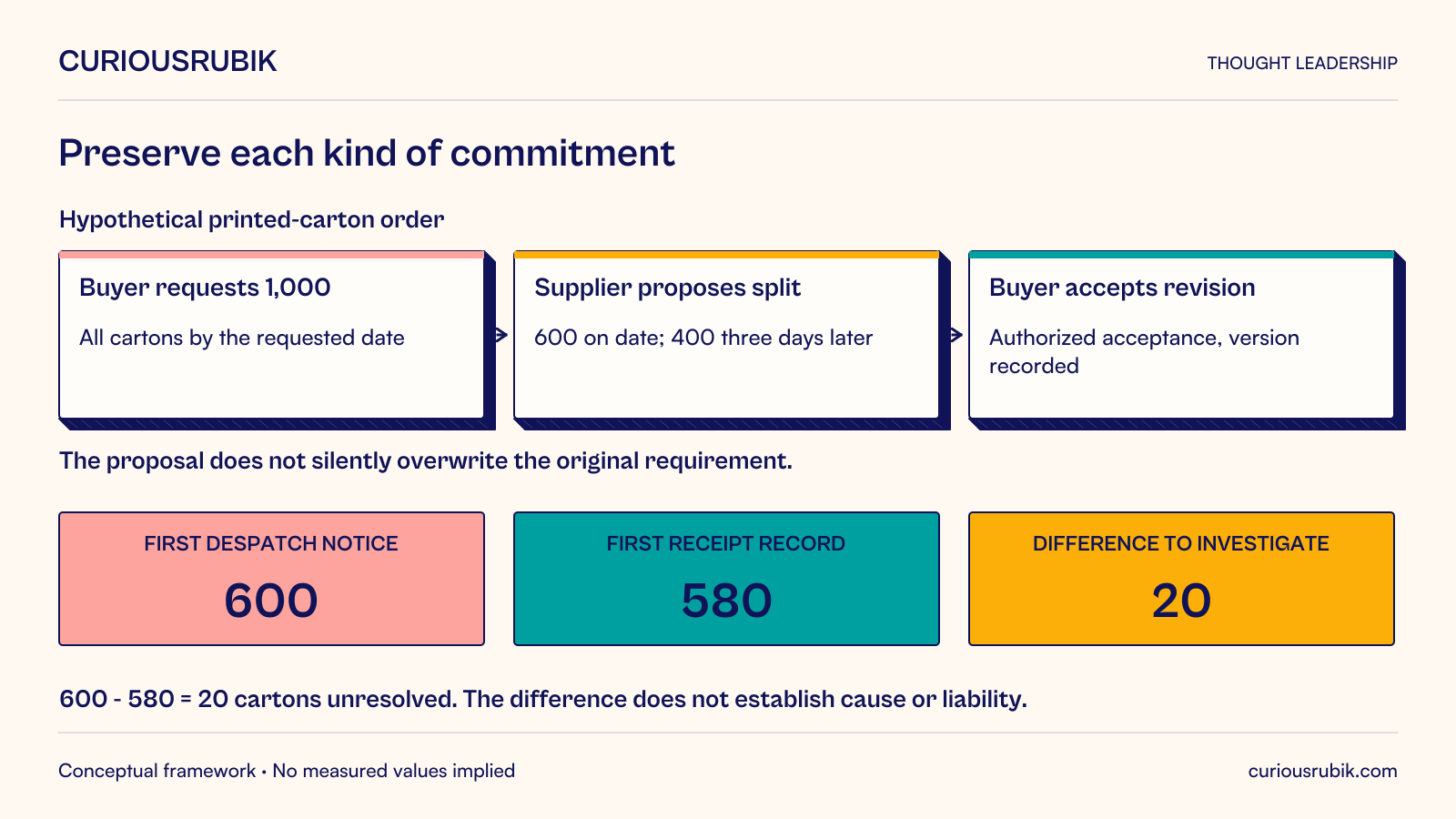
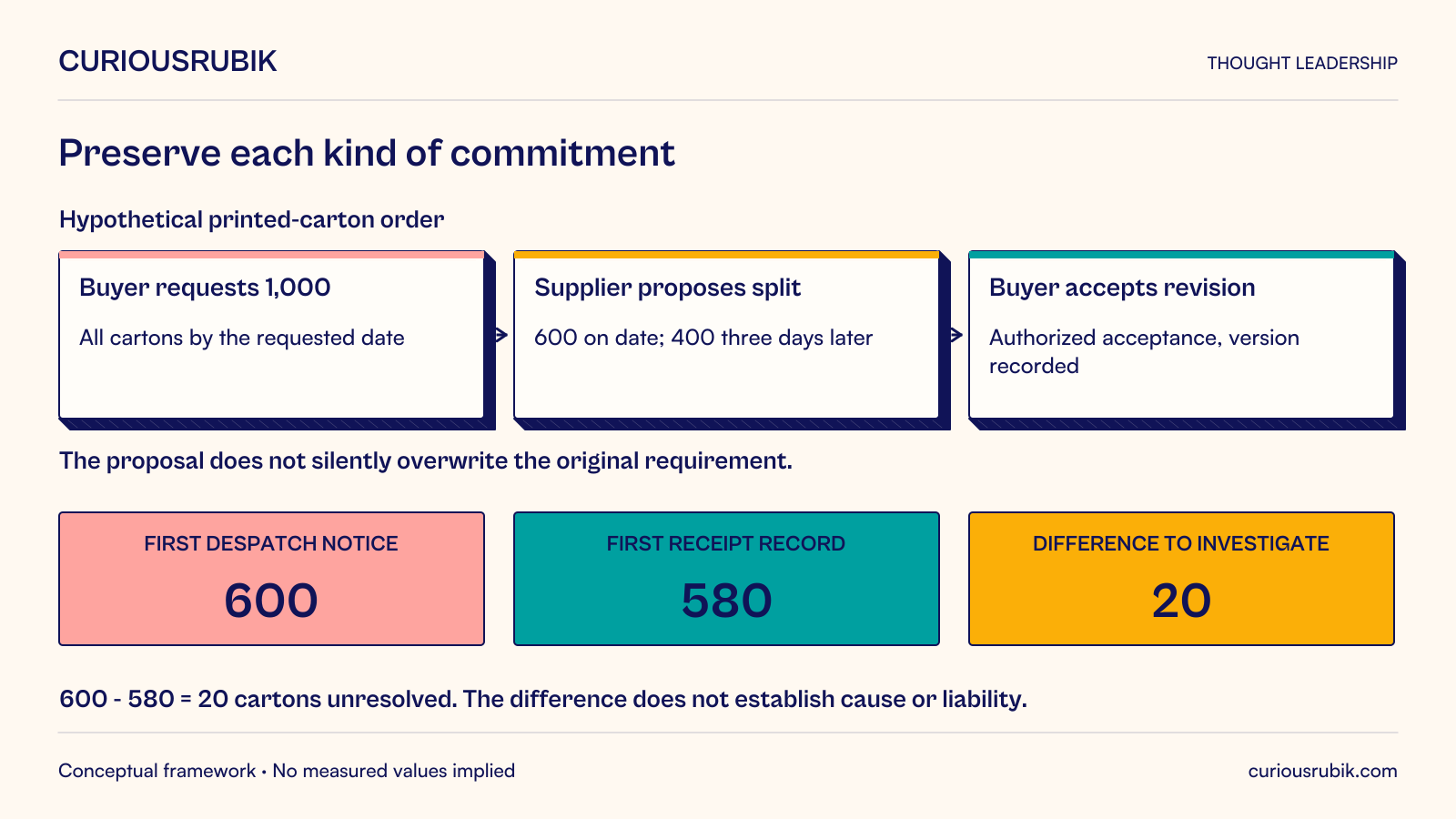
Consider a hypothetical manufacturer ordering 1,000 printed cartons for a product launch. The purchase order requests all cartons by a specified date. The supplier reports that it can provide 600 by that date and proposes the remaining 400 three days later.
The portal should show the original requirement and the proposed split. It should route the exception to someone authorized to assess the launch impact and accept, reject or renegotiate the proposal. The supplier’s response should not silently overwrite the buyer’s required date.
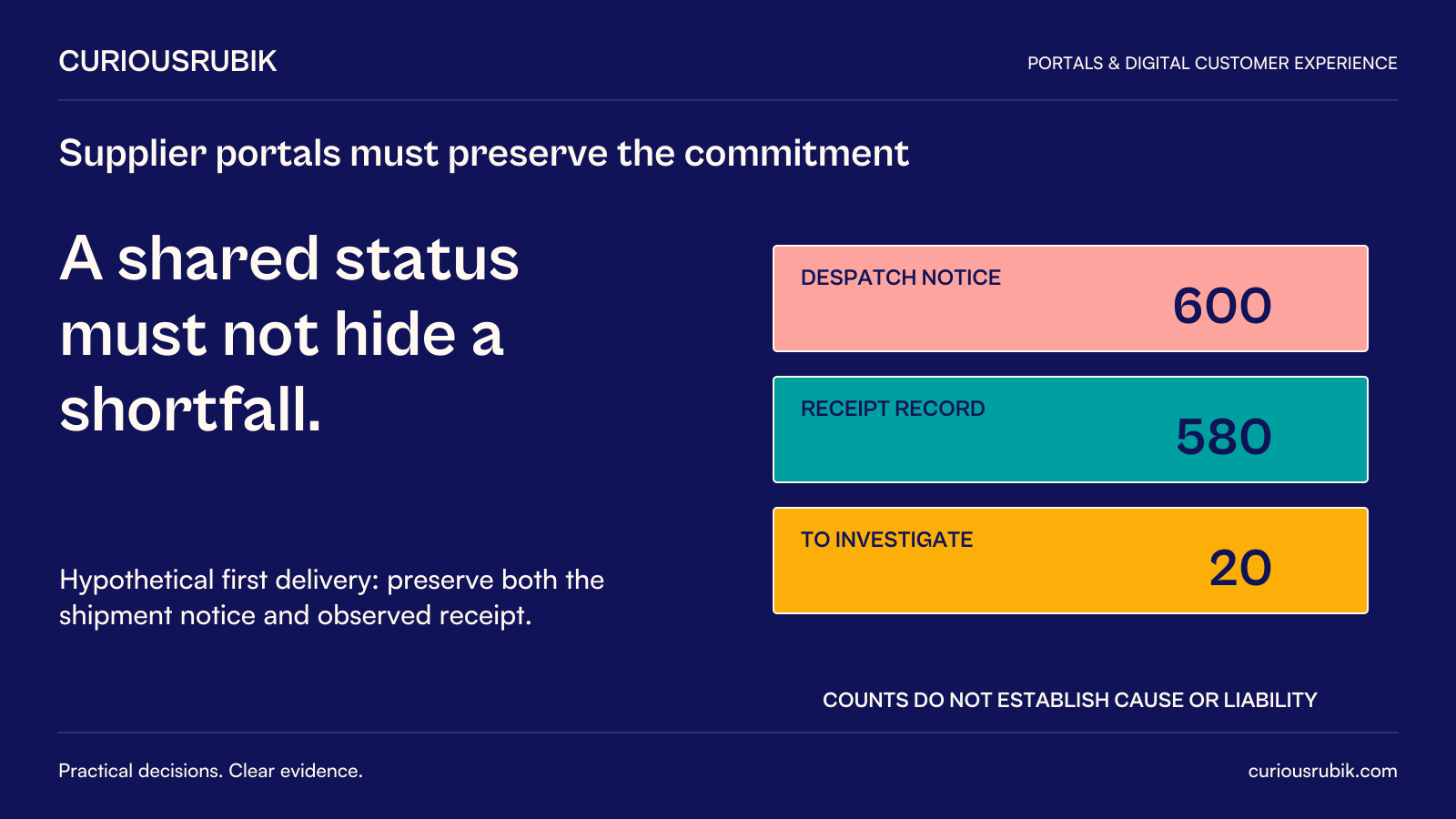
Suppose the buyer accepts the split. The planning view can then show 600 due in the first delivery and 400 in the second, with the accepted revision identified. If the first shipment notice lists 600 but receiving records 580, the portal should preserve a 20-carton discrepancy rather than treat the entire first commitment as fulfilled.
That discrepancy does not by itself establish why the difference occurred or who is responsible. The parties may need to investigate counting, damage, packing or documentation. The portal’s job is to expose the difference, preserve evidence and support the authorized resolution.
A planning team can now see the current commitment and the actual receipt without searching through correspondence. That is more valuable than a green order status that conceals the shortfall.
Make line-level exceptions actionable
Many procurement issues occur at a line, quantity or delivery-schedule level. An order-level status may be too coarse to support the next decision. Determine which level of detail the operation genuinely needs.
Show the affected item, requested condition, proposed condition, reason and response deadline where relevant. Provide the context needed for a decision without forcing the reviewer to reconstruct the entire order history.
Assign a responsible role and define what happens when no response arrives. An exception should not remain indefinitely in a shared inbox where each party assumes the other is acting. Escalation should reflect business consequence and available authority rather than a universal timer.
Let users distinguish a question from a proposed amendment and a proposed amendment from an accepted change. Discussion can inform a decision, but it should not accidentally become the decision record.
Keep the current position easy to find while preserving the history needed to explain it. A chronological message stream alone can make the latest authorized commitment surprisingly difficult to identify.
Integrate around ownership rather than duplication
The portal should connect to the purchasing and receiving records that the business relies on. Define which system creates the order, which accepts a revision and where receipt and invoice states originate.
A supplier may enter information through the portal while another supplier sends equivalent information through an established integration. Both routes should feed a consistent business interpretation, with duplicate and conflicting submissions handled deliberately.
Avoid requiring suppliers to re-enter data already exchanged reliably through another channel merely to improve portal adoption statistics. A portal can provide visibility and exception management while an integration carries routine transactions.
For each interface, define what a successful technical delivery means and what business processing still remains. A received message can fail validation or require review. Display that state honestly and provide a correction path.
Test changes that arrive while another party is acting. For example, a buyer revising an order should not unknowingly accept a supplier response to an older version. The application needs a way to identify the relevant version and require renewed review when the basis of the decision has changed.
Give suppliers a reason to use the service
A portal imposes work on suppliers as well as buyers. Consider how it fits their staff, transaction volume and existing systems. A small supplier handling a few orders may need a simple interface; a high-volume supplier may need structured exchange and bulk operations.
Make the benefit concrete: fewer status enquiries, clear exception handling, access to the current order or visibility into the stage of an invoice query. Do not promise payment timing or dispute resolution that the underlying process cannot support.
Provide clear onboarding, role administration and help. Suppliers need to know who can access which buyer relationship and who can respond with the necessary authority. Personnel changes should not leave former employees with continuing access or strand the account without an administrator.
Test with suppliers who have different operating conditions. A design that works for a dedicated account team may be impractical for a small business owner managing several customers. Accessibility and understandable language belong in that assessment.
Adoption improves when the portal reduces ambiguity and duplicated work for both sides. Making it mandatory does not establish that those benefits exist.
Protect sensitive changes and confidential information
Supplier collaboration includes commercially sensitive information. Limit access to the appropriate buyer-supplier relationship, roles and records. A user serving several customers should not see one customer’s prices, forecasts or attachments in another context.
Changes to payment destinations or other sensitive supplier details need a separately designed verification and approval process. A portal submission alone should not be treated as sufficient proof that a consequential change is legitimate. The specific controls should follow the organization’s risk policies and responsible specialists’ guidance.
Distinguish permission to propose a change from permission to approve it. Record the decision and maintain an audit trail that can support investigation without indiscriminately exposing sensitive information in logs or notifications.
Review downloaded files, exports and shared links as well as the main interface. A secure login does not establish that every document-delivery path is correctly restricted.
Measure the quality of collaboration
Useful measures connect to the decisions the portal is meant to improve. Examples include the time to obtain an actionable supplier response, the age of unresolved exceptions, the effort required to clarify a change and the accuracy of accepted commitments against actual events.
Define the population and meaning of each measure. A supplier response rate can look healthy while many responses are incomplete or refer to obsolete order versions. A reduction in emails can occur without any improvement in the underlying procurement work.
Separate supplier performance from portal performance. A late delivery may reflect production or transport issues, while a portal can still make the risk visible early enough for action. Conversely, a delivery can arrive on time despite a portal that creates unnecessary administrative work.
Use qualitative feedback to explain exceptions. Ask whether buyers and suppliers can identify the current commitment and the next responsible action without assistance. That is a direct test of the shared record’s usefulness.
Expand from trustworthy commitments
Start with a bounded procurement flow whose events, ownership and exception paths are clear. Establish that the portal reflects the same authorized position as the systems and people doing the work.
Then consider additional capabilities, such as document exchange, forecasting collaboration or performance review, on their own merits. Each adds new meanings and permissions that need definition.
Vendor portals transform collaboration when they make commitments and differences visible enough to act on. The essential result is not that every conversation moves online. It is that both parties can understand what was requested, what was accepted, what actually happened and what still needs a decision.