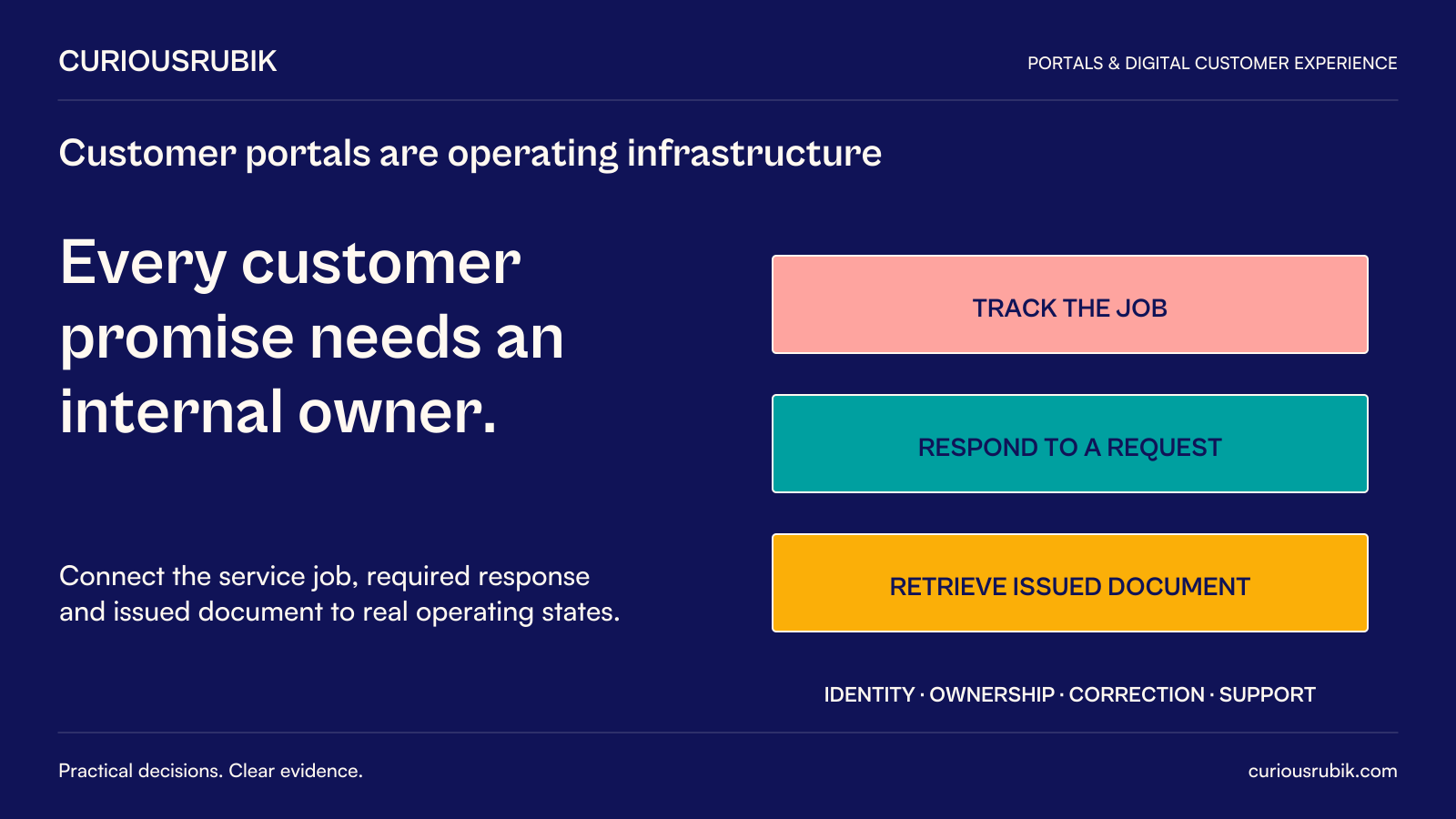
A portal becomes business infrastructure when customers, suppliers or employees depend on it to complete recurring work. At that point, it is no longer just another website. Its status information influences decisions, its forms create operational demand and its availability affects the service the organization has promised.
That does not mean every business needs a portal or that every interaction should become self-service. The important question is whether a defined group repeatedly needs information or actions that the organization can provide reliably through a supported digital channel.
For a business sponsor, the investment decision should begin with that recurring dependency. A portal earns its place when it connects a useful external task to an accountable internal process, with clear information, permissions and a way to resolve exceptions.
Identify the work people return to perform
A useful portal has a reason for someone to return. That reason might be retrieving an approved document, checking a service request, supplying missing information or reviewing a proposed change. A collection of company news and links may support communication, but it does not by itself establish a self-service operating model.
Research the recurring questions and actions in existing interactions. Look at what people ask, what evidence they need and why an employee currently has to intervene. Distinguish information that is hard to find from decisions that genuinely require judgment.
Frequency alone is not enough. An action may happen rarely but carry a high consequence when it does. Conversely, a frequent request may be easier to eliminate through a clearer process than to reproduce in a portal.
Choose an initial service boundary that is coherent for the user. If the portal lets a customer start a request but provides no receipt, progress or correction path, it has digitized an entry point without supporting the whole task.
Treat the portal as a promise about the operation
When a portal says a request is complete, users reasonably expect that state to mean something. The application therefore needs agreed definitions for its visible statuses and a reliable connection to the process that establishes them.
Separate a received submission from accepted work and completed service. Explain what happens next, who must act and whether additional information is needed. Avoid using a reassuring label to hide an unresolved queue.
Every visible action should have an operating owner. Who handles a disputed status? Who corrects a document linked to the wrong account? Who responds when a submission is accepted by the portal but never appears in the internal work queue?
These responsibilities should be designed before the portal is launched. Otherwise, the digital channel can create a new layer of uncertainty while employees continue to resolve the same questions manually.
A calibration-service portal shows the infrastructure threshold
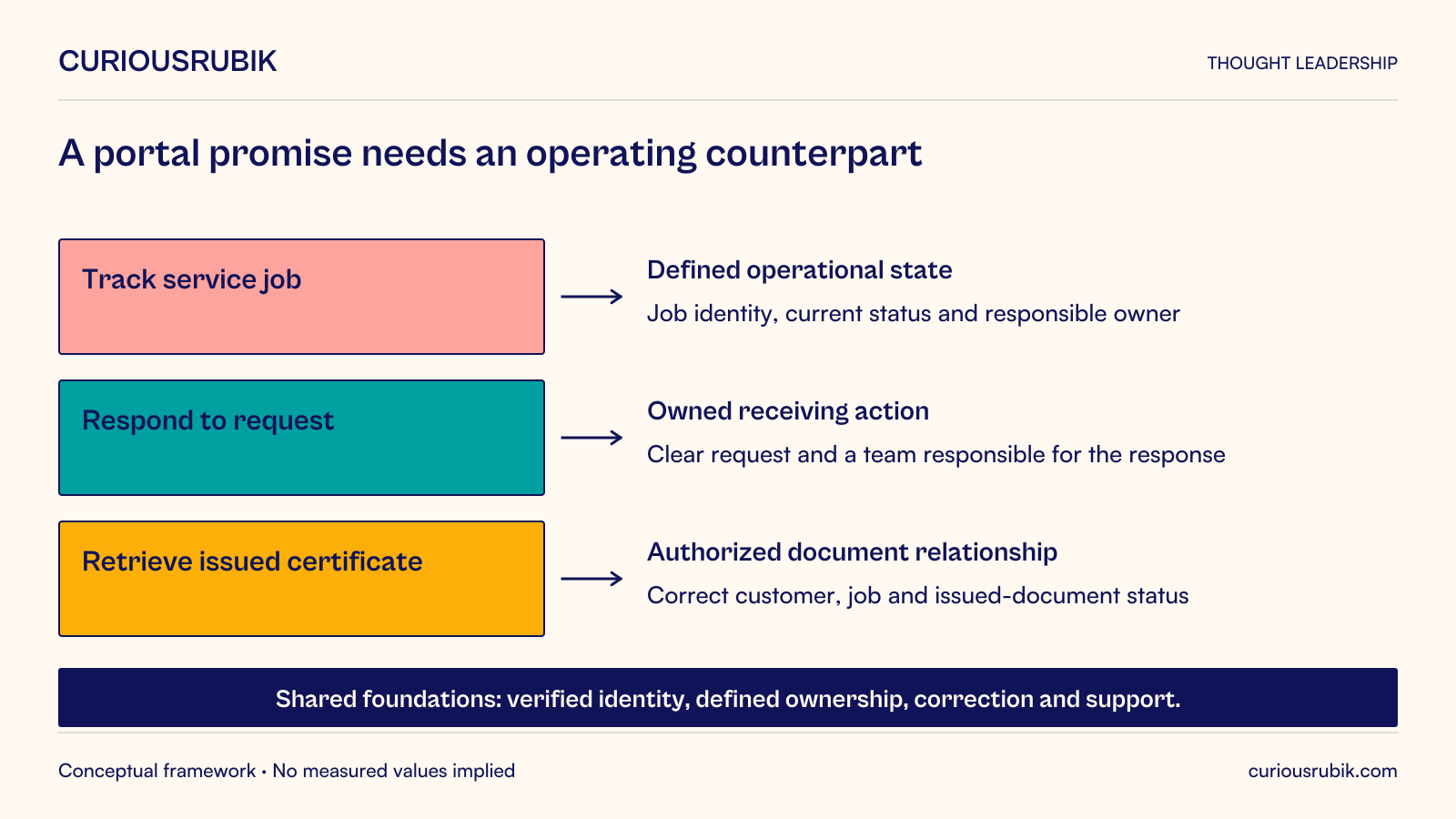
Consider a hypothetical business that services and calibrates industrial measuring equipment. Its customers repeatedly ask whether an instrument has been received, whether work is waiting for their response and where to retrieve the issued certificate.
An initial portal could expose those tasks without attempting to automate every technical decision. It might show the instrument’s service-job identity, the current operational state, any customer action required and the document available for that job. The meaning and release of technical documents remain governed by the business’s established procedures.
The dependencies are specific. A certificate must belong to the correct job and authorized customer relationship. A request to change the delivery destination must reach the responsible team and may require review before acceptance. A status indicating that a customer response is needed should make the required response clear.
If the portal displays an issued document while an internal correction is underway, the business needs a policy for its visible status and access. If a customer phones instead, the employee should be able to find the same request and record the resulting action without creating an unexplained duplicate.
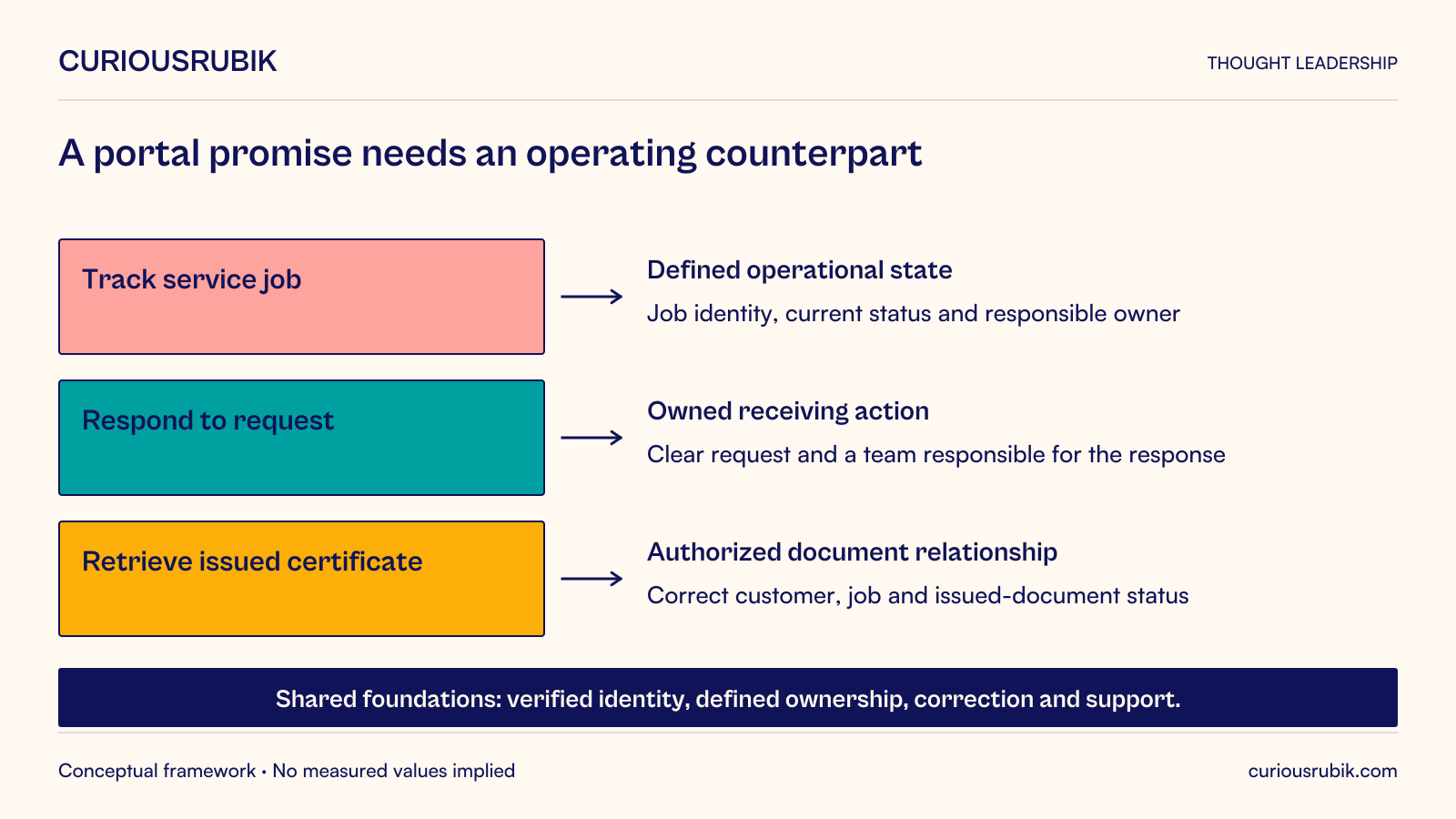
This is the threshold that matters. The portal’s value comes from a trustworthy service relationship, not from the number of pages available after login.
Decide what can be self-served safely
Some tasks are suitable for direct completion because the rules, authority and consequences are clear. Others should let the user prepare or request an action while retaining a review step.
For example, downloading an authorized issued document differs from asking the business to amend that document. The second action may need investigation and approval. Presenting both as simple editing would misrepresent the user’s authority and the organization’s responsibility.
Define the boundary for each task: what the user can see, propose, submit, change and confirm. State what happens when the information is incomplete or the request falls outside normal rules. A clear escalation path is part of self-service, not evidence that it has failed.
Avoid hiding complexity by silently shifting it to the user. If a customer must understand internal department codes to route a request, the portal is exposing the organization’s structure rather than helping complete the task. The service should translate a recognizable user need into the appropriate internal work.
Connect channels through the same service record
People may switch between a portal, email and a conversation for practical reasons. They may need help, lack access temporarily or be handling an unusual case. A portal strategy should account for that movement.
The UK Government Digital Service’s Service Standard discusses coordinating online and offline experience, involving frontline operations and understanding how changes in one channel affect another. Its guidance is written for public services; the operational principle is useful to business portals as well. GDS, Provide a joined up experience across all channels.
Give the service request a stable identity that both the user and support team can reference. Where appropriate, record consequential actions from other channels against that same case. The goal is continuity of the work, with suitable authentication and authorization in each channel.
Do not measure success solely by a fall in calls. Calls can decrease because the portal solves the task, but also because people cannot find help or have given up. Examine completion and unresolved demand before interpreting channel volume.
Support teams need training and visibility into the portal’s behavior. A new digital feature can change the questions they receive and the evidence they need to resolve them.
Fund reliability in proportion to dependence
The more the business relies on a portal, the more it needs an explicit operating model. Define expected service hours, support arrangements, monitoring and recovery priorities according to the tasks it carries.
A temporary outage in a document library has a different consequence from an outage near a time-sensitive submission deadline. The organization should know how users will be informed, which alternatives remain available and how work submitted through an alternative path will be reconciled later.
Monitor the complete service, not just whether the login page responds. Can an authorized customer retrieve the correct document? Does a request reach its internal owner? Are notifications delivered to the intended recipient? Can support identify and resolve a failed transaction?
Maintenance is also part of the investment. Changes to internal systems, roles, documents and business rules can invalidate the portal’s assumptions. Assign responsibility for reviewing those dependencies rather than treating launch as the end of the project.
Make access follow the business relationship
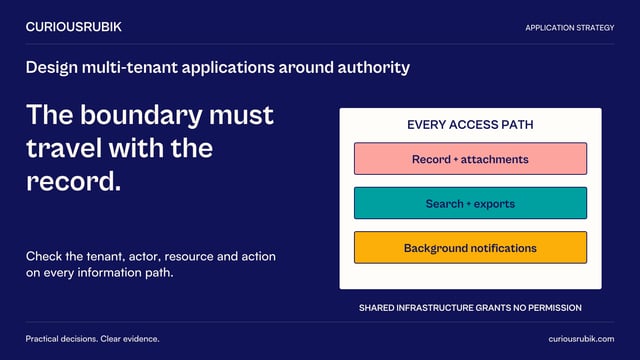
A portal account establishes an identity, but it does not automatically establish access to every record associated with a company name. Define the authorized relationship among the person, organization, location and specific service records.
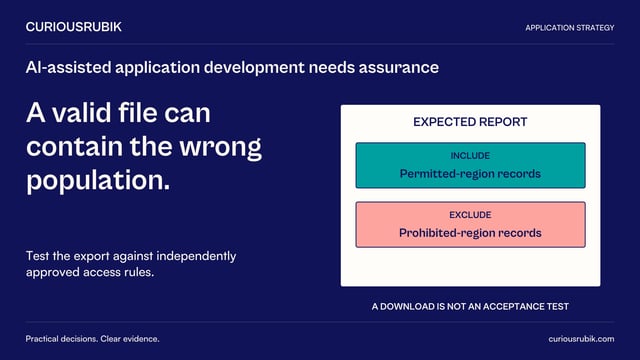
Plan for delegated users, people leaving an organization and customers operating across several accounts. Decide who can invite users and approve changes to their access. Test whether those changes take effect across downloads, search, exports and support-assisted actions.
Keep the visible design understandable without exposing unnecessary information. A person should know which account or context they are using, especially when they legitimately represent more than one organization.
Security and usability need to be designed together. An access model that is technically sound but impossible for customers to administer can create a constant support burden. A convenient model that grants broad access by assumption creates a different and potentially more serious problem.
Establish whether the portal is worth operating
Build a baseline around the selected recurring tasks. Record demand, staff effort, correction work, elapsed time and completion quality where those measures are relevant. Include the people who currently perform the work and those who receive its outputs.
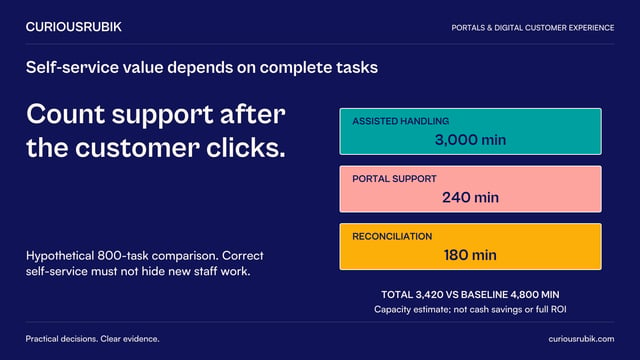
Estimate the full operating cost: identity support, integrations, content and document maintenance, monitoring, accessibility testing, incident response and continuing improvements. A portal can reduce one category of manual work while creating another.
Evaluate the first release with users who represent the intended audience, including those who need assistance or use accessible interaction methods. Observe whether they can complete the task and understand its outcome. A login count or page-view total is evidence of activity, not successful service.
Keep the comparison honest. A change in demand, staffing or underlying process can affect the outcome alongside the portal. Separate measured effects from assumptions and describe any released capacity without automatically claiming a cash saving.
The result may support expansion, redesign or a narrower scope. Choosing not to automate a poorly understood exception can be a sensible decision while the business improves the process behind it.
Start with a service that can become dependable
A practical first release should offer a small set of complete, useful tasks with clear owners, trusted information and a support route. Test the operational connection and the exception path as carefully as the interface.
Then expand according to demonstrated need and the organization’s ability to maintain the service. Adding another feature also adds permissions, states, dependencies and support obligations. Those should be visible in the decision.
Self-service portals become important infrastructure when they let people act confidently without losing the organization’s accountability. Their strategic value lies in making recurring business interactions dependable, understandable and connected to work that actually gets done.