A workflow can require human approval and still provide little meaningful oversight. The reviewer may see only a polished recommendation, lack the source evidence, face an unmanageable queue, or have no practical way to change the proposed action.
In that design, the person becomes the place where responsibility is recorded rather than where judgment improves the result. Calling the process human-in-the-loop does not resolve the problem.
Effective human participation must be designed as work. Specify the judgment the person contributes, the information and authority they need, the time available, and the conditions that require escalation. For an automation sponsor, the central question is whether the combined human-and-system process makes better decisions than either component would make under the actual operating conditions.
Identify the human contribution precisely
“Review the output” is too vague. The person might verify a fact, resolve ambiguity, apply policy, weigh competing objectives, or authorize an external commitment. Each contribution needs a different interface and skill set.
A clerk checking an extracted invoice number needs access to the source document and a clear comparison. A commercial manager deciding whether to accept an exception needs context, options, and authority. A technical expert assessing an unusual case may need to inspect evidence the automation did not consider.
Decide what the system will prepare and what the person must determine independently. Do not give reviewers responsibility for errors they have no reasonable means to detect.
Also specify what the reviewer is not expected to do. A person cannot validate a complex model’s entire statistical behavior while processing one case. Model evaluation, operational monitoring, and individual case review are complementary responsibilities.
Design the handover from machine to person
The handover should explain why review is required, what the system has already done, what remains uncertain, and what action is proposed. Include the relevant source evidence and the possible consequences of accepting or changing the result.
Preserve the current state while review occurs. If the automation continues making changes in parallel, the reviewer may approve a situation that no longer exists. Use clear versioning and rules for invalidating approval when material evidence changes.
NASA’s work on human-centered aviation automation emphasizes communication, coordination, and feedback between people and automated systems. Aviation differs substantially from office workflows, but the underlying design concern is relevant: a responsible operator must understand what the automation is doing and be able to respond effectively. NASA, Human-Centered Aviation Automation, 1996.
A brief generic warning does not provide that understanding. The interface should expose the uncertainty that matters for the decision, not merely announce that an AI system was involved.
Use a review-work contract
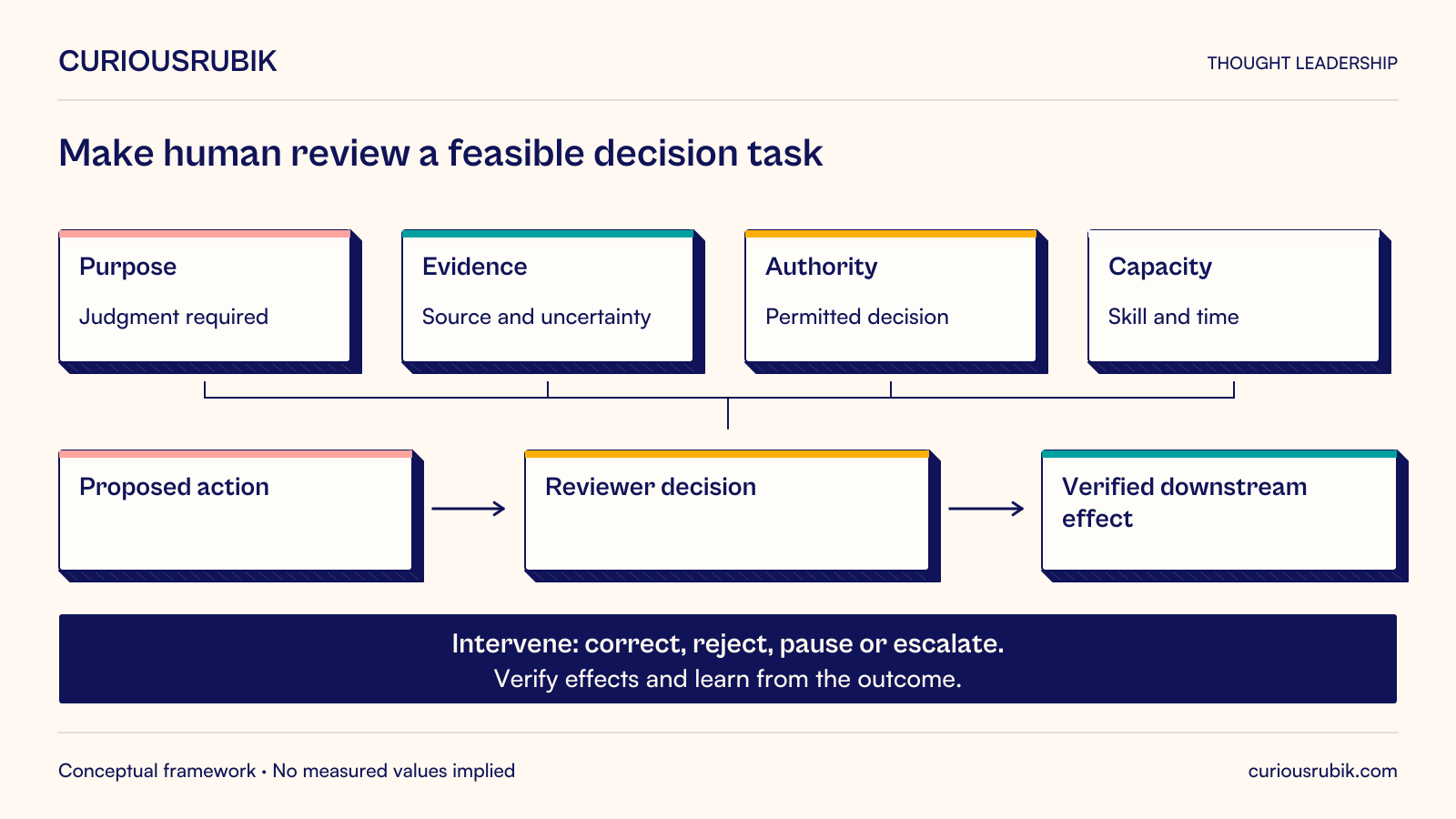
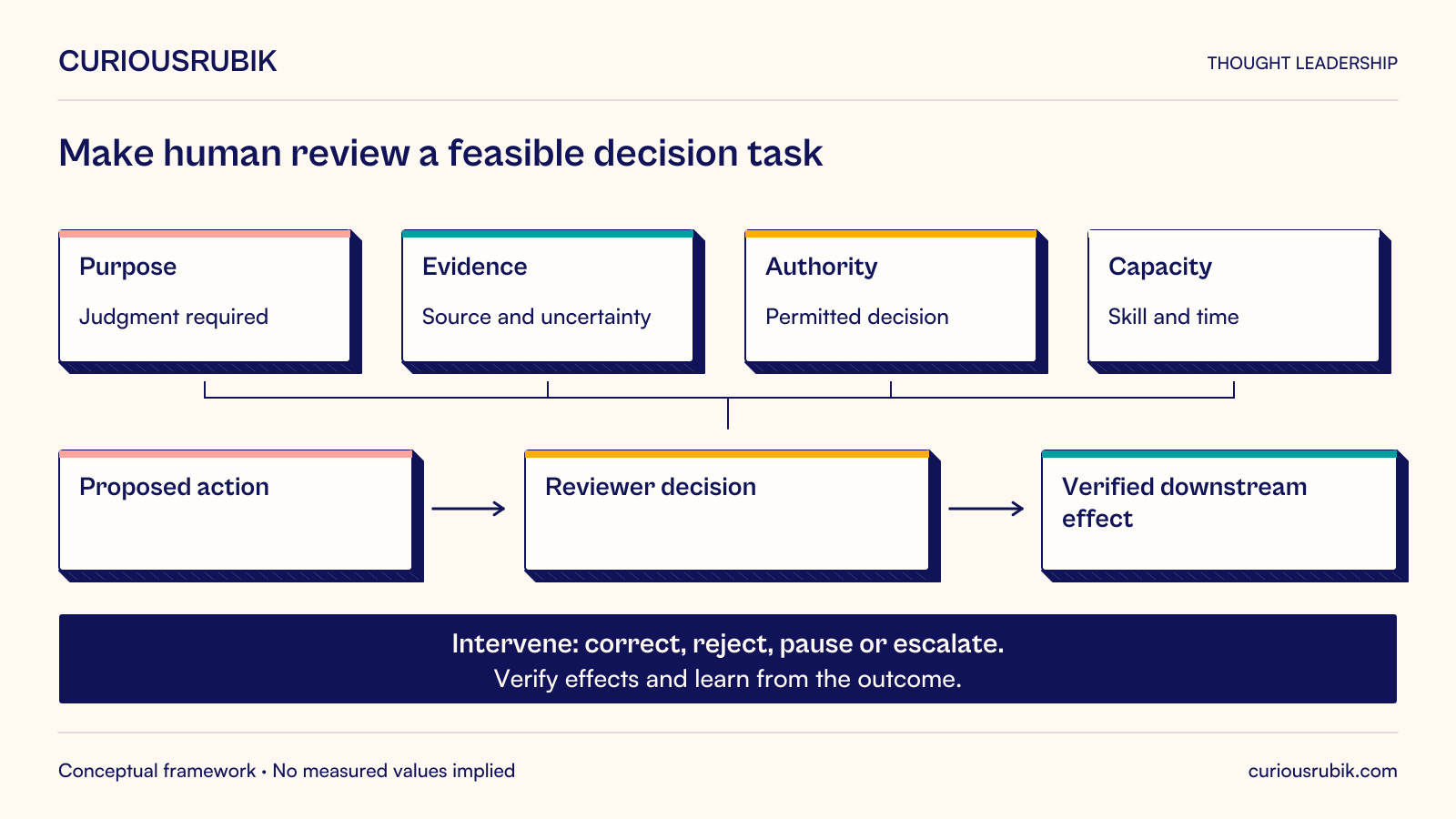
A practical working heuristic defines six elements: purpose, evidence, authority, capacity, intervention, and feedback. This is a proposed design aid, not a human-factors standard.
Purpose states the judgment the person must contribute. Evidence specifies what they need to inspect. Authority defines which changes they may approve or make.
Capacity includes review time, skills, workload, and cover. Intervention provides a usable way to correct, reject, pause, or escalate. Feedback records what the decision teaches the process owner without treating every override as proof that the person or the system was wrong.
If one element is missing, human review can become superficial. Evidence without time encourages scanning. Time without authority creates a queue of questions. Authority without a workable intervention mechanism encourages changes outside the controlled process.
A freight-document team redesigns exception review
Consider a hypothetical logistics company using automation to extract shipment references, quantities, locations, and service instructions from customer documents. Uncertain extractions are sent to a review team before they update the operational record.
The original interface shows the suggested value and a confidence score. Reviewers can accept it or open the entire document in another window. Under time pressure, many cases are accepted quickly. The process records a human approval but provides little evidence that the source was checked.
The redesign identifies the actual review task: establish the correct operational value from the document and resolve any inconsistency with the existing shipment. It shows the relevant source region beside the proposed value, the current record, and the reason for referral. A mismatch in customer identity receives different handling from a difficult-to-read quantity.
Where a value could materially change the shipment, the reviewer must inspect the supporting evidence and use the authorized correction path. Ambiguous instructions go to a role able to clarify them with the appropriate party. The system does not invite a reviewer to guess merely to clear the queue.
The company tests documents with similar references, conflicting amendments, missing units, and instructions embedded in free text. It also includes cases where the suggested value looks plausible but is wrong. Evaluation measures incorrect acceptance, unnecessary correction, escalation quality, and total review effort.
The pilot may find that some document types are unsuitable for the proposed review speed or require specialist knowledge. The business can narrow automation scope rather than treating every referral as equivalent. This hypothetical example describes a design and evaluation method, not a measured error-reduction claim.
Make explanations inspectable
A generated explanation can sound convincing without accurately representing the basis of a recommendation. Reviewers need evidence they can check, not merely a more fluent argument for accepting the output.
NIST’s explainable-AI principles distinguish meaningful explanation, explanation accuracy, and knowledge limits alongside the provision of an explanation. For operational review, this supports showing what the system knows, what supports the result, and where its competence ends. NISTIR 8312, Four Principles of Explainable Artificial Intelligence.
In the freight example, a highlighted document region is useful only if it actually supports the extracted value. A correct source link attached to an unsupported interpretation does not solve the problem.
Use uncertainty information carefully. A numerical confidence score may be misunderstood as the probability that the whole business action is correct. Explain what the score represents and validate whether users interpret it appropriately. Do not use an arbitrary threshold as a substitute for evaluating the consequence of error.
Avoid making agreement the easiest behavior by default
An interface can unintentionally encourage acceptance. The proposed answer may be prominent, while source evidence and rejection controls are difficult to reach. Review speed targets can reinforce that pattern.
For consequential judgments, consider whether the reviewer should inspect key evidence before seeing the recommendation or make an initial assessment independently. This can be tested rather than imposed universally; extra steps may be unnecessary for simple low-risk verification.
Make correction proportionate and easy. If rejecting a suggestion requires a long form while acceptance requires one click, the workflow biases behavior through effort. Capture the reason needed for learning without turning disagreement into a penalty.
Review a sample of accepted cases as well as overrides. A low override rate may indicate strong automation, weak review, or an intimidating process. The rate alone cannot distinguish them.
Treat review capacity as part of the safety mechanism
A review requirement is only credible if qualified people can perform it within the available time. Estimate workload using observed case complexity and variation, not only an average handling time from a demonstration.
Separate routine verification from specialist interpretation. If all cases share one queue, easy work can consume expert attention while difficult cases age. Routing should reflect the skills and authority needed.
Plan for bursts. A changed document format or source-system problem can suddenly increase referrals. Define what happens when the queue exceeds responsible capacity: pause affected automation, narrow eligible cases, add qualified cover, or change service expectations through the authorized process.
Do not solve overload by silently bypassing review. A system that depends on a person approving every exceptional case must have a controlled response when that person is unavailable.
Preserve the ability to intervene
Reviewers need more than accept and reject. Depending on the task, they may need to edit a value, request information, choose another option, defer a decision, or stop further action.
Ensure the intervention reaches the system that will act. A correction in a review screen is insufficient if a downstream message already contains the old value. Use clear state transitions and prevent material actions from outrunning required approval.
Define reversal limits. Some changes can be corrected easily; an external message, dispatch, or contractual commitment may have consequences that persist after a technical rollback. Place human judgment before the relevant point when the risk requires it.
Log enough to reconstruct the decision: evidence version, proposed action, reviewer decision, material changes, and resulting effect. Avoid collecting irrelevant personal information or creating a log so broad that important facts cannot be found.
Evaluate the combined decision system
Measure the full workflow, including preparation, review, correction, escalation, and recovery. An improvement in machine accuracy may not improve the final decision if the remaining errors become harder for people to detect.
Use representative cases and deliberately challenging examples. Include unfamiliar formats, incomplete evidence, conflicting instructions, and situations outside the system’s approved scope. Protect real customer information in testing.
Compare with the existing process or a simpler alternative. A structured form and clear rules may outperform a sophisticated recommendation system for some tasks. Human-in-the-loop design should not be used to justify technology that adds more verification burden than value.
Evaluate over enough time to observe learning and fatigue. A short pilot with unusually attentive experts may not represent a sustained production queue. Record the support conditions that contributed to the result.
Learn from disagreement without automating it away
An override can reveal missing evidence, a flawed rule, a model limitation, or a reviewer mistake. Investigate patterns with the appropriate specialists.
Do not immediately retrain a model on every accepted correction or convert every common override into a rule. The correction may be context-specific, inconsistent, or outside the reviewer’s authority. Validate the lesson before changing the system.
Maintain human competence where it remains necessary. If staff rarely perform a critical judgment unaided, provide appropriate practice, guidance, and escalation support. The organization should not discover during an outage that nobody can interpret the work without the tool.
A useful human-in-the-loop system gives people a real opportunity to improve the decision and the means to act on their judgment. The presence of a person in the diagram is only the starting point. The design must make their contribution informed, feasible, and consequential.