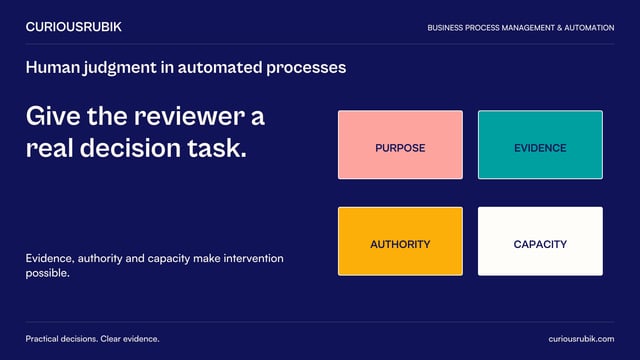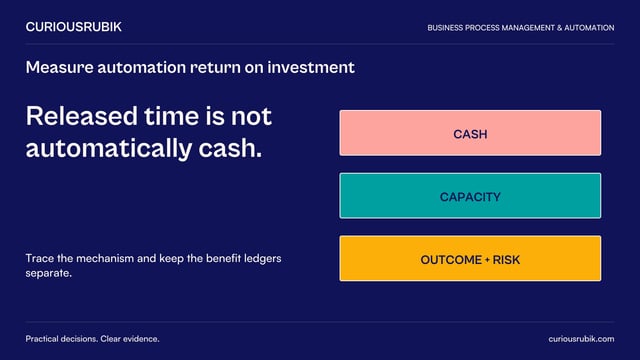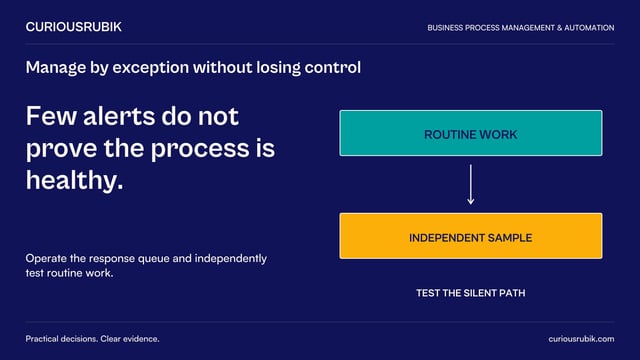
An automation team can fix a failed interface. It cannot decide whether a request should be accepted, which department should absorb additional work, or whether an old approval is still necessary. When those decisions have no owner, technical teams become reluctant interpreters of business policy.
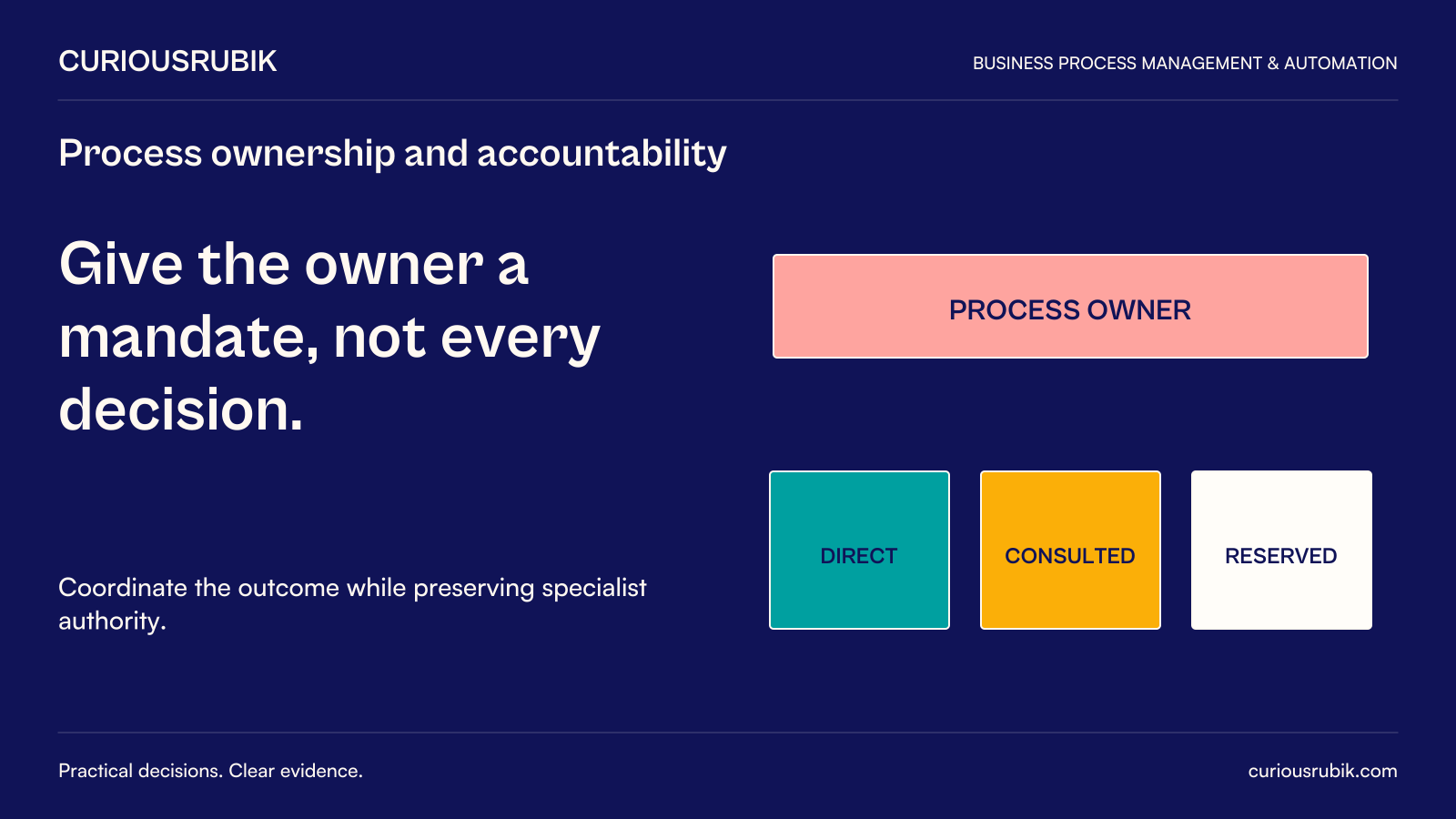
Process ownership supplies the authority and accountability that make automation maintainable. The owner defines the intended outcome, coordinates decisions across functions, and ensures that the process remains useful as conditions change.
The title should not be read as dismissing technology. Reliable tools and engineering are essential. The point is that tools execute and expose decisions; someone in the business must own the decisions that determine whether the process works. For executives, the practical task is to create that role with real rights, capacity, and boundaries rather than adding a name to a responsibility chart.
Own an outcome with a defined boundary
A process owner needs a clear unit of accountability. “Own onboarding” is too broad until the organization specifies whose onboarding, what counts as ready, where the process begins, and which outcomes remain outside scope.
A useful boundary might run from an approved employee-start request to verified first-day readiness for defined roles. That includes coordination across several teams while preserving their specialist responsibilities.
Define the recipient of the outcome and the failure that matters. A completed checklist may not mean the employee can begin useful work. A process can meet every departmental target while leaving an essential dependency unresolved.
ISO’s process-approach guidance links processes to intended results and calls for responsibilities and authorities to be established. The practical implication is to give ownership a business purpose and a workable mandate, rather than treating it as a software-administration role. ISO, The process approach in ISO 9001:2015.
Distinguish process ownership from other roles
The process owner is accountable for the integrity and improvement of the end-to-end design. A system owner is responsible for an application’s operation and lifecycle. A data owner governs the meaning and quality of a defined information domain. A control owner maintains a specific protective mechanism.
One person may hold several roles in a small organization, but the responsibilities remain different. A CRM administrator can configure a routing rule without having authority to change commercial policy. An HR data owner can correct a start date without owning every downstream readiness task.
Department managers retain responsibility for staff, skills, and capacity. The process owner coordinates the shared outcome and makes or escalates cross-boundary decisions under an agreed mandate.
This distinction prevents two failures: expecting the process owner to control everything, and giving the role responsibility without any useful authority. Both make ownership nominal.
Write a decision charter rather than a broad job description
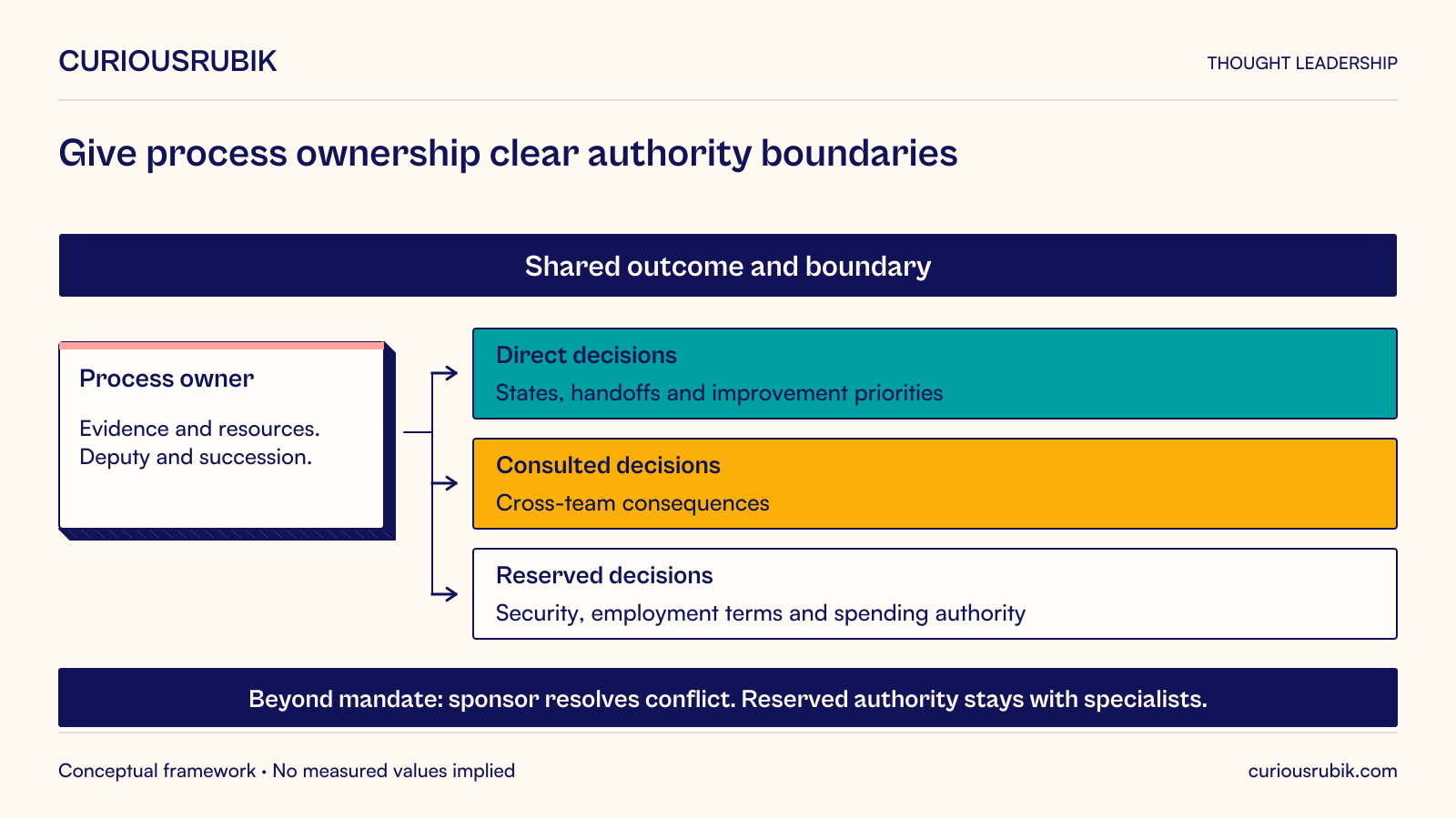
A practical working charter specifies the outcome, boundaries, decision rights, evidence, resources, and escalation route. This is an author-proposed management tool, not a universal governance standard.
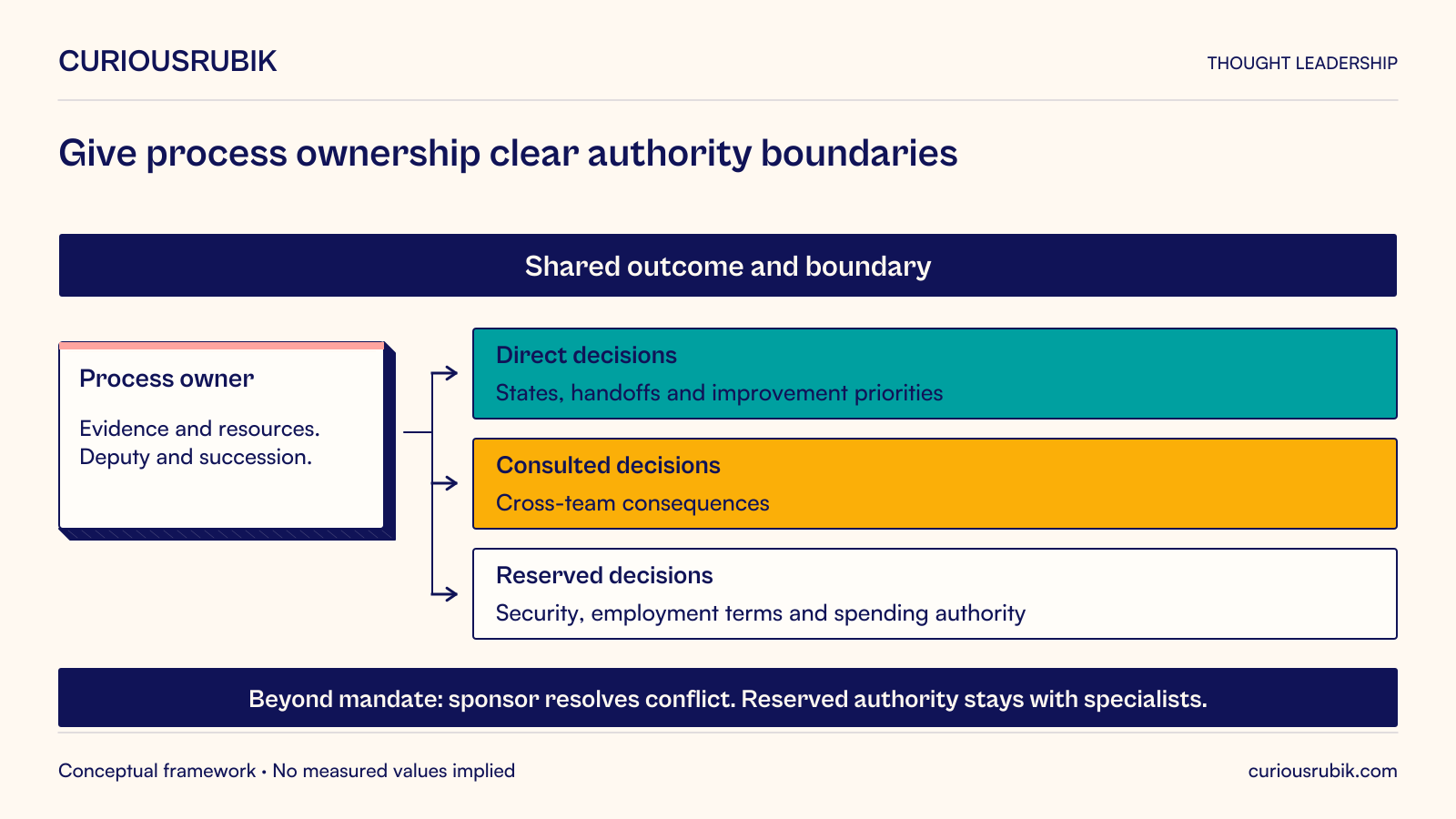
Decision rights should name what the owner may change directly, what requires consultation, and what belongs to another authority. The owner might standardize handoff definitions or prioritize process improvements while needing approval for spending, staffing, security policy, or contractual changes.
Evidence defines how the owner will know the process is working. Include end-to-end outcomes, exception patterns, and information about work displaced between teams. Avoid measuring the owner solely on local speed or automation percentage.
Resources include time, analytical support, and access to the relevant operational information. A process owner who has no capacity to investigate problems cannot maintain the design through meetings alone.
The escalation route must lead to someone who can resolve conflicting priorities. “Raise it to the steering committee” is insufficient if that committee has no authority over the affected departments.
A growing consultancy makes employee readiness a shared outcome
Consider a hypothetical consulting business whose new employees depend on HR, IT, facilities, payroll, and a hiring manager. Each team receives a task from an onboarding workflow. The dashboard marks onboarding complete when all tasks are closed.
A review finds that “equipment prepared” does not establish that the employee can access the required applications. Hiring managers sometimes change the start date by email, while the workflow retains the original date. IT closes requests when access is provisioned, but nobody confirms that the access matches the approved role.
The company appoints a process owner for first-day readiness. The owner does not gain authority to bypass security approval or determine employment terms. Those decisions remain with the appropriate specialist owners.
The charter gives the process owner authority to define shared readiness states, require an authoritative start-date update, convene resolution of blocked cases, and prioritize improvements within an approved budget. A sponsor resolves disagreements involving staffing or policy beyond that mandate.
The workflow separates prepared, provisioned, verified, and blocked states where those distinctions affect readiness. A changed start date triggers a review of dependent commitments. The hiring manager confirms the required work context, while security and application owners approve access through their established processes.
The pilot includes a remote employee, a role requiring restricted access, a changed start date, and a delayed device delivery. It measures readiness at the agreed boundary, unresolved blockers, late changes, and effort spent coordinating outside the workflow.
The example does not claim a productivity result. It shows how a process owner can improve coordination without taking over specialist authority or mistaking task closure for a usable outcome.
Give the owner a way to resolve tradeoffs
Cross-functional processes create competing objectives. One team may prefer complete information before starting; another may need early preparation to meet a deadline. A local efficiency target can increase work elsewhere.
The process owner should make the tradeoff explicit: what outcome improves, what cost or risk changes, which team is affected, and what evidence supports the choice. Decisions outside the charter move to the sponsor with clear options.
The 2014 US federal Green Book describes organizational structure, assigned responsibility, and delegated authority as elements of internal control. It is a historical public-sector reference here, not a statement of current private-sector compliance requirements. Its relevance is that accountability needs an explicit authority structure. GAO, 2014 Standards for Internal Control.
Record material decisions and their rationale. When a future manager asks why a rule exists, the answer should not depend on finding the person who attended the original workshop.
Maintain a business backlog after go-live
Automation creates a continuing stream of requests: add a field, change a threshold, introduce an exception, connect another system, or alter a notification. Without business ownership, these changes accumulate according to who asks most persistently.
The process owner should assess each request against the intended outcome and its cross-process consequences. A change that saves one team’s time may weaken evidence or add work downstream.
Separate urgent repair from improvement. A failed workflow needs rapid restoration within established authority. A request to change business policy needs the appropriate decision process even if it arrives through the same support queue.
Keep the backlog small enough to manage. Record the problem, affected cases, evidence, expected benefit, dependencies, and owner. Retire requests whose purpose has disappeared rather than preserving them indefinitely as a sign of responsiveness.
Use exceptions as evidence of design quality
Repeated exceptions tell the owner where the process does not fit reality. Review their causes, resolution effort, and consequences rather than only their count.
Some exceptions should become supported variants. Others reveal poor inputs or avoidable local workarounds. Some must remain exceptional because their risk or commercial context requires judgment.
The owner should coordinate the decision without assuming that frequency alone justifies automation. In the onboarding example, frequent requests for access outside a role template may indicate an outdated template, unclear job design, or inappropriate requests. Those possibilities require different responses.
Include cases that pass normally. A low exception rate can conceal weak detection. Sampling and outcome review help the owner assess whether the routine process still deserves trust.
Design for succession in the ownership role
An owner can become another single point of dependency if decisions, relationships, and undocumented exceptions accumulate around them.
Maintain the charter, process versions, decision records, active risks, measures, and key dependencies in an accessible controlled location. Name a deputy with a defined authority boundary and rehearse important decisions before an absence.
When the owner changes, review the mandate rather than simply replacing the name. Organizational changes may have altered the process boundary or the sponsor’s authority. Make unresolved decisions and temporary exceptions visible to the successor.
Ownership should survive a reorganization or the departure of a strong individual. The goal is an enduring management capability, not a permanent reliance on one effective coordinator.
Keep governance proportional to the business
A small organization may combine process ownership, operations management, and system administration in one role. It still benefits from distinguishing which decisions require business judgment and which are technical maintenance.
A larger organization may need several process owners whose boundaries interact. Define those interfaces carefully. Overlapping ownership can create competing standards; gaps can leave nobody accountable for the transition.
Avoid creating a committee for every process change. Delegate ordinary decisions within clear limits and reserve collective review for material cross-functional tradeoffs. Governance that makes every improvement slow can encourage the workarounds it was intended to prevent.
The process owner should remain close to actual work. Regular case review and direct contact with operators are more informative than relying exclusively on summary dashboards.
What to require from an automation engagement
Ask the supplier to identify which business decisions must be owned before configuration and which responsibilities remain after handover. Require a clear separation between technical support, process policy, data correction, and control decisions.
Include business ownership in readiness criteria. A technically complete workflow with no owner for exceptions or future rule changes is not operationally ready.
Review the proposed support model. If every policy question must return to the implementation partner, the organization has purchased a continuing dependency rather than built a sustainable capability.
Process ownership earns its value through timely decisions, coherent tradeoffs, and continuing improvement. The tool makes the process executable. The owner keeps it worth executing as the business changes.