Restoring this close and preventing the next recurrence are separate pieces of work.
When the same close problem returns, review the series of incidents as one problem. Keep the immediate recovery record, but also ask what conditions allow the issue to recur, which evidence would test the explanation and who owns prevention. Closing each support ticket after a spreadsheet correction can leave the next close exposed to the same failure.
For Singapore regional finance, repeated symptoms may originate in country data or an upstream interface rather than the group report where the difference first appears. A useful problem review follows the records across that boundary. It should distinguish an observed cause from a plausible theory and preserve accounting decisions for the appropriate finance owner.
Reconstruct three recurrences without inventing a cause
The following example is fictional. It describes a deliberately simplified configured process, not a standard NetSuite behavior or a known product defect.
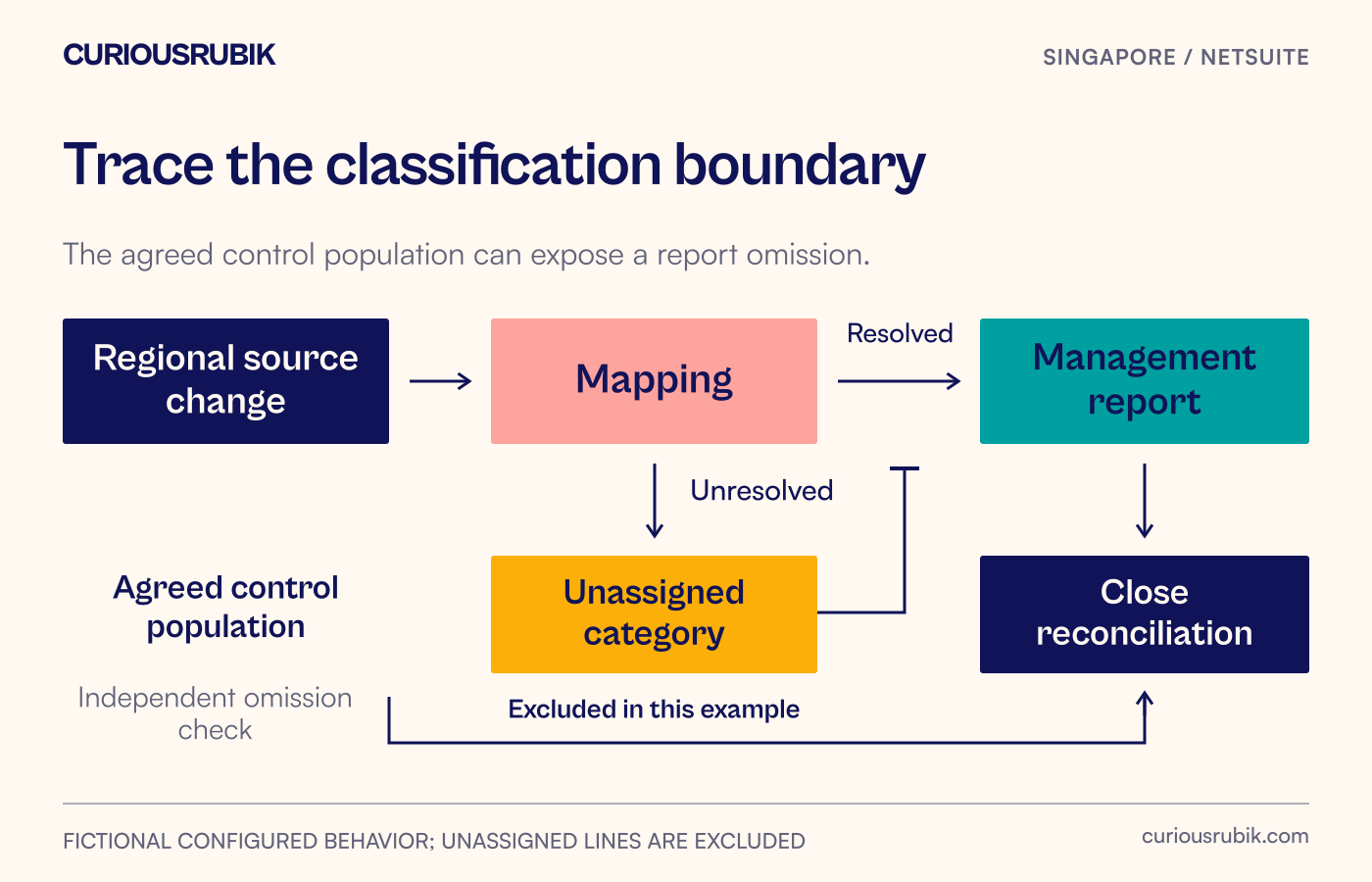
A Singapore headquarters receives expense data from regional operations. An interface maps each source entity and project code to the approved reporting classification. In this fictional design, an unresolved mapping sends the line to an “Unassigned” review category. A management report excludes that category. Finance notices a difference when it reconciles the report to the agreed control population.
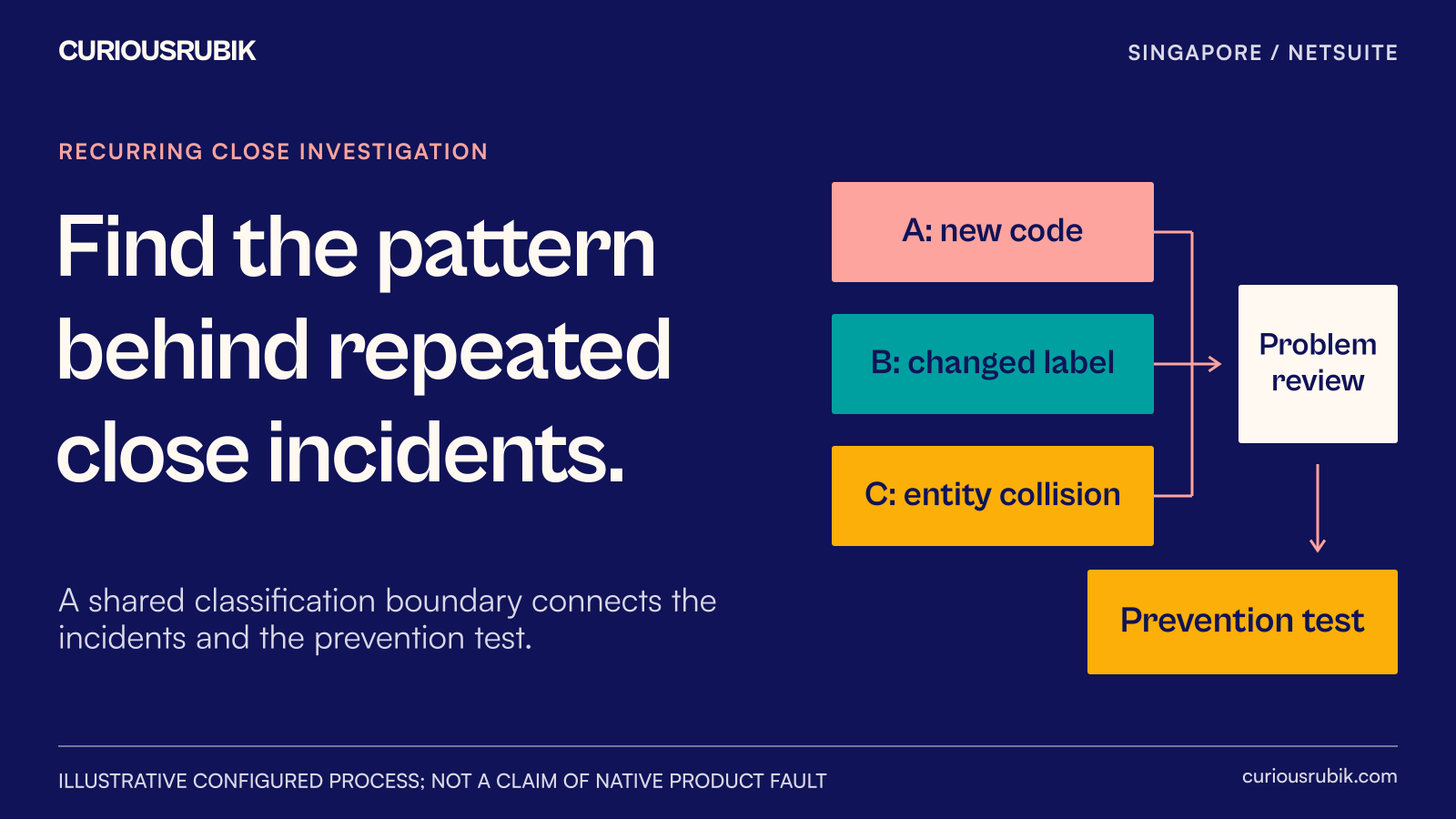
Close A: a country team introduces a new project code. The mapping is missing. Support helps identify the affected lines, and finance authorizes the correction. The immediate report difference is resolved. The ticket records “new project mapping added.”
Close B: a source team changes a project label that the configured mapping unexpectedly relies on. Another group of lines reaches Unassigned. The team repeats a correction, but the earlier ticket is not linked because the visible source label is different.
Close C: a new regional source uses an existing code with a different meaning. Investigation finds that a separate part of the configured lookup does not consistently distinguish the source entity. The close review is delayed while finance identifies the affected population.
The symptoms are similar, but the three immediate triggers differ. Declaring “bad user data” as the root cause would miss the mapping design, change ownership and report visibility questions.
Create a common evidence timeline
For each recurrence, record the source event, the version of the mapping or configuration, the affected record references, the first detection and the recovery action. Include who approved any financial correction. Use the appropriate access controls and avoid copying unnecessary personal or financial detail into widely circulated tickets.
Link the records through their shared process, not only the error wording. In the fictional example, all three incidents involve the route from regional source code to group reporting classification. The source changes differ, but the same operating boundary deserves investigation.
Also record evidence that does not fit the theory. If some new codes were classified correctly, compare how their mappings were created. If a report difference occurred without any Unassigned lines, investigate that separately rather than forcing it into the same explanation.
The timeline should support a causal test. Sequence alone is insufficient: a source change preceding a close issue does not establish that it caused the issue. The team needs a reproducible relationship or another defensible form of evidence.
Write the problem record at three levels
Use a compact record with the following filled entries from the example:
Immediate triggers: a new code, a changed label and an entity-specific code collision. Evidence: source change records and affected line references. Owner: the relevant country data owner.
Configured behavior to investigate: inconsistent lookup keys and an unresolved category excluded from the management view. Evidence: mapping definitions, controlled test results and report criteria. Owner: the application or integration lead, with finance review of the intended meaning.
Operating conditions: no agreed checkpoint for source-code changes, and no named owner reviewing Unassigned before the close. Evidence: the existing change process and responsibility record. Owner: the regional process lead and Singapore controller.
The record should state which entries are confirmed and which remain hypotheses. It may be necessary to investigate several contributing conditions rather than select one convenient “root cause.” A technical change alone may not prevent recurrence if new source codes can still arrive without an owner.
Design a prevention test before proposing the fix
The fictional team proposes an entity-aware stable-code mapping, explicit handling of unresolved codes and a finance-owned exception review. These are design proposals requiring approval and account-specific implementation. They are not described as built-in NetSuite settings that every account can enable.
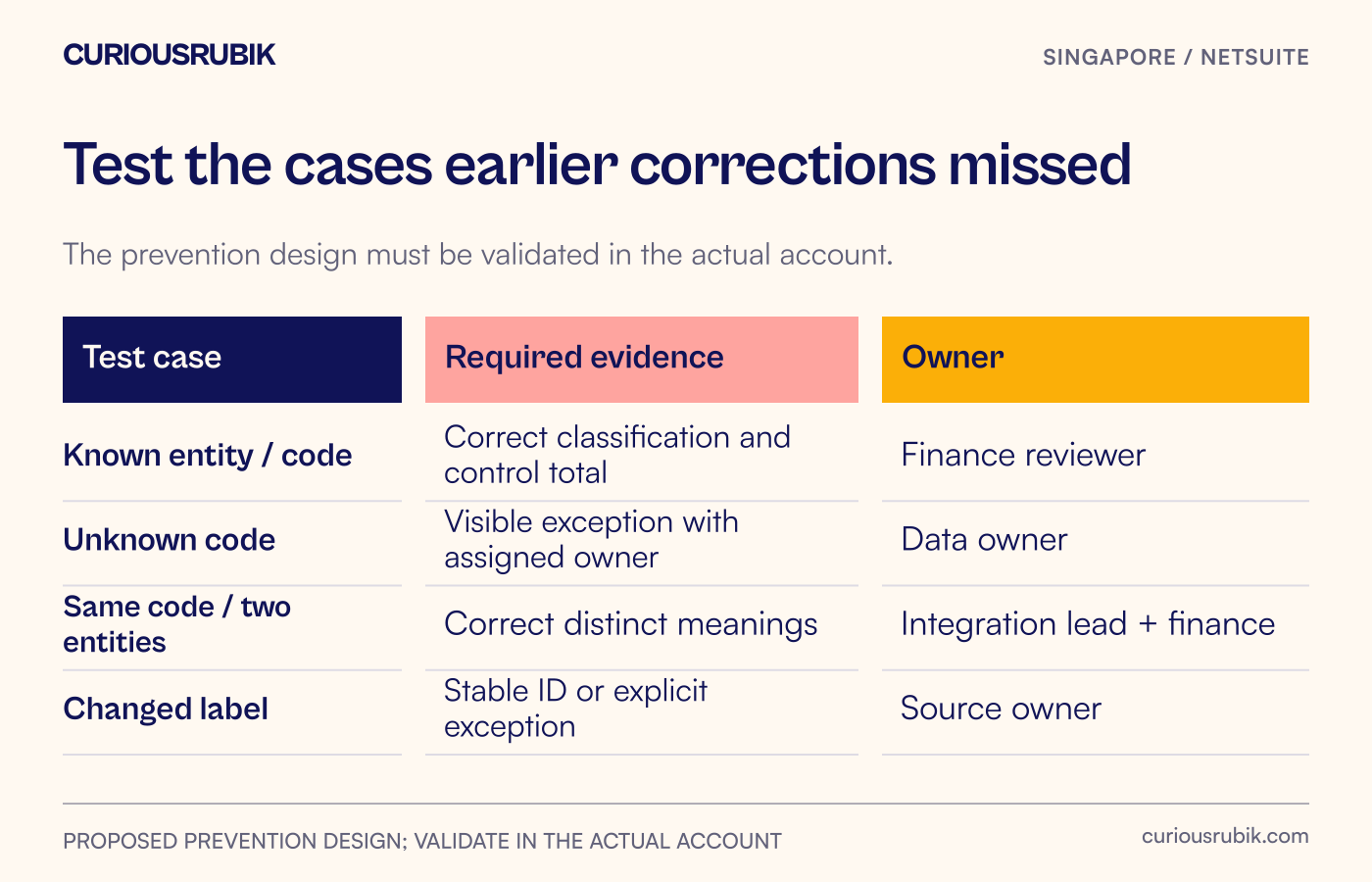
The prevention test contains four cases:
- A known entity and code produce the approved classification and appear in the expected control totals.
- An unknown code becomes a visible exception with a named owner. It must not disappear from the review population.
- The same code in two entities follows each approved meaning without cross-classification.
- A changed display label leaves a stable identifier's meaning intact under the approved design, or creates an explicit review exception if the source cannot supply a stable identifier.
For each case, define the expected result before execution. Verify both the individual line and the reconciliation population. Compare totals within the same agreed currency and reporting basis; a mixed-currency sum would not provide useful evidence.
Oracle documents sandbox testing, subject to feature limitations. Confirm safe test data and external endpoints before exercising the interface. Do not replay a production event simply because a test is urgent. The approved recovery method must consider whether a transaction may already have been processed.
Decide what can close and what must remain open
The incident can be recorded as restored once the agreed process works and the owner accepts the recovery evidence. The underlying problem remains open until its approved prevention work and validation conditions are met. Keep those statuses linked so a closed ticket does not imply that recurrence risk has disappeared.
In the example, finance approves a corrected close population while the mapping change proceeds through its separate review. The problem record names the owner of that change, the prevention tests and the next operating evidence to inspect. It also records the temporary exception-review responsibility until the permanent change is accepted.
Choose a follow-through period based on the mechanism being tested. A clean close with no new project codes provides limited evidence about handling new codes. The next relevant source change and the next close may be more informative than an arbitrary number of quiet days.
Agree who reviews that evidence and what would reopen the investigation. If the same symptom returns, compare it with the earlier causal model instead of assuming the previous fix was wrong or that every recurrence has the same cause.
Bring linked incidents and their actual recovery evidence to a NetSuite support review. For Singapore regional finance, the useful result is a prevention decision that reaches back to the source process, with a test that can demonstrate whether the proposed change addresses the recurring failure.