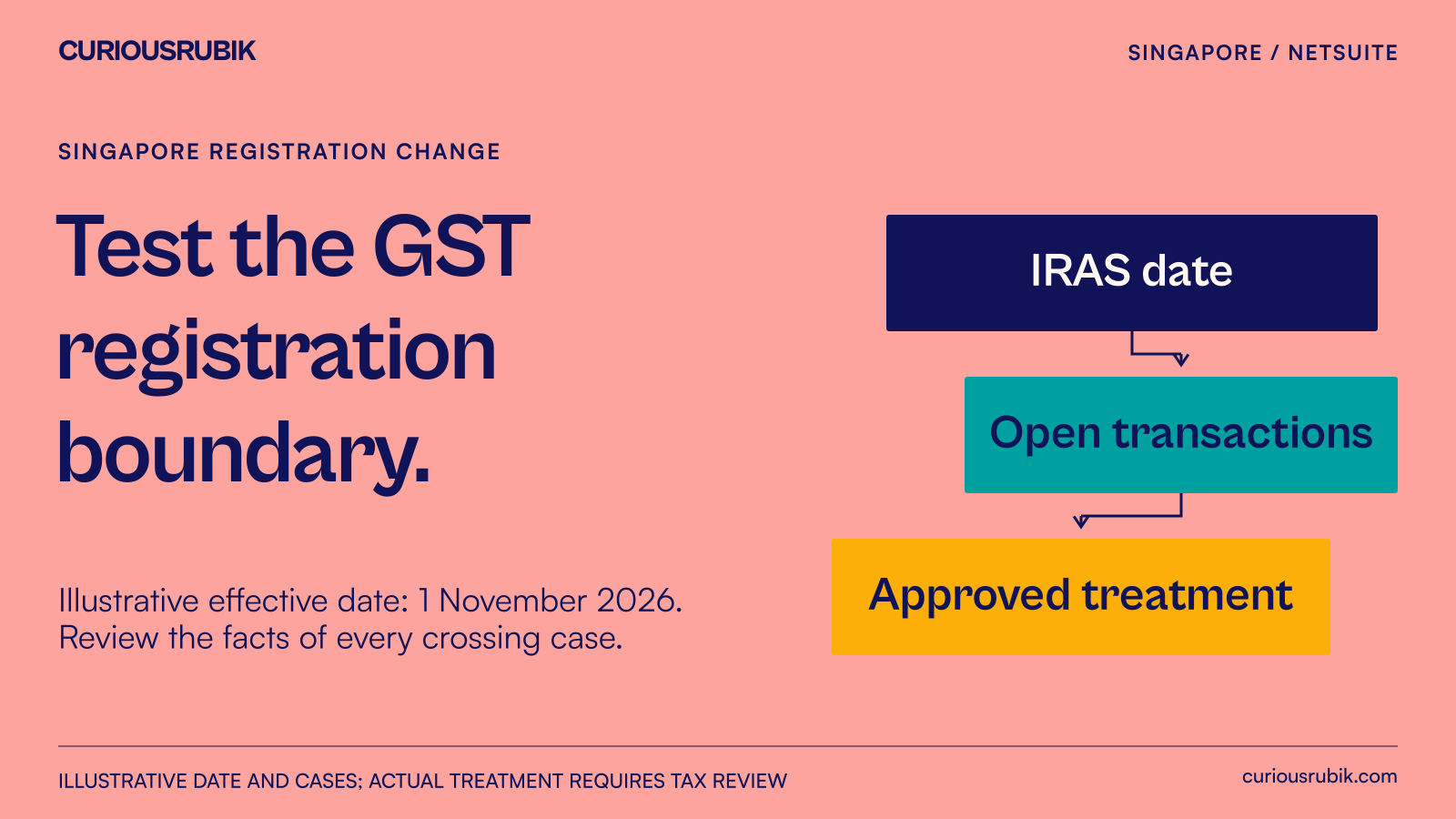
The registration notification anchors the test; transaction facts determine what else must be reviewed.
Use the effective date in the entity's IRAS registration notification as the starting evidence for a GST status change. Then test how open transactions cross that boundary in NetSuite. An application date, an implementation date and a customer's order date can all differ from the date on which registration takes effect.
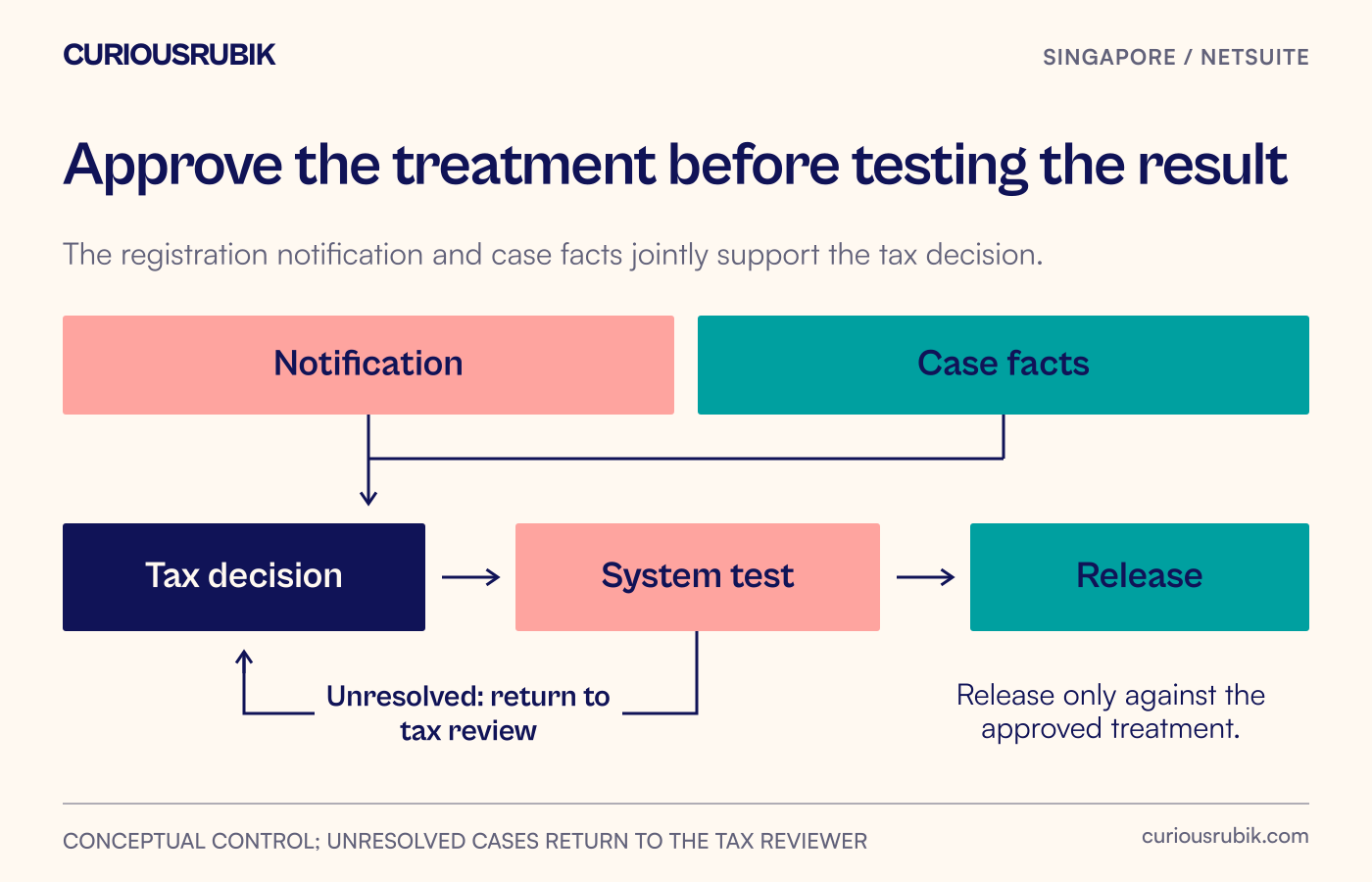
The finance team should supply the expected treatment for each scenario before the administrator changes configuration. Testing against those approved decisions prevents a technically consistent date rule from being mistaken for a complete tax assessment.
Start with an approved date and a transaction population
IRAS's registration guidance says the successful-registration notification provides the GST registration number and effective date. Charging GST must follow that effective date. For compulsory late registration, the notified date can be backdated, which makes existing transactions particularly important to the review.
Do not apply a blanket change to every open order. Build a population showing the order date, invoice-issue date, payment receipt, service or delivery evidence, credit references and legal entity. A sales order alone normally does not settle the GST time-of-supply question. IRAS's general rule for most transactions uses the earlier of invoice issuance and payment receipt, with special cases requiring separate attention.
This population should cover more than sales records created after the change. Include saved drafts, deposits, partially billed orders, transactions arriving through integrations and corrections to earlier invoices. A transition can fail because an older transaction is completed under an obsolete default rather than because a new invoice is calculated incorrectly.
An illustrative boundary pack
Assume a fictional Singapore entity has an IRAS notification with an effective registration date of 1 November 2026. This date and every transaction below are invented. The example specifies test ownership and evidence, not tax advice for a real registration.
The tax reviewer creates five case records before configuration testing:
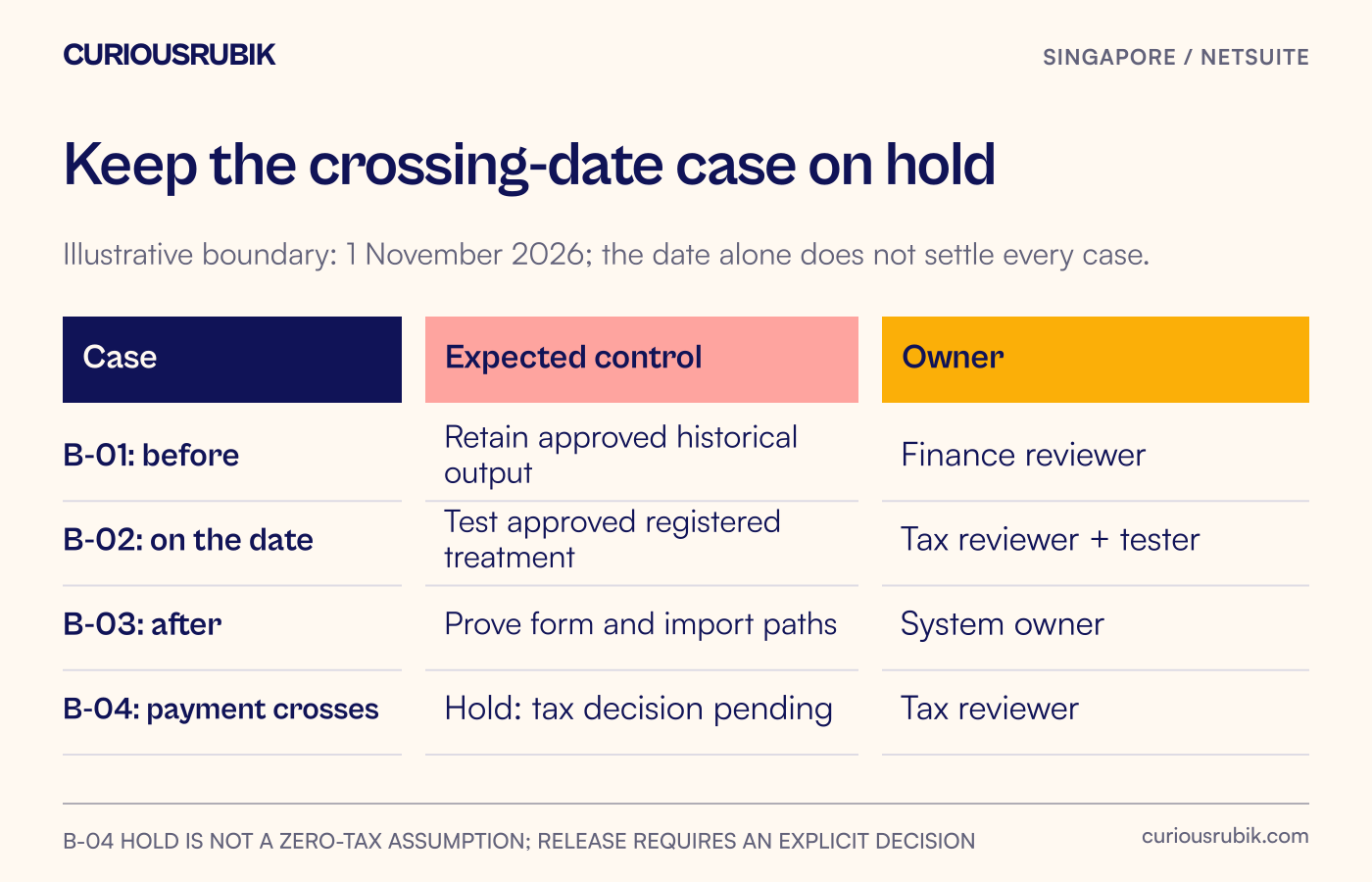
- B-01, wholly before the boundary: order, issued invoice and payment all dated 30 October. The reviewer marks this as a pre-registration case under the scenario's stated facts. Expected system check: the historical document remains unchanged after the status update, and no GST registration number is retrospectively printed by an uncontrolled template change.
- B-02, exactly on the boundary: a new invoice issued on 1 November for an ordinary domestic supply, with no earlier invoice or payment. The reviewer approves the registered-entity treatment. Expected check: the relevant tax determination, registration details and invoice output match that signed expectation.
- B-03, after the boundary: a new order and invoice on 2 November. Expected check: the approved registered-entity treatment applies through both the normal user form and the operational import route.
- B-04, crossing payment and invoice dates: a payment received on 31 October relates to an invoice issued on 2 November. Expected check: the case is held for the reviewer's explicit decision until the nature and treatment of the payment are resolved. An invoice date alone cannot be the test oracle.
- B-05, later correction: a credit requested on 3 November relates to the B-01 invoice. Expected check: the original invoice link and adviser-approved correction treatment survive, without the current customer default silently deciding the answer.
The pack is filled enough to run: each case has a reference, dates, a business situation and an expected control outcome. B-04 deliberately remains a tax-decision hold. A valid acceptance process needs an honest unresolved case as well as successful ones.
Make the tax decision readable to the tester
A direction such as “apply GST correctly” is too vague. For each case, finance should record the expected tax classification, relevant dates, document requirements, reporting period and any correction procedure. Include the facts and assumptions on which the decision relies.
The tester records the actual outcome without rewriting the expectation to match it. Where a result differs, classify whether the cause is incomplete business evidence, a mistaken configuration, stale master data, an integration mapping or a misunderstood expected treatment. Each cause belongs to a different owner.
For B-04, the next action is to obtain the payment agreement and ask the tax reviewer to determine its treatment. It is not to choose the tax code that makes the sample pass. Once the reviewer signs the completed expectation, rerun the transaction from a controlled starting state and record the new evidence.
Inspect the installed tax route
Oracle's Singapore Localization documentation describes prerequisites including SuiteTax and Tax Reporting Framework. That specific SuiteApp should not be conflated with every legacy or custom Singapore tax configuration. Identify the actual account's tax engine, installed SuiteApps, entity setup, effective-dated settings and invoice forms before proposing the change.
The product can support a configured treatment, but enabling a localization does not establish the correct registration date or determine a difficult transaction's tax result. If scripts or external billing systems create the transactions, include their date and tax-field mappings in the test scope.
Capture the old settings and the authorized new settings. Specify who may deploy the change and who may release held transactions afterward. A configuration change approved by IT alone is insufficient evidence for a tax-policy decision.
Prove what happens to the documents
Inspect the generated invoice and credit outputs, not just a transaction subtotal. Check registration details, document dates, tax labels and the references linking a correction to the original transaction. Regenerate a sample historical document to see whether a changed template unexpectedly changes its representation.
Then inspect the reporting effect through the actual configured route. The purpose is to trace each tested transaction to the report population expected by the reviewer, including deliberately excluded or held cases. Do not “fix” a report difference by changing dates until the tax owner explains the correct treatment.
An open deposit or a previously issued invoice may require a distinct correction process. Preserve the original evidence and the approved sequence rather than rebuilding every transaction as if it had originated after registration.
Release the transition with a short exception list
Before release, require the notification, transaction population, signed expectations, before-and-after configuration evidence and tested document outputs. Record which cases passed, which need further tax advice and which cannot be exercised in the available environment.
Assign daily ownership of the transition exceptions until the affected open transactions are resolved. This is a focused operational check for the change, not a substitute for the entity's continuing tax controls. Reconcile the first affected reporting population to the approved cases and investigate transactions that escaped the boundary test.
For continuing reporting controls, the existing Singapore GST reconciliation guide explains how to preserve source populations and signed adjustments. The status transition needs this additional effective-date test pack so finance can see exactly which historic and open transactions were considered.