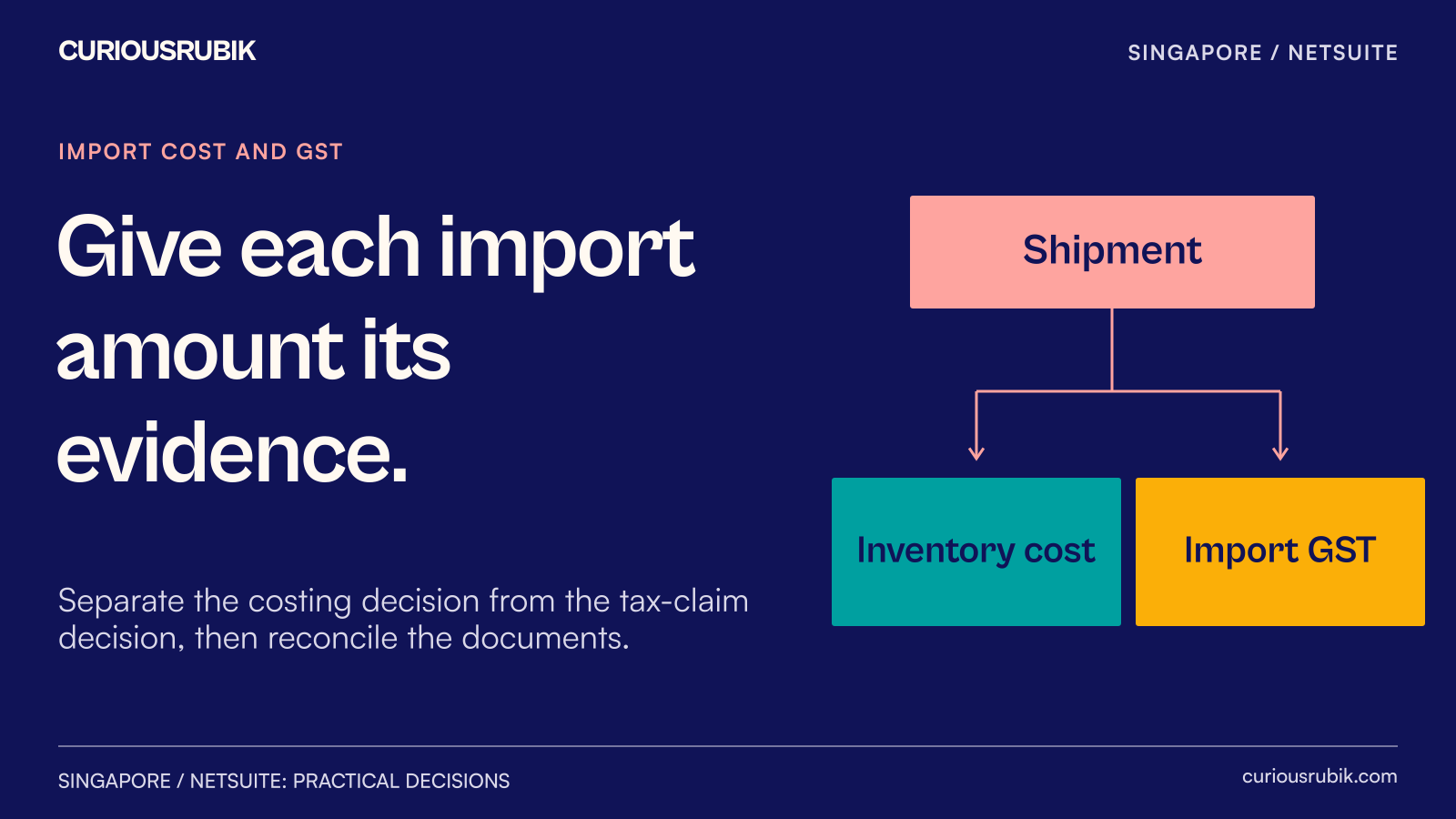
Separate the costing decision from the tax-claim decision, then reconcile their shared documents.
Treat a shipment's inventory cost and its import GST as two linked calculations with different evidence. The costing calculation explains what the business includes in inventory. The GST calculation explains the permit amount and the input tax the qualified reviewer permits the business to claim. One total cannot safely stand in for both.
For a Singapore importer using NetSuite, the useful control is a shipment-level bridge connecting the supplier invoice, freight charges, receiving records, import permit and approved accounting decisions. It should make a difference visible before someone adds every import-related charge to a landed-cost category.
Build the bridge around a shipment reference
Choose a reference that links the commercial shipment to its receipts and supporting documents. If one shipment has multiple permits or partial receipts, retain those relationships rather than forcing a single document number into the control sheet.
For every charge, record the supplier, currency, amount, document date, allocation decision and supporting record. Add two separate decisions: whether the charge belongs in inventory cost under the approved accounting policy, and whether an associated GST amount is claimable under the relevant conditions.
The first is an accounting assessment. The second depends on tax eligibility and evidence. A paid charge, an invoice attachment or a successful NetSuite allocation does not establish both decisions.
Keep document completeness visible. A shipment may be physically received while the final freight invoice or permit evidence is still being reconciled. The control should show an estimate as an estimate and identify the event that will replace it.
A worked shipment with different evidence totals
This is an original fictional example. Its amounts, exchange rate, approvals and allocation choices illustrate a reconciliation only; they are not market rates or prescribed accounting treatments.
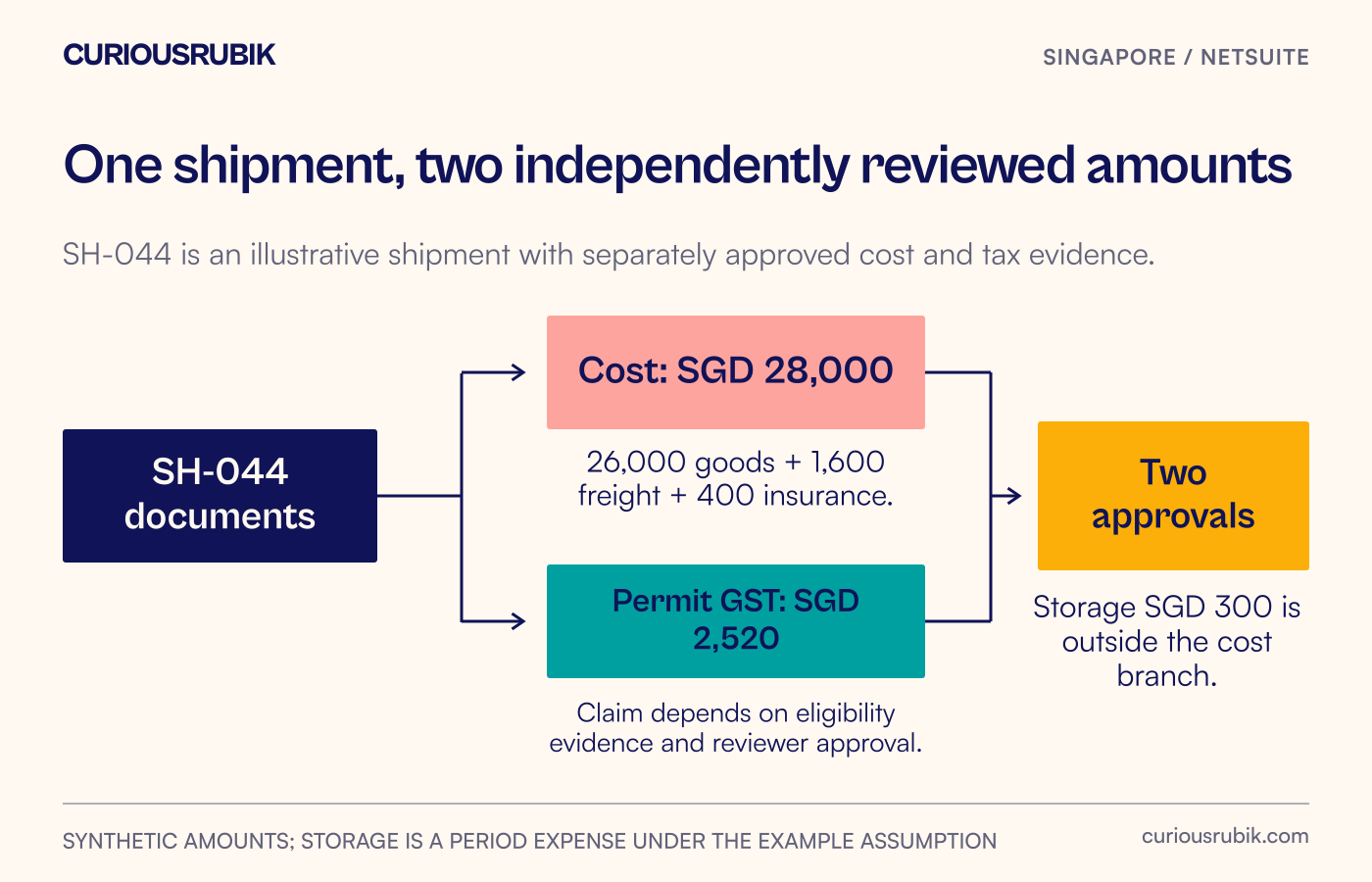
Shipment SH-044 contains 100 identical units. The goods invoice is USD 20,000. Under the hypothetical approved book rate of SGD 1.30 per USD, its book cost is SGD 26,000. Freight of SGD 1,600 and insurance of SGD 400 have been approved for capitalization in this particular example. A separate SGD 300 storage charge is approved as a period expense.
The approved inventory-cost bridge is therefore SGD 26,000 + SGD 1,600 + SGD 400 = SGD 28,000. With 100 identical units and the scenario's approved equal-quantity allocation, that is SGD 280 per unit. The storage charge remains outside this calculation.
Separately, the import permit states SGD 2,520 of GST. The tax reviewer has checked the importer identity, business use and relevant supporting evidence and approved the full SGD 2,520 claim for this fictional shipment. This approval is a scenario assumption, not an inference that all import GST is recoverable.
Suppose the preparer's initial working sheet contains SGD 2,340 of import GST, derived from a different book-based calculation. The tax-evidence difference is SGD 180: SGD 2,520 less SGD 2,340. Finance must investigate and correct the working evidence according to the approved process. It should not bury SGD 180 in freight simply to make a spreadsheet balance.
Read the permit on its own terms
IRAS guidance directs import input-tax claims to the SGD amounts shown on the Singapore Customs import permits, subject to the conditions for claiming input tax. This is why a supplier-invoice conversion cannot automatically replace the permit's tax figure.
Check that the permit belongs to the entity and goods under review. Match the shipment, quantities and supporting invoices, and explain discrepancies. A permit amount copied from another shipment can look numerically reasonable while being unsupported for the current claim.
If eligibility is unresolved, label the claim decision pending and assign it to the tax reviewer. The controller separately determines how any non-recoverable amount is treated in the accounts. Do not universally classify non-recoverable GST as inventory cost or expense without that accounting decision.
Special import schemes and unusual ownership arrangements need their own review. The simple paid-import example above does not establish treatment for every import route used by a Singapore business.
Match the NetSuite allocation to the signed policy
Oracle documents transaction-level landed-cost allocation by weight, quantity or value across eligible items configured to track landed cost. The selected method and source affect the result. The equal-quantity allocation in SH-044 is a business assumption for identical units, not a universal freight rule.
Check the item setup and the actual receipt or bill route. If Advanced Receiving is used, Oracle's transaction-level guidance identifies the receipt as the allocation point. Source selection and tax treatment also depend on the configuration; test the account's actual path rather than copying a generic screen procedure.
Estimated Landed Cost is a separate documented capability in the Supply Chain Management SuiteApp. Its templates and estimates should not be assumed available in every subscription. If the business uses estimates, show how the approved final charge replaces or reconciles the estimate so the two do not become duplicate cost.
The implementer's deliverable is evidence that the configured allocation reproduces the approved cost policy. It does not include independently deciding which charges the accountant should capitalize or which import GST the tax reviewer may claim.
Investigate three failures without forcing a total
First, assume the freight document contains both freight and a separately identified tax amount. Compare the selected landed-cost source with the approved capitalizable amount. Confirm that a source configuration has not pulled in recoverable tax unintentionally.
Second, suppose only 80 of SH-044's 100 units are received in the first transaction. The simple SGD 280 calculation cannot by itself determine how all shipment charges should be allocated between received and outstanding goods. Ask finance for the approved partial-receipt treatment, then test the configured allocation and later reconciliation.
Third, suppose the final insurance bill differs from the estimate. Preserve the estimate, final document and approved adjustment relationship. Do not replace the original evidence with a new total that obscures when the difference was recognized.
Each failure requires a specific decision and a repeatable test. A general “landed cost reconciles” sign-off gives the next reviewer too little information.
Close the shipment with two signed totals
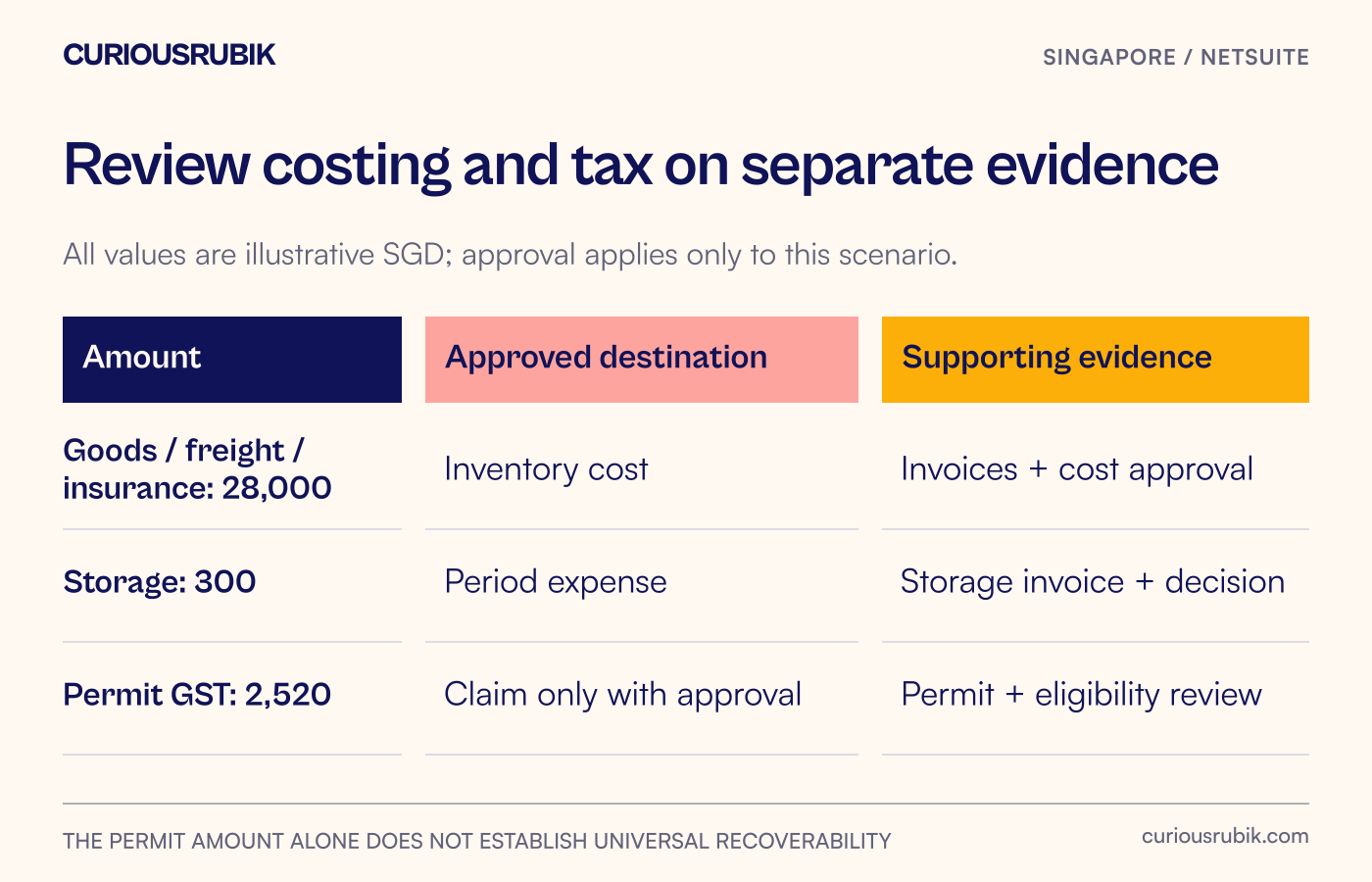
The SH-044 close pack should contain the USD goods invoice and book-rate evidence, the SGD freight and insurance documents, the storage expense decision, receipt quantities, the permit, the tax-eligibility review and the final configured allocation.
The costing reviewer signs SGD 28,000 of inventory cost and SGD 300 of period expense under the illustrative assumptions. The tax reviewer signs the SGD 2,520 permit-based claim and the explanation for the initial SGD 180 variance. Those are related approvals with separate purposes.
Before applying the design to more shipments, test partial receipts, late charges and a claim held for missing evidence. Bring those cases to a NetSuite implementation discussion. A useful design should explain every amount's destination and show who has authority to change it.