Make regional expense authority visible.
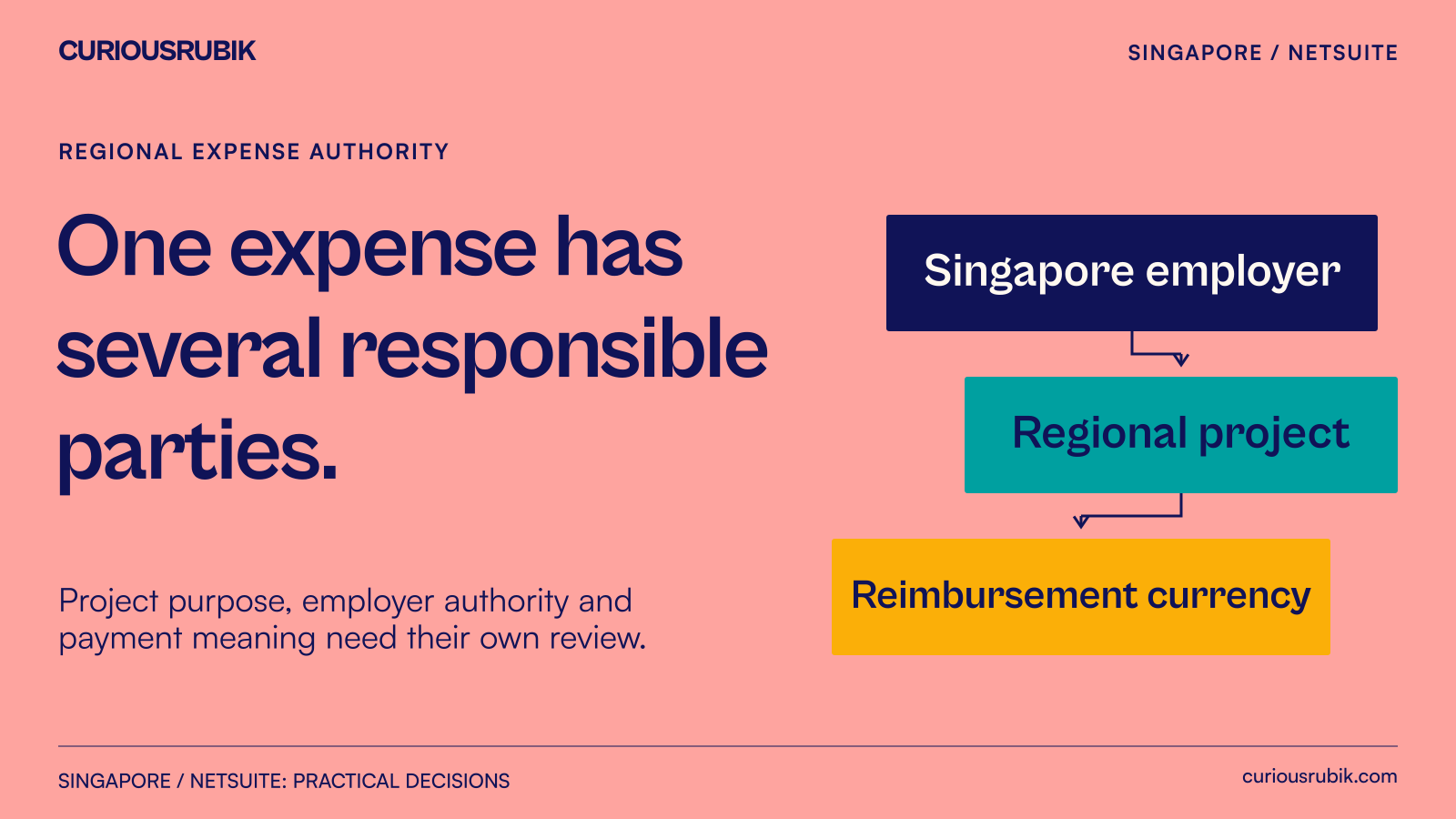
A Singapore shared-services team needs to know more than who approved an expense. It needs to distinguish the employee's employer, the business benefiting from the spend, the person authorised to approve it and the currency in which the employee will be reimbursed. Those relationships can differ on a single claim.
Build the relationship map before designing the employee screen. A mobile submission, custom employee portal and payroll feed can each show an “approved” status while referring to different decisions. A useful expense process makes those meanings explicit and prevents an apparently simple regional claim from being routed by the wrong identity.
Follow one traveller rather than a generic workflow
Consider an illustrative regional employee, Nadia. She is employed by a Singapore entity, works on a project managed by a Malaysian group company and incurs a hotel expense in USD. Her Singapore supervisor confirms that the trip was authorised. The Malaysian project owner confirms that the work belongs to the project. The proposed reimbursement is in SGD under the employer's policy.
All names, facts and amounts in this example are invented. Suppose the receipt is USD 240. That is the original expense amount, not a statement of the eventual SGD payment. Finance must establish the applicable conversion and reimbursement treatment in the configured process.
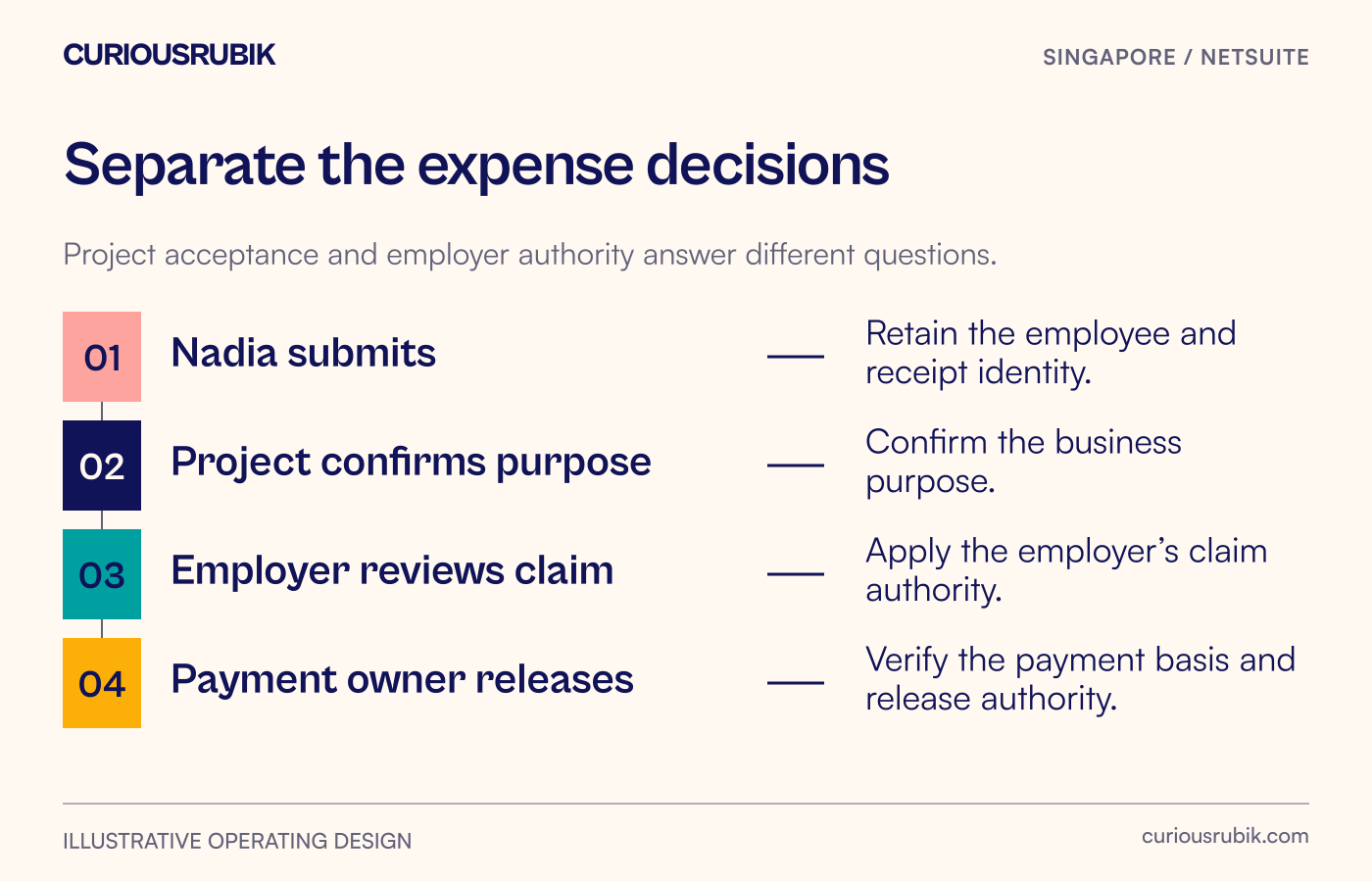
The initial design routes Nadia's claim to the Malaysian project owner and labels the response “approved.” Shared services then treats it as ready for reimbursement. The missing step is the Singapore employer's required authority and accounting review. Project acceptance has been mistaken for authority to release the employee's payment.
Correcting this does not necessarily require another application. It requires separate, testable decisions. The project owner confirms attribution. The employer's designated reviewers confirm the remaining policy and accounting requirements. The payment owner releases the reimbursement through the approved route and records the outcome.
Complete the identity and authority map
For Nadia's example, the filled map has five entries. Use equivalent entries for the actual entities and roles before configuring approval rules.
- Employee identity: Nadia's controlled employee record and employing Singapore entity. The employee-data owner verifies the current relationship. A free-text project name cannot override it.
- Cost attribution: the Malaysian project and its approved cost-bearing relationship. The project owner confirms the business purpose; finance determines any required cross-entity accounting treatment.
- Approval authority: the supervisor, project reviewer and accounting reviewer, with the precise decision each can make. The process owner documents delegation and prohibited self-approval.
- Currency evidence: USD receipt amount, selected reimbursement currency and the rate evidence required by the chosen workflow. The finance owner explains which values are estimates and which support the eventual settlement.
- Payment outcome: approved beneficiary route, release authority and a reference showing what was actually paid. The payment owner resolves a failed or returned reimbursement without creating a second claim.
This map avoids making the employee choose an accounting entity merely to get the expense to the right manager. Where the user interface needs a project choice or another classification, the implementation team should show how it maps to the approved relationship and what happens if that relationship is invalid.
What NetSuite configuration can establish
Oracle's Employee Center expense guidance describes an employee subsidiary context in OneWorld. It also describes foreign-currency expense reporting, where the available reimbursement currencies depend on currencies set up on the employee record. The currency of the receipt, an estimated converted line amount and the reimbursement amount therefore need careful interpretation.
The same guidance identifies feature and preference dependencies for intercompany expenses. Do not assume that choosing a project from another company automatically creates the intended cost recharge. Finance must approve that treatment, and the configured account must demonstrate the supported transaction path.
NetSuite for Mobile supports employee expense capture, including receipt attachments. That capability is useful evidence for a mobile option, but it does not prove Nadia's complete cross-entity approval and payment design. A custom employee portal needs its own mapping and access tests. A payroll system may be a separate payment or employment-record route; its country coverage and integration cannot be inferred from the mobile app.
Have the solution owner identify the entry route, approval mechanism and reimbursement route separately. This prevents an attractive capture screen from concealing missing work downstream.
A denial test reveals the real boundary
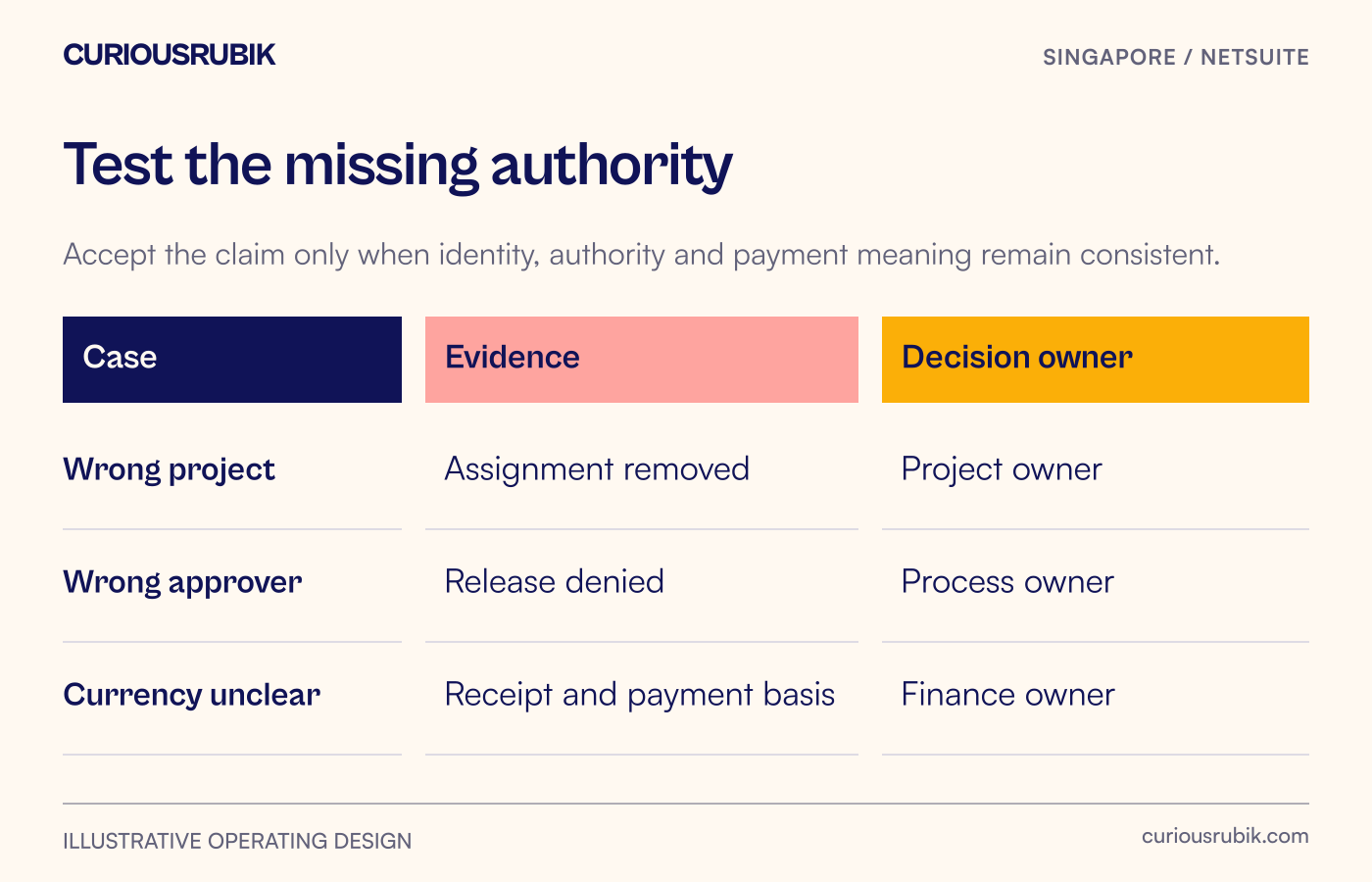
Use a synthetic copy of Nadia's case to test a reviewer who lacks the required authority. Let the Malaysian project reviewer confirm business purpose, then attempt the accounting approval or reimbursement release reserved for the Singapore team.
The expected result is the organisation's approved restriction, demonstrated through the actual configured route. Record what was attempted, which role was used and what the system allowed. If a custom portal passes the request using a broader integration identity, investigate the end-to-end control; the reviewer's visible menu alone is insufficient.
Next, remove Nadia's project assignment and attempt a new claim against it. Test both a fresh submission and a previously saved draft. Decide how a genuinely incurred expense should be redirected for review without giving the employee continuing access to unrelated project information.
Finally, test an absent supervisor. A substitute reviewer needs a documented authority basis, an effective period and the appropriate access. Shared-services staff should not solve the absence by changing the employee's employer or granting a broad role.
Explain the currency to the employee
A traveller needs a clear answer to “What will I receive?” Avoid presenting a converted estimate as an irrevocable payment promise. Oracle's expense guidance notes that displayed converted line amounts can be estimates and that reimbursement calculations depend on the rate at reimbursement.
In Nadia's case, retain the USD 240 receipt and identify SGD as the proposed reimbursement currency under the example policy. The employee-facing explanation should say where the final reimbursement amount will be confirmed. Do not invent an exchange rate or imply that all payment routes settle on the same basis.
If the eventual payment differs from the employee's expectation, shared services should be able to explain the approved conversion, any non-reimbursable portion and the actual payment reference. Keep a dispute about payment distinct from a request to change the underlying business expense. Re-entering the receipt merely to obtain a different payment amount risks obscuring the original claim.
Give the operating team a usable handoff
The completed handoff should let a new shared-services analyst trace one claim from employee to project, reviewer and payment. Include the role configuration or workflow evidence, a passed denial case and one failed-payment example. Keep sensitive beneficiary details within the approved payment process rather than copying them into a general support document.
Broader time and expense approval controls remain relevant. The regional design adds a specific question: can each reviewer explain which entity and which decision their approval represents?
Bring the filled identity map to an employee portal discussion. Start with the expense that crosses an organisational boundary, because that is where the difference between a convenient form and a workable shared-services process becomes visible.