Project completion establishes that agreed delivery work has reached an acceptance point. It does not establish that the business outcome improved, that the improvement came from the transformation, or that it will persist under ordinary operating conditions. Those are separate questions requiring evidence after launch.
For an executive reviewing a digital workflow investment, the decision is whether to expand, adjust, or stop further spending based on the observed service result. A shorter average cycle time can be encouraging, but it may reflect a change in case mix rather than better performance. A high adoption rate can coexist with more rework or a burden shifted to customers.
The practical approach is to define the outcome population, compare equivalent work, and examine the mechanism that was supposed to produce value. This article uses a hypothetical translation-services workflow to show why aggregate measures can mislead and how to build a useful post-completion review.
Keep delivery evidence and outcome evidence separate
Delivery evidence includes released capabilities, tested integrations, trained users, and accepted support arrangements. These are important prerequisites. They help explain whether the intervention was implemented as intended, but they do not directly prove its effect.
Operating evidence shows how work now moves: which cases use the new process, where exceptions wait, how often records need correction, and whether staff follow the intended rules. It connects the delivered capability to the eventual result.
Outcome evidence concerns what matters to the recipient and the business, such as accepted delivery time, quality, predictability, or resource effort. Use definitions that reflect the complete service rather than the portion most convenient for the system to report.
A good review can find that delivery succeeded while the outcome remains unproven. That is a useful management result if it leads to a specific investigation or adjustment. Forcing every completed project into a success narrative makes later decisions less informed.
Define the measurement population before comparing results
Specify which work is included, when the clock starts and stops, and how canceled, reopened, or incomplete cases are treated. A process that measures only successfully completed cases may omit the work that is causing the greatest harm.
Keep definitions consistent across the comparison. Starting the clock at initial customer contact before launch and at accepted submission afterward would create an artificial improvement. If the business deliberately changes the boundary, report both views or explain why they are not directly comparable.
Record relevant case characteristics before the outcome is known. Length, complexity, language, service tier, and source quality may affect translation work. Classifying difficult cases only after they take longer can make the analysis circular and invite inconsistent interpretation.
Identify changes in demand and operating conditions. Staffing, seasonality, customer composition, and concurrent process changes can influence the result. The purpose is not to explain away every finding, but to avoid attributing all movement to the new technology.
A hypothetical translation-workflow result
Imagine a hypothetical translation-services provider introducing a digital intake and coordination workflow. Management compares average time to an accepted delivery before and after launch. For this teaching example, there are two predefined job classes: routine work and complex work.
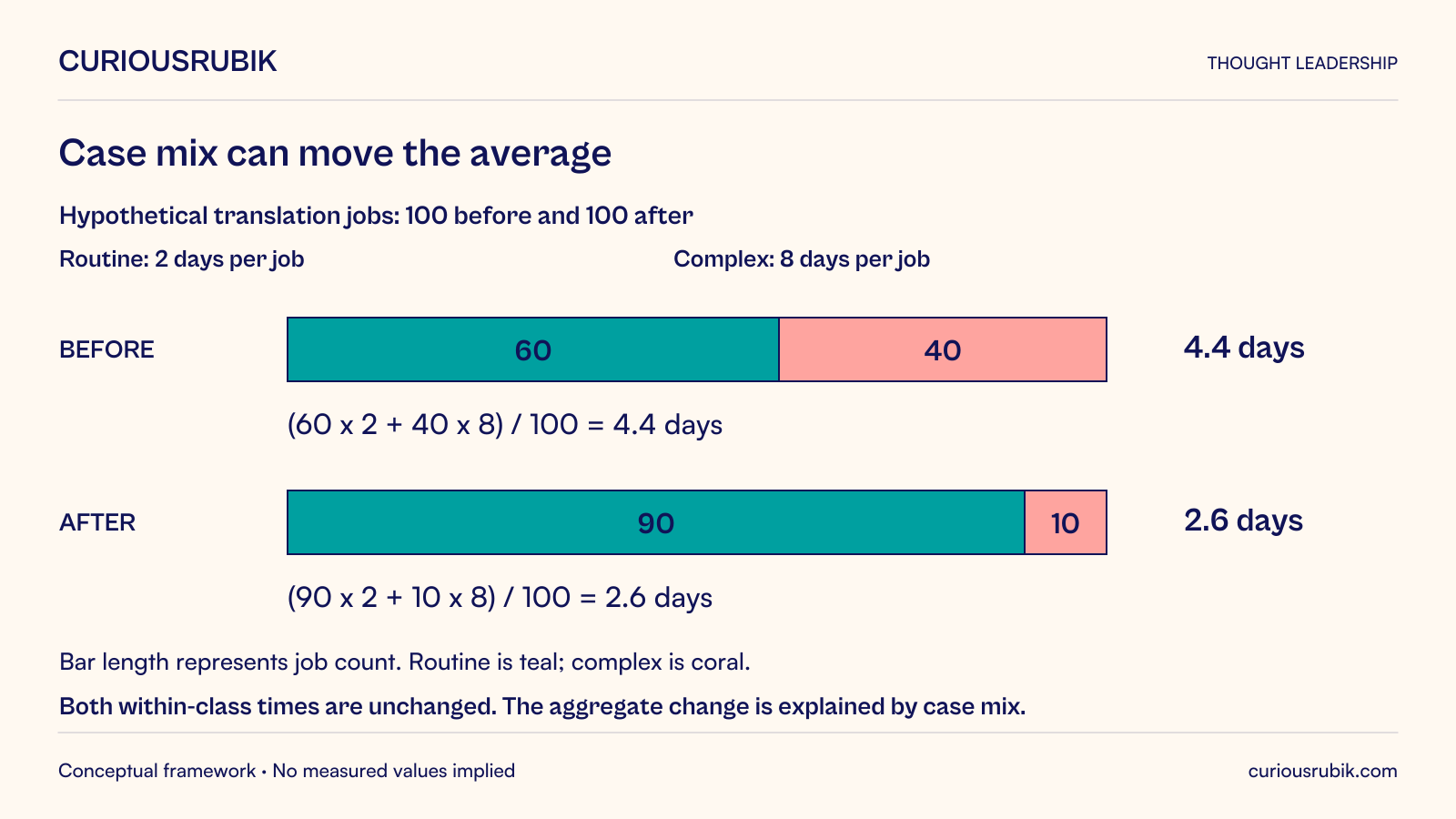
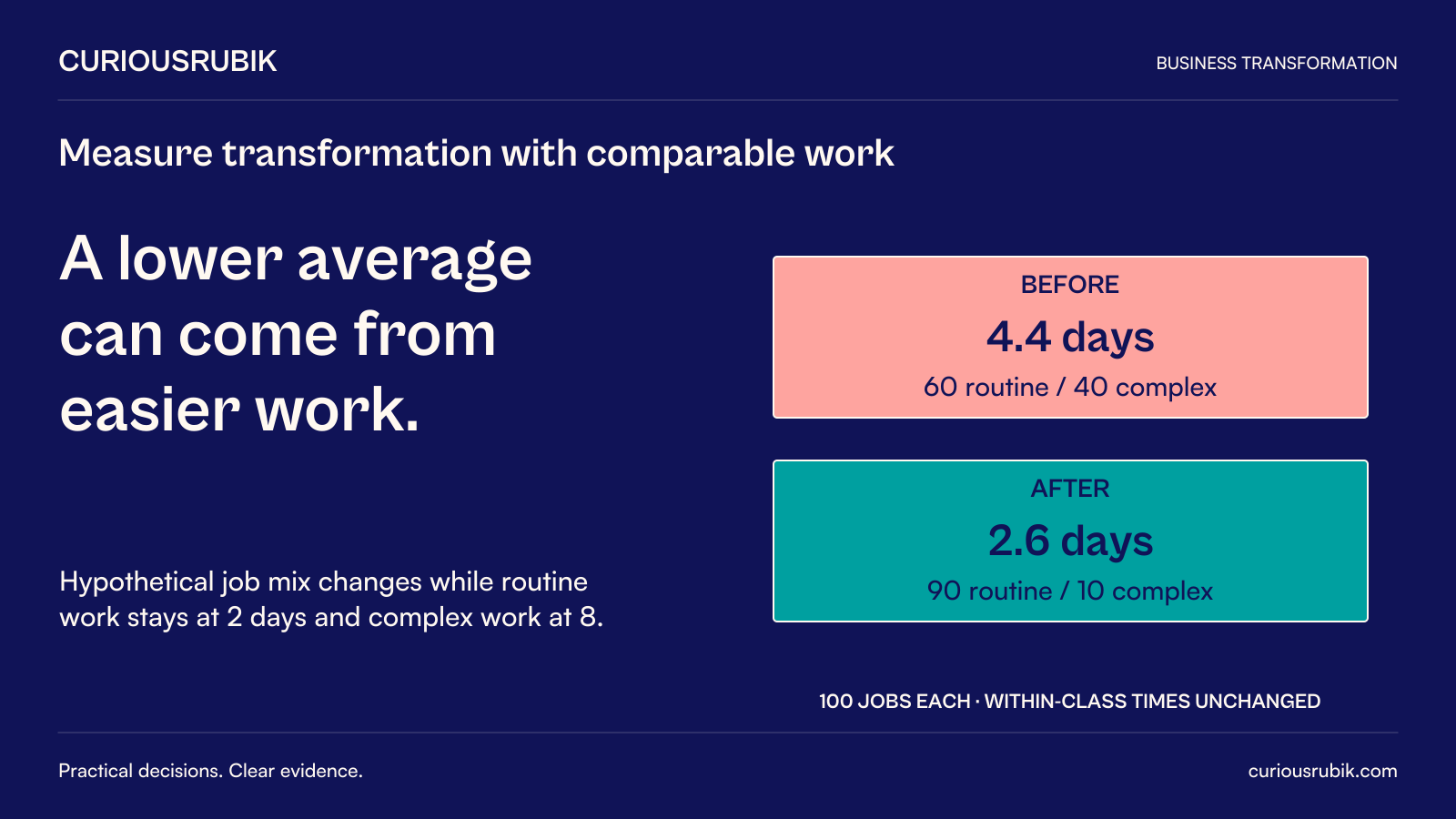
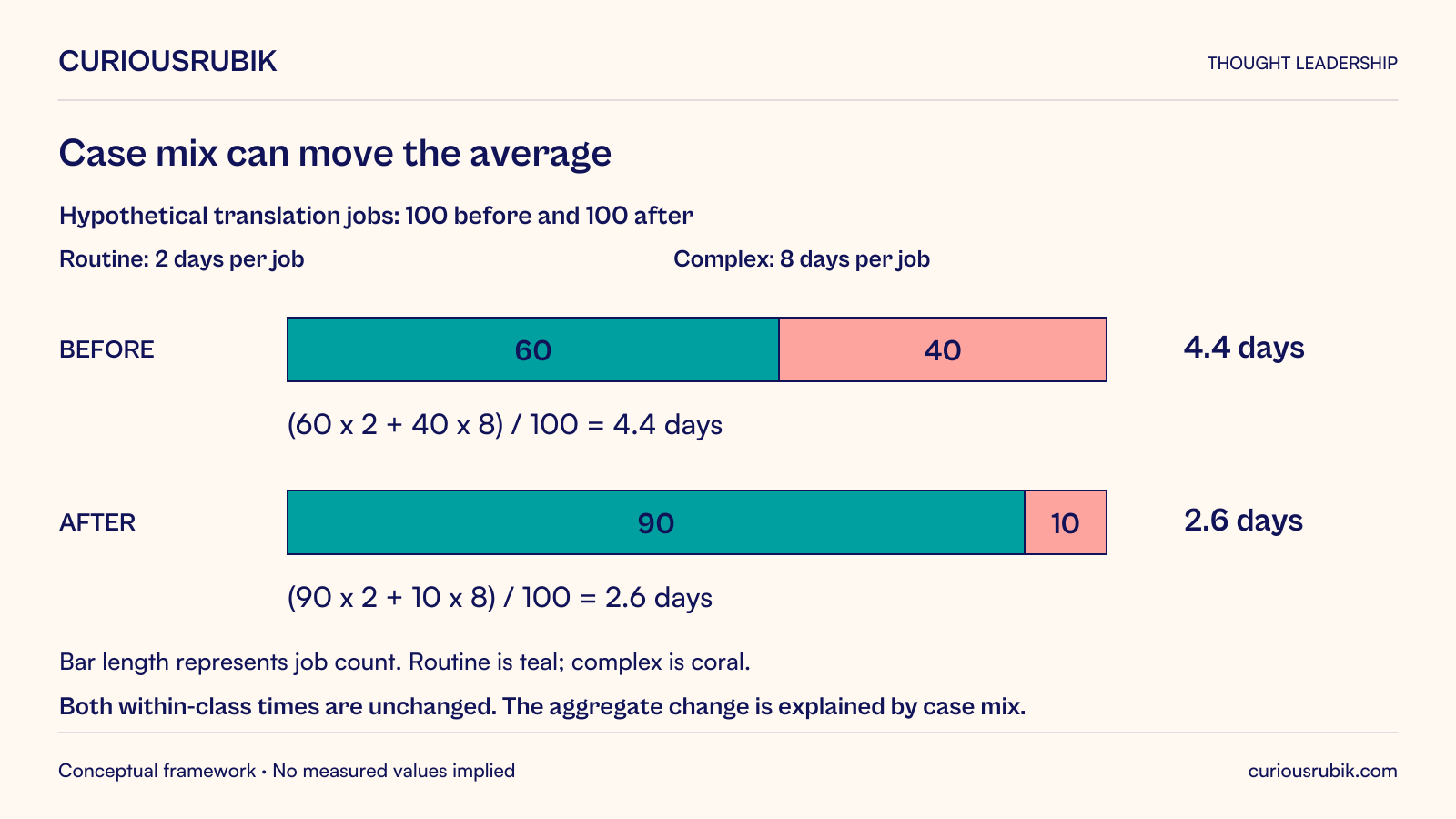
Before launch, the observed population contains 60 routine jobs taking two days each and 40 complex jobs taking eight days each. The weighted average is 4.4 days: 60 times two plus 40 times eight, divided by 100 jobs.
After launch, the population contains 90 routine jobs taking two days each and ten complex jobs taking eight days each. The weighted average is 2.6 days: 90 times two plus ten times eight, divided by 100 jobs. All figures and classifications are hypothetical.
The aggregate average has fallen by 1.8 days, yet neither job class has become faster. The change in mix explains the difference in this simplified example. Reporting the full decline as a transformation benefit would be incorrect.
The review should compare routine jobs with routine jobs and complex jobs with complex jobs, while also examining quality, deadline reliability, and work still open. It should investigate why the mix changed and whether the new service influenced that change. A shift toward easier work might itself matter commercially, but it is a different claim from faster processing of equivalent jobs.
Now suppose complex jobs have been routed to an external team and omitted from the new dashboard. That would be a different problem: the population boundary changed. The evaluation must retain the complete service view, including external effort and outcomes, rather than allowing difficult work to disappear from the denominator.
Match the evaluation design to the question
Monitoring asks what is happening. Evaluation asks how an intervention was implemented, whether it achieved the intended result, or what contributed to that result. Different questions require different comparisons and evidence.
GAO’s Designing Evaluations guidance distinguishes evaluation questions and designs for implementation and effectiveness. Its public-program context does not prescribe a private-company experiment, but the central discipline applies: choose evidence that can answer the actual decision question. GAO-12-208G, Designing Evaluations, 2012
A consistent before-and-after comparison can reveal operational change, but may not isolate the intervention’s effect. Where feasible and appropriate, a comparison group, phased rollout, or other carefully designed approach can strengthen interpretation. Qualified analysts should assess the assumptions and limitations.
Use qualitative case review to explain mechanisms. A shorter coordination step may result from better intake information, a staffing change, or a new deadline policy. Tracing representative jobs helps determine which part of the transformation deserves credit and which still needs work.
Measure quality and displacement alongside speed
A faster delivery is not necessarily better if it contains errors or creates another review cycle. Define acceptance and track material corrections, reopened work, and customer effort. The relevant quality measure should reflect the service’s actual obligations and intended use.
Look for work transferred to another participant. Digital intake may reduce internal entry while requiring customers to prepare more information. That can be a good tradeoff if it improves the complete service, but the customer burden should remain visible.
Measure the tail as well as the average. A small number of severely delayed jobs can matter even when typical performance improves. Review aging open work and the reasons for delay rather than waiting until every case closes before it enters reporting.
Keep cost categories distinct. Reduced effort can create capacity, while cash savings require a realizable spending change. Quality or reliability benefits may justify investment without being converted into speculative monetary values. Report them clearly instead of forcing every outcome into one financial ratio.
Test whether the benefit mechanism actually operates
Write the proposed chain from capability to behavior to outcome. For the translation workflow, structured intake may reduce missing-information exchanges, which may shorten coordination time, which may improve accepted delivery. Each link can be examined separately.
If the final outcome does not change, inspect the chain before concluding that the technology failed. Perhaps customers do not supply the intended information, specialists still wait on another dependency, or the new process applies only to a small portion of work.
Conversely, if the outcome improves, verify that the expected mechanism is present. A temporary increase in staffing may produce the result while the new capability contributes little. The business should understand that dependency before assuming the improvement will persist after project support ends.
Select a few leading indicators that help diagnose the mechanism, but do not promote them into benefits without evidence. Fewer missing fields can be useful; it does not automatically establish higher customer satisfaction or lower total cost.
Continue the review after the project team leaves
Assign an operational benefit owner with access to the necessary data and authority to act. A project can close while outcome measurement continues, provided responsibilities and review decisions are clear. Do not leave benefits in a report owned by a team that has disbanded.
Review results under ordinary staffing and representative demand. A launch period with extra support may not reflect steady operation. Record the transition so changes in performance can be interpreted honestly.
Keep data definitions and calculation logic controlled. If a status or service boundary changes, assess its effect on the trend. A dashboard refresh should not silently rewrite the meaning of the benefit measure.
Use findings to make a decision. Continue, refine the process, narrow the scope, expand a proven capability, or stop an unproductive investment. Measurement that never changes a decision risks becoming reporting overhead rather than management evidence.
Build a concise post-completion evidence pack
The executive review should show the intended outcome, delivered capability, actual operating reach, comparable results, quality and displacement measures, alternative explanations, and the next decision. Include limitations without burying the main finding.
For the hypothetical translation provider, the correct conclusion is that the aggregate cycle-time improvement is explained by mix in the stated data. The next action is to examine comparable job classes and the intended coordination mechanism, not announce a quantified transformation saving.
Begin by choosing one claimed benefit and reconstructing its denominator, timing boundary, and comparison. Then inspect the work behind the measure. Digital transformation is worth continuing when the enterprise can demonstrate a useful outcome under credible conditions and understand what sustains it. Project completion is the point at which that operating evidence becomes especially important, not the point at which the question ends.