A digital transformation roadmap delivers value when it sequences complete operating improvements and the dependencies that make them possible. A list of platforms with launch dates describes planned delivery. It does not explain when customers or employees will experience a better outcome, which business changes are required, or what evidence justifies the next commitment.
For a COO and CIO planning a shared membership service across a cinema group, the decision is how to balance foundational work with usable increments. Building every foundation first can postpone learning and benefits indefinitely. Launching visible features before identity, entitlement, and support are dependable can create a service the organization cannot operate.
The practical roadmap should connect outcomes, capabilities, dependencies, operating changes, and decision gates. This article develops that structure through a hypothetical cinema-membership program. The sequence is an illustrative planning approach, not a universal delivery timetable or a claim that a particular platform produces the stated benefits.
Start with a small number of operating outcomes
Define what should improve and for whom. A cinema group might want members to establish their current entitlement, use it at eligible locations, and resolve an account issue without repeated explanation. Those outcomes can guide tradeoffs more effectively than “modernize the customer platform.”
Establish the current situation. Trace representative member journeys and record failure modes, effort, and service consequences. Separate a missing capability from an unreliable existing one. An attractive new interface may be less urgent than fixing an entitlement mismatch that staff already handle every day.
Assign an owner to each outcome and identify the mechanism expected to improve it. If the benefit depends on staff retiring a duplicate lookup, that operating change belongs in the roadmap. If it depends on members adopting a self-service path, include the access and support work needed for that adoption.
Avoid a long wish list of equally important outcomes. Choose the decisions the next planning period must resolve, and state what will remain outside scope. Focus creates a basis for comparing initiatives that otherwise compete through enthusiasm or executive visibility.
Map dependencies in business terms
A dependency is a condition another capability needs, not merely a technical component on an architecture diagram. Online entitlement display may depend on agreed membership rules, reliable account identity, current status data, and an owner for disputes.
Distinguish hard dependencies from convenient sequencing. Some conditions must exist before a service can operate correctly. Others can be handled temporarily through a controlled manual route. Make the tradeoff visible rather than treating every dependency as either optional or a reason to delay everything.
Identify shared dependencies that support several outcomes. A dependable membership identifier may help staff lookup, self-service, and reporting. That can justify early investment, but the roadmap should still show a bounded deliverable and its first use rather than funding an undefined enterprise cleanup.
Record who supplies each dependency and when its evidence will be available. A project can appear on schedule while waiting for an unresolved business rule. The dependency map should expose that decision with the same clarity as an unfinished interface.
A hypothetical cinema-membership sequence
Imagine a hypothetical cinema group whose locations use different membership records. Staff can usually resolve discrepancies through phone calls, but members receive inconsistent answers about benefits at another location. The group wants a shared digital experience.
The first proposed roadmap begins with a new member app, followed by a central data platform and later staff training. A dependency review shows that the app would display status whose meaning differs across locations. The sequence produces a visible product before a reliable service.
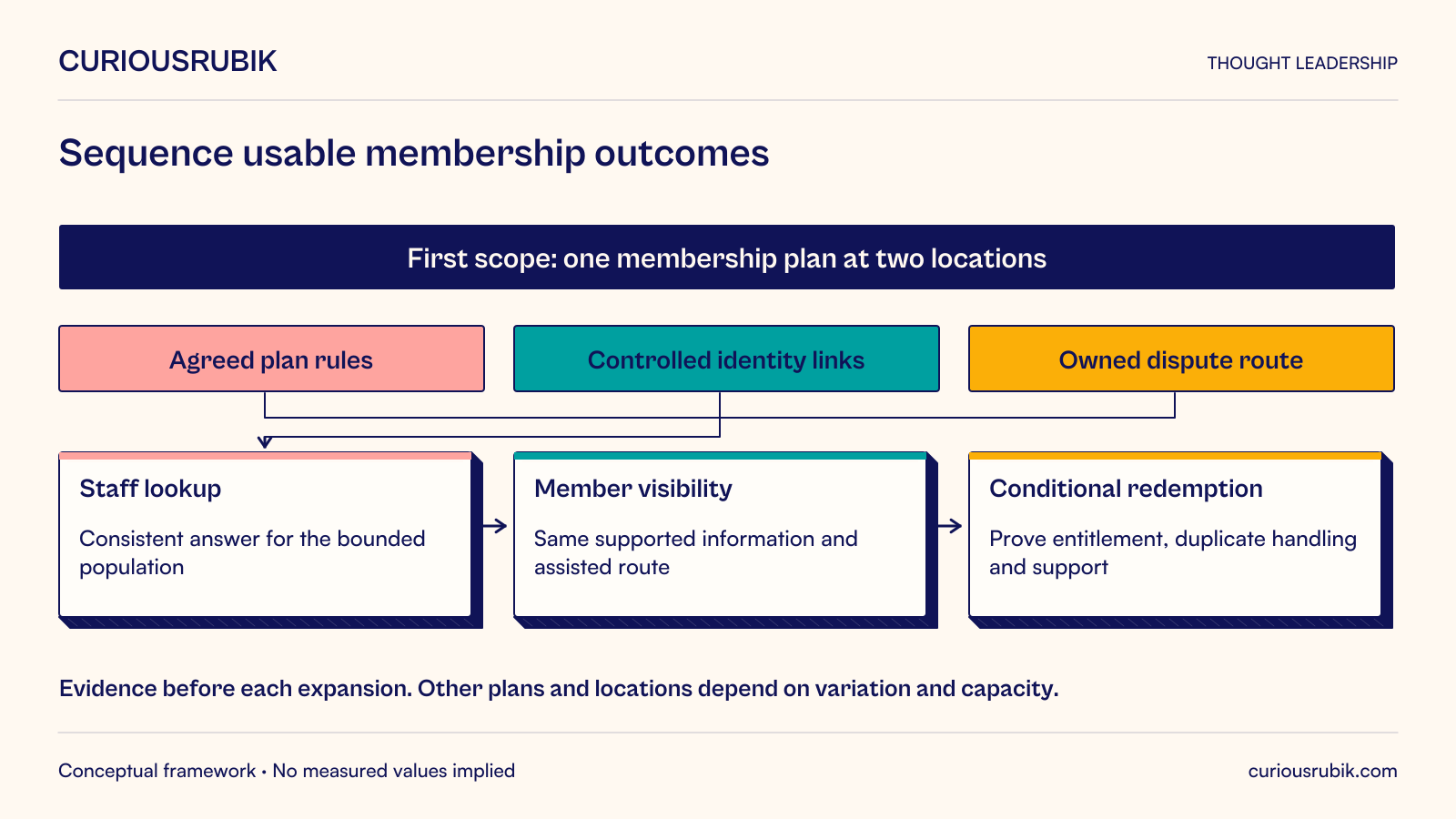
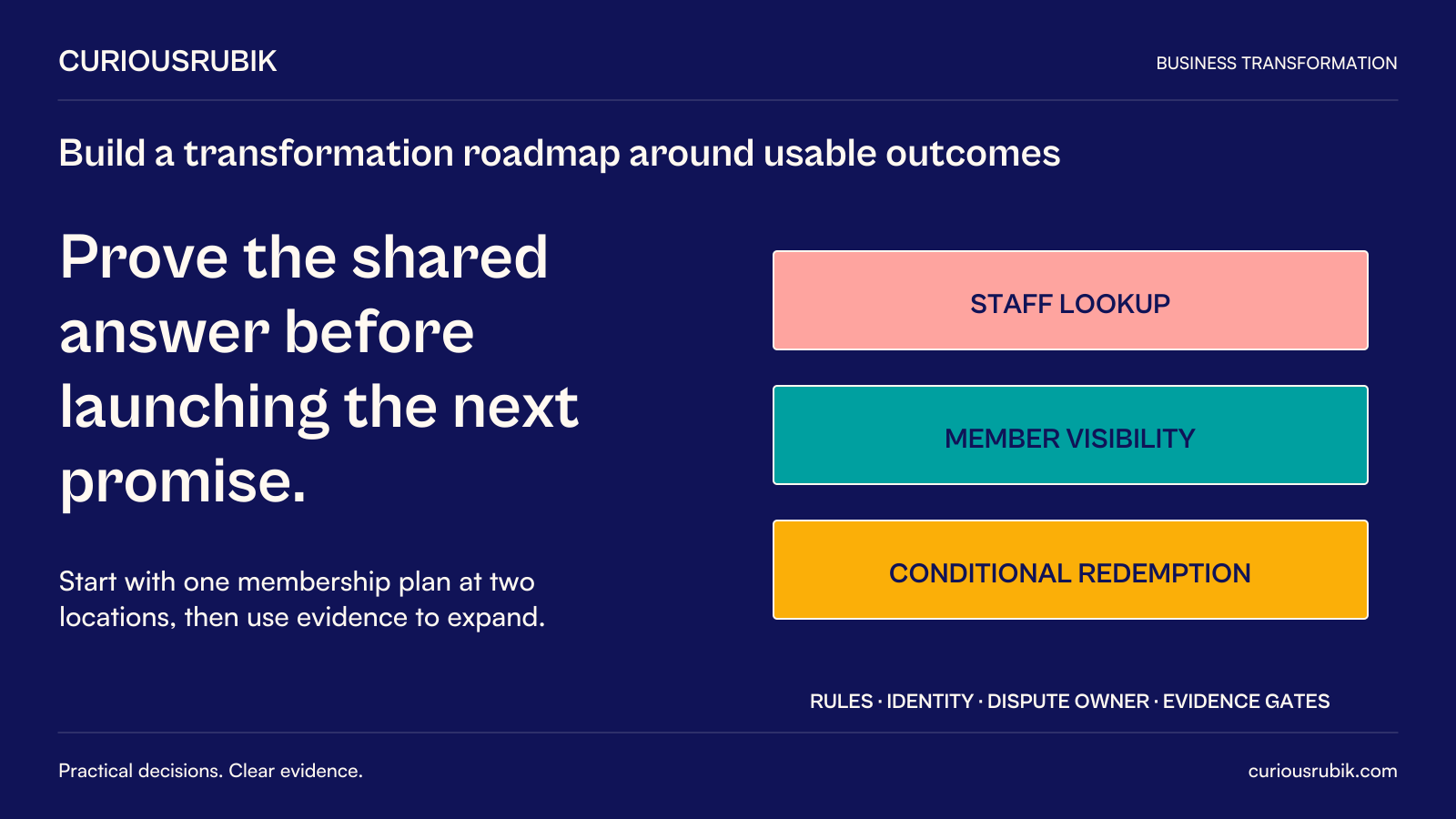
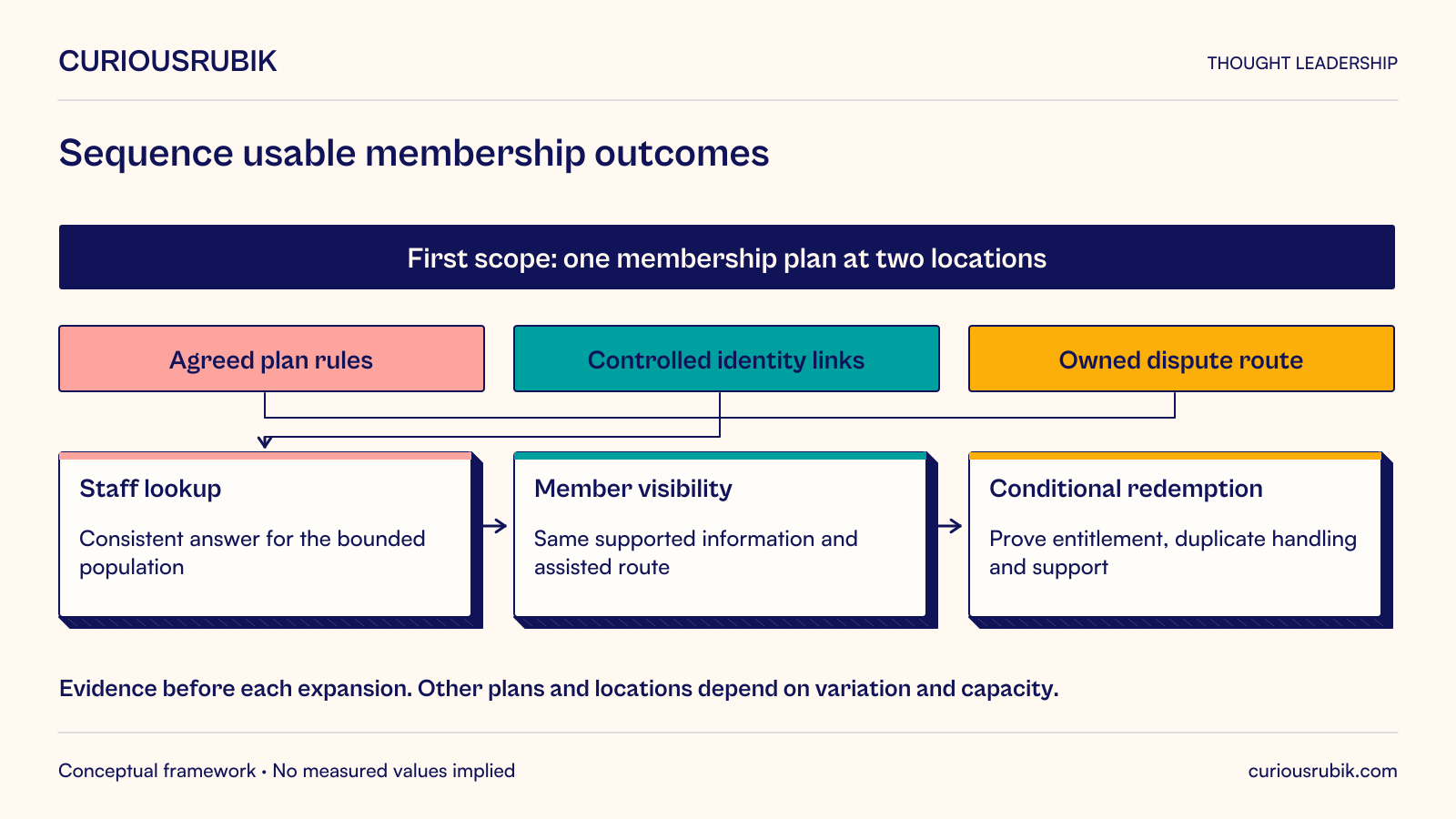
The revised first increment covers one membership plan at two locations. The group agrees the plan’s entitlement rules, establishes controlled identity links, and gives staff a shared lookup with an owned dispute route. The intended outcome is a consistent answer for that bounded population, not completion of every customer-data improvement.
The second increment exposes the same supported information to members, with clear explanations and an assisted route for unresolved identity. Staff use the same authoritative interpretation. The group measures whether members can answer the intended questions and whether contacts or corrections move elsewhere.
The third increment may enable a defined digital redemption flow, but only after current entitlement, duplicate-use handling, accepted outcomes, and support are demonstrated. A canceled or amended membership is included in testing. The business decides which conditions permit redemption under its approved terms rather than letting the interface infer them.
Other plans and locations enter later based on evidence about variation and capacity. A location with materially different rules may require another increment. The roadmap protects the shared outcome while acknowledging that an apparently uniform membership label can conceal different operating commitments.
Design increments that include the receiving operation
An increment should include the process, data, controls, support, and user behavior needed for its outcome. A completed API or configured module can be an important deliverable, but it may not be a complete value increment on its own.
Specify the acceptance evidence. For the first cinema increment, staff should be able to establish the agreed entitlement for representative cases and resolve known exceptions through the intended route. A demonstration using only clean sample accounts would not establish that capability.
Include retirement or reduction of old work. If staff continue using two contradictory lookups after the new one launches, the intended consistency benefit may not occur. Decide when the old route can be retired, who authorizes that step, and what fallback remains necessary.
Show any temporary operating cost explicitly. A manual dispute team may make an early increment feasible, but its workload and expected duration belong in the plan. Temporary support should not become invisible permanent labor beneath an optimistic roadmap.
Compare initiatives as a portfolio
Evaluate each initiative’s contribution, dependencies, uncertainty, operating burden, and opportunity cost. A small enabling change can be more valuable than a large feature if it unlocks several accepted outcomes. Conversely, a foundation with no credible path to use may deserve a narrower scope.
GAO’s IT investment-management guidance uses selection, control, and evaluation and addresses portfolio-level management. It provides a useful planning discipline, but does not establish a universal ranking score for a private company’s transformation choices. GAO-04-394G, IT Investment Management, 2004
Avoid false precision in scoring. A spreadsheet that assigns numerical weights to uncertain benefits can obscure judgment rather than improve it. Show the evidence behind the estimate and the assumptions that would change the ranking.
Account for shared capacity. Several attractive initiatives may all require the same membership-policy experts or integration team. A portfolio that ignores that constraint is not feasible even if each project has a plausible individual plan. Sequence around actual scarce roles and decision windows.
Use decision gates to manage uncertainty
A gate should answer a material question: are the rules coherent, can the service operate, is the benefit mechanism working, or is wider scope justified? It should not become a ceremony that approves the next phase because time has passed.
Specify options at the gate. Continue, narrow, revise, pause, or stop should remain real choices. If evidence shows that member self-service creates more unresolved contacts than it removes, the roadmap should permit redesign before broader rollout.
Separate learning commitments from delivery commitments. A bounded investigation can establish whether identity matching is feasible without promising a full group launch. Its output should be a decision and evidence, not an indefinite exploration activity.
Keep later dates as ranges or conditional targets where uncertainty remains. The organization can still coordinate resources and communicate intent without pretending that an untested dependency has a precise completion date. Increase commitment as evidence improves.
Connect the roadmap to benefit realization
For every outcome, record the baseline, intended change, owner, measurement source, and review point. Distinguish adoption of the new process from the resulting operational benefit. A shared lookup used frequently may still provide inconsistent answers if the source rules are wrong.
Track disbenefits and displaced effort. A new self-service route may reduce simple questions while concentrating complex disputes in a smaller team. That may be a good tradeoff, but only if the team has the needed skills and capacity.
Revisit the business case after scope changes. Deferring digital redemption while keeping staff lookup can be sensible, but the expected benefits must reflect that narrower service. Do not retain the original benefit total after removing the capability that produced it.
Report progress as demonstrated capability and remaining uncertainty alongside delivery status. Executives should know what users can now do reliably, what has improved, and which next decision requires their attention. Completed project tasks are useful supporting evidence, not the whole account of value.
Keep the roadmap changeable without making it arbitrary
Set a regular review of assumptions, dependencies, and operating evidence. Allow new information to change sequence while preserving the strategic outcomes unless management deliberately changes them. This prevents the roadmap from becoming either a frozen promise or a constantly rewritten wish list.
Document why priorities move. A dependency may prove harder, customer needs may change, or a smaller intervention may achieve the same result. The rationale helps teams distinguish disciplined adaptation from loss of direction.
The next useful step is to choose one outcome and draw the shortest credible path to an accepted operating increment. Include the business rules, data, support, and work that must stop, then name the evidence needed before expanding. A transformation roadmap earns its value by guiding those commitments, not by arranging technology purchases into an attractive sequence of dates.