NetSuite or a Finance Led ERP Approach Choosing the Right Operating Scope
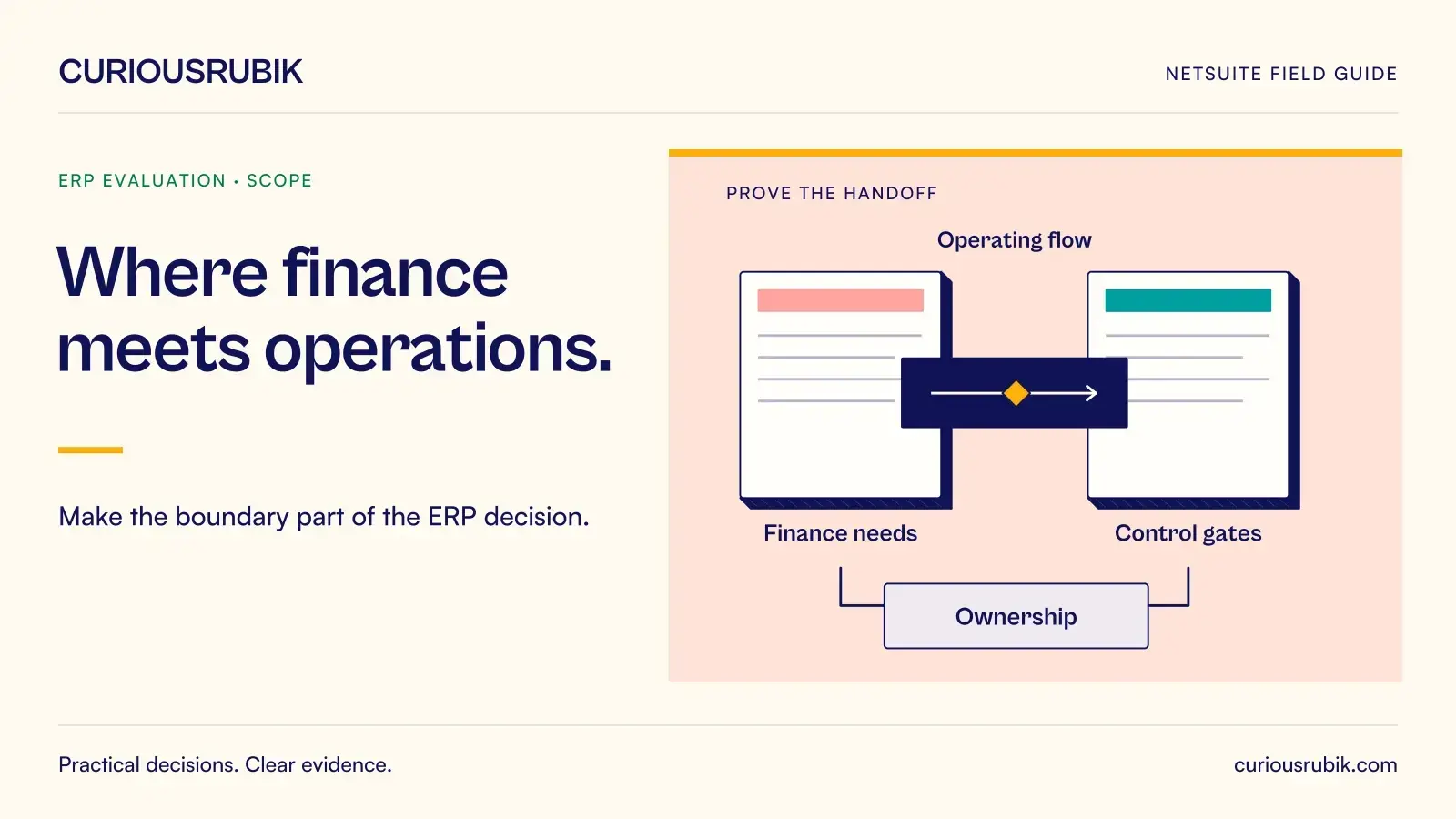
A finance system selection often changes direction when the team follows a transaction beyond the ledger. An invoice depends on fulfillment. Margin depends on inventory cost. Revenue reporting depends on contract changes. A system that meets the finance checklist may still leave substantial operational work between applications.
The right comparison is therefore between complete operating approaches. Evaluate NetSuite as the proposed integrated suite alongside a finance-led architecture that retains or adds specialist operational systems. The decision should reflect where your business needs connected processes and where specialization is worth the integration responsibility.
Neither approach earns an automatic advantage. This guide gives CFOs and controllers a requirement-weighted method for deciding, with hypothetical examples showing how either architecture could be appropriate.
Begin with the finance requirements that cannot move
Document the essential finance outcomes before discussing product scope. Include entity reporting, approval evidence, account reconciliations, management dimensions, audit access and the treatment of complex transactions.
Separate accounting-policy requirements from software preferences. “Recognize this contract according to the approved policy and reconcile the resulting entries” is a requirement. “Use this particular screen” may simply reflect familiarity with the current system.
Capture reporting frequency and the decisions each report supports. A quarterly statutory reporting need has different operational implications from daily gross-margin analysis by warehouse and product. Both matter, but they create different demands on source data and timing.
Identify the owner who can approve each result. An ERP selection becomes vulnerable when finance requirements are documented by IT without an accountable finance reviewer.
Find the points where finance depends on operations
Trace a small set of high-value transactions from origin to reporting. For a distributor, that may mean purchase order, receipt, supplier bill, stock movement, fulfillment and customer invoice. For a service business, it may mean contract, staffing, time approval, billing and revenue.
At each boundary, ask what must arrive in finance, how quickly and with what evidence. Does the ledger need transaction-level detail or a controlled summary? Can an operational correction change a closed-period result? Who investigates when source and target disagree?
Measure the existing friction. Count recurring reconciliations, manual adjustments and unresolved interface exceptions. These are useful inputs to selection, provided they are measured from your operation rather than borrowed from a sales estimate.
A broader suite can simplify some boundaries, but only when the proposed design genuinely brings the relevant workflows together. Retaining several external operating systems changes that calculation.
Build a weighted scorecard with mandatory gates
A hypothetical service company allocates 45% of its score to finance controls, 20% to reporting, 20% to integration manageability and 15% to operational functionality. A stock-intensive business might put much more weight on inventory and fulfillment.
For each category, define a passing demonstration. A reporting test could require the controller to drill from a management total to the underlying transaction with their intended access. An integration test could require an operator to correct a rejected record without creating a duplicate.
Use mandatory gates for requirements that cannot be traded away. If a proposed design cannot preserve a critical approval boundary, a strong usability score should not compensate for that failure.
Mark unverified capabilities as unknown. Distinguish demonstrated standard functionality, configured behavior, separately licensed features and extensions. The commercial proposal must include the components used to achieve the score.
Compare two hypothetical businesses
Consider a professional services group with four entities, no physical stock and a well-established specialist delivery platform. Its finance team needs stronger consolidation, approvals and management reporting. A finance-led architecture may be attractive if the delivery platform can provide reliable, reconciled financial inputs and the organization can support the integration.
The decisive test is not whether the specialist platform is popular. It is whether contract changes, approved work and billing adjustments arrive completely and remain traceable. If that evidence is strong, replacing the entire operating platform may create more disruption than value.
Now consider a regional distributor whose finance team repeatedly reconciles inventory, purchasing and fulfillment across separate systems. A proposed NetSuite design that connects those processes may address the source of the reconciliation burden. It still needs to prove warehouse fit, item handling and reporting with realistic data.
The second business should not assume that broader scope guarantees success. If critical warehouse requirements depend on additional applications, include those interfaces and support responsibilities in the comparison.
Make entity complexity visible
The number of legal entities is only one dimension. Ask whether entities trade with each other, use different currencies, share customers or inventory, and require different accounting or reporting treatment.
Prepare one intercompany scenario with a timing difference and one consolidated report with drill-down. Show who resolves mismatches and how approved adjustments are represented. Confirm the specific licenses and configuration required for the proposed NetSuite or alternative architecture.
Include access boundaries. A local finance user may need one entity while group finance needs broader visibility. Demonstrate the intended roles rather than relying on an administrator view that bypasses the real constraints.
Future entities should be discussed through a credible expansion scenario, with assumptions clearly labeled. Buying for an undefined global future can obscure the requirements that matter now.
Price the responsibilities around the software
Compare the full proposed scope: subscriptions, implementation, migration, training, interfaces, support and internal ownership. Request the assumptions behind transaction volumes, user categories and future entity additions.
For every interface, identify who monitors it, who fixes mapping errors and who tests it after changes. Include recurring reconciliation effort in the operating model. A low integration build estimate does not answer who will investigate failures two years later.
Avoid manufacturing a return-on-investment figure from hoped-for hours saved. Establish the current baseline, identify which tasks the demonstrated design actually removes and treat remaining benefits as assumptions until validated.
The final recommendation should explain both the chosen architecture and the responsibilities the organization accepts by choosing it.
A worked weighted scorecard
This hypothetical scorecard compares two designs that have already passed their mandatory requirements. Scores run from one to five, with five representing the strongest demonstrated fit. The weights reflect one buyer's priorities; they are not universal product rankings.
| Criterion | Weight | Design A score | Design B score |
|---|---|---|---|
| Financial controls | 35% | 4 | 5 |
| Operational workflow | 25% | 3 | 4 |
| Integration ownership | 20% | 5 | 3 |
| Reporting usability | 20% | 4 | 4 |
Multiply each score by its weight and divide by five to calculate percentage points. Design A earns 28, 15, 20 and 16 points, totalling 79. Design B earns 35, 20, 12 and 16 points, totalling 83. Retain the demonstration record beside each score. A higher total cannot override a failed mandatory control, and an untested requirement should remain unresolved rather than receive an average score.
Frequently asked selection questions
Is a finance-led approach suitable for a growing company?
It can be, if operational systems and interfaces support the expected complexity. Growth alone does not settle the architecture; changing transaction requirements and ownership do.
Does an integrated suite eliminate reconciliations?
No. Financial controls and reconciliations remain necessary. The evaluation should identify which manual handoffs may be reduced and which controls still need dedicated owners.
Should operations attend finance demonstrations?
Yes, when finance depends on their source records. Operations can identify missing detail or unrealistic assumptions that a ledger-focused demonstration may conceal.
How should unknown capabilities affect the decision?
Keep them unresolved until demonstrated or documented within the proposed scope. Assign a deadline and owner, and avoid treating a sales assurance as equivalent to tested evidence.
Decide through the finance to operations boundary
CuriousRubik can help scope a NetSuite evaluation around the transactions that connect finance and operations. Bring your weighted requirements and recurring reconciliation problems to make the discussion specific.
Related reading